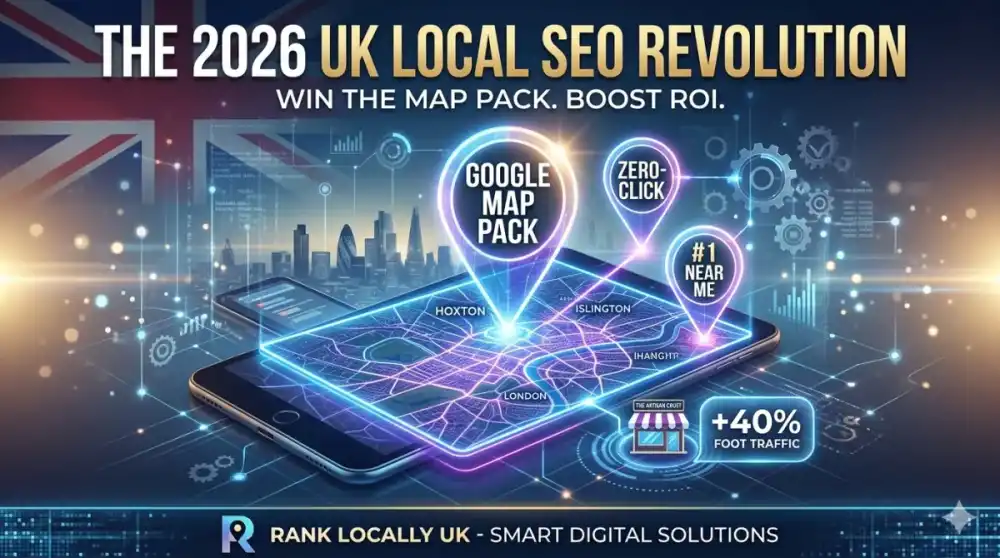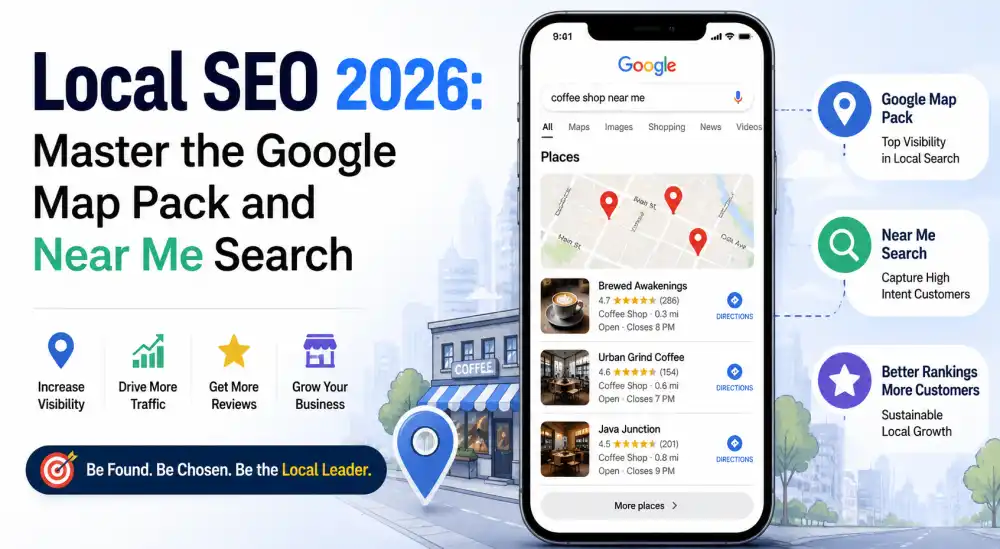
In the rapidly evolving digital landscape of 2026, the traditional "Search Engine Results Page" (SERP) as we once knew it has transformed. For UK small businesses—from boutique bakeries in Shoreditch to independent plumbers in Islington—the game has moved beyond simply "having a website." We are now living in the era of the "Near Me" Revolution, powered by conversational AI, hyper-local precision, and the dominance of the Google Map Pack.
At Rank Locally UK, we’ve analyzed the data: 2026 is the year of the Zero-Click Search. If your business isn't the immediate answer to an AI’s query, you're invisible. This guide breaks down exactly how to navigate this new frontier.
The "Near Me" Revolution: How AI-powered Search is Changing the Game
Gone are the days when a customer would type "plumber London" into a search bar and scroll through ten blue links. In 2026, the UK consumer uses "Ask Maps" or conversational AI interfaces on their smartphones and smart home devices.
The Rise of "Ask Maps" and Conversational Search
Google’s AI-integrated "Ask Maps" has turned search into a dialogue. A user now says: "Hey Google, find me a Gas Safe registered plumber near City Road that is open now and has fixed a boiler leak in the last week."
This shift means your Local SEO strategies must be more than just keywords; it must be Contextual Data. AI models prioritize:
-
Recency of Activity: Are you posting updates to your Google Business Profile?
-
Specific Service Verification: Does your profile explicitly mention "boiler leak repair" in recent reviews or service lists?
-
Trust Signals: Are your credentials (like Gas Safe or Checkatrade) digitally linked and verifiable?
Why Tradespeople Must Pivot
For local tradespeople, AI-powered search is a double-edged sword. It filters out the "jacks-of-all-trades" and highlights the specialists. To win in this environment, your digital footprint must provide "Schema Markup" that tells the AI exactly what you do, where you do it, and what your customers think of that specific service. Learn more about our Schema implementation services here.
Hyper-Local Keyword Strategy: Why "SEO London" is a Waste of Money
If you are a local business, trying to rank for a keyword like "SEO London" or "Plumber London" is like trying to shout in a crowded stadium. It is expensive, highly competitive, and—most importantly—it’s inefficient.
The Fall of the "Broad Keyword"
London is not one market; it is a collection of hundreds of micro-markets. A person in Hoxton looking for a coffee shop is highly unlikely to travel to Richmond. Search engines know this. In 2026, "Geofencing" in search is so precise that the results shown to someone on one end of Old Street are different from those shown to someone at the other end.
The Power of the Borough: SEO Hoxton vs. SEO Islington
By narrowing your focus to Hyper-Local Keywords, you achieve three things:
-
Lower Cost Per Acquisition (CPA): It is significantly cheaper to rank for "Emergency Plumber Islington" than "Plumber London."
-
Higher Intent: A user searching for a specific borough is usually ready to book or buy now.
-
Authority in the "Local Cluster": When you dominate a specific area like Hoxton, Google views you as the "Local Hero," making it easier to expand your "radius of dominance" into neighboring areas like Shoreditch or Clerkenwell.
Rank Locally UK Tip: Don't just list your city. Create dedicated landing pages for every postcode district you serve (e.g., EC1V, N1, SE1).
Zero-Click Searches: Winning the Map Pack Without the Click
A "Zero-Click Search" occurs when the user finds exactly what they need on the search results page—address, phone number, reviews, or even a booking button—without ever clicking through to your actual website.
The Google Map Pack: Your New Storefront
In 2026, the Google Map Pack (the "3-Pack") is the most valuable real estate on the internet. It is the first thing users see, and often the only thing. To win here, your Google Business Profile (GBP) must be treated as your primary website.
Key Strategies for Zero-Click Dominance:
-
Direct Bookings: Integrate your scheduling software directly into your Google profile. If a customer can book a table or a consultation without leaving the search page, they will choose you over a competitor who requires a website visit.
-
Inventory Integration: For retail businesses, your live stock should be visible on your profile via "Pointy" or local inventory feeds.
-
Q&A Optimization: Pre-populate your "Questions & Answers" section with common inquiries. This provides the AI with the data it needs to answer user queries instantly.
Winning the "Featured Snippet"
When a user asks a question, Google often pulls a "Snippet" of text from a website to answer it. By structuring your content in a Q&A format—using clear, concise language—you can become the "Featured Answer," even if you aren't the #1 ranked organic site.
Case Study: The 40% Increase – How a London Bakery Cracked the Code
Let’s look at a real-world application of these strategies. "The Artisan Crust," a small bakery near Old Street, was struggling with foot traffic despite having a high-quality product.
The Challenge: They were invisible to the thousands of office workers commuting through Old Street Station daily. They had a website, but it was buried under national chains like Greggs or Pret A Manger.
The Rank Locally Strategy:
-
Hyper-Local Focus: We stopped targeting "Bakery London" and started targeting "Sourdough Hoxton" and "Best Coffee Old Street."
-
Visual GMB Updates: We implemented a strategy of daily "Product Posts" on their Google Business Profile—high-resolution photos of fresh pastries coming out of the oven at 8:00 AM daily.
-
Local "Near Me" Signal Boosting: We optimized their profile for "Breakfast near Old Street Station," specifically targeting the "commuter intent" keyword cluster.
-
Review Velocity: We set up a system to encourage customers to leave reviews mentioning specific products (e.g., "The almond croissant is the best in Shoreditch").
The Result: Within three months, "The Artisan Crust" saw a 40% increase in verified foot traffic. Their Google Business Profile insights showed that 70% of their new customers found them through "Discovery" searches (searching for a category, not the brand name) and never clicked on their website—they simply clicked "Directions."
FAQ
1. What is the most important ranking factor for local businesses in 2026?
Proximity and relevance are king. Google prioritizes businesses that are physically closest to the searcher and have the most verifiable "local signals" (reviews, accurate NAP data, and active GMB updates).
2. Does my website still matter if I focus on my Google Business Profile?
Absolutely. Your website acts as the "source of truth" for the AI. If your GBP says you are a plumber, but your website doesn't mention plumbing services, Google will be less likely to trust your profile.
3. What is "Zero-Click" search, and is it bad for my traffic?
It means the user gets their answer without visiting your site. While website traffic might dip, conversion usually rises because the user has already received the information they needed to make a decision.
4. How often should I post to my Google Business Profile?
Consistency is better than frequency. We recommend at least 2-3 updates per week. These can be offers, news, photos of completed work, or answers to customer questions.
5. Should I reply to every review, even the bad ones?
Yes. Responding to negative reviews professionally shows potential customers that you care about service and resolution. It also provides an opportunity to include keywords naturally in your reply.
6. What is Schema Markup, and do I need it?
Schema is "behind-the-scenes" code that helps search engines understand your content better. For local businesses, it tells Google your address, opening hours, and service areas, which is vital for appearing in the Map Pack.
7. Can I rank in a different town or borough than where my business is based?
It is extremely difficult to rank in a location where you do not have a physical presence. Focus on your immediate service area first. If you have multiple branches, we can help you set up location-specific pages to target those areas.
8. Why are my competitors ranking higher if I have a better website?
They are likely winning on "local signals"—they may have more consistent reviews, a more active Google Business Profile, or better local citations (mentions of their business on other websites).
9. How do I track success if people aren't clicking through to my website?
Focus on "Direction Requests," "Call Button" clicks, and "Booking" conversions within the Google Business Profile dashboard. These are your most important KPIs in 2026.
10. Is Rank Locally UK available to help me manage this?
Yes. We specialize in helping UK businesses dominate the Map Pack and navigate the complex AI-driven search landscape.
Future-Proofing Your UK Business
The digital landscape of 2026 demands a shift in mindset. You are no longer just managing a website; you are managing a Digital Ecosystem. By embracing the "Near Me" revolution, focusing on hyper-local borough keywords, and optimizing for the Zero-Click economy, your business can out-maneuver even the largest national competitors.
Rank Locally UK is here to ensure that when your neighbors search, they find you.
Top Categories
Top Viewed Articles


Spread the Word
Know someone who would love this? Share it with them!