
Articles for Royal Microscopical Society RMS
Explore 1 business insights in all locations
Insider
Share Your Business Story
Reach our community by sharing your business insights, expert guides, or success stories on the world's most trusted local platform.
Write Your Article Now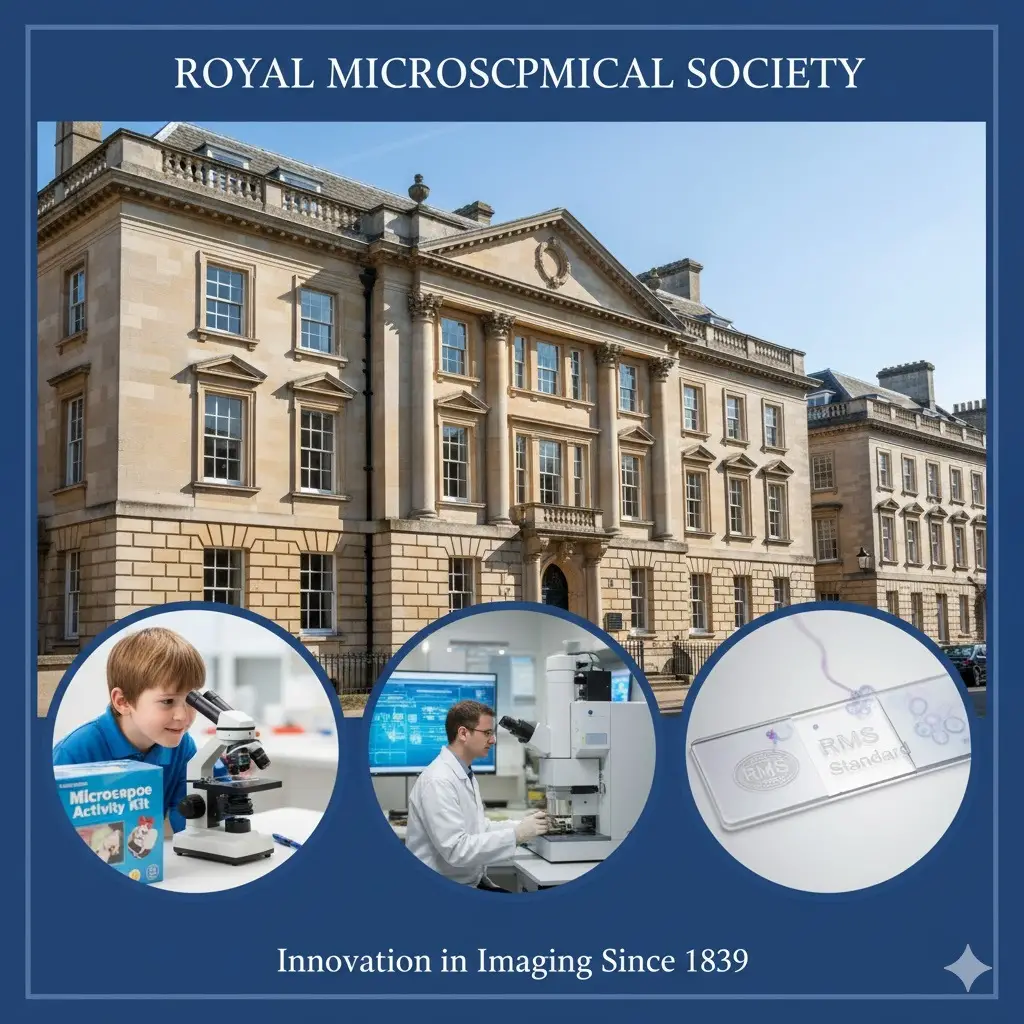
Educational Services
Apr 02, 2026
Royal Microscopical Society: A Global Hub for Imaging
Global Epicenter of Microscopy: An Introduction
The Royal Microscopical Society (RMS) stands as a monumental pillar in the global scientific community. Established in 1839, it is the oldest organization of its kind in the world, dedicated exclusively to the promotion and advancement of microscopical science. Headquartered in the historic city of Oxford, United Kingdom, the society has evolved from a small gathering of Victorian innovators into a dynamic international hub for imaging excellence.
For nearly two centuries, the Royal Microscopical Society has bridged the gap between fundamental academic research and industrial application. By fostering a collaborative platform for distinguished scientists, technologists, and enthusiasts, the society ensures that microscopy remains a cornerstone of modern discovery across life sciences, materials science, and imaging technology.
Foundations of Excellence: History and Royal Charter
The origins of the society can be traced back to September 3, 1839, when founding members Edwin Quekett and Joseph Jackson Lister met at Wellclose Square, London. Their goal was simple yet profound: to formalize a collective for "the promotion of microscopical investigation." Lister’s own research into achromatic lens systems had recently transformed the microscope from a recreational toy into a precision scientific instrument.
In 1866, the society was granted a Royal Charter (RC000788), a prestigious recognition that solidified its status as a legal entity and a leader in the field. Today, as a registered charity (241990), the RMS continues to uphold the rigorous standards of its founders while embracing the digital and nano-scale revolutions of the 21st century.
Scientific Publishing: The Journal of Microscopy and infocus
A core mission of the Royal Microscopical Society is the dissemination of high-quality research. The society manages two primary publications that are essential reading for the community:
Journal of Microscopy: This is the oldest journal dedicated to microscopy science. Peer-reviewed and globally respected, it covers everything from light and electron microscopy to scanning probe techniques and image analysis. It serves as a vital record of technological breakthroughs.
infocus Magazine: The society’s quarterly magazine provides a more conversational yet technical look at the community. It features event reports, book reviews, and "how-to" guides, keeping members informed about the latest trends and product innovations.
World-Class Events: The Microscience Microscopy Congress (mmc)
The mmc (Microscience Microscopy Congress) series is the flagship event of the RMS. Held biennially, it is one of the largest exhibitions and conferences of its kind in Europe. The event brings together thousands of delegates to witness live demonstrations of the latest equipment, attend parallel scientific sessions, and participate in the famous "Learning Zone."
The Microscience Microscopy Congress is more than just a trade show; it is a catalyst for networking. It provides early-career researchers a platform to present their posters alongside Nobel laureates, ensuring a continuous exchange of knowledge across generations.
Professional Development and Training
The Royal Microscopical Society is renowned for its extensive calendar of CPD-accredited training courses. Recognizing that the quality of an image is only as good as the operator’s skill, the RMS offers specialized workshops in:
Light Microscopy: From basic brightfield to advanced confocal and super-resolution.
Electron Microscopy (EM): Both Scanning (SEM) and Transmission (TEM) techniques.
Flow Cytometry: High-speed cell analysis and sorting.
Bioimaging: Specialized training for life science researchers.
The RMS Diploma
For professionals seeking formal recognition, the RMS Diploma offers a flexible, portfolio-based qualification. It is designed to be of a similar standard to a Master's degree, allowing technicians and researchers to validate their expertise while remaining in full-time employment.
Inspiring the Next Generation: Outreach and Activity Kits
The RMS commitment to education begins at the primary level. The society's Microscope Activity Kits are provided free of charge to primary schools across the UK. These kits contain "RMS-standard" approved microscopes, digital cameras, and curriculum-mapped activities. By allowing children to see the "hidden world" of salt crystals or insect wings, the society inspires the scientists of tomorrow. Since its inception, over 100,000 children have benefited from this outreach program.
International Standards and the "RMS Standard"
One of the most practical contributions of the society to global science is the "RMS Standard." In the 19th century, the society fixed the dimensions of microscope slides at 3 inches by 1 inch. This standard was eventually adopted worldwide, ensuring that slides produced in one corner of the globe would fit into a microscope manufactured in another. This spirit of standardization continues today through their work with international ISO committees.
Membership and Fellowship (FRMS)
Joining the Royal Microscopical Society offers unparalleled benefits. Members gain access to a global network of experts, discounted rates for conferences, and eligibility for prestigious grants and studentships. After three years of continuous membership and demonstrated contribution to the field, members can apply for the status of Fellow of the Royal Microscopical Society (FRMS), a globally recognized post-nominal that denotes professional excellence.
Technical Specializations and Committees
The society is structured into various Scientific Section Committees, each focusing on a specific niche of imaging:
Materials Science: Focusing on the microstructure of metals, polymers, and ceramics.
Life Sciences: Advancing our understanding of cellular biology and pathology.
Scanning Probe Microscopy (SPM): Exploring surface topographies at the atomic level.
Data Analysis: Addressing the modern challenge of "Big Data" in imaging.
The Royal Microscopical Society is not just a historical institution; it is a vibrant, forward-looking charity that drives innovation. Whether it is through the rigorous peer-review of the Journal of Microscopy, the massive scale of the mmc congress, or the simple joy of a child using a Microscope Activity Kit, the RMS ensures that the science of the small continues to have a massive impact on our world.
Frequently Asked Questions
1. What is the Royal Microscopical Society?
The RMS is the world's oldest scientific society dedicated to the advancement of microscopy and imaging, founded in 1839 and based in Oxford, UK.
2. Who can join the RMS?
Membership is open to anyone with an interest in microscopy, including students, professional researchers, technicians, and corporate entities.
3. What is the "RMS Standard" for slides?
It refers to the standardized size of microscope slides (3x1 inches), a dimension established by the society in the 19th century that is still the global industry standard today.
4. How can my school get a Microscope Activity Kit?
Primary schools in the UK can request a kit for free through the RMS website. The kits are loaned for a full term and include all necessary equipment and lesson plans.
5. What is the mmc series?
The Microscience Microscopy Congress (mmc) is the society's flagship international conference and exhibition, showcasing the latest in imaging technology.
6. Does the RMS offer professional certifications?
Yes, the RMS offers a CPD-accredited Diploma and various training courses. Long-term members can also achieve Fellowship (FRMS) status.
7. Is the Journal of Microscopy available to the public?
While it is a subscription-based journal, many articles are available via Open Access. RMS members receive discounted subscriptions.
8. What scientific areas does the RMS cover?
The society covers all forms of microscopy (Light, Electron, SPM), flow cytometry, image analysis, and their applications in both life and materials sciences.
9. How is the RMS funded?
As a registered charity, the RMS is funded through membership fees, journal publishing, event registrations, and donations.
10. Where is the RMS headquarters located?
The physical address is 37/38 St Clements, Oxford, OX4 1AJ, United Kingdom, near the Angel & Greyhound Meadow.
Business Snapshot
Founders: Edwin Quekett and Joseph Jackson Lister
Founded: September 3, 1839
Website: https://www.rms.org.uk
Helpdesk: +44 (0) 1865 248768
Email: info@rms.org.uk
Physical Address: 37/38 St Clements, Oxford, OX4 1AJ, UK
Social Media: LinkedIn, Twitter/X, Instagram, Facebook
London
7 Views
- Prev
- 1
- Next
Share This Page
My Page
Scan QR to open
Barcode