
Articles for University of Oxford
Explore 1 business insights in all locations
Insider
Share Your Business Story
Reach our community by sharing your business insights, expert guides, or success stories on the world's most trusted local platform.
Write Your Article Now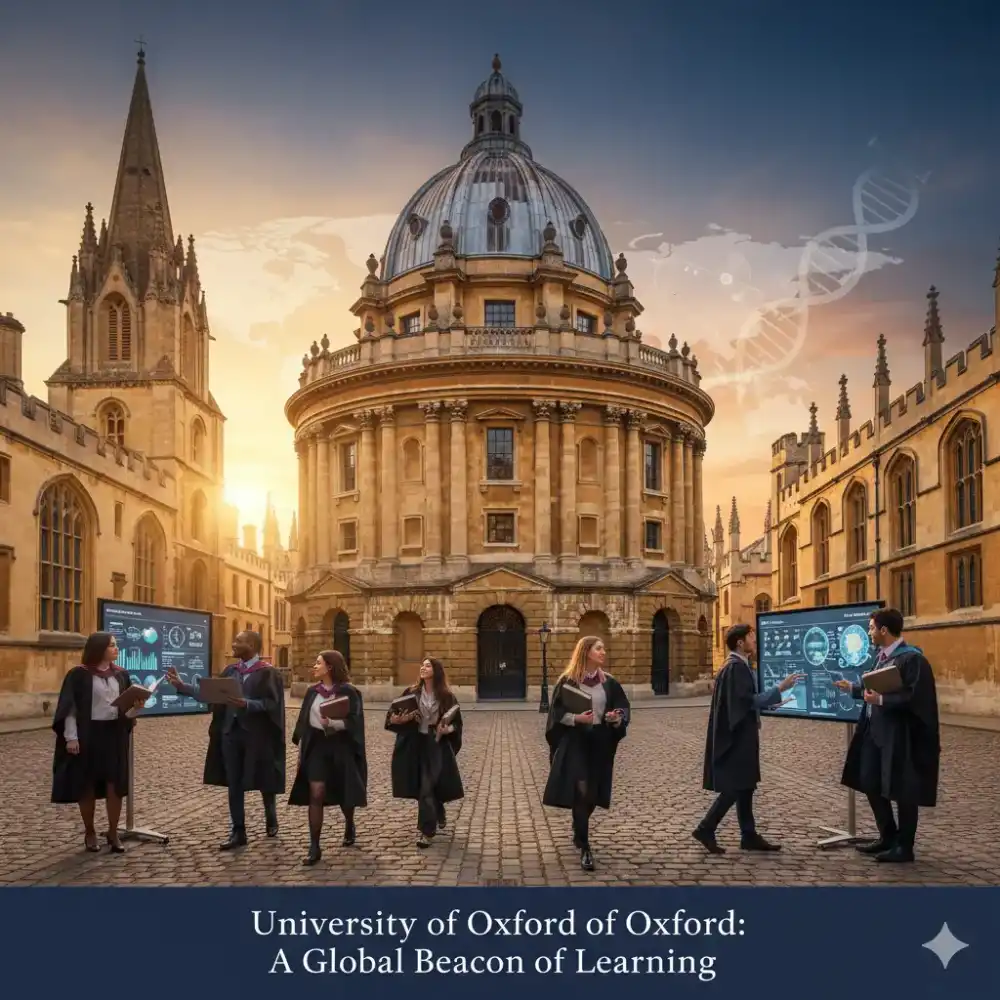
Educational Services
Apr 08, 2026
University of Oxford: A Global Beacon of Learning
The University of Oxford, located in the heart of Oxfordshire, United Kingdom, stands as a testament to nearly a millennium of intellectual pursuit. As the oldest university in the English-speaking world, with evidence of teaching dating back to 1096, it has evolved from a medieval center for clerics into a 21st-century powerhouse of higher education and world-class research.
The Mission of Excellence
The University’s mission is clear and unwavering: to achieve and sustain excellence in every area of its teaching and research. This mission is not merely a corporate statement but a lived reality for the 14,000 employees and over 26,000 students who call Oxford home. By maintaining and developing its historical role as a leading center of learning, Oxford continues to foster a unique collegiate ecosystem that promotes interdisciplinary collaboration and intellectual independence.
A Tradition of Innovation: The Value Proposition
Oxford’s value proposition lies in its ability to marry centuries-old traditions of academic rigor with a modern, forward-looking approach to innovation. Whether it is the Oxford-AstraZeneca COVID-19 vaccine or pioneering work in Artificial Intelligence (AI) and Ethics, the University consistently proves that historical institutions can lead the charge in technological and social advancement.
The Collegiate System: A Unique Academic Ecosystem
Unlike most modern universities that operate from a centralized campus, Oxford is a federation of over 30 self-governing colleges and halls. This collegiate system is the heartbeat of the Oxford experience.
Personalized Learning: Each college provides a small, supportive community where students benefit from the "tutorial system"—intensive, small-group teaching sessions that encourage deep critical thinking.
Interdisciplinary Life: At a college dining table, a nuclear physicist might sit next to a philosopher, sparking the kind of cross-pollination that leads to global breakthroughs.
Lifelong Membership: A student’s college often becomes their primary social and academic identity, providing a sense of belonging within a vast, global institution.
Global Impact and Research Leadership
Oxford’s research footprint is massive. In the 2021 Research Excellence Framework (REF), Oxford was recognized for having the highest volume of world-leading research in the UK.
Medical Sciences and Global Health
Oxford is perhaps most globally recognized for its Medical Sciences Division. The development of the Oxford-AstraZeneca vaccine saved millions of lives during the pandemic and showcased the University's ability to mobilize rapidly for global health. Beyond vaccines, the University leads in:
Genomics and Personalized Medicine: Tailoring treatments to individual genetic profiles.
Tropical Medicine: Operating major research units in Africa and Southeast Asia to combat malaria, tuberculosis, and emerging pathogens.
Neuroscience: Mapping the human brain to understand mental health and degenerative diseases.
Humanities and Social Sciences
While its scientific achievements often make headlines, Oxford’s leadership in the Humanities and Social Sciences is equally profound. From the Oxford Internet Institute (studying the societal impact of the web) to the Blavatnik School of Government (shaping global policy), the University is a primary architect of modern thought.
Academic Divisions and Programs
Oxford offers a vast array of undergraduate and postgraduate programs across four main divisions:
Humanities: Including History, Classics, and Modern Languages.
Mathematical, Physical, and Life Sciences: Home to world-class labs in Physics, Engineering, and Chemistry.
Medical Sciences: Leading the world in clinical and experimental medicine.
Social Sciences: Including the world-renowned Saïd Business School and the Department of Politics and International Relations.
The Oxford University Press (OUP)
As the largest university press in the world, Oxford University Press serves as a vital arm for the dissemination of knowledge. Publishing in over 40 languages, OUP supports the University’s objective of excellence in research and education by making high-quality resources accessible globally.
A Diverse and Global Community
With students and faculty from over 160 countries, Oxford is a melting pot of global talent. This diversity is central to its success, ensuring that research and learning are informed by a wide range of cultural and social perspectives. The Rhodes Trust, based at Oxford, continues to bring the world's most promising scholars to the University, further cementing its role in shaping future global leadership.
Amenities and Facilities
Oxford’s physical infrastructure is as impressive as its academic standing.
Bodleian Libraries: One of the oldest and most extensive library systems in Europe, containing over 13 million printed items.
University Parks: Providing 70 acres of green space for recreation and sports.
Museums: The Ashmolean Museum, the Museum of Natural History, and the Pitt Rivers Museum offer students and the public access to world-class collections.
Innovation Districts: Through Oxford University Innovation, the University has spun out hundreds of companies, turning academic research into commercial reality.
Practical Information for Visitors and Applicants
Headquarters: Wellington Square, Oxford, OX1 2JD, UK.
Contact: For general inquiries, the helpdesk can be reached at +44 (0)1865 270000 or via email at enquiries@admin.ox.ac.uk.
Working Hours: University offices typically operate Monday to Friday, 9:00 AM – 5:00 PM.
Certifications: The University holds a Royal Charter and a TEF Gold status for teaching excellence.
Frequently Asked Questions
1. What is the University of Oxford's ranking?
As of 2025, the University of Oxford has held the #1 spot in the Times Higher Education World University Rankings for nine consecutive years, recognized for its research quality and teaching excellence.
2. When was the University of Oxford founded?
While there is no single "founding date," evidence of teaching in Oxford exists from as early as 1096, making it the oldest university in the English-speaking world.
3. How do I apply to Oxford?
Undergraduates apply through UCAS by a specific deadline (usually October 15th for the following year). Postgraduates apply directly to the University through its online portal.
4. What is the "Collegiate System"?
It is a structure where the University is comprised of many independent colleges. Every student belongs to a college, which provides accommodation, meals, and academic support.
5. Can I visit the University of Oxford?
Yes. Many of the University’s libraries, museums, and college grounds are open to the public, though some colleges may charge a small entry fee or have restricted hours during exam periods.
6. What subjects is Oxford best for?
Oxford is a world leader across the board, but it is particularly famous for Medical Sciences, Humanities (especially PPE—Philosophy, Politics, and Economics), and Mathematical & Physical Sciences.
7. Does Oxford offer financial aid?
Yes, Oxford has one of the most generous financial support packages in the UK for domestic students, and numerous scholarships (like the Rhodes and Clarendon scholarships) are available for international students.
8. What is the Oxford-AstraZeneca vaccine?
It is a COVID-19 vaccine developed by the University of Oxford and the British-Swedish company AstraZeneca. It was one of the first and most widely distributed vaccines globally.
9. Who are some famous Oxford alumni?
Oxford has produced 28 British Prime Ministers, over 30 international leaders, 55 Nobel Prize winners, and 120 Olympic medalists. Famous names include Stephen Hawking, Oscar Wilde, and Malala Yousafzai.
10. How many students go to Oxford?
The University has approximately 26,000 students, including roughly 12,000 undergraduates and 14,000 postgraduates.
The University of Oxford remains an unparalleled pillar of global knowledge. From its medieval roots to its leadership in 21st-century AI & Ethics, it continues to prove that academic excellence and innovative research are the most powerful tools for addressing the world's most complex challenges. For students, researchers, and visitors alike, Oxford offers a glimpse into the past and a blueprint for the future.
Oxford
4 Views
- Prev
- 1
- Next
Share This Page
My Page
Scan QR to open
Barcode