
10 Bad Habits Ruining Your Career Outlook & How to Fix Them
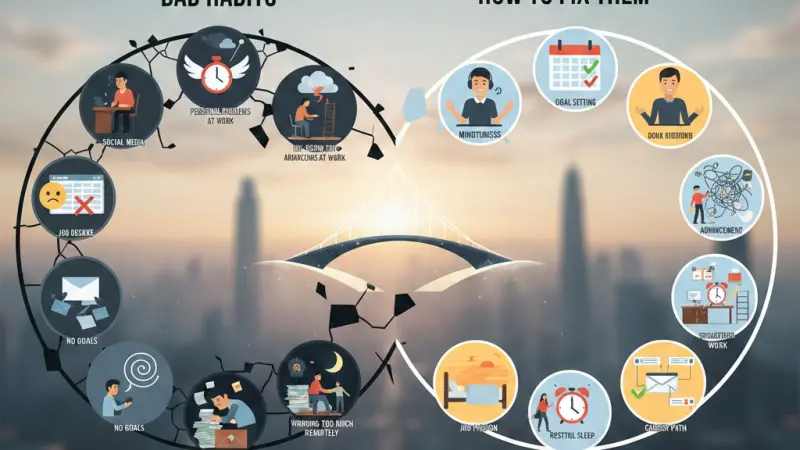
In the modern landscape of 2026, the boundary between our professional lives and personal identities has become more porous than ever. While we strive for "work-life integration," many professionals find themselves trapped in a cycle of dissatisfaction. Being happy in your career is not just a luxury; it is a critical driver for both productivity and long-term personal happiness. When you are unhappy with a career, it ruins your outlook on that career, reduces your daily output, and can even lead to physical burnout.

If you feel that your professional spark has dimmed, it is likely not due to one single event, but rather a collection of subtle, corrosive behaviors. If changes to your work situation need to occur, it is important to take the steps to do so in order to meet your own career goals.
Here are the ten most common bad habits that are likely ruining your professional outlook and detailed strategies on how to overcome them once and for all.
1. Bringing Personal Situations to Work
Not leaving personal difficulties at home wrecks your outlook on your job. Humans are emotional creatures, and it is impossible to flip a switch and turn off your feelings. However, if you are unhappy at home, it inevitably comes to work with you, manifesting as irritability, lack of focus, or decreased empathy for colleagues.
How to Overcome It:
To maintain a professional mindset, you must learn the art of "compartmentalization." Leave your personal business at the door and focus on your job. Establish a morning "commute ritual"—even if you work from home—that signals the transition from "Person" to "Professional."
Save personal discussions for breaks or lunch hours. However, recognize that you are not a robot. It is difficult to leave truly tragic situations at the door; in those situations, it is better to be transparent. Ask for some leniency from your manager or take a mental health day to address the root cause rather than letting it bleed into your work performance for weeks.
2. Not Setting Work-Related Goals
Without goals, you have nothing to look forward to in your career. Many people treat their jobs as a series of repetitive tasks rather than a journey toward a destination. This lack of direction leads to a "treadmill effect" where you are working hard but going nowhere, which is a recipe for resentment.
How to Overcome It:
Gamify your career. Set a goal to receive a promotion, become a team leader, or obtain a specific raise. Once you reach that goal, immediately set another. The key is to make each goal slightly bigger so that you have to work a little harder to reach it. When you have a "why," the "how" becomes much easier to bear.
3. Constantly Checking Email Accounts
In our hyper-connected 2026 environment, the "ding" of a new notification provides a dopamine hit that is hard to resist. However, unless you need email for work purposes as your primary function, keeping it open all day is a productivity killer. It forces your brain into a state of "continuous partial attention," where you never truly dive deep into meaningful work.
How to Overcome It:
Treat email as a task, not a background activity. Schedule 5 minutes per hour—or better yet, three blocks of 20 minutes a day—to check emails. Respond only to those that are work-related and urgent. For everything else, use the "Two-Minute Rule": if it takes less than two minutes, do it now; otherwise, schedule it for later.
4. Working Long Hours
There is a persistent myth that long hours equal high productivity. In reality, working in an industry that requires excessive hours is exhausting and leads to diminishing returns. It creates a mental association between "work" and "pain," making you not want to go to work at all.
How to Overcome It:
Boundaries are your best friend. Consider a schedule change, or speak with a superior about working a different shift with fewer hours per shift. If your workload is the problem, look at your efficiency. Often, you can get more done each hour to prevent working longer hours. Focus on high-impact tasks (the 80/20 rule) and learn to say "no" to low-value meetings.
5. Not Sleeping Enough
Sleep is the fundamental pillar of cognitive function. When you don’t get enough, you don’t perform well, your emotional regulation fails, and your "outlook" becomes naturally more pessimistic. In 2026, with the rise of AI-integrated tools, the cognitive load on workers is higher than ever—making rest non-negotiable.
How to Overcome It:
View sleep as a professional requirement. Make a sleep schedule and stick to it, even on weekends. Your body needs a consistent circadian rhythm to be in sync so that you can perform at your best. Avoid screens 60 minutes before bed to prevent blue light from disrupting your melatonin production.
6. Working Too Much Remotely
While working from a remote location or from home is more comfortable, it can easily become a major distraction. At home, you are likely to be more interested in enjoying your relaxation space, watching television, or taking care of household chores. Over time, the lack of "work-place" energy can make you feel isolated and uninspired.
How to Overcome It:
To remedy this, try to work from home sparingly or implement a "hybrid" model. When you are at work in a professional setting, your concentration naturally stays on work due to environmental cues. If you must work remotely, maintain a strict productivity schedule and designate a specific area of your home as a "work-only zone."
7. Working a Job You Dislike
There is not much point to working a job or in an industry that you dislike. It is essentially the "career kiss of death." If you are not excited about the industry you work in, it is impossible to sustain high performance over the long term.
How to Overcome It:
If a total career pivot isn't immediately possible, find an aspect of the industry that you do enjoy and focus your energy there. Perhaps you dislike the industry but love the technology, or you dislike the product but love your team. Finding one "anchor of joy" can help you take more pride in your work while you plan your next move.
8. No Room for Advancement
The feeling of being "stuck" is one of the quickest ways to ruin your professional outlook. If there is no room for growth, it makes it hard to stay positive about showing up every day.
How to Overcome It:
Don't wait for opportunities to be handed to you. Schedule a meeting with your superiors and let them know that you are looking for an added challenge. If the company truly has no path forward, it may be time to use your current role as a stepping stone. View your current job as a "paid internship" for your next, better role.
9. Procrastination
While some people claim they work better under pressure, procrastinating actually brings on immense physiological stress. It keeps your brain in a state of "looming dread," which colors your entire day—even your time off.
How to Overcome It:
Use the "Eat the Frog" technique: do your hardest, most unpleasant task first thing in the morning. Set yourself a rigid task schedule and stick to it. This prevents the "Sunday Scaries" and stops you from having to work late to make up for lost time.
10. Social Media Distractions
Social media is designed to be addictive, and in 2026, the algorithms are more "sticky" than ever. Checking social media on company time breaks your flow and makes work feel like an interruption to your digital life, rather than the other way around.
How to Overcome It:
Stay off social media while at work. Use app blockers if necessary. Only access these networks on designated breaks when you are physically away from your desk. By reclaiming your focus, you’ll find that the workday goes by faster and feels more rewarding.
Maximize Your Business Reach in the UK
If you are a business owner looking to improve your outlook and growth, visibility is key. For those operating in the United Kingdom, leveraging a high-authority uk online business directory is essential for SEO and lead generation.
Whether you are a small startup or an established firm, getting listed on a uk business directory helps customers find you exactly when they need your services.
The local page uk business directory offers a comprehensive platform to find local businesses uk and connect with a wider audience. By joining the local businesses list uk, you ensure your company is part of the most trusted uk business listings online. From a uk small business directory perspective to a broader uk b2b business directory or uk b2c business directory focus, Local Page UK covers all sectors.
Don't miss out on the opportunity for a business listing uk. This business listing uk allows you to claim your spot on a business listing uk without any initial cost. For those in the capital, a business listing uk can significantly boost your local search presence. Whether you need a business listing uk or a specialized business listing uk, our business listing uk is designed to help you thrive.
Explore our local business listings uk to see how other uk verified business listings are performing. Our uk local business directory is the premier uk business directory website for uk service listings, uk top rated local businesses, and uk professional services listings. From the uk home services directory to the uk local trades directory, your search for the best business directory uk online ends here. Use the local page uk listings to perform a uk local business search and see why we are the top choice for uk service providers directory needs.
Questions Clients Commonly Ask
1. How do I stop bringing my personal problems to work?
Create a physical or mental transition ritual. This could be listening to a specific podcast on your commute or spending five minutes at your desk "journaling out" your worries before starting your first work task.
2. What are the best work-related goals to set?
Start with SMART goals: Specific, Measurable, Achievable, Relevant, and Time-bound. Examples include learning a new software by next month or increasing your sales output by 10% this quarter.
3. Is checking email really that bad for productivity?
Yes. Every time you switch from a complex task to check an email, it takes an average of 23 minutes to get back into "the zone." This is known as "context switching" cost.
4. How can I talk to my boss about working fewer hours?
Focus on the "output" rather than the "hours." Propose a trial period where you work a condensed schedule while maintaining or exceeding your current performance metrics.
5. How much sleep do I actually need for work performance?
While it varies, the scientific consensus is 7–9 hours for most adults.
Sleep deprivation mimics the cognitive impairment of being legally intoxicated.
6. Why is remote work sometimes bad for career outlook?
It can lead to "proximity bias," where managers inadvertently favor in-office employees for promotions, and it can cause social isolation which lowers job satisfaction.
7. Should I quit my job if I dislike the industry?
Not immediately. It is better to "job craft"—redefine your current role to include things you like—while researching and networking for your next move.
8. What if my company truly has no room for advancement?
Look for "horizontal" growth. Learn skills in a different department or take on leadership of a special project. If that fails, look for external opportunities.
9. How do I stop procrastinating on difficult tasks?
Break them down into "micro-tasks." Instead of "Write Annual Report," your first task should be "Open Word Document and Save File."
10. How do I resist social media at work?
Keep your phone in another room or in a desk drawer. Out of sight, out of mind.
11. Is it okay to check personal email at work?
Only during designated breaks. Mixing personal and professional digital spaces leads to mental fatigue.
12. Can a bad outlook on work affect my health?
Absolutely. Chronic work stress is linked to heart disease, depression, and a weakened immune system.
13. How do I deal with a toxic coworker?
Maintain professional boundaries, document interactions if necessary, and focus on your own goals rather than their behavior.
14. What is the "Four-Day Work Week" and does it help?
Many UK companies in 2026 have adopted this. It often increases productivity by forcing employees to be more efficient during their working hours.
15. How often should I update my career goals?
Every six months. This ensures your goals still align with your personal growth and the changing market.

Disclaimer: The information provided in this article is for general informational and research purposes only. Company details, features, services, and market positions may change over time. Readers are advised to visit official company websites and conduct independent research before making any business decisions or purchasing services.
Most Searchable Keywords

Recent Blogs


Related Listings

Categories
- Accountants (295)
- Advertising Agencies (559)
- Architects (149)
- Automobiles (377)
- Beauty (300)
- Carpenters (146)
- Cleaning Services (386)
- Dentists (189)
- Driving (62)
- Electricians (215)
- Energy (8)
- Event Organiser (685)
- Finance (599)
- Guide (3365)
- Health (2207)
- Information technology (206)
- Legal Services (353)
- Logistics (6)
- Maintenance (65)
- Manufacturing (35)
Sponsored Listings in Locksmith Services


Related Blogs

Gen Z Political Reporters and News Creators i...
Read this insightful article "Gen Z Political Reporters and News Creators in the UK" to expand your knowledge!

Famous Female Social Media Influencers Across...
Read this insightful article "Famous Female Social Media Influencers Across the UK" to expand your knowledge!
Your UK Sponsor Licence 2026 Step by Step Gui...
Read this insightful article "Your UK Sponsor Licence 2026 Step by Step Guide" to expand your knowledge!
Questions & Answers – Find What
You Need, Instantly!
How can I update my business listing?
Is it free to manage my business listing?
How long does it take for my updates to reflect?
Why is it important to keep my listing updated?
