
A Complete Guide to Marriage Allowance for UK Residents
- 👤 Ryan Reynolds
- 👁️ 79 Views
- Last Updated: July 20, 2026
- 🏷️ Guide

Understanding the intricacies of the UK tax system can be daunting, but uncovering legitimate ways to reduce your annual tax bill is always a worthwhile endeavour. One of the most underutilised yet highly beneficial tax reliefs available today is the Marriage Allowance for UK Residents. Designed specifically to support households where income disparity exists between spouses or civil partners, this government initiative allows couples to optimise their collective tax burden. In this comprehensive guide, we will explore the precise mechanisms of this allowance, delving into commercial contexts, buying considerations for tax software, and the vital steps required to ensure you and your partner do not miss out on hundreds of pounds in potential savings. Whether you are navigating HM Revenue and Customs (HMRC) for the first time or you are looking for professional advisory services to manage a complex portfolio, this article will serve as your definitive resource.

Understanding the Marriage Allowance for UK Residents
The Marriage Allowance for UK Residents is a dedicated tax perk that permits the lower-earning partner in a marriage or civil partnership to transfer a specific portion of their tax-free Personal Allowance to the higher-earning partner. By executing this transfer, the higher earner’s tax bill is significantly reduced. In an economic climate where every penny counts, claiming this allowance is a strategic move for UK households.
Market Insights and Current UK Trends
Currently, millions of eligible couples across the United Kingdom are failing to claim their rightful tax reductions. Recent market insights suggest that despite numerous awareness campaigns by HMRC and leading financial advisors, roughly 2 million eligible couples have yet to apply. This gap is primarily driven by a lack of understanding regarding the eligibility criteria, the mechanics of tax codes, and the sheer assumption that applying is a complex bureaucratic process.
However, with the rise of digital tax solutions and Making Tax Digital (MTD) initiatives, it has never been easier to claim what is rightfully yours. The commercial landscape is now filled with intuitive platforms and professional services that streamline these applications, offering robust support to UK taxpayers.
Core Rules and UK Marriage Allowance eligibility
Before you can reap the financial rewards, you must ensure that your household meets the strict criteria set out by HMRC. Understanding your UK Marriage Allowance eligibility is the foundational step in this process.
Income Thresholds and Brackets
To qualify for the 2025/2026 tax year, the following criteria must be met:
-
You must be married or in a legally recognised civil partnership.
-
One partner must be a non-taxpayer. This generally means their income falls below the standard Personal Allowance threshold of £12,570.
-
The other partner must be a basic rate taxpayer. In England, Wales, and Northern Ireland, this means their income is typically between £12,571 and £50,270.
-
For residents in Scotland, the higher earner must pay the starter, basic, or intermediate rate, meaning their income is usually between £12,571 and £43,662.
HMRC Marriage Allowance rules Explained
The HMRC Marriage Allowance rules strictly dictate that you cannot claim this allowance if you are merely living together (cohabiting) without a legal marriage or civil partnership certificate. Furthermore, if the higher-earning partner falls into the higher or additional tax rate brackets, the couple is entirely disqualified from this specific scheme. It is also important to note that receiving a pension or living abroad does not instantly disqualify you, provided you still receive a standard UK Personal Allowance.
The Mechanics: How to transfer personal tax allowance
When you decide to transfer personal tax allowance, the lower earner is effectively sacrificing a portion of their tax-free threshold to benefit the household unit. For the 2025/2026 tax year, the maximum amount that can be transferred is £1,260.
The Process of Transferring
-
Assessment: The lower earner calculates their total taxable income, ensuring it remains below £12,570.
-
Application: The lower earner applies to HMRC to initiate the transfer.
-
Tax Code Adjustment: Once approved, HMRC alters the tax codes of both individuals. The recipient (higher earner) will usually see their tax code change to include an 'M', signifying they are receiving the allowance. The transferor (lower earner) will see their code change to end in 'N'.
-
Financial Adjustment: The £1,260 is added to the higher earner's Personal Allowance. Since they pay tax at the 20% basic rate, this directly equates to a maximum saving of £252 for the tax year.
Understanding these tax allowances for UK spouses ensures that families can efficiently manage their net income, redirecting funds that would otherwise be lost to taxation toward savings, investments, or household expenses.
Maximising the Financial Benefits
The immediate relief on your current tax bill is attractive, but the true commercial and financial value lies in understanding the broader scope of these allowances.
Exploring civil partnership tax benefits
It is a common misconception that tax allowances are exclusively tailored for traditional marriages. The UK government ensures absolute parity, meaning civil partnership tax benefits operate under the exact same legislative framework. Civil partners have identical rights to transfer their allowances, meaning no legally joined couple is left at a disadvantage.
Understanding marriage tax credit limits
Taxpayers must be acutely aware of the marriage tax credit limits. You cannot transfer any arbitrary amount; the law restricts the transfer to a flat £1,260 (roughly 10% of the current Personal Allowance). Even if the lower earner has £5,000 of unused allowance, only £1,260 can be shifted across to the partner. Despite this ceiling, the consistent year-on-year savings compound into a highly valuable financial asset for the household.
How to calculate Marriage Allowance savings
If you want to accurately calculate Marriage Allowance savings, the mathematics are straightforward but heavily dependent on exact income figures.
-
Example Scenario: Partner A earns £10,000. Partner B earns £30,000.
-
Partner A's Personal Allowance is £12,570. They pay £0 in tax.
-
Partner B's Personal Allowance is £12,570. They pay 20% tax on £17,430.
-
By transferring £1,260, Partner A's allowance drops to £11,310 (still above their £10,000 income, so they still pay £0 tax).
-
Partner B's allowance rises to £13,830. They now only pay 20% tax on £16,170.
-
The household achieves a net reduction in their tax liability.
This simple arithmetic showcases the profound tax savings for married couples who proactively manage their HMRC profiles.
Historical Claims and the Backdating Process
One of the most commercially lucrative aspects of this government scheme is the ability to look backwards.
If you have been eligible for several years but failed to claim, the capital is not lost.
Marriage Tax Allowance backdate Rules
Under the current Marriage Tax Allowance backdate provisions, you can claim for up to four previous tax years. As of the 2025/2026 tax year, you can legally backdate claims to the 2021/2022 tax year.
-
2021/2022 Tax Year
-
2022/2023 Tax Year
-
2023/2024 Tax Year
-
2024/2025 Tax Year
If your circumstances met the eligibility criteria during all of these historical periods, a backdated claim could result in a lump sum rebate of over £1,000. This retrospective rebate is often issued via cheque or a direct bank transfer from HMRC.
Step-by-Step Guide on how to claim Marriage Allowance
If you are ready to proceed, you need to know exactly how to claim Marriage Allowance without encountering administrative friction.
-
Gather Necessary Documentation: Ensure you have both your own and your partner’s National Insurance numbers.
-
Verify Identities: You will need a way to prove your identity to HMRC. This often requires a UK passport, driving licence, or details from a recent P60 or payslip.
-
Apply Online: The fastest and most secure method is via the official GOV.UK portal. The lower-earning partner must be the one to submit the application.
-
Wait for Confirmation: Once submitted, HMRC typically processes the application within a few weeks, subsequently updating your respective tax codes.
-
Utilise Professional Software: For self-employed individuals or those with complex income streams (like property or foreign dividends), utilising compliant digital platforms can seamlessly integrate this allowance into your annual Self Assessment.
Top UK Companies
Navigating tax allowances, Self Assessments, and compliance can be complex, especially with the rollout of Making Tax Digital (MTD). UK residents and businesses often rely on professional software and advisory firms to ensure they maximise their allowances and remain compliant. Below are 12 of the most prominent companies operating in the UK tax and accounting sector.
1. TaxScouts
Company Overview: A highly popular online tax preparation service in the UK that pairs taxpayers with certified accountants for a flat fee.
Key Features: Fixed pricing, rapid turnaround times, and a completely digital interface.
Products or Services: Personal Self Assessment tax returns, landlord tax returns, and general tax advisory.
Why it is relevant in the UK market: For couples looking to claim allowances but who also have side-hustles or freelance income, TaxScouts provides an affordable bridge between DIY filing and hiring a traditional accountant.

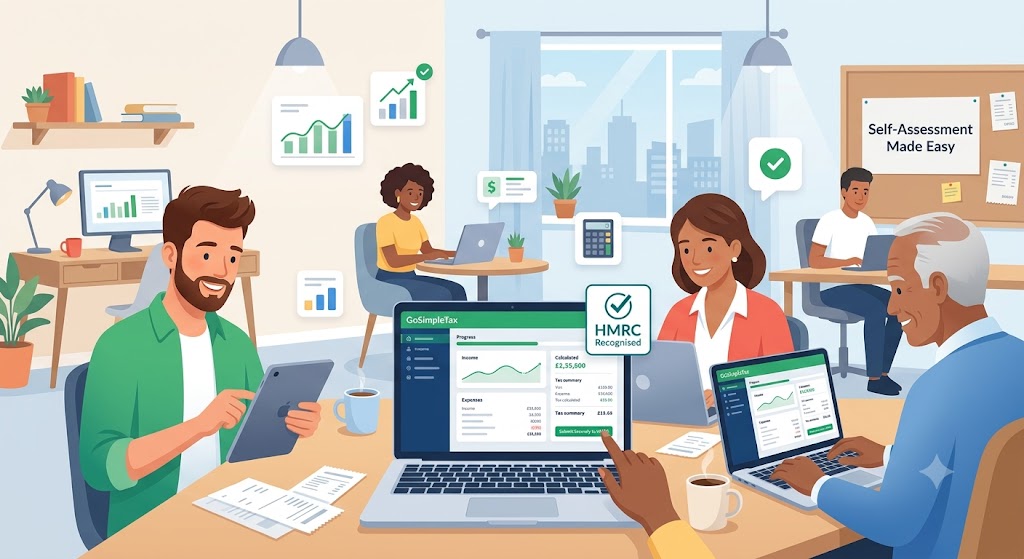
2. GoSimpleTax
Company Overview: An intuitive, HMRC-recognised online tax software designed specifically to help individuals easily file their Self Assessment tax returns.
Key Features: Real-time tax liability estimates, automatic error checking, and direct submission to HMRC.
Products or Services: Self Assessment software, tax saving tips, and MTD bridging software.
Why it is relevant in the UK market: As one of the best UK tax return software platforms available, it actively prompts users with tax-saving opportunities, ensuring manual claims like the Marriage Allowance are not overlooked during annual filings.
3. TaxNav
Company Overview: A modern, HMRC-recognised software dedicated to simplifying Making Tax Digital for Income Tax (MTD IT) compliance for sole traders and landlords.
Key Features: Browser-based platform, spreadsheet bridging (Excel, Google Sheets), and AI-driven error checking.
Products or Services: Quarterly MTD submissions, final declarations, and CIS deduction retrieval.
Why it is relevant in the UK market: With MTD for Income Tax arriving soon, TaxNav provides a seamless transition for self-employed spouses who need to report their income accurately while maintaining their basic rate status to qualify for partner tax allowances.

4. IRIS Elements
Company Overview: A powerhouse in the UK accounting software industry, IRIS provides cloud-based solutions tailored for both individual taxpayers and large accountancy firms.
Key Features: ISO 27001 certification, comprehensive VAT and Income Tax filing, and deep integration with HMRC APIs.
Products or Services: IRIS Elements Tax, payroll solutions, and practice management for accountants.
Why it is relevant in the UK market: Trusted by over 15,000 accountants, it is the backbone software used by many of the top UK tax advisors to manage client portfolios and ensure all eligible tax reliefs are applied accurately.

5. QuickBooks UK
Company Overview: A globally recognised financial software company with a heavily localised UK version designed for small businesses, freelancers, and sole traders.
Key Features: Automated expense tracking, invoicing, and open banking integrations.
Products or Services: Cloud accounting software, payroll integration, and MTD-ready tax filing.
Why it is relevant in the UK market: QuickBooks makes it incredibly easy for lower-earning freelancers to track their net profit, ensuring they know exactly when they fall below the £12,570 threshold and can transfer their allowance to their partner.

6. Xero UK
Company Overview: A leading cloud-based accounting platform that dominates the UK SME market, known for its beautiful user interface and extensive app ecosystem.
Key Features: Bank reconciliation, customisable dashboards, and a massive marketplace of integrated apps.
Products or Services: Bookkeeping, payroll, tax estimates, and expense management.
Why it is relevant in the UK market: Xero provides crystal-clear visibility into personal and business finances, making it a critical tool for married business owners structuring their salaries and dividends to optimise their household tax position.

7. Crunch
Company Overview: An online accountancy firm and software provider tailored specifically for freelancers, contractors, and small businesses in the UK.
Key Features: Combination of proprietary accounting software and unlimited access to client managers and chartered accountants.
Products or Services: Limited company accounting, sole trader accounting, and Self Assessment filing.
Why it is relevant in the UK market: By offering both software and human advisory, Crunch helps working couples strategise their income streams efficiently, ensuring compliance with HMRC while maximising available reliefs.

8. TaxAssist Accountants
Company Overview: The UK’s largest network of independent accountants servicing small businesses and self-employed individuals through high-street branches.
Key Features: Face-to-face advisory, highly localised market knowledge, and comprehensive accountancy services.
Products or Services: Year-end accounts, tax planning, payroll, and personal tax returns.
Why it is relevant in the UK market: For individuals who prefer in-person consultations, TaxAssist provides essential guidance on personal tax thresholds, backdating claims, and overall household financial health.

9. Sage UK
Company Overview: A veteran in the UK software industry, providing robust accounting, payroll, and HR software.
Key Features: Deep compliance frameworks, scalable software for growing businesses, and advanced reporting.
Products or Services: Sage Accounting, Sage Payroll, and compliance modules.
Why it is relevant in the UK market: Sage is integral for UK employers and business owners. Accurate payroll reporting through Sage ensures that tax codes (like 'M' and 'N') applied by HMRC are processed flawlessly on employee payslips.

10. FreeAgent
Company Overview: A cloud accounting software company specifically built for freelancers, small businesses, and their accountants, notably owned by NatWest Group.
Key Features: Jargon-free interface, automated tax timelines, and seamless bank feeds.
Products or Services: Invoicing, expense tracking, Corporation Tax estimates, and Self Assessment filing.
Why it is relevant in the UK market: FreeAgent takes the complexity out of tax forecasting. It allows self-employed spouses to project their end-of-year earnings, empowering them to make informed decisions about transferring tax allowances before the April deadline.

Comparison Table: Choosing Your Tax Software or Advisor
To help you decide which route is best for managing your taxes and claiming allowances, review the comparison table below.
| Provider / Software | Best Suited For | Key Strength | HMRC Recognised (MTD) | Delivery Method |
| GoSimpleTax | Individuals / DIY Filers | Ease of use and real-time tax saving prompts | Yes | Cloud Software |
| TaxNav | Landlords & Sole Traders | Spreadsheet bridging and no hidden fees | Yes | Cloud Software |
| TaxScouts | Freelancers / Side-hustles | Flat-fee access to certified accountants | N/A (Service) | Web Service & Human |
| Xero UK | Small to Medium Businesses | Extensive app ecosystem and clear dashboards | Yes | Cloud Software |
| TaxAssist | Local High-Street Businesses | Face-to-face local accounting support | N/A (Service) | In-person / Hybrid |
| IRIS Elements | Accountancy Practices | Robust compliance and portfolio management | Yes | Professional Software |
Common Mistakes and Expert Tips
Even with straightforward rules, many UK taxpayers make costly errors when dealing with HMRC.
Common Mistakes:
-
Assuming Automatic Application: The allowance is never applied automatically upon marriage. You must proactively apply.
-
Misunderstanding Income Brackets: If the higher earner strays even £1 into the higher tax bracket (e.g., earning £50,271 via a sudden bonus), the entire household becomes ineligible.
-
Forgetting to Cancel: If your financial circumstances change (for instance, the lower earner gets a promotion and exceeds the £12,570 threshold), you must contact HMRC to cancel the transfer, or you will face unexpected tax demands later.
Expert Tips:
-
Leverage Dividends Properly: Remember that dividend income counts towards your total taxable income. Calculate this carefully before transferring allowances.
-
Check Your Tax Code: Always review your payslips after an application. Ensure the 'M' and 'N' codes have been correctly applied by your employer's payroll department.
-
Backdate Before the Deadline: The ability to claim backdated years operates on a rolling basis. On April 5th of every year, the oldest eligible year falls off the ledger. Act swiftly to secure maximum rebates.
FAQ Section
1. Can we claim the allowance if we are cohabiting but not married?
No. The Marriage Allowance for UK Residents is strictly legislated for couples who are legally married or in a recognised civil partnership. Cohabiting couples, regardless of how long they have lived together, do not qualify for this specific tax relief.
2. What happens if the higher earner's income fluctuates into the higher tax bracket?
If the higher earner’s income exceeds the basic rate threshold (£50,270 in England/Wales/NI or £43,662 in Scotland) at any point during the tax year, the couple loses eligibility for that year. It is crucial to monitor bonuses, overtime, and dividend payouts that might inadvertently push the earner into the higher rate.
3. Does claiming the allowance affect my State Pension?
No. Transferring a portion of your Personal Allowance does not have any negative impact on your National Insurance contributions or your future entitlement to the UK State Pension.
4. Can I claim on behalf of a deceased spouse?
Yes. If your spouse or civil partner has passed away, you can still make a backdated claim for any of the eligible tax years up to 2021/2022 that occurred prior to their death. You will need to contact the HMRC Income Tax helpline to process this specific type of claim.
5. How quickly will we see the tax savings?
If you apply for the current tax year, HMRC will adjust the higher earner's tax code within a few weeks. The savings will then be distributed evenly across the remaining payslips of the tax year.
For backdated claims, HMRC typically issues a rebate cheque or bank transfer within 4 to 6 weeks.
Final Thoughts
Taking control of your household finances requires vigilance and a solid understanding of government provisions. The Marriage Allowance for UK Residents is a prime example of a straightforward, highly commercial benefit that requires minimal administrative effort but yields substantial financial rewards. By ensuring you meet the income thresholds, keeping abreast of HMRC rules, and utilising the right professional software or advisory services, you can securely protect your household’s wealth. Whether you are adjusting your current tax code or claiming a four-year backdated lump sum, the time to act and optimise your tax position is today.

Disclaimer: The information provided in this article is for general informational and research purposes only. Company details, features, services, and market positions may change over time. Readers are advised to visit official company websites and conduct independent research before making any business decisions or purchasing services.
Most Searchable Keywords

Recent Blogs



Related Listings


Categories
- Accountants (295)
- Advertising Agencies (559)
- Architects (149)
- Automobiles (376)
- Beauty (300)
- Carpenters (146)
- Cleaning Services (386)
- Dentists (189)
- Driving (61)
- Electricians (215)
- Energy (8)
- Event Organiser (684)
- Finance (598)
- Guide (3363)
- Health (2205)
- Information technology (206)
- Legal Services (352)
- Logistics (6)
- Maintenance (65)
- Manufacturing (35)

Sponsored Listings in Health and Wellbeing


Related Blogs

Bristol Firework Displays Every Local Should...
Read this insightful article "Bristol Firework Displays Every Local Should Experience" to expand your knowledge!

Self Assessment Registration 2026 Common Erro...
Read this insightful article "Self Assessment Registration 2026 Common Errors and Rules" to expand your knowledge!
Calculate Your 2026 Employer National Insuran...
Read this insightful article "Calculate Your 2026 Employer National Insurance Bill Easily" to expand your knowledge!
Questions & Answers – Find What
You Need, Instantly!
How can I update my business listing?
Is it free to manage my business listing?
How long does it take for my updates to reflect?
Why is it important to keep my listing updated?
