
AI Content Detection Protecting Your Brands Voice and SEO
- 👤 Tim David
- 👁️ 84 Views
- Last Updated: March 25, 2026
- 🏷️ Information technology
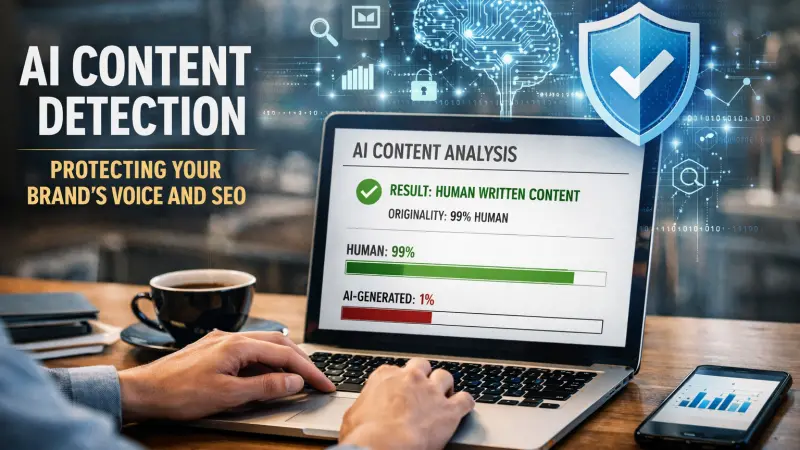
According to the World Economic Forum’s Global Risks Report 2024, the rapid proliferation of mis- and disinformation fueled by artificial intelligence now sits at the very top of the global risk landscape. For United Kingdom small-to-medium enterprises (SMEs), contractors, and professional service providers, this isn't merely a high-level geopolitical concern; it is a direct threat to the integrity of digital communication. As generative AI becomes a staple in the modern workstation, the challenge of distinguishing between authentic human insight and machine-generated echoes has reached a critical tipping point.

The Growing Challenge of Generative AI in UK Business
In recent years, the UK business landscape has seen a monumental shift in how content is produced. From freelance copywriters to internal marketing teams, the lure of Large Language Models (LLMs) such as OpenAI’s ChatGPT, Anthropic’s Claude, and Meta’s Llama is undeniable. These tools offer unprecedented speed and efficiency. However, as the volume of AI-generated material increases, so too does the "AI Content Conundrum"—the difficulty of maintaining quality, accuracy, and a unique brand voice in a sea of algorithmic output.
Carolina Klint, Chief Commercial Officer for Europe at Marsh McLennan, highlights that these breakthroughs "radically disrupt the risk outlook for organisations." Many businesses are currently struggling to react to threats arising from misinformation and strategic miscalculation. For a UK-based contractor or consultant, the risk is twofold: losing the trust of a discerning client base and falling foul of search engine algorithms that increasingly prioritise "Helpful Content" created by humans for humans.
Understanding the Hidden Threat: Sentiment Neutralisation
One of the most insidious issues identified in recent studies is the "neutralisation" of sentiment. While many users believe that paraphrasing an article through an AI tool simply makes it more professional or concise, research from AI detection authority Originality.ai suggests a more damaging outcome. When an LLM rewrites text, it tends to pull the emotional weight of the content toward a flat, neutral centre. This "watering down" of original thought can render a powerful opinion piece or a heartfelt brand story entirely lifeless.
The Study: How LLMs Alter Original Intent
A benchmark study led by Jonathan Gillham, Founder and CEO of Originality.ai, investigated how popular LLMs handle sentiment. The study analysed 100 articles across various sentiment scales—ranging from highly negative to highly positive. These articles were سپس paraphrased by ChatGPT, Claude 2, and Llama 2. The results were startling for those who value brand personality:
- Sentiment Flattening: Articles with strong emotional hooks (scoring 1 or 5 on a sentiment scale) were consistently pulled toward a neutral score of 3.
- Claude 2 Trends: This model showed the most significant reduction in word count, often stripping away 43.5% of the original text, which frequently removed the nuances that gave the writing its character.
- Llama 2 Trends: Conversely, Meta’s model tended toward a more positive, wordier output, yet still struggled to maintain the specific "bite" or critical tone of the source material.
Why Sentiment Analysis Matters for UK SMEs
For a business operating in the UK—where consumer trust is often built on transparency and a distinct, authoritative voice—losing sentiment is synonymous with losing influence.
Sentiment analysis is the process of categorising text as positive, negative, or neutral. It is the metric used by brands to understand customer reviews, survey responses, and public perception.
If a UK law firm, for example, writes a critical analysis of a new regulation, that text likely carries a firm, authoritative, and perhaps cautious sentiment. If an AI "optimises" this text into a neutral format, the urgency and the expert "warning" are lost. The reader is left with "just the facts," which, while accurate, fails to provide the professional guidance the client actually pays for. As Jonathan Gillham notes, "Dampening those qualities might prevent readers from perceiving how potentially troublesome or heartening an event might be."
The Impact on SEO and Brand Integrity
Search Engine Optimisation (SEO) in 2024 and beyond is heavily focused on Experience, Expertise, Authoritativeness, and Trustworthiness (E-E-A-T). Google and other major search engines have become increasingly adept at identifying patterns associated with mass-produced, low-effort AI content. This has led to the rise of "Parasite SEO," where reputable domains are hijacked by AI-generated content designed solely to rank, rather than to inform.
The Rise of "Parasite SEO"
Research suggests that approximately 46% of major publishers are already using AI for content creation. In some cases, high-authority sites have been found hosting articles written by "fake" authors—identities generated by AI to give a veneer of expertise to automated text. For a legitimate UK service provider, competing with these automated "content farms" requires a doubling down on human authenticity. AI content detection tools are no longer just for academics; they are essential for businesses to audit their own output and ensure their contributors are maintaining high standards of integrity.
How to Identify AI-Generated Content: A Practical Guide
Becoming an "AI sleuth" is becoming a required skill for business owners. Whether you are hiring a freelance copywriter or reviewing a report from a sub-contractor, knowing how to spot the hallmarks of machine-generated text is vital. While SaaS tools provide a technological solution, there are several manual indicators to watch for:
- Repetitive Sentence Structure: AI often defaults to a predictable rhythm, using similar sentence lengths and starting phrases.
- Lack of Recent Cultural Context: Machines are trained on datasets with "knowledge cut-offs," meaning they often miss very recent UK-specific developments or nuanced cultural slang.
- Excessive Hedging: AI often uses phrases like "It is important to consider," "On the other hand," and "In conclusion," in a way that feels overly formal and robotic.
- Factually Hollow Statements: AI is prone to "hallucinations"—confidently stating facts that are entirely fabricated, especially when dealing with specific UK legal or financial details.
The Ethical Advancement of AI
Technology expert Alex Fink suggests that while AI is "gullible," the future of the industry hinges on our capacity to distinguish fact from fiction. If AI can be used to create deepfakes and neutralised misinformation, it must also be harnessed to stop it. For the ethical UK business, this means using AI as a supportive tool for brainstorming or data analysis, rather than a replacement for human critical thinking.
When AI is used to "distil" information, it often removes the very human elements that foster connection. In a professional service context, such as consultancy or healthcare, those human elements are the primary product.
Separating the "signal from the noise" is the only way to advance AI ethically while preserving the value of professional expertise.
Strategies for Maintaining Authenticity
To avoid the pitfalls of AI content degradation, UK businesses should implement the following strategies:
1. Establish an AI Content Policy
Clearly define how AI tools should and should not be used within your organisation. If you use contractors, ensure your agreements specify that final deliverables must be human-verified and free from significant AI-driven sentiment shifts.
2. Utilise Robust Detection Tools
Incorporate tools like Originality.ai into your editorial workflow. These platforms offer up to 99% accuracy in identifying AI-generated text, allowing you to publish with confidence and maintain your site's SEO standing.
3. Focus on First-Person Experience
AI cannot replicate personal anecdotes, case studies from your specific UK projects, or the "war stories" of a veteran contractor.
By grounding your content in real-world experience, you make it inherently difficult for an AI to mimic and more valuable for your human readers.
Frequently Asked Questions
What is AI content detection?
AI content detection is the process of using specialised software and algorithms to determine whether a piece of writing was produced by a human or a Large Language Model (LLM) like ChatGPT. These tools look for linguistic patterns, predictability, and "perplexity" scores that are characteristic of machine-generated text.
Why does AI-generated content sound so neutral?
Most LLMs are trained to be helpful, harmless, and honest. As a result, they are programmed to avoid extreme opinions or inflammatory language. When they rewrite or paraphrase text, they naturally gravitate toward the "middle ground," which often strips away the unique tone or emotional urgency of the original author.
Will using AI content hurt my website's ranking in the UK?
Google has stated that it rewards high-quality, helpful content regardless of how it is produced. However, AI content that is unedited, lacks "Expertise" (the E in E-E-A-T), or is designed solely to manipulate search rankings is frequently penalised in algorithm updates. For most UK SMEs, relying solely on AI without human oversight is a significant SEO risk.
How can I tell if my copywriter is using AI?
Look for a sudden shift in tone, an absence of specific local references, and a lack of depth in complex topics. You can also use detection software to audit their work. If the content feels "flattened" or lacks the specific professional insights you expect, it may have been heavily processed by an LLM.
What is sentiment analysis in SEO?
Sentiment analysis involves evaluating the emotional tone of a piece of content. In SEO, this is important because search engines aim to match the "intent" of a search query with the "tone" of a result.
If a user is looking for a passionate review or a critical guide, a neutral AI-generated article may not satisfy their search intent as well as a human-written piece.
Conclusion
As we navigate the "AI Content Conundrum," the priority for UK businesses must remain the preservation of the human voice. While AI offers remarkable tools for efficiency, it cannot yet replicate the nuanced, sentiment-rich communication that builds lasting professional relationships. By staying informed about the risks of sentiment neutralisation and employing rigorous AI content detection strategies, UK SMEs can ensure their digital presence remains authoritative, authentic, and high-ranking in an increasingly automated world.

Disclaimer: The information provided in this article is for general informational and research purposes only. Company details, features, services, and market positions may change over time. Readers are advised to visit official company websites and conduct independent research before making any business decisions or purchasing services.
Most Searchable Keywords
No suggested searches available.

Recent Blogs



Related Listings
-
Undo Capital
-

Top Mobile App Developers in UK | Downtown Applications
-

Polar DC
-

Chronicle Online
-

Imobisoft

Categories
- Accountants (295)
- Advertising Agencies (559)
- Architects (149)
- Automobiles (377)
- Beauty (300)
- Carpenters (146)
- Cleaning Services (386)
- Dentists (189)
- Driving (62)
- Electricians (215)
- Energy (8)
- Event Organiser (685)
- Finance (599)
- Guide (3365)
- Health (2207)
- Information technology (206)
- Legal Services (353)
- Logistics (6)
- Maintenance (65)
- Manufacturing (35)

Sponsored Listings in Information Technology
Related Blogs

Gen Z Political Reporters and News Creators i...
Read this insightful article "Gen Z Political Reporters and News Creators in the UK" to expand your knowledge!

Famous Female Social Media Influencers Across...
Read this insightful article "Famous Female Social Media Influencers Across the UK" to expand your knowledge!

Your UK Sponsor Licence 2026 Step by Step Gui...
Read this insightful article "Your UK Sponsor Licence 2026 Step by Step Guide" to expand your knowledge!
Questions & Answers – Find What
You Need, Instantly!
How can I update my business listing?
Is it free to manage my business listing?
How long does it take for my updates to reflect?
Why is it important to keep my listing updated?
