
Artemis 2 Live Tracker and Mission Launch Everything Explained
- 👤 Alex
- 👁️ 99 Views
- Last Updated: April 9, 2026
- 🏷️ Information technology
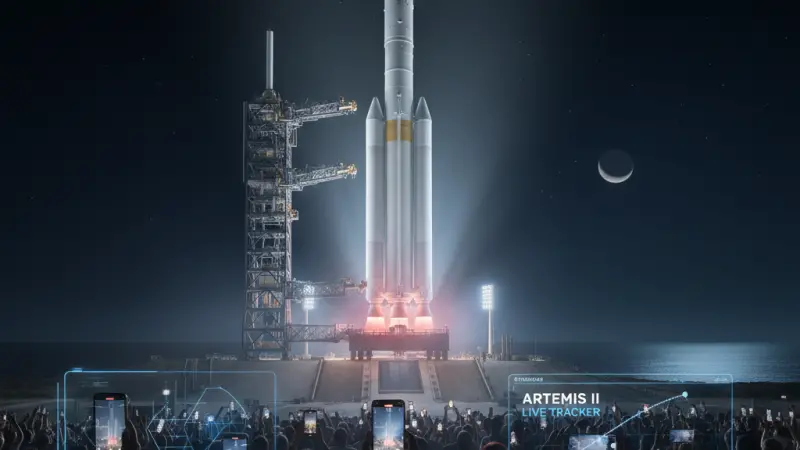
Humanity is on the brink of a historic return to the lunar vicinity. For the first time in over fifty years, a crewed spacecraft will leave Earth's orbit and venture toward the Moon. The Artemis 2 mission represents more than just a flight; it is the ultimate stress test for the systems that will eventually land the first woman and first person of color on the lunar surface. But how can you follow this journey in real-time? Why does the Artemis 2 Rakete Größe matter so much for this specific trajectory? And where can you find a reliable Artemis 2 Live Tracker during the ten-day mission?
Whether you are a space enthusiast or a casual observer, understanding the mechanics of this mission is crucial. This isn't just a "flyby." It is a complex ballet of orbital mechanics, deep-space communication, and human endurance. In this guide, we break down every aspect of the mission, from the Artemis 2 Start Live event to the technical specifications of the SLS rocket.
What is the Artemis 2 Mission?
Artemis 2 is the first crewed mission of NASA’s Artemis program, scheduled to send four astronauts (Reid Wiseman, Victor Glover, Christina Koch, and Jeremy Hansen) on a 10-day flight around the Moon and back to Earth. Using the Space Launch System (SLS) rocket and Orion spacecraft, the mission will perform a "lunar free-return trajectory," testing life-support systems in deep space without landing on the Moon. This mission paves the way for the Artemis 3 lunar landing.
- The Significance of Artemis 2 in Modern Space Exploration
- Artemis 2 Live Tracker: How to Follow the Path to the Moon
- Watching the Artemis 2 Start Live: Viewing Guide
- Artemis 2 Rakete Größe: Understanding the SLS Powerhouse
- The Crew and the Capsule: Living in Orion
- Artemis 2 Live Map: The Free-Return Trajectory Explained
- Hidden Truths: What Most People Miss About the Mission
- Frequently Asked Questions (FAQ)
The Significance of Artemis 2 in Modern Space Exploration
The journey of Artemis 2 is the culmination of years of iterative testing. Following the uncrewed success of Artemis 1, which proved the Orion capsule could survive the intense heat of atmospheric reentry, Artemis 2 adds the most volatile variable: humans. The mission is designed to prove that the Orion’s life-support systems, communication arrays, and manual override controls function perfectly in the harsh radiation environment of deep space.
But here is the kicker: Unlike Apollo missions, Artemis is built on a framework of sustainability and international cooperation. With the inclusion of Canadian Space Agency astronaut Jeremy Hansen, Artemis 2 marks the beginning of a truly global lunar presence. This mission doesn't just look back at the 1960s; it looks forward to Mars. Every hour spent on the Artemis 2 Live Tracker is an hour of data collected for the eventual journey to the Red Planet.
The mission profile is a "Hybrid Free Return Trajectory." This means the spacecraft will use Earth’s gravity to "slingshot" itself around the Moon. If the engines were to fail after the initial burn, the laws of physics would naturally pull the crew back to Earth. This built-in safety mechanism is a testament to the conservative yet brilliant engineering behind the mission. It is about balancing the thrill of discovery with the absolute necessity of crew safety.
Artemis 2 Live Tracker: How to Follow the Path to the Moon
For those looking to keep a constant eye on the mission, the Artemis 2 Live Tracker is your digital window into the cosmos. NASA’s "AROW" (Artemis Real-time Orbit Website) is expected to provide high-fidelity data once the mission commences. This tracker doesn't just show a static dot; it provides velocity, distance from Earth, distance from the Moon, and the current mission elapsed time.
Using a Artemis 2 Live Map allows viewers to see exactly where the Orion capsule is in relation to the lunar surface. During the "Trans-Lunar Injection" phase, the speed will be staggering—over 22,000 miles per hour. Watching the telemetry on a live tracker gives you a sense of scale that photos simply cannot convey. You can see the moment the crew loses contact with Earth as they pass behind the far side of the Moon, a period of silence that remains one of the most tense moments in any lunar flight.
Moreover, the Artemis 2 Tracker will integrate data from the Deep Space Network (DSN). This is a global array of giant radio antennas that support interplanetary spacecraft missions. By following the tracker, you are essentially watching the pulse of the mission.
You can see when the spacecraft is "talking" to the Goldstone complex in California, the Madrid complex in Spain, or the Canberra complex in Australia. It is a 24/7 global operation that keeps four humans alive a quarter-million miles away.
Watching the Artemis 2 Start Live: Viewing Guide
The Artemis 2 Start Live broadcast will likely be one of the most-watched events in history. When the four RS-25 engines and two solid rocket boosters ignite at Kennedy Space Center’s Launch Complex 39B, they will produce 8.8 million pounds of thrust. Finding a high-quality Artemis 2 Live Stream is essential for experiencing this raw power.
The launch window is a precise calculation. Unlike a flight to a terrestrial destination, the Moon is a moving target. The SLS must launch at a specific second to ensure the Orion capsule intersects the Moon’s orbit at the correct angle. If you are watching the live stream, pay attention to the "T-minus" count. The most critical moments occur in the first two minutes of flight, where the boosters provide the majority of the lift before being jettisoned into the Atlantic Ocean.
Expect the live stream to feature multiple camera angles, including "RocketCam" views attached to the SLS itself. These views provide a dizzying perspective as the Earth recedes into a blue marble. The broadcast will also feature commentary from astronauts and engineers who can explain the "Max Q" (maximum dynamic pressure) phase, where the rocket faces the most intense physical stress during its ascent through the atmosphere.
Artemis 2 Rakete Größe: Understanding the SLS Powerhouse
When discussing the Artemis 2 Rakete Größe (rocket size), the numbers are difficult to wrap the human mind around. The Space Launch System (SLS) Block 1 configuration stands at a staggering 322 feet (98 meters). To put that into perspective, it is taller than the Statue of Liberty. The sheer volume of fuel required to break Earth's gravity is what dictates this massive scale.
The core stage alone holds 537,000 gallons of liquid hydrogen and 196,000 gallons of liquid oxygen. The diameter of the core stage is 27.6 feet, making it a vertical skyscraper of propellant. But size isn't just about height; it's about capability. The SLS is designed to evolve. While the Artemis 2 version is already the most powerful rocket ever built to reach orbit, future iterations will be even larger to carry the heavy hardware needed for lunar bases.
The weight of the rocket at launch is approximately 5.75 million pounds. Most of that weight is gone within minutes as fuel is consumed. What remains is the relatively small Orion capsule and the Service Module provided by the European Space Agency. This "size-to-payload" ratio highlights how incredibly difficult it is to move mass from the surface of Earth into deep space. Every pound of the Artemis 2 Rakete Größe is meticulously engineered to ensure that the 20,000-pound Orion capsule reaches its destination safely.
The Crew and the Capsule: Living in Orion
Inside the Orion capsule, the four-person crew will live in a space about the size of a small SUV. While this may seem cramped for a 10-day mission, the Orion is significantly more spacious than the Apollo command modules. It features improved waste management (a space toilet that actually works), private sleeping quarters, and advanced touch-screen interfaces that replace the thousands of physical switches found in 1960s spacecraft.
The crew includes Mission Commander Reid Wiseman, Pilot Victor Glover, and Mission Specialists Christina Koch and Jeremy Hansen. Their daily routine will involve monitoring the spacecraft's health, performing medical checks, and conducting "proximity operations" early in the mission.
This involves using the spent upper stage of the SLS rocket as a target to test Orion’s manual handling—a skill that will be vital for future missions that involve docking with the Lunar Gateway station.
Radiation protection is a major focus for this crew. Since they are traveling beyond the protection of Earth’s magnetic field, they are exposed to solar flares and cosmic rays. The Orion capsule is equipped with "shelter" areas where the crew can huddle during a solar particle event, using the spacecraft’s own mass and water supplies as a shield. Following their health through official updates is just as important as following the Artemis 2 Live Tracker.
Artemis 2 Live Map: The Free-Return Trajectory Explained
If you look at an Artemis 2 Live Map, you will notice the flight path looks like a giant figure eight. This is the "Free-Return Trajectory." After launching and performing a check-out orbit around Earth, the Orion capsule will fire its engines to head toward the Moon. This burn is called Trans-Lunar Injection (TLI).
The map will show the capsule flying past the Moon at an altitude of about 4,600 miles above the surface. At this point, the Moon’s gravity will "grab" the spacecraft and swing it around. This maneuver actually speeds the spacecraft up relative to the Sun but slows it down relative to the Earth, setting it on a path that leads directly back home. It is a masterpiece of gravitational navigation.
One of the most exciting phases to watch on the live map is the "High Earth Orbit" phase. Before heading to the Moon, Orion will spend nearly 24 hours in a very high orbit around Earth. This allows the crew to test the life support systems while still being close enough to abort and return quickly if something goes wrong. Once they commit to the lunar leg of the journey, they are "all in."
Hidden Truths: What Most People Miss About the Mission
Think about this: Most people believe the hardest part of the mission is the launch. While the launch is certainly the most explosive, the "Entry, Descent, and Landing" (EDL) phase is where the most danger lies. When Orion returns from the Moon, it will be traveling at 25,000 mph. It will hit the Earth's atmosphere so fast that it will create a plasma field around the capsule, reaching temperatures of 5,000 degrees Fahrenheit.
Another "hidden truth" is the role of the European Service Module (ESM). The SLS is an American rocket, but the Orion capsule cannot survive without its European "tail." The ESM provides the air,
water, and electricity for the crew, as well as the main engine that performs orbital corrections. Without this international partnership, Artemis 2 would literally run out of breath.
Finally, keep in mind the psychological aspect. These four individuals will be the most isolated humans in history during their time on the far side of the Moon. They will be further from home than anyone has been since the final Apollo 17 astronauts in 1972. The sense of "Earthrise"—seeing our entire world as a tiny blue dot—is an experience that will profoundly change the way these astronauts see our planet.
Conclusion
Artemis 2 is more than a sequel to Artemis 1; it is the definitive proof of concept for the next century of human spaceflight. By following the Artemis 2 Live Tracker and tuning into the Artemis 2 Start Live broadcast, you aren't just watching a news event—you are witnessing a turning point in our history as a multi-planetary species. From the massive Artemis 2 Rakete Größe to the precision of the Artemis 2 Live Map, every detail of this mission is a testament to human ingenuity.
As we wait for the engines to roar to life at Kennedy Space Center, the world watches with bated breath. We are going back to the Moon, and this time, we are staying. Keep your eyes on the stars and your browser set to the live mission trackers to stay updated on this incredible journey.
Frequently Asked Questions (FAQ)
When is the Artemis 2 launch date? The Artemis 2 mission is currently targeted for late 2025 or 2026. Launch dates in space exploration are fluid and depend on the completion of rigorous safety testing and hardware readiness. Always check the Artemis 2 Start Live countdown for the most up-to-date timing.
How long does the Artemis 2 mission last? The mission is planned to last approximately 10 days. This includes the initial Earth orbits for systems checking, the four-day transit to the Moon, the lunar flyby, and the four-day return journey ending in a splashdown in the Pacific Ocean.
Will Artemis 2 land on the Moon? No, Artemis 2 will not land on the Moon. It is a flyby mission designed to test the spacecraft and crew systems. The first landing of the Artemis program is scheduled for the Artemis 3 mission, which will occur at least a year after Artemis 2.
Can I see Artemis 2 from Earth with a telescope? While the SLS rocket is visible during launch, the Orion capsule is too small to be seen with standard backyard telescopes once it is in deep space. However, you can track its position using a professional Artemis 2 Live Tracker or live map to know exactly which part of the sky it is in.
What is the purpose of the Artemis 2 Live Tracker? The tracker provides real-time telemetry, including velocity, altitude, and position.
It allows the public to engage with the mission and understand the complexities of deep-space navigation as the crew travels 250,000 miles away from Earth.
Why is the Artemis 2 Rakete Größe so significant? The size of the SLS rocket is a direct result of the energy required to lift a crew-rated spacecraft and its life support systems out of Earth's deep gravity well and send it to the Moon. It is currently the only rocket capable of sending the Orion capsule to the lunar vicinity in a single launch.
Disclaimer: The information provided in this article is for general informational and research purposes only. Company details, features, services, and market positions may change over time. Readers are advised to visit official company websites and conduct independent research before making any business decisions or purchasing services.
Most Searchable Keywords
Recent Blogs


Related Listings



Categories
- Accountants (295)
- Advertising Agencies (559)
- Architects (149)
- Automobiles (377)
- Beauty (300)
- Carpenters (146)
- Cleaning Services (387)
- Dentists (189)
- Driving (62)
- Electricians (215)
- Energy (8)
- Event Organiser (686)
- Finance (602)
- Guide (3372)
- Health (2207)
- Information technology (206)
- Legal Services (353)
- Logistics (6)
- Maintenance (65)
- Manufacturing (35)
Sponsored Listings in Information Technology

Related Blogs

How Much Do UK Actors Really Earn Full Indust...
Read this insightful article "How Much Do UK Actors Really Earn Full Industry Breakdown" to expand your knowledge!

Blue Light Card UK 2026 Check Eligibility and...
Read this insightful article "Blue Light Card UK 2026 Check Eligibility and Claim" to expand your knowledge!

BBC Radio 1 DJs Net Worth Ranking Revealed
Read this insightful article "BBC Radio 1 DJs Net Worth Ranking Revealed" to expand your knowledge!
Questions & Answers – Find What
You Need, Instantly!
How can I update my business listing?
Is it free to manage my business listing?
How long does it take for my updates to reflect?
Why is it important to keep my listing updated?
