
Before You Fund: A Guide to Investment & 10 Recession-Proof Businesses
Starting a business is perhaps one of the most exhilarating journeys an individual can undertake. It begins with a spark—an idea that keeps you up at night, a conversation with friends that turns into a "what if," and eventually, the serious consideration of leaving your 9-to-5 to build something of your own.
However, passion alone doesn't pay the bills or scale a startup. Most entrepreneurs reach a crossroads where their personal savings aren't enough to bridge the gap between a prototype and a market-leading product. This is where the hunt for capital begins. But before you pitch to an angel investor or launch a crowdfunding campaign, you must ensure your foundation is rock-solid.
In this comprehensive guide, we will break down the essential requirements for seeking investment and explore ten business sectors that historically thrive even when the economy takes a downturn.
Crucial Points to Consider Before Seeking Funding
The "burn rate" of a startup isn't just about money; it’s about time and reputation. If you approach investors prematurely, you risk burning bridges before you’ve even built them. Here is your checklist to ensure you are truly investment-ready.
1. Develop a Comprehensive Business Plan
A business plan is much more than a document; it is your roadmap. Many founders make the mistake of keeping the plan in their heads. If it isn’t on paper, it doesn’t exist to an investor.
Executive Summary: A high-level overview of the problem you are solving.
Operational Strategy: How will the day-to-day business function?
Revenue Model: Exactly how will the business generate cash?
2. Rigorous Market Research
Investors are not moved by "gut feelings." They are moved by data. You must provide verifiable information that demonstrates a demand for your product.
TAM, SAM, and SOM: Define your Total Addressable Market, Serviceable Addressable Market, and Serviceable Obtainable Market.
Competitor Analysis: Who else is doing this, and why are you better?
Consumer Trends: Is the market growing or shrinking?
3. Granular Financial Models
If the business plan is the heart, the financial model is the circulatory system. Investors will scrutinize your spreadsheets. You need to present:
Projected Costs: Fixed and variable expenses.
Customer Acquisition Cost (CAC): How much does it cost to get one customer?
Lifetime Value (LTV): How much revenue does that customer bring over time?
Breakeven Point: When will the business stop losing money and start making it?
4. The One, Three, and Five-Year Roadmap
Early-stage investing is a long game. An investor wants to see that you aren't just thinking about the launch party, but about the Series B funding round three years from now or an exit strategy in five years.
5. Proof of Concept and Leads
While market research shows theoretical demand, "leads" show actual interest. If you have a waiting list of 1,000 people or a pilot program with five beta testers, you are infinitely more attractive to an investor than someone with just a PowerPoint.
6. Personal Skill and Leadership
Do you have the "Right Stuff"? If you are entering a technical field but have no technical background, you need to show how you have bridged that gap—either through intensive training or by hiring a specialized co-founder. Investors invest in people as much as they do in ideas.
7. Skin in the Game (The "Exciting" Investment)
If you haven't put your own money (or "sweat equity") into the business, why should someone else? Showing that you, along with friends and family, have contributed initial capital proves that those who know you best believe in the vision.
8. Identity and Branding
Your brand is the "personality" of your business. A strong brand identity—including a clear mission statement, visual assets, and a defined tone of voice—shows that you are professional and ready for the public eye.
9. Defined Funding Goals
Never ask for "as much as I can get." You must have a surgical breakdown of your requirements. For example:
£10,000 for R&D and prototyping.
£5,000 for initial digital marketing and SEO.
£5,000 for legal fees and intellectual property.
10. The Reward: Exit and ROI
Investors are not donors; they expect a return. You must be able to articulate when and how they will see their money again. Whether it’s through dividends, a future buyout, or an IPO, the "exit" must be visible on the horizon.
10 Recession-Proof Businesses to Start Today
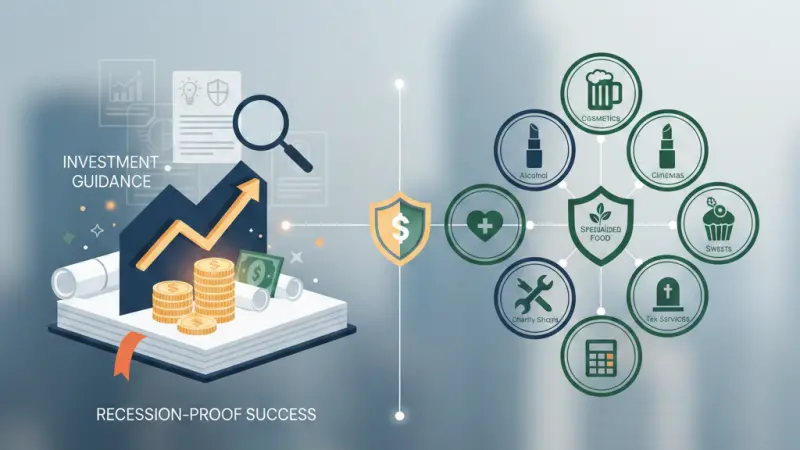
Economic cycles are inevitable. While luxury real estate or high-end travel might suffer during a recession, certain industries remain remarkably resilient. Here are ten sectors where demand remains constant.
1. Alcohol and Spirits
History shows that in times of economic stress, alcohol consumption remains steady or even increases. While high-end champagne sales might dip, the "average" spirit or craft beer market stays strong. Distribution and local retail (convenience stores) are excellent entry points.
2. The Cosmetics Industry (The "Lipstick Effect")
Economists have long noted the "Lipstick Effect"—the theory that consumers will still buy small luxury items, like premium
lipstick, even during an economic downturn. It’s an affordable indulgence that provides a psychological boost.
3. Independent Cinemas and Niche Entertainment
Mainstream cinema is expensive, but the desire for escapism is higher during a crisis. A business that combines a unique experience—such as an independent "boutique" cinema with a specialized dining menu—offers a value proposition that massive chains cannot replicate.
4. Healthcare and Elder Care
The "Silver Tsunami" is real. As the Baby Boomer generation ages, the demand for home healthcare, specialized medical equipment, and wellness services is skyrocketing. This sector is heavily regulated but offers immense long-term stability.
5. Specialized and Niche Food Stores
While people may stop eating at five-star restaurants, they don't stop caring about their health or dietary preferences. Subscription-based vegan boxes or gluten-free local delivery services tap into a "sticky" customer base that views these products as necessities, not luxuries.
6. Sweets, Desserts, and "Comfort Food"
Sugar is a powerful motivator. Small bakeries specializing in comfort foods like cupcakes, brownies, or artisanal chocolates often see growth during recessions because they provide an affordable way for people to treat themselves.
7. Repair and Maintenance Shops
In a boom economy, people replace broken items. In a recession, they repair them. This applies to everything from smartphones and laptops to cars and domestic appliances. A specialized repair shop is a high-demand, low-overhead business model.
8. Charity Shops and Resale Markets
When budgets tighten, the "second-hand" economy flourishes. Starting a curated vintage shop or an online resale platform for high-quality used goods allows you to capitalize on the thrifty consumer’s needs.
9. Funeral Services
While it is a somber industry to discuss, it is entirely recession-proof. It is one of the few industries with a 100% "customer" base eventually. Innovations in eco-friendly burials or simplified memorial services are currently disrupting this traditional space.
10. Tax and Accounting Services
In a crisis, everyone wants to protect their wealth. Businesses need to find every tax efficiency possible to survive, and individuals need help navigating complex financial landscapes. If you are a qualified accountant, your skills are never more valuable than during a downturn.
Elevate Your Business Visibility
Building a business is only half the battle; getting found by your customers is the other. Whether you are a new startup or an established service provider, being present where your customers are searching is vital for survival.
Local Page UK is the premier destination to ensure your company is seen. As a leading uk online business directory, we provide a platform for entrepreneurs to showcase their services to a national and local audience. Utilizing a uk business directory is one of the most cost-effective ways to boost your SEO and local reach.
If you are looking to find local businesses uk, or want your company to appear on a comprehensive local businesses list uk, our platform is designed for you. From a specialized uk small business directory to a robust uk b2b business directory and uk b2c business directory, we cover every sector of the economy.
Our business directory uk online helps bridge the gap between uk service providers directory listings and the customers who need them. Get your uk business listings online today on the local page uk business directory, the most trusted uk business directory website.
Ready to get started? You can claim a business listing uk right now. Our business listing uk offers a business listing uk that helps startups gain immediate traction. As a top-tier business listing uk, we make it easy to manage your business listing uk. Don't miss out on a business listing uk; even a business listing uk can significantly impact your digital footprint. Our business listing uk options ensure that even those on a tight budget can access a business listing uk or a business listing uk.
For those seeking even more depth, explore our local business listings uk. We host a wide array of uk service listings and uk verified business listings. Whether you want to find uk top rated local businesses or browse a uk home services directory, we have the data. Our platform includes uk professional services listings, uk trade services listings, and a dedicated uk local trades directory. Experience the power of local page uk listings and simplify your uk local business search today.
What Professionals Often Want to Know
1. When is the "perfect" time to seek funding? There is no perfect time, but the "ready" time is when your data proves your idea works and you have a clear plan for how an investor's money will generate a return.
2. Do I really need a 5-year plan? Yes. While things will undoubtedly change, a 5-year plan shows investors that you have the vision to scale and an intended endpoint.
3. What is the most common reason investors say "No"? Usually, it is a lack of market validation. If you can't prove people want to buy what you're selling, the risk is too high.
4. Is crowdfunding better than Venture Capital? It depends on your goal. Crowdfunding is great for consumer products and building a community; VC is better for high-growth tech that requires massive upfront capital.
5. How much of my own money should I invest? Invest what you can afford to lose. Investors don't look for a specific dollar amount, but rather a percentage of your capability that shows commitment.
6. Are service-based businesses recession-proof? Essential services (plumbing, tax, healthcare) are. Luxury services (personal styling, luxury travel) are not.
7. Why do alcohol and sweets do well in crises? These are known as "affordable vices." When people can't afford a new car, they treat themselves to a nice bottle of wine or a fancy dessert to cope with stress.
8. Can I start a business with zero capital? Yes, specifically in the service or digital sectors. You can start by listing your skills on a uk business directory to find your first clients.
9. What is the "Lipstick Effect"? It is the observation that during financial crises, consumers still buy small, morale-boosting luxury items like cosmetics.
10. How important is a brand name? A name is just the beginning. A "brand" is the promise you make to your customers. It’s vital for trust-building.
11. Should I quit my job before getting funding? Ideally, no. It is safer to build your "Proof of Concept" as a side hustle until you have enough traction to attract investment.
12. What are "Leads" in a startup context? Leads are potential customers who have expressed interest, signed up for a newsletter, or engaged with a prototype.
13. How do I find a local repair shop to model my business after? You can use a uk local business search on Local Page UK to see what services are currently offered in your area.
14. Is the funeral industry hard to enter? Yes, due to high regulations
and the need for significant physical infrastructure, but it offers unparalleled stability.
15. How does SEO help my new business? SEO ensures that when someone searches for a service you provide, your name appears at the top. Using directories like Local Page UK is a key part of this strategy.
Disclaimer: The information provided in this article is for general informational and research purposes only. Company details, features, services, and market positions may change over time. Readers are advised to visit official company websites and conduct independent research before making any business decisions or purchasing services.
Most Searchable Keywords
Recent Blogs


Related Listings

Categories
- Accountants (295)
- Advertising Agencies (559)
- Architects (149)
- Automobiles (377)
- Beauty (300)
- Carpenters (146)
- Cleaning Services (387)
- Dentists (189)
- Driving (62)
- Education (1)
- Electricians (215)
- Energy (8)
- Event Organiser (686)
- Finance (602)
- Guide (3379)
- Health (2207)
- Information technology (206)
- Legal Services (358)
- Logistics (6)
- Maintenance (65)
Sponsored Listings in Health and Wellbeing

Related Blogs

Strictly Come Dancing Judges Study Love Life...
Read this insightful article "Strictly Come Dancing Judges Study Love Life and Income" to expand your knowledge!

Basel 3.1 Final What UK Banks Must Complete B...
Read this insightful article "Basel 3.1 Final What UK Banks Must Complete Before 2026" to expand your knowledge!

Discover Christmas Lights Switch On Events in...
Read this insightful article "Discover Christmas Lights Switch On Events in Gloucestershire" to expand your knowledge!
Questions & Answers – Find What
You Need, Instantly!
How can I update my business listing?
Is it free to manage my business listing?
How long does it take for my updates to reflect?
Why is it important to keep my listing updated?
