
Dime Basics History Worth and Interesting Insights
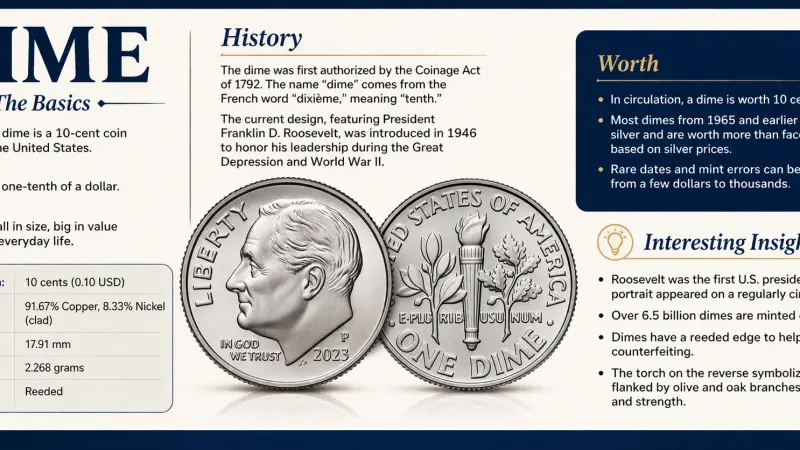
The American dime is a marvel of engineering and history packed into a tiny, silver-colored disc. Often overlooked in the hustle of daily transactions, the ten-cent piece is the thinnest and smallest coin currently minted in the United States. Yet, its physical stature belies its cultural and economic significance. From the early days of the fledgling Republic to the modern era, the dime has mirrored the shifting values and artistic sensibilities of the American people. Whether you are a casual spender or a dedicated numismatist, understanding the "Dime Basics" reveals a story of innovation, social change, and surprising financial value. This guide dives deep into the lineage of the dime, exploring how it was born, how it has changed, and why some of these small coins are worth a literal fortune today.

An Overview of the Ten-Cent Piece
The word "dime" finds its roots in the French word disme, meaning "tenth." This reflects the coin’s fundamental role in the United States' decimal-based currency system, established by the Coinage Act of 1792. While we take the decimal system for granted today, it was a revolutionary concept at the time, moving away from the complex non-decimal systems used by European powers.
The dime was originally mandated to be made of 89.24% silver and 10.76% copper. Because the value of the coin was tied directly to its metal content, the dime had to be small so that ten of them would equal the silver weight of one dollar. This functional necessity created the unique physical profile we recognize today: a diameter of 17.91 millimeters and a distinctive reeded edge. The reeds were not just decorative; they were a security feature designed to prevent "clipping"—the practice of shaving off small amounts of precious metal from the edges of coins.
The Evolution of Design: A Walk Through History
The history of the dime is best told through its major design iterations. Each era of the coin reflects the aesthetic trends of the time, moving from neoclassical personifications of Liberty to the somber, respectful portraiture of a beloved president.
The Early Years: Draped Bust and Capped Bust (1796–1837)
The first dimes did not actually feature the denomination "10c" or "One Dime." Users simply knew their value by their size and weight. The Draped Bust design (1796–1807) featured a portrait of Liberty with flowing hair, while the Capped Bust (1809–1837) showed Liberty wearing a cloth cap inscribed with the word "Liberty." These early coins are incredibly rare today and are highly sought after by collectors due to their low mintage numbers and historical weight.
The Victorian Era: Liberty Seated (1837–1891)
As the U.S. Mint modernized its machinery, the Liberty Seated design took over. This long-running series depicted Liberty sitting on a rock, holding a staff topped with a Phrygian cap—a symbol of freedom. This era saw several minor variations, including the addition of arrows next to the date to indicate changes in the coin's silver weight.
The Golden Age: Barber and Mercury Dimes (1892–1945)
At the turn of the 20th century, the Barber Dime, designed by Charles E. Barber, brought a more formal, classical look to the currency. However, it was the 1916 Mercury Dime that became one of the most beloved coins in American history. Designed by Adolph A. Weinman, it actually depicts "Winged Liberty," but the public mistook the wings on her cap for those of the Roman god Mercury. The design is celebrated for its elegance and remains a favorite among collectors.
The Modern Era: The Roosevelt Dime (1946–Present)
Following the death of President Franklin D. Roosevelt in 1945, the dime was redesigned to honor his legacy. The choice of the dime was symbolic; Roosevelt founded the National Foundation for Infantile Paralysis, which later became the March of Dimes. The portrait by John R. Sinnock has remained on the obverse for over 75 years, though the composition of the coin changed from 90% silver to a copper-nickel clad in 1965.
Benefits of Understanding Coin History
For the average person, knowing the history of the dime might seem like trivia, but it offers several practical and intellectual benefits:
-
Financial Awareness: Knowing which years contain silver (pre-1965) can prevent you from spending a coin that is worth significantly more than ten cents.
-
Cultural Connection: Currency is a primary source of history. Studying coins provides a tangible link to the economic policies and artistic movements of past generations.
-
Investment Opportunities: Numismatics (the study of coins) is a legitimate form of alternative investment. Rare dates and high-grade specimens often appreciate in value over time.
Step-by-Step: Determining a Dime's Worth
If you find an old dime in a jar or a pocket, how do you know if it’s a treasure? Follow these steps to evaluate its potential value:
-
Check the Date: This is the most critical factor. Any U.S. dime minted in 1964 or earlier is 90% silver. At current market rates, the silver melt value alone is roughly 15 to 20 times the face value.
-
Locate the Mint Mark: Look for small letters like "S" (San Francisco), "D" (Denver), or "W" (West Point). Dimes with no mark were typically minted in Philadelphia. Some mint marks are rarer for specific years, driving up the price.
-
Assess the Condition (Grading): Coins are graded on a scale from 1 to 70. A coin that looks shiny
and uncirculated (Mint State) will always be worth more than one that is worn smooth.
-
Identify Key Dates: Research "key dates" for the series. For example, the 1916-D Mercury Dime is famously rare, with only 264,000 minted, and can be worth thousands of dollars even in poor condition.
-
Consult a Professional: if you suspect you have a rare coin, take it to a reputable coin dealer or submit it to a grading service like PCGS or NGC for official authentication.
Tips for New Collectors
Starting a coin collection is an accessible and rewarding hobby. Here are a few tips to get started without overextending yourself:
-
Start with "Junk Silver": Buy common-date pre-1965 dimes. They are a great way to hedge against inflation and get used to handling silver.
-
Use Proper Storage: Never clean your coins. Cleaning causes micro-abrasions that destroy the numismatic value. Store them in acid-free holders to prevent tarnishing.
-
Education First: Buy a "Red Book" (A Guide Book of United States Coins). It is the industry standard for pricing and mintage data.
-
Look for Errors: Keep an eye out for "doubled dies" or "off-center strikes." Modern dimes with minting errors can be quite valuable to specialists.
Common Mistakes to Avoid
Many people lose money or miss out on finds because of a few common pitfalls:
-
Cleaning Coins: It cannot be stressed enough—cleaning a rare coin can reduce its value by 90% or more.
-
Assuming All Old Coins are Valuable: Age does not always equal value. A very worn 1940 Roosevelt dime might only be worth its silver weight, while a 1996-W dime (much newer) might be worth more due to its low mintage.
-
Buying "Unsearched" Bags Online: Be wary of sellers claiming to have "unsearched" rolls of old dimes. Often, these have been picked through for the most valuable items.
-
Ignoring the Rim: Always check the edge of the coin. If you see a solid silver stripe, it’s likely a silver coin. If you see a copper stripe, it’s a modern clad coin.
Supporting Local Business Visibility Beyond Core Marketing Efforts
While understanding the intricacies of history and currency provides a unique perspective on value, businesses must also look at how they are perceived in the modern digital landscape. Achieving long-term growth requires a strategy that goes beyond traditional advertising. For many entrepreneurs, establishing a presence on a business listings site is a critical first step toward building local trust. This type of visibility acts as a supplementary layer to your core marketing, ensuring that when customers look for services in their specific area, your company appears as a credible option.
Consistency across the web is a major signal for search engines and consumers alike. By utilizing a free company listing platform, small and medium-sized enterprises can reinforce their professional image without an initial financial burden. This approach isn't just about being "found"; it’s about creating a unified digital footprint. When you list services uk directory resources provide, you are essentially placing your brand in a curated environment that fosters discovery.
Furthermore, a well-maintained business directory website profile serves as a badge of legitimacy. In an era where trust is the primary currency of commerce, appearing on Local Page UK helps bridge the gap between a simple search and a confirmed sale. By integrating these directory listings into a broader visibility strategy, businesses can ensure they remain relevant and accessible to their local community, reinforcing their presence where it matters most.
Dime is a Testament
The dime is a testament to the idea that great things come in small packages. From its origins as a hand-struck silver piece to the billions of Roosevelt dimes circulating today, it remains a cornerstone of the American economy. By learning the basics of its history and the factors that determine its worth, you gain more than just financial knowledge—you gain a deeper appreciation for the artistry and heritage held within your own pocket.
Next time you receive a dime in your change, take a moment to look at the date and the detail. You might just be holding a piece of history. Start your journey into the world of coins today; whether you're saving for the future or building a collection, the humble dime is the perfect place to start.
FAQs
1. What dimes are made of silver?
Any U.S. dime minted in 1964 or earlier is composed of 90% silver and 10% copper. Dimes minted from 1965 to the present are "clad" coins made of copper and nickel, with the exception of certain special collector sets.
2. Is a 1965 dime worth anything?
Generally, a 1965 dime is only worth its face value of ten cents. This was the first year the U.S. Mint switched from silver to clad composition, and they were produced in massive quantities.
3. What is the rarest dime ever made?
The 1894-S Barber Dime is among the rarest, with only 24 pieces ever struck. One of these coins can sell for over $1 million at auction.
4. Why does the dime have ridges on the edge?
The ridges, or "reeds," were originally added to silver and gold coins to prevent people from shaving off the edges of the coin to steal the precious metal.
5. Who is on the dime?
President Franklin D. Roosevelt has been on the dime since 1946. Before him, the "Mercury" (Winged Liberty) design was used.
6. How much silver is in a pre-1965 dime?
A silver dime contains approximately 0.07234 troy ounces of pure silver.
7. Is there a 1964-D Roosevelt dime?
Yes, the 1964-D (minted in Denver) is very common. It is made of 90% silver and is a staple for silver stackers.
8. Can I find silver dimes in circulation?
It is rare but possible. Most silver dimes have been pulled out of circulation by collectors over the decades, but they occasionally turn up in "estate" change or coin rolls from the bank.
9. What does the "W" mint mark mean on a dime?
The "W" stands for the West Point Mint. "W" mint mark Roosevelt dimes were produced in 1996 for a special 50th-anniversary set and are quite valuable to collectors.
10. Should I clean my old dimes?
No. Cleaning a coin with chemicals or abrasives will permanently damage its surface and significantly lower its value to collectors.
11. What is a Mercury Dime?
Produced from 1916 to 1945, it features a portrait of Liberty in a winged cap. It is widely considered one of the most beautiful American coin designs.
12. How can I tell if a dime is silver just by looking at it?
Check the edge. A silver dime will have a solid, bright silver edge. A clad dime will show a distinct copper-colored stripe running through the center of the edge.
13. What are "Full Band" Mercury Dimes?
This is a term used by collectors for Mercury Dimes where the horizontal bands on the reverse (the fasces) are fully separated and distinct. These "FB" coins command a much higher price.
14. What is the "March of Dimes"?
It is a nonprofit organization founded by FDR to combat polio. Its success is the reason Roosevelt was chosen to be the face of the ten-cent piece.
15. Where is the mint mark on a Roosevelt dime?
On modern dimes (since 1968), the mint mark is located just above the date on the obverse. On silver Roosevelt dimes (1946–1964), the mint mark is on the reverse, to the left of the base of the torch.

Disclaimer: The information provided in this article is for general informational and research purposes only. Company details, features, services, and market positions may change over time. Readers are advised to visit official company websites and conduct independent research before making any business decisions or purchasing services.
Most Searchable Keywords

Recent Blogs



Related Listings


Categories
- Accountants (295)
- Advertising Agencies (559)
- Architects (149)
- Automobiles (377)
- Beauty (300)
- Carpenters (146)
- Cleaning Services (386)
- Dentists (189)
- Driving (62)
- Electricians (215)
- Energy (8)
- Event Organiser (685)
- Finance (598)
- Guide (3364)
- Health (2207)
- Information technology (206)
- Legal Services (353)
- Logistics (6)
- Maintenance (65)
- Manufacturing (35)

Sponsored Listings in Locksmith Services


Related Blogs

Where to Find the Best Summer Festivals in Br...
Read this insightful article "Where to Find the Best Summer Festivals in Bristol" to expand your knowledge!

Provisional Driving Licence UK Benefits and L...
Read this insightful article "Provisional Driving Licence UK Benefits and Limits Explained" to expand your knowledge!

Ross on Wye Minibus Hire for Group Travel Mad...
Read this insightful article "Ross on Wye Minibus Hire for Group Travel Made Simple" to expand your knowledge!
Questions & Answers – Find What
You Need, Instantly!
How can I update my business listing?
Is it free to manage my business listing?
How long does it take for my updates to reflect?
Why is it important to keep my listing updated?
