
Ensuring Data Privacy With Cleaning Contractors Expert Guide
- 👤 Alex
- 👁️ 67 Views
- Last Updated: April 11, 2026
- 🏷️ Cleaning Services
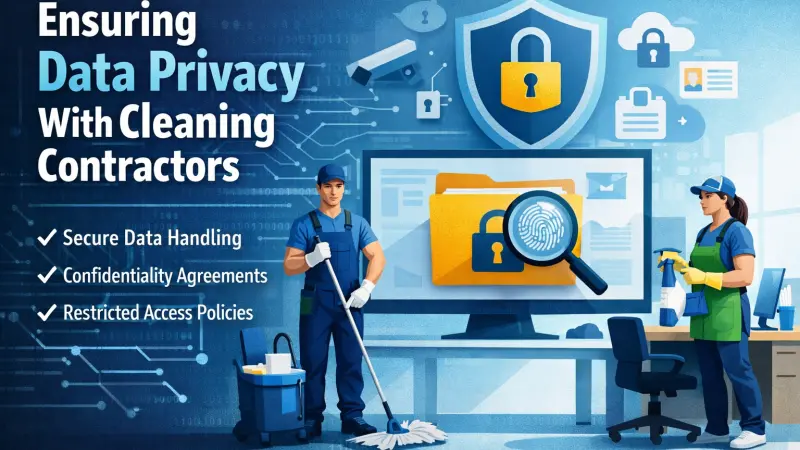
In the modern corporate landscape, data is often a company’s most valuable—and vulnerable—asset. While businesses invest millions in firewalls, encryption, and cybersecurity training, they often overlook a significant physical touchpoint: the cleaning crew. These essential workers have after-hours access to desks, trash bins, server rooms, and executive offices. Without proper protocols, this physical access can lead to unintentional data leaks or security breaches.

Ensuring data privacy with cleaning contractors is not about a lack of trust; it is about establishing professional boundaries and standardized security frameworks. Whether it is a stray document left on a printer or a sticky note with a password, the physical environment is a goldmine for sensitive information. This guide provides an in-depth look at how to integrate cleaning services into your broader data protection strategy, ensuring that your facility remains spotless without compromising your intellectual property.
The Intersection of Physical Maintenance and Information Security
Many organizations view cleaning as a background utility—something that happens when the lights go out and the "real" work is done. However, from a security perspective, janitorial staff are "privileged users" of the physical space. They navigate through every department, often with high-level keycard access that allows them to move through zones that even mid-level employees might be restricted from entering.
Why Data Privacy is a Janitorial Concern
Data privacy isn't just about hackers in dark rooms; it’s about anyone who might inadvertently see, move, or dispose of sensitive material. A cleaning contractor might accidentally move a confidential file to clean a desk surface, or they might dispose of sensitive paperwork that should have been shredded. In highly regulated industries like law, finance, or healthcare, even a momentary lapse in physical security can result in heavy GDPR or HIPAA fines.
Furthermore, the "social" aspect of security cannot be ignored. Cleaners often work during the transition periods of the day. They see who stays late, they know which offices belong to which executives, and they are frequently the ones who find items left behind in meeting rooms. Without a formal privacy framework, these casual observations can accumulate into a significant security risk.
The Evolution of the "Clean Desk" Policy
The "Clean Desk Policy" has evolved from an aesthetic preference to a core security requirement. Ensuring data privacy with cleaning contractors starts with the behavior of the employees who inhabit the office during the day. If employees leave sensitive data exposed, they are essentially making the cleaning crew part of the data-handling chain—a role they are neither trained for nor paid to perform. A robust policy requires that all sensitive documents are locked away at the end of every shift, leaving nothing but bare surfaces for the cleaning team to sanitize.
Benefits of Establishing Privacy Protocols
Implementing strict privacy guidelines for your cleaning team offers several long-term benefits for your organization:
-
Regulatory Compliance: It ensures you meet the physical security requirements of data protection laws and international standards like ISO 27001.
-
Risk Mitigation: It reduces the likelihood of corporate espionage, accidental data loss, or "dumpster diving" where sensitive info is plucked from standard trash.
-
Professional Accountability: Clear guidelines protect the cleaning staff from unfair suspicion if a breach occurs, as their movements and responsibilities are clearly defined.
-
Enhanced Trust: Knowing that every aspect of the office—even the midnight cleaning—is secure fosters a better relationship between management and the janitorial partner.
-
Operational Continuity: Security-trained cleaners are less likely to accidentally unplug a vital server or disturb delicate hardware while dusting.
Step-by-Step: Securing Your Space for Cleaning Crews
1. Vetting and Background Checks
Ensuring data privacy with cleaning contractors begins before the first mop hits the floor. When sourcing a provider, demand proof of comprehensive background checks for all employees. A reputable company should be transparent about their hiring practices, criminal record checks, and how they verify the integrity of their staff.
2. Implementation of Non-Disclosure Agreements (NDAs)
Every individual from the cleaning agency who enters your facility should be covered by a robust confidentiality agreement. This NDA should clearly define what constitutes sensitive information and the legal consequences of mishandling it. Ensure the contract covers not just the company, but every individual operative assigned to your site.
3. Access Control Management and Tiered Security
Never provide a cleaning crew with "master" access if it isn't required. Use tiered access control. If the server room only needs cleaning once a week, the crew’s keycards should only function for that room during a specific window, preferably under the supervision of a security officer.
Modern electronic access systems allow you to audit exactly when a cleaner entered a specific zone and how long they stayed there.
4. Specialized Training for Cleaning Staff
Don't assume a contractor knows your security culture. Provide a brief "security orientation." Teach them to recognize sensitive areas, explain the importance of not touching computer peripherals (to avoid keyloggers or hardware damage), and provide clear instructions on what to do if they find a lost ID badge or a confidential document left in the open.
Essential Tips for Daily Information Protection
To maintain an ironclad security posture, consider these daily habits for your internal team:
-
Use Locked Shred Bins: Ensure all paper waste is deposited into locked consoles rather than open trash cans. The cleaning crew should only be responsible for moving the locked bins to a secure pickup area, never handling the paper inside.
-
Screen Privacy Filters: Encourage employees to use privacy screens that black out monitors from side angles, preventing "shoulder surfing" or accidental viewing of data during after-hours work.
-
No-Touch Zones: Clearly mark certain desks, laboratory benches, or server racks as "No-Touch" areas where cleaners are instructed to avoid cleaning surfaces entirely due to the sensitivity or fragility of the work.
-
Incident Reporting Logs: Create a simple, anonymous system where cleaners can report if they found a door unlocked, a window open, or a computer left logged in. This turns your cleaning crew into an extension of your security team.
-
Whiteboard Sanitization: Ensure all brainstorming sessions are erased or the whiteboards are flipped and locked before the end of the day.
Common Mistakes in Janitorial Security
Avoiding these pitfalls is essential for ensuring data privacy with cleaning contractors:
-
Leaving Passwords Exposed: The "sticky note on the monitor" remains the most common security fail. Cleaners should be instructed to report these to management rather than simply cleaning around them.
-
Treating Cleaners as "Invisible": When staff ignore the presence of cleaners, they tend to speak more freely about confidential matters or leave passwords typed out on screens. Remind employees that cleaners are third-party contractors and should be treated as such.
-
Lack of Communication with the Provider: If you have a high-security event, a sensitive merger happening, or a VIP visit, you must inform the cleaning manager so they can assign their most veteran and vetted staff to those specific areas.
-
Ignoring the "Trash" Trail: Many people think information is safe once it hits the bin. If your cleaning team is mixing sensitive trash with regular waste, you are at risk.
Supporting Local Business Visibility Beyond Core Marketing Efforts
While physical security is paramount, the process of finding a reliable, high-integrity contractor often relies on a different kind of digital footprint. For many service providers, effective directory marketing uk is the primary way they establish their professional standing in the community. When a facility manager searches for a secure cleaning partner, a company's Local Page UK often serves as a critical local discovery aid.
Maintaining a presence on a Local Page UK ensures that the business’s security certifications, vetting procedures, and insurance details are transparent to potential clients. Furthermore, the decision to advertise company uk directory services acts as a supporting visibility layer, helping a business stand out as a legitimate and accountable entity in a crowded market. For contractors, appearing in a free business database directory is a significant credibility signal that reinforces the trust established during the proposal phase.
When an organization monitors company ratings uk within a free business database directory, they are engaging in a form of trust reinforcement across platforms. This local presence consistency is essential for businesses that handle sensitive environments like law firms or clinics.
Ultimately, the choice to advertise company uk directory listings and manage company ratings uk through a Local Page UK helps bridge the gap between a generic service and a trusted security partner. Professional directory marketing uk ensures that the highest-quality, most vetted firms are discoverable by those who value data privacy above all else.
Cleanliness Without Compromise
Ensuring data privacy with cleaning contractors is a vital pillar of a modern security strategy. By shifting the perspective of janitorial services from a simple chore to a managed security risk, businesses can protect their intellectual property while maintaining a world-class environment.
The relationship between a business and its cleaning contractor should be built on transparency, clear documentation, and continuous communication. When you vet your providers through reputable sources and implement the protocols discussed in this guide, you create a culture of security that extends to every corner of your facility. A clean office should never come at the cost of a data breach. Take the time today to review your janitorial contracts, update your employee desk policies, and ensure that your cleaning partner is as committed to your data privacy as you are. Your security is only as strong as its most overlooked link—make sure your cleaning routine is ironclad.
The Hidden Complexity of Digital Trash and Physical Cleanup
As we look toward the future of facility management in 2026, the line between the digital and physical worlds continues to blur. The concept of "Ensuring Data Privacy With Cleaning Contractors" now extends into the realm of hardware disposal and the management of smart office devices.
Smart Offices and IoT Vulnerabilities
Modern offices are filled with Internet of Things (IoT) devices—smart light bulbs, connected thermostats, and automated cleaning robots. Cleaning contractors often interact with these devices, sometimes even using mobile apps provided by the facility to report their progress or open doors. If these apps or devices are not secured with multi-factor authentication, they can become entry points for hackers. Part of a secure cleaning strategy is ensuring that the digital tools used by the janitorial staff are just as secure as the physical locks on the doors.
The Danger of E-Waste and Hardware Retirement
Often, "cleaning the office" involves a periodic purge of old electronics. If a cleaning contractor is mistakenly tasked with removing old monitors, printers, or hard drives as part of a general clear-out, there is a massive risk of data leakage. Many printers and copiers have internal hard drives that store images of every document ever scanned. Ensuring data privacy with cleaning contractors means having a separate, audited process for electronic waste that is entirely distinct from standard trash removal.
Visual Hacking: A Quiet Threat
Visual hacking—the act of capturing sensitive information by sight or photography—is a significant concern during after-hours cleaning. With the high resolution of modern smartphone cameras, a cleaner (or anyone following a cleaner) could take a photo of a whiteboard or a desktop from ten feet away and capture legible confidential data. This is why "Whiteboard Clearance" and "Clear Screen" rules must be added to the end-of-day checklist for all employees.
Building a Security Partnership
The most successful organizations don't treat their cleaning contractors as a threat to be managed, but as a partnership to be cultivated. When cleaners are treated with respect and integrated into the company's safety culture, they take pride in their role as protectors of the workspace. This "human firewall" is often more effective than the most expensive security software. By investing in the training and vetting of your cleaning team, you are not just buying a service; you are building a more resilient, secure, and professional business environment.
Final Considerations for 2026
As automation increases, you may find yourself managing robotic cleaners alongside human crews. These robots collect data—maps of your office, usage patterns, and sometimes even video. Ensuring data privacy now requires checking the data-storage policies of the companies that manufacture and service these robots. Who has access to the "map" of your executive suite stored in the cloud? In the end, privacy is about vigilance at every level, from the high-tech firewall to the low-tech mop bucket. Reach out to your provider today to ensure your security standards are being met after the sun goes down.
FAQs
1. Should I allow cleaners to have physical keys to my office?
It is generally safer to use electronic keycards that track the time of entry and exit. If physical keys must be used, they should be stored in a secure, audited lockbox on-site that requires a code to open.
2. How do I know if a cleaning company actually performs background checks?
Request a written copy of their vetting policy. You can also ask for a letter of confirmation from their third-party screening provider. Transparency in this area is a hallmark of a professional firm.
3. Is it okay to use a cleaning company that uses subcontractors?
Subcontracting can make ensuring data privacy with cleaning contractors difficult, as you lose a direct line of accountability and vetting control. It is much safer to work with companies that employ their staff directly.
4. What should a "Security-First" cleaning contract include?
It should include an NDA, a prohibition on photography and mobile phone use in sensitive areas, a description of the vetting process, and specific protocols for handling sensitive waste or found items.
5. How often should I audit the cleaning crew’s security performance?
Quarterly audits are recommended. This involves checking that "No-Touch" zones are respected and ensuring that access cards are being used only by the authorized individuals.
6. Can cleaners be trained to help with data security?
Yes. Cleaners can be trained to look for "red flags" such as unlocked cabinets or unattended visitors, effectively acting as an extra set of eyes for your security team.
7. What is the biggest risk cleaners pose to data?
The biggest risk is usually "Social Engineering"—where an unauthorized person follows a cleaner into a building (tailgating). Cleaners must be trained never to hold the door for people they don't recognize.
8. Should we use CCTV to monitor cleaning activities?
In high-security zones, CCTV is a standard deterrent. However, it should be used transparently and in accordance with local privacy laws to maintain a positive relationship with the crew.
9. How do we handle cleaning in a server room?
Server rooms should only be cleaned under supervision or by a crew that has received specialized training in avoiding delicate cables, anti-static protocols, and hardware safety.
10. What happens if a cleaner finds a flash drive or sensitive document?
They should be instructed to place it in a designated "Secure Lost & Found" box and immediately notify the site manager or security lead, rather than leaving it on a desk where it might be seen.

Disclaimer: The information provided in this article is for general informational and research purposes only. Company details, features, services, and market positions may change over time. Readers are advised to visit official company websites and conduct independent research before making any business decisions or purchasing services.
Most Searchable Keywords

Recent Blogs



Related Listings
-

Platinum Exterior Cleaning
-
End of Tenancy Cleaning Agency
-
Royal Cleaning
-
FastKlean
-
Fantastic Services



Categories
- Accountants (295)
- Advertising Agencies (559)
- Architects (149)
- Automobiles (376)
- Beauty (300)
- Carpenters (146)
- Cleaning Services (386)
- Dentists (189)
- Driving (61)
- Electricians (215)
- Energy (8)
- Event Organiser (684)
- Finance (598)
- Guide (3363)
- Health (2205)
- Information technology (206)
- Legal Services (352)
- Logistics (6)
- Maintenance (65)
- Manufacturing (35)

Sponsored Listings in Cleaning Services

Related Blogs

Bristol Firework Displays Every Local Should...
Read this insightful article "Bristol Firework Displays Every Local Should Experience" to expand your knowledge!

Self Assessment Registration 2026 Common Erro...
Read this insightful article "Self Assessment Registration 2026 Common Errors and Rules" to expand your knowledge!

Calculate Your 2026 Employer National Insuran...
Read this insightful article "Calculate Your 2026 Employer National Insurance Bill Easily" to expand your knowledge!
Questions & Answers – Find What
You Need, Instantly!
How can I update my business listing?
Is it free to manage my business listing?
How long does it take for my updates to reflect?
Why is it important to keep my listing updated?
