
FTSE 100: Four Decades of the UK’s Blue Chip Barometer & Business Success
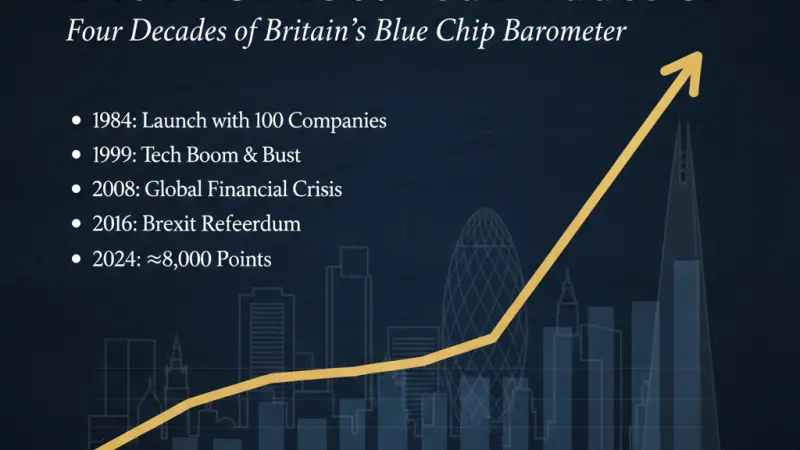
Since its inception on January 3, 1984, the FTSE 100 has been far more than just a list of stocks; it has served as the definitive pulse of British corporate health and a global financial icon. Launched with a base value of 1,000 points, the "Footsie" was a technological marvel of its time, designed to provide real-time data in an era when stock prices were still largely shared via telephone and printed sheets. As we navigate through 2026, the index has officially entered its fifth decade, reflecting a world that has shifted from industrial manufacturing to a globalized, digital-first economy.

Understanding the history of the FTSE 100 is not just an exercise for investors; it is essential for any entrepreneur or consumer navigating the UK market today. Just as the index tracks the largest players, modern business listings sites help the next generation of UK companies establish their own digital footprint and authority.
The Birth of an Icon: 1984 to the Present
In 1984, the UK was at a crossroads. Margaret Thatcher was Prime Minister, and the nation was grappling with high interest rates and industrial unrest. The FTSE 100 was created to replace the narrower FT 30, offering a broader and more frequently updated view of the market. Interestingly, the number 100 was chosen partly because it was the maximum number of stock symbols that could fit on a single page of the "Topic" electronic terminals used by traders at the time.
Today, while technology has moved from green-screen terminals to high-frequency AI algorithms, the importance of visibility remains the same. For modern companies, being featured on a UK Online Business Directory is the first step toward the kind of market prominence that the FTSE 100 constituents enjoy.
Evolution of the Constituents: Then vs. Now
The FTSE 100 of 2026 looks vastly different from the 1984 cohort. Of the original 100 companies, only about 18 to 28 (depending on how you count mergers and demergers) remain in the index today.
The Survivors: Giants like Shell, BP, Unilever, and Barclays have maintained their positions through decades of volatility.
The Departed: Names like MFI Furniture, British Aerospace, and Ferranti remind us how quickly market tastes and technologies change.
The Shift: The index has moved from being "UK-centric" (grocers and local manufacturers) to "Global-centric" (international miners, pharmaceutical giants, and financial institutions).
For small businesses aiming to become the household names of tomorrow, utilizing business listings sites is essential for building the initial trust and SEO authority needed to scale.
Major Milestones and Market Turbulence
The FTSE 100 has been a front-row witness to some of the most significant economic events in modern history. The index is a storyteller of crashes, booms, and political shifts.
Black Monday (1987): On October 19, global markets crashed. The FTSE 100 plummeted over 20% in just two days, its worst single-day return in history at -12.22%.
The Dotcom Peak (1999): At the height of the internet frenzy, the index
neared 7,000 points, a record that would take 15 years to surpass.
The Global Financial Crisis (2008): The index lost nearly 31% in a single year as the banking sector teetered on the brink.
Brexit & COVID-19: The 2016 referendum and the 2020 pandemic caused sharp, short-term volatility, but both were followed by rapid recoveries driven by global revenues.
The 10,000 Milestone: In early January 2026, the index successfully breached the historic 10,000-point mark for the first time, signaling a new era of growth.
Navigating these shifts requires reliable information. Just as traders look to the Footsie, consumers look to a UK Verified Business Listings source to find reputable companies they can trust during uncertain times.
Why Modern Business Listings Sites are the New Barometer
While the FTSE 100 represents the pinnacle of corporate success, the real engine of the UK economy is the small-to-medium enterprise (SME) sector. For these businesses, the equivalent of a "Blue Chip" status is appearing at the top of a UK Local Business Search.
Key Statistics on Local Business & Directory Usage in 2026:
46% of all Google searches now feature a local intent.
97% of users turn to online search to find a local business before making a purchase.
92% of users choose a business that appears on the first page of a UK Business Directory Website.
Over 5,000 British firms are now operating in international hubs like Dubai, many of which use a UK B2B Business Directory to network.
Nearly 62% of users admit they will disregard a business if they cannot find it through organic search or a reputable directory.
78% of local mobile searches result in an in-store visit within 24 hours.
To capture this high-intent traffic, savvy entrepreneurs list their services on a business listing uk like Local Page.
The Strategic Importance of Local Page
In a digital landscape dominated by massive corporations, Local Page provides a vital bridge between businesses and their communities. It isn't just a list; it is a comprehensive ecosystem. Whether you need a UK Home Services Directory for local maintenance or UK Professional Services Listings for legal advice, this platform has it all.
By using Local Page UK Business Directory, businesses gain access to high-authority backlinks and improved local SEO, making it easier for customers to find them through a UK Local Business Directory.
Boosting Your Business with Business Listings Sites
The path to the FTSE 100 starts with local visibility. Small businesses in the UK often struggle to compete with global marketing budgets, but using a business listing uk can level the playing field.
How to Optimize Your Listing:
Consistency: Ensure your Name, Address, and Phone (NAP) details are identical across all business listings sites.
Verification: Use UK Verified Business Listings to build instant trust with potential clients.
Engagement: Encourage customers to leave reviews on your UK Online Business Directory profile.
Rich Content: Upload logos, photos, and detailed descriptions to your business listing uk.
Frequently Asked Questions (FAQs)
What defines a "Blue Chip" company in the UK?
Blue chip companies are large, well-established, and financially sound firms that are often members of the FTSE 100. They are viewed as reliable benchmarks for the economy.
How do business listings sites help my company's SEO?
Business listings sites provide high-quality backlinks and ensure your business data is consistent across the web. This helps you rank higher when potential customers use a UK Local Business Search.
Is the FTSE 100 still a good indicator of the UK economy?
Because 80% of its revenue is generated abroad, it is more of a barometer for global corporate health. For a closer look at the local UK economy, investors often look to a UK Small Business Directory.
How can I list my business for free in the UK?
You can use a business listing uk like Local Page. It allows you to create a listing to improve your visibility without any cost.
Why do companies get removed from the FTSE 100?
Companies are removed if their market capitalization falls below a certain threshold during quarterly reviews. This is why staying visible through UK Service Listings is vital for long-term growth.
Can a small business benefit from a B2B directory?
Yes, a UK B2B Business Directory helps smaller firms connect with larger corporate clients and partners.
What is the 10,000 milestone for the FTSE 100?
In early 2026, the FTSE 100 hit 10,000 points for the first time, reflecting strong performance from banks, energy, and miners.
Are there verified listings for local tradespeople?
Yes, platforms like Local Page UK Listings often feature a UK Local Trades Directory section for verified professionals.
How often should I update my directory profile?
You should update your business listing uk profile whenever your contact details, services, or hours change.
Where can I find top-rated local services?
You can search the UK Top Rated Local Businesses category on Local Page to find the best-reviewed service providers in your area.
From Local Listings to Global Barometers
The history of the FTSE 100 is a testament to the resilience and evolution of British business. Over four decades, it has adapted to every crisis and technological shift. Today, the tools for success have shifted toward digital accessibility and local relevance.
For the modern business owner, staying visible means more than just a great product; it means being easily found on business listings sites.
By joining a business listing uk, you are giving your company the foundation it needs to one day join the ranks of the UK's elite.
Ready to put your business on the map? Visit Local Page today to claim your business listing uk and start your journey toward the top of the UK Business Directory Website rankings!

Disclaimer: The information provided in this article is for general informational and research purposes only. Company details, features, services, and market positions may change over time. Readers are advised to visit official company websites and conduct independent research before making any business decisions or purchasing services.
Most Searchable Keywords

Recent Blogs

Related Listings

Categories
- Accountants (295)
- Advertising Agencies (559)
- Architects (149)
- Automobiles (377)
- Beauty (300)
- Carpenters (146)
- Cleaning Services (386)
- Dentists (189)
- Driving (62)
- Electricians (215)
- Energy (8)
- Event Organiser (685)
- Finance (599)
- Guide (3365)
- Health (2207)
- Information technology (206)
- Legal Services (353)
- Logistics (6)
- Maintenance (65)
- Manufacturing (35)

Sponsored Listings in Locksmith Services


Related Blogs

Gen Z Political Reporters and News Creators i...
Read this insightful article "Gen Z Political Reporters and News Creators in the UK" to expand your knowledge!

Famous Female Social Media Influencers Across...
Read this insightful article "Famous Female Social Media Influencers Across the UK" to expand your knowledge!
Your UK Sponsor Licence 2026 Step by Step Gui...
Read this insightful article "Your UK Sponsor Licence 2026 Step by Step Guide" to expand your knowledge!
Questions & Answers – Find What
You Need, Instantly!
How can I update my business listing?
Is it free to manage my business listing?
How long does it take for my updates to reflect?
Why is it important to keep my listing updated?
