
High-Ticket Dropshipping Strategy Quality Over Quantity
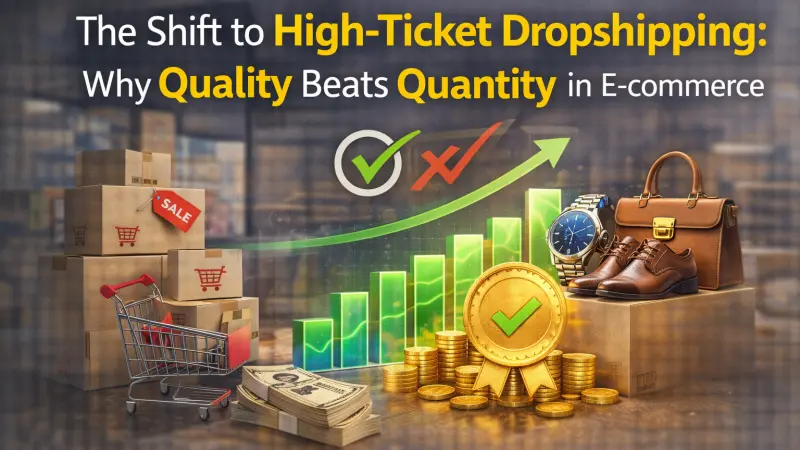
Imagine making $1,500 in profit from a single sale rather than grinding through 300 transactions just to hit the same number. That is exactly what a smart high-ticket dropshipping strategy can deliver. More entrepreneurs are ditching the race-to-the-bottom model of cheap, high-volume selling and moving toward premium products that pay more per order, attract better customers, and build stronger brands. If you have been wondering whether this model is right for you, this guide breaks it all down — plainly and practically.

Why the Old Dropshipping Playbook Is Breaking Down
The traditional dropshipping model — find a cheap product, slap it on a store, run Facebook ads, repeat — worked brilliantly around 2016. Today, it is a crowded, expensive, and exhausting arena. Ad costs have surged dramatically, with the average cost-per-click on Facebook rising by over 89% between 2019 and 2024. Meanwhile, consumers have become far more skeptical of generic stores selling unbranded goods with 4-to-6-week shipping windows.
According to a 2023 Statista report, global e-commerce sales surpassed $5.8 trillion, yet profit margins for low-ticket dropshippers continue to compress as competition intensifies. Selling a $12 phone case and pocketing $2 in margin is no longer a viable long-term business. Something had to change — and high-ticket dropshipping is that change.
What Exactly Is High-Ticket Dropshipping?
High-ticket dropshipping is a business model where you sell premium, higher-priced products — typically ranging from $500 to $10,000 or more — without holding any inventory. You partner with reputable suppliers or manufacturers, list their products on your store, and when a customer orders, the supplier ships directly to them.
The key difference from traditional dropshipping is the price point and the supplier quality. You are not sourcing from random overseas warehouses. You are working with established, often domestic, suppliers who carry furniture, fitness equipment, outdoor gear, commercial appliances, art, or specialty tools.
A simple breakdown of how it works:
- You build a niche store focused on a premium product category
- You establish wholesale or authorized dealer agreements with quality suppliers
- A customer places an order on your store
- You forward the order to the supplier at wholesale cost
- The supplier ships to the customer, often with white-label packaging
- You pocket the difference as profit
Why Quality Beats Quantity: The Core Argument
The math alone makes a compelling case. If your average profit per sale is $800 versus $8, you need 100 times fewer sales to hit the same revenue target. That means less customer service volume, fewer refund headaches, and less ad spend spread thin across hundreds of micro-transactions.
Research from McKinsey shows that premium and luxury e-commerce grew at nearly 3x the rate of mainstream e-commerce between 2020 and 2023. Customers buying high-value products tend to research more, make more deliberate purchasing decisions, and — when satisfied — become loyal advocates for your brand.
Here is why quality wins in the long run:
- Higher profit margins — typically 20–40% compared to 5–15% in low-ticket dropshipping
- Lower return rates — customers who spend $2,000 on a product tend to be more informed buyers
- Less competition — fewer sellers are willing to do the work to enter premium niches
- Better customer relationships — high-ticket buyers value service, which gives you a relationship to build on
- Stronger brand credibility — associating with quality products elevates your store's reputation
Choosing the Right Niche for a High-Ticket Strategy
Not every expensive product is a smart play. The best niches for a high-ticket dropshipping strategy combine healthy demand, manageable competition, and suppliers willing to work with independent retailers.
Strong performing high-ticket niches include:
- Home office furniture and ergonomic equipment
- Outdoor and camping gear (kayaks, high-end tents, solar equipment)
- Fitness equipment (commercial treadmills, home gyms)
- Pet accessories and luxury pet furniture
- Specialty tools and industrial equipment
- Art and home décor
- Electric bikes and scooters
How to validate a niche before committing:
- Check Google Trends to see if interest is stable or growing
- Analyze competitor stores using tools like SimilarWeb or SEMrush
- Search for suppliers on platforms like Wholesale Central, SaleHoo, or directly via Google
- Estimate the total addressable market using keyword research data
- Confirm the average order value supports healthy profit margins after ad spend
A good rule of thumb: if a product sells for $800 or more and has
a recognizable brand or category associated with it, it is worth investigating further.
Finding and Vetting Reliable Suppliers
This is where high-ticket dropshipping demands more effort than the low-ticket version — and that is actually a feature, not a bug. The barrier to entry filters out lazy competitors.
When approaching suppliers, professionalism matters immediately. Have a proper business entity set up, a polished website, and a clear value proposition for why they should work with you. Many established brands actually prefer working with smaller, focused online retailers who can represent their products well.
What to look for in a high-ticket supplier:
- Clear return and warranty policies
- Fast and reliable domestic shipping (2–7 business days is ideal)
- Willingness to provide product images, specs, and descriptions
- A track record with other resellers
- No minimum order quantity requirements for dropshippers
According to a 2022 Shopify survey, 84% of e-commerce entrepreneurs say finding reliable suppliers is their single biggest challenge. Investing time here pays dividends across every other part of your business.
Building a Store That Converts Premium Buyers
A high-ticket customer does not buy impulsively. They read, compare, question, and evaluate trust signals carefully. Your store must reflect the premium nature of what you are selling.
Must-have trust elements for a high-ticket store:
- Professional, clean design with fast load times
- Detailed product descriptions that answer every possible question
- High-resolution product images and, ideally, video walkthroughs
- Transparent return, warranty, and shipping policies
- Live chat or phone support availability
- Customer reviews and testimonials (especially for the specific product)
- Security badges and clear payment options
One important insight: studies show that 88% of online shoppers won't return to a website after a bad user experience. For high-ticket items where a single bounce costs you potentially $600+ in potential profit, investing in your site experience is non-negotiable.
Marketing a High-Ticket Dropshipping Business
You do not need massive traffic to succeed with high-ticket products — you need the right traffic. This fundamentally changes how you approach marketing.
Effective channels for high-ticket dropshipping:
Search Engine Optimization (SEO) — Buyers of premium products often do significant research before purchasing. Ranking for long-tail keywords like "best commercial treadmill for home gym" or "ergonomic standing desk under $1500" drives highly qualified, purchase-ready traffic with no ongoing ad cost.
Google Shopping Ads — High-ticket buyers frequently use Google Shopping to compare options. A well-optimized product feed here converts efficiently because the buyer is already in decision mode.
Content Marketing — Blog posts, buying guides, and comparison articles position your store as an authority. A guide titled "How to Choose the Right Kayak for Beginners" builds trust and captures traffic throughout the customer's research journey.
Email Marketing — The sales cycle for a $2,000 product can be days or weeks.
Building an email list and nurturing leads with helpful content significantly improves conversion rates.
YouTube and Video Reviews — Video content drives purchasing confidence for expensive items. A thorough product walkthrough can be the final push a hesitant buyer needs.
According to HubSpot, businesses that prioritize blogging are 13 times more likely to achieve a positive marketing ROI. For high-ticket dropshippers, content is not optional — it is infrastructure.
Common Challenges and How to Solve Them
Every business model has friction points. High-ticket dropshipping is no different, but the challenges are manageable when you understand them upfront.
Challenge 1: Longer Sales Cycles Buyers spending thousands of dollars take their time. Solution: Invest in email nurture sequences, retargeting ads, and live chat to stay present during their decision window.
Challenge 2: Supplier Relationship Management Unlike low-ticket wholesale platforms, high-ticket suppliers require active relationship management. Solution: Communicate regularly, ask for exclusive territory agreements, and follow up on orders proactively.
Challenge 3: Handling Returns and Damage Claims Large items like furniture or gym equipment sometimes arrive damaged. Solution: Have a crystal-clear process documented in advance, and always work with suppliers who carry freight insurance.
Challenge 4: Cash Flow Timing Some suppliers require payment before the customer's payment clears. Solution: Establish net-30 payment terms when possible or maintain a working capital buffer for order processing.
The Future of High-Ticket E-commerce
The trajectory is clear. As consumer trust in online shopping for large purchases grows, the high-ticket market will continue to expand. A 2024 forecast from eMarketer projects that online sales of products priced above $500 will grow by 22% annually through 2027.
Emerging technologies are also reshaping the landscape. Augmented reality (AR) tools now let shoppers virtually place furniture or fitness equipment in their homes before buying, dramatically reducing purchase hesitation for high-ticket items. Brands like IKEA and Wayfair have already demonstrated that AR increases purchase intent by up to 40%.
Personalization at scale is another accelerating trend. Stores that use customer data to tailor recommendations and follow-up communication will hold a significant advantage in high-ticket categories where the relationship between seller and buyer is more personal and trust-dependent.
Quick-Start Action Plan
If you are ready to begin, here is a focused starting framework:
- Choose one niche based on your interest, market demand, and supplier availability
- Register a business entity (LLC is standard in the US) and obtain a reseller certificate
- Build a professional Shopify or WooCommerce store with premium theme and trust elements
- Identify and contact 5–10 suppliers to apply for dealer or wholesale accounts
- Load 10–20 products with full descriptions, specifications, and images
- Set up Google Analytics, Google Search Console, and a basic SEO strategy
- Launch Google Shopping Ads with a modest budget to test product-market fit
- Begin producing content (buying guides, comparisons) for organic search traffic
- Install a live chat tool and set up an email capture with a nurture sequence
- Review performance weekly and double down on what is working
The shift from low-ticket to high-ticket dropshipping is not just a trend — it is a strategic evolution driven by economics, consumer behavior, and market maturity. Fewer sales, higher margins, better customers, and stronger brand positioning make the high-ticket model a compelling alternative for entrepreneurs serious about building a sustainable online business. The work is real, the bar is higher, but so is the reward.
Things People Want to Know
1. What is high-ticket dropshipping? High-ticket dropshipping is a business model where you sell premium products priced typically above $500 without holding inventory. Suppliers ship directly to your customers, and you earn the difference between the wholesale and retail price.
2. How much can I realistically earn with high-ticket dropshipping? Earnings vary widely, but many established high-ticket dropshippers earn between $5,000 and $50,000 per month in profit. A single sale can generate $500 to $3,000 in margin depending on the product and niche.
3. Do I need a lot of money to start? You do not need inventory capital, but you should budget for website development, initial advertising, and business setup costs. A realistic starting budget ranges from $1,000 to $3,000.
4. What products work best for high-ticket dropshipping? Strong categories include furniture, fitness equipment, outdoor gear, specialty tools, electric bikes, and luxury home goods. The best products solve a clear need and have strong brand recognition.
5. How do I find suppliers for high-ticket products? Search Google for manufacturers or wholesale distributors in your niche, explore directories like Wholesale Central or SaleHoo, and attend industry trade shows where brands actively seek retail partners.
6. Is high-ticket dropshipping legal? Yes, it is completely legal. You operate as an authorized reseller for your suppliers. Ensure you have proper business registration, a reseller certificate, and agreements with each supplier.
7. How long does it take to make the first sale? With paid advertising (Google Shopping), some sellers make their first sale within 2–4 weeks. With an SEO-only approach, expect 3–6 months before seeing consistent organic traffic.
8. Do high-ticket customers really buy online? Absolutely. Consumer comfort with large online purchases has grown significantly. Studies show that over 60% of shoppers now feel comfortable purchasing items above $1,000 online, up from just 30% a decade ago.
9. How do I handle customer service for expensive products? Offer responsive live chat, phone support, and clear written policies. Being proactive — sending shipping updates and checking in post-delivery — significantly reduces disputes and increases reviews.
10. What is the biggest mistake beginners make in high-ticket dropshipping? Rushing to launch with a poorly built store and unverified suppliers. High-ticket buyers scrutinize trust signals carefully. Invest in your store's professionalism and supplier relationships before spending on advertising.
11. Can I run a high-ticket dropshipping business part-time? Yes, especially in the early stages. The lower order volume compared to low-ticket dropshipping makes it more manageable alongside other commitments, though growth will require more dedicated time as the business scales.
12. What platforms are best for building a high-ticket store? Shopify is the most popular option due to its ease of use and app ecosystem. WooCommerce on WordPress is another strong choice, offering more customization for content-heavy, SEO-focused strategies.
13. How important is SEO for high-ticket dropshipping? Extremely important. High-ticket buyers are researching extensively before purchasing. Ranking for niche-specific keywords drives free, high-intent traffic that converts well without ongoing ad spend.
14. What profit margins should I expect? High-ticket dropshipping typically yields margins of 20–40% per sale. On a $2,000 product, that translates to $400–$800 profit per transaction, compared to a few dollars on typical low-ticket items.
15. Can I scale a high-ticket dropshipping business long-term? Yes. Many entrepreneurs transition from dropshipping to holding limited inventory of their best sellers, building private-label versions of top products, or acquiring other stores in their niche — all leveraging the brand authority and supplier relationships built through dropshipping.
The e-commerce landscape rewards focus, quality, and smart positioning more than ever before. A well-executed high-ticket dropshipping strategy gives you the ability to build a business that generates meaningful income without the relentless grind of high-volume, low-margin selling.
From choosing the right niche to building a trustworthy store and cultivating reliable supplier partnerships, every element of this model is designed for sustainability and growth.
The opportunity is real, the timing is right, and the path is clearer than most beginners realize. Start with one niche, commit to quality at every step, and let the economics of premium products do the heavy lifting for you.

Disclaimer: The information provided in this article is for general informational and research purposes only. Company details, features, services, and market positions may change over time. Readers are advised to visit official company websites and conduct independent research before making any business decisions or purchasing services.
Most Searchable Keywords
Recent Blogs


Related Listings


Categories
- Accountants (295)
- Advertising Agencies (559)
- Architects (149)
- Automobiles (377)
- Beauty (300)
- Carpenters (146)
- Cleaning Services (386)
- Dentists (189)
- Driving (62)
- Electricians (215)
- Energy (8)
- Event Organiser (685)
- Finance (599)
- Guide (3365)
- Health (2207)
- Information technology (206)
- Legal Services (353)
- Logistics (6)
- Maintenance (65)
- Manufacturing (35)

Sponsored Listings in Locksmith Services


Related Blogs

Gen Z Political Reporters and News Creators i...
Read this insightful article "Gen Z Political Reporters and News Creators in the UK" to expand your knowledge!

Famous Female Social Media Influencers Across...
Read this insightful article "Famous Female Social Media Influencers Across the UK" to expand your knowledge!
Your UK Sponsor Licence 2026 Step by Step Gui...
Read this insightful article "Your UK Sponsor Licence 2026 Step by Step Guide" to expand your knowledge!
Questions & Answers – Find What
You Need, Instantly!
How can I update my business listing?
Is it free to manage my business listing?
How long does it take for my updates to reflect?
Why is it important to keep my listing updated?
