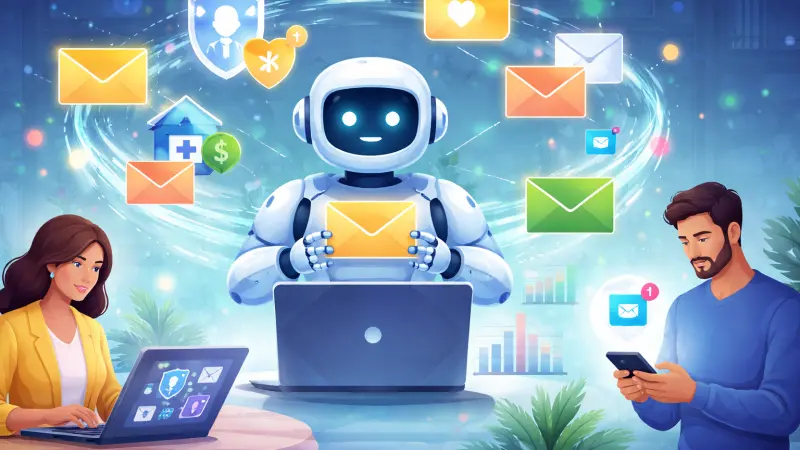
Have you ever wondered why some insurance providers seem to reach out with the exact coverage you need, precisely when you need it? The answer rarely lies in coincidence; instead, it is found in the sophisticated application of Artificial Intelligence (AI). In the contemporary UK insurance landscape, the traditional 'spray and pray' approach to digital outreach is rapidly becoming obsolete. As consumer expectations for relevance increase, AI has emerged as the definitive tool for customising email marketing for insurance prospects, transforming cold data into meaningful, high-value conversations that respect the recipient's time and specific financial circumstances.
The Evolution of Digital Outreach in the Insurance Sector
The journey of insurance marketing in the United Kingdom has transitioned from local high-street brokers to massive digital aggregators, and now, to the era of hyper-personalisation. AI serves as the engine for this latest shift, allowing firms to process vast quantities of data to understand prospect behaviour. By leveraging machine learning algorithms, insurers can now predict which life events—such as moving house, starting a family, or purchasing a new vehicle—are likely to trigger a need for specific insurance products. This proactive stance ensures that email communications are not viewed as intrusive spam, but rather as helpful, timely resources that assist in risk management and financial planning.
Furthermore, the integration of AI allows for a level of segmentation that was previously impossible. Instead of broad categories like 'homeowners' or 'drivers', AI enables 'segments of one'. It analyses historical interaction data, website browsing patterns, and even external economic factors to tailor the tone, imagery, and offer within a single email. For a young professional in London looking for contents insurance, the AI might choose a fast-paced, mobile-optimised format with a focus on gadget cover. Conversely, for a retiree in the Cotswolds, the system might prioritise a detailed, long-form layout highlighting reliability and comprehensive heritage home protection, ensuring the message resonates deeply with the individual's specific lifestyle and values.
Leveraging Predictive Analytics for Timely Engagement
One of the most significant advantages of using AI in email marketing is the ability to utilise predictive analytics. Insurance is inherently a product of 'the future'—it is a promise of protection against potential events. AI algorithms can analyse the 'Next Best Action' for a prospect by evaluating their current portfolio and identifying gaps. For instance, if a prospect has recently searched for information regarding business liability on a firm's website, the AI can automatically trigger an educational email series regarding professional indemnity. This ensures that the insurance provider remains top-of-mind during the critical research phase of the buyer's journey, providing value before a sale is even attempted.
In addition to content, timing is a critical factor that AI optimises with surgical precision. 'Send-time optimisation' (STO) is a feature of AI-driven platforms that determines when a specific individual is most likely to open and engage with their inbox. Rather than sending a mass blast at 9:00 AM on a Monday, the AI might deliver an email to one prospect at 7:30 PM on a Tuesday because that is when they historically check their personal messages. By respecting these individual habits, insurance firms significantly improve their open rates and reduce the likelihood of their communications being ignored or moved to the bin, thereby maximising the return on their digital marketing investment.
The Role of Natural Language Processing in Copywriting
Natural Language Processing (NLP) is a branch of AI that allows machines to understand and generate human-like text. In the context of insurance email marketing, NLP is used to craft subject lines and body copy that trigger positive psychological responses. AI tools can test thousands of variations of a subject line in real-time to see which resonates best with a UK audience.
Whether it is a focus on 'peace of mind', 'financial security', or 'premium savings', the AI learns which linguistic triggers are most effective for different demographics, ensuring that the initial hook of the email is as compelling as possible.
Readability is another crucial area where AI contributes to quality. Insurance can often be a complex subject, filled with jargon and 'legalese' that can alienate prospects. AI-powered writing assistants help marketers simplify their language, ensuring that the benefits of a policy are communicated clearly and concisely. By removing fluff and unnecessary technical terms, the content becomes more accessible. This transparency builds trust—a vital currency in the insurance industry. When a prospect feels they truly understand what is being offered, they are far more likely to engage with the call to action and move further down the conversion funnel.
Key Benefits of AI Integration in Email Strategy
- Enhanced Personalisation: Delivering content that reflects the specific needs and life stage of each prospect.
- Improved Conversion Rates: Using data-driven insights to present the right offer at the right time.
- Operational Efficiency: Automating repetitive tasks, allowing marketing teams to focus on high-level strategy.
- Data-Driven Decisions: Moving away from guesswork and basing campaigns on hard evidence and predictive modelling.
- Scalability: Managing thousands of individual relationships simultaneously without a loss in message quality.
Automated Journey Mapping and Lifecycle Marketing
The insurance lifecycle is often long, spanning decades of a customer’s life. AI facilitates the creation of automated 'journeys' that nurture a prospect from their first interaction through to renewal and beyond. For example, a prospect who requests a quote but does not buy can be entered into a 're-engagement' sequence. The AI monitors their interactions; if they return to the site three months later, the system can automatically send a follow-up email with an updated quote or a helpful guide on 'What to Look for in a Policy'. This level of persistence, handled automatically, ensures that no lead is ever truly 'lost' due to simple forgetfulness or timing issues.
Moreover, AI helps in identifying 'churn' risks before they happen. By monitoring engagement levels—such as a sudden drop in email opens or clicks—the AI can flag a prospect or existing client as being at risk of moving to a competitor. The system can then automatically deploy a 'loyalty' email, perhaps offering a policy review or an educational piece on new features added to their coverage. This proactive maintenance of the relationship is far more cost-effective than trying to acquire a new customer from scratch. In the UK market, where competition is fierce and price-comparison sites are prevalent, this AI-driven loyalty can be a significant competitive advantage.
Ethical Considerations and Data Privacy in the UK
While AI offers incredible power, it must be balanced with the strict data privacy regulations in the United Kingdom, specifically the UK GDPR. Customising email marketing requires the collection and processing of personal data, which must be handled with the utmost transparency and security. AI systems used by insurers must be designed with 'privacy by design' principles, ensuring that data is only used for the purposes for which it was collected. Prospects must have clear options to opt-in and out of communications, and the AI should be used to honour these preferences instantly across all platforms.
Ethical AI also involves ensuring that algorithms are not creating biased outcomes. In insurance, it is vital that AI does not unfairly penalise certain groups based on flawed data sets. Leading UK insurers are increasingly investing in 'Explainable AI' (XAI), which allows humans to understand how a machine reached a specific conclusion or recommendation. By maintaining human oversight and ensuring the AI's logic is transparent, firms can provide personalised experiences that are not only effective but also fair and compliant with the highest ethical standards of the financial services industry.
Practical Examples of AI Customisation in Action
To understand the impact of AI, consider a UK-based motor insurance provider. Traditionally, they might send a generic renewal reminder 30 days before a policy expires. With AI, the process is far more nuanced. The AI might notice that the prospect has recently started working from home more often based on their telematics data. The resulting email could suggest a 'pay-per-mile' option, showing that the insurer has noticed their changing lifestyle and is offering a way to save money. This practical application of data creates a sense of being 'looked after', which is the hallmark of modern customer service.
Another example involves life insurance. A prospect might download a guide on 'Planning for your First Child'. The AI identifies this intent and begins a drip-feed of informational content over several months, covering topics like education savings and family protection.
By the time the prospect is ready to buy, the insurer has established itself as an authority and a partner in the prospect’s new life stage. This long-term, value-focused approach is made possible only through the automation and intelligence provided by AI, allowing the firm to scale empathy across their entire prospect database.
Frequently Asked Questions
How does AI improve email open rates for insurance companies?
AI improves open rates by using send-time optimisation to deliver emails when a prospect is most likely to check their inbox. Additionally, it uses Natural Language Processing to craft more engaging and relevant subject lines based on historical performance data.
Is AI-driven marketing compliant with UK GDPR?
Yes, provided the insurance firm follows strict data processing protocols. AI can actually assist with compliance by ensuring that opt-out requests are processed instantly and that data usage remains within the boundaries of the prospect's consent.
Does AI replace human marketers in the insurance industry?
No, AI is a tool that enhances the capabilities of human marketers. It handles the data-heavy tasks of segmentation, timing, and testing, allowing human professionals to focus on creative strategy, ethical oversight, and high-level brand positioning.
Can AI help in reducing the cost of insurance lead generation?
Absolutely. By targeting prospects with higher precision and automating the nurturing process, AI reduces the amount of wasted spend on uninterested audiences and increases the conversion rate of existing leads.
What kind of data does AI need to customise insurance emails?
AI typically uses a mix of first-party data (like website visits and previous email interactions), demographic information, and sometimes third-party data regarding life events or economic trends to create a complete prospect profile.
Is AI-personalised email marketing only for large insurance firms?
While large firms were early adopters, many AI marketing tools are now accessible to smaller brokers and niche insurers,
allowing them to compete on a more level playing field by providing a high-quality, personalised service.
The integration of AI into email marketing represents a fundamental shift in how the insurance industry connects with the public. By focusing on relevance, timing, and educational value, insurers can move away from being seen as a grudge purchase and toward being viewed as a trusted financial partner. As AI technology continues to evolve, we can expect even deeper integrations, perhaps with voice assistants and real-time risk assessment, further blurring the lines between marketing and proactive protection. For businesses looking to enhance their reach, maintaining an accurate presence in a Local Page UK listing can be a vital step. Using a free business search directory or a free company search directory ensures that your firm is discoverable. For those seeking to broaden their reach, adding your details to a verified business directory is an excellent way to ensure your company directory online presence is robust. Ultimately, improving online visibility through a company directory online is about ensuring that when your AI-driven marketing sparks interest, your prospects can easily find and verify your business credentials.