
How Digital Marketing Drives Leads for Home Automation Services
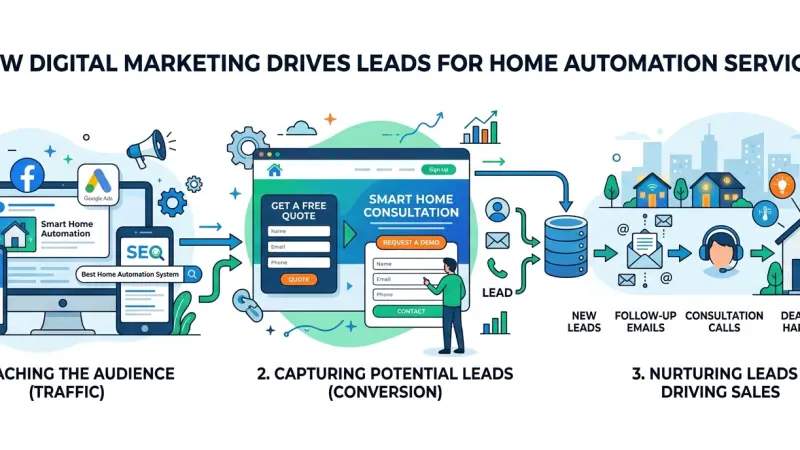
The home automation industry has reached a definitive tipping point in 2026. What was once a luxury reserved for the tech-savvy elite or ultra-wealthy estate owners has become a standard expectation for modern homeowners seeking efficiency, security, and comfort. As the "Internet of Things" (IoT) matures into the "Intelligence of Everything," the market has expanded exponentially. However, this expansion brings a significant challenge for service providers: increased competition and a more skeptical, well-informed consumer base.

For home automation firms, specialized technical expertise is no longer the sole requirement for success. You might be the best at calibrating Dolby Atmos systems or integrating complex KNX lighting grids, but if your potential clients cannot find you during their research phase, that expertise remains untapped. The challenge lies in bridge-building—connecting sophisticated technical capabilities with the specific, often emotional, needs of a local audience.
Digital marketing serves as this essential bridge. It is the invisible infrastructure that transforms a casual "search query" into a high-value "service call." Unlike traditional advertising, which often casts a wide and expensive net, modern digital strategies allow for surgical precision. This ensures that your message reaches individuals at the exact moment they are looking to upgrade their living spaces. This comprehensive guide provides a deep dive into the nuanced ways digital marketing drives sustainable lead generation for home automation services, focusing on the pillars of trust, education, and hyper-local visibility.
The Evolution of Lead Generation in the Smart Home Sector
To understand where lead generation is going, we must look at how it has evolved. Historically, home automation leads were the byproduct of "insider" networks. Referrals came from architects, high-end builders, or expensive storefronts in affluent neighborhoods. While these legacy channels remain valuable, the modern consumer journey has moved almost entirely online.
In 2026, the path to a smart home installation usually begins with a specific problem. A homeowner might be frustrated by rising energy costs and search for "smart HVAC optimization." Or, perhaps they are concerned about neighborhood security and look for "integrated AI surveillance." Digital marketing allows businesses to be present during these "micro-moments." By providing immediate, authoritative answers through search engines and social platforms, service providers establish a "pre-sell" relationship. This shift from "push" marketing (interruption) to "pull" marketing (attraction) ensures that the leads generated are not just names in a database, but high-intent prospects who already view the provider as an expert.
Core Strategies for Driving Quality Leads
Generating leads in a technical field requires a balance between "hard" data and "soft" lifestyle benefits. Homeowners don't buy wires and sensors; they buy peace of mind, time, and luxury.
1. Content Marketing as a Trust Engine
Home automation is inherently complex. For many consumers, the fear of "breaking the house" or being locked into a proprietary system is a major barrier to entry. Content marketing addresses these psychological barriers by demystifying the technology.
-
Educational Blogging: Instead of writing about "Our Newest Services," write about "How Matter 1.5 Will Change Your Home in 2026." This positions you as a forward-thinking consultant rather than just a contractor.
-
Video Demonstrations: A 60-second clip of a voice-controlled "Goodnight" routine—where doors lock, lights dim, and the thermostat drops—is worth more than ten pages of technical specifications.
-
The "Price" Question: One of the most effective ways to generate leads is to address the "elephant in the room." Detailed guides on "What a Smart Home Actually Costs" help filter out low-budget leads while building massive trust with serious prospects.
2. Search Engine Optimization (SEO) and the Search Landscape
SEO remains the most sustainable driver of leads. However, in 2026, SEO is no longer just about keywords; it’s about "Entity-Based Search" and "Search Generative Experiences" (SGE).
-
Local Intent: When someone searches for a "smart home installer near me," search engines look for local relevance, proximity, and verified reviews.
-
Natural Language Processing: With the rise of voice-activated AI assistants, people are asking full questions: "Who is the best person to fix my Control4 system in London?" Your website content must be optimized to answer these specific, long-tail questions.
-
Technical SEO: Because home automation is a technical field, your website must reflect that. Fast load times, mobile-first design, and secure (HTTPS) browsing are signals that you handle technology with care.
3. The Visual Power of Social Platforms
We live in a visual age. Platforms like Instagram, Pinterest, and TikTok have become search engines in their own right for interior design and home tech.
-
The "Behind the Scenes" Pull: Showing the "guts" of an installation—the neatly organized server rack,
the hidden wiring—demonstrates a level of professionalism that appeals to high-end clients.
-
User-Generated Content (UGC): Encouraging a client to share a video of their new home cinema in action provides "social proof" that no amount of paid advertising can replicate.
Step-by-Step: Building a Lead Generation Machine
Building a marketing funnel for a service-based business requires a logical progression from awareness to conversion.
Step 1: Define the Ideal Client Profile (ICP)
Not all leads are created equal. Are you targeting:
-
The Luxury Enthusiast: Wants the absolute best, cares about brand names (Lutron, Crestron), and values exclusivity.
-
The Modern Family: Values security, ease of use for children, and energy savings.
-
The "Aging in Place" Market: A massive growth sector in 2026, focusing on smart health monitoring and automated lighting for safety. Your digital marketing language, imagery, and ad targeting must vary significantly between these groups.
Step 2: The Landing Page Optimization
One of the most common mistakes is driving paid traffic to a generic "Home" page. If an ad promises "Smart Lighting Solutions," the user should land on a page that only talks about lighting. This page should have:
-
A clear, benefit-driven headline.
-
High-quality original photography.
-
A simple, low-friction contact form.
-
Trust badges (Certifications, local awards).
3. Implementing "Lead Magnets"
A lead magnet is a high-value piece of content given in exchange for an email address. In the home automation world, this could be:
-
The 2026 Smart Home Readiness Checklist: Helps homeowners determine if their current wiring can handle new protocols.
-
Energy Audit Template: A tool to help them see how much they could save with smart thermostats and blinds. This allows you to capture leads who are in the "research" phase but not quite ready to call, giving you the opportunity to nurture them via email.
The Role of Technical Authority in Conversions
In the 2026 market, consumers are wary of "cowboy installers." Digital marketing allows you to broadcast your technical authority through:
-
Partnership Badges: Displaying official partner logos from reputable manufacturers.
-
Case Studies: Documenting a project from the initial "messy" phase to the polished final result. This proves you have a process.
-
White Papers: For B2B leads (developers and architects), providing deep-dive documents on the ROI of smart technology in new builds is a powerful lead generator.
Analyzing the 2026 Consumer Behavior
The consumer of 2026 is "hyper-informed." They have likely watched dozens of YouTube reviews before contacting you. This means your digital marketing shouldn't just repeat what they already know. Instead, focus on the "Implementation Gap."
Most people know what a smart bulb is; very few know how to integrate 50 of them into a circadian lighting system that mimics the sun's natural cycle. Digital marketing should focus on the professional integration aspect—the "glue" that holds the smart home together. This is where the true value lies and where the highest-quality leads are found.
Common Mistakes to Avoid in Home Automation Marketing
-
Selling Hardware, Not Experience: Don't sell a "smart lock"; sell the feeling of never having to wonder if the front door is locked while you're at work.
-
Ignoring Mobile Users: Many homeowners browse for home ideas on their phones during their commute or while watching TV. If your site doesn't work perfectly on mobile, you've lost the lead.
-
Ghosting Inquiries: The "half-life" of a digital lead is incredibly short. If someone fills out a form, they expect a response within hours, if not minutes. Using automated CRM tools to send an immediate "We received your request" email is vital.
-
Over-complicating the Message: If your grandmother wouldn't understand your homepage, it’s too technical. Keep the "what" simple and the "how" in the technical specs section.
Advanced Lead Nurturing Strategies
Once you have a lead, the work is only half done. Home automation projects often have long "gestation periods"—the time between initial interest and final installation can be months.
-
Drip Email Campaigns: Send a series of emails over six weeks that educate the lead on different aspects of smart homes (Security week, Entertainment week, Energy week).
-
Retargeting Ads: Use "reminder" ads for people who visited your pricing page but didn't fill out a form. These ads should focus on a "limited-time consultation" or a recent success story.
-
Webinars and Live Q&As: Hosting a live session on Instagram or Zoom where you answer common questions about home tech can convert "lukewarm" followers into "hot" leads.
Supporting Local Business Visibility Beyond Core Marketing Efforts
While sophisticated global strategies are impressive, the home automation industry remains a service-based, local endeavor. You cannot remotely install a multi-room audio system. Therefore, business discoverability is fundamentally tied to how well a company is anchored in its local geography.
Beyond the flashy ads and high-end video content, there is a strategic layer of "digital plumbing" that keeps a business visible to its immediate community. Utilizing a business directory website acts as a persistent supporting visibility layer, ensuring that the company appears where local users are actually looking.
For an installer, maintaining local presence consistency is a key credibility signal. When a potential client sees a company listed on a free company listing platform, it provides trust reinforcement across platforms, showing that the business is established and reputable. To list services uk directory style allows a specialized firm to capture "niche" searches that general search engines might miss. Furthermore, using a business listings site ensures that the company acts as a local discovery aid, helping neighbors find the experts they need without the noise of national retailers. Ultimately, appearing on a well-maintained Local Page UK provides the "local proof" that complements high-level marketing efforts.
Digital marketing for home automation is no longer just about being "online." It is about creating a comprehensive digital ecosystem that mirrors the physical smart homes you install. By combining educational content, localized SEO, and strategic social proof, you can drive a consistent stream of high-quality leads that are ready to invest in professional services.
The key to success in 2026 is authenticity. Consumers are looking for experts who can guide them through the "gadget fatigue" and provide a unified, simple experience. If your digital marketing can demonstrate that you understand their lifestyle and possess the technical chops to improve it, lead generation becomes a natural byproduct of your authority.
Frequently Asked Questions (FAQs)
1. How much should I spend on digital marketing for my automation business? Most successful service businesses reinvest 5% to 10% of their gross revenue into marketing. For a growth phase, you might lean toward the higher end of that scale.
2. Which is better for leads: SEO or Pay-Per-Click (PPC)? PPC is better for immediate leads (turning on the tap), while SEO is better for long-term sustainability and lower overall cost-per-lead. Ideally, you should use both.
3. Does social media actually result in sales for installers? Yes, but rarely directly. Social media is usually a "touchpoint" where people research your work before heading to your website to book a consultation.
4. How do I compete with big retailers like Amazon or Best Buy? Compete on service, not hardware. Retailers sell boxes; you sell "peace of mind," "custom integration," and "local support." Focus your marketing on the "Concierge" experience.
5. What is the most important keyword for my website? "Home automation installer [Your City]" is usually the highest-converting keyword, but "Smart home security [Your City]" often has a higher search volume.
6. Should I use AI to write my marketing content? AI can help with drafts, but home automation is a "high-trust" industry. Your content needs a human voice, original photos of your work, and specific local knowledge to be effective.
7. How can I get more Google reviews? The best way is to build a review request into your "handover" process. When you show the client how to use their new system and they are most excited, ask them for a review right then.
8. Do I need a professional videographer for my marketing? While "polished" videos are great for your website, "raw" smartphone videos often perform better on social media because they feel more authentic.
9. What is a "Conversion Rate"? This is the percentage of website visitors who take an action (like calling you or filling out a form). If 100 people visit and 5 call you, your conversion rate is 5%.
10. How do I target architects and interior designers? Use LinkedIn for direct outreach and create a specific "Professional Partners" page on your website that details how you make their jobs easier.
11. Why is local presence consistency so important? If your phone number or address is different on various websites, search engines like Google will trust your business less, which can lower your search rankings.
12. Can I generate leads without a website? It is extremely difficult. While you can use social media, a website is your only "owned" digital property where you can fully control the brand story and capture lead data.
13. What is the biggest mistake in lead generation? Failing to follow up. Many businesses spend thousands to get the lead but lose it because they didn't call the person back for two days.
14. Does "Matter" compatibility matter for my marketing? In 2026, yes. It is a major selling point.
Mentioning it shows you are building "open" systems that won't become obsolete in two years.
15. How do I measure if my marketing is working? Track your "Cost Per Lead" (Total Spend / Number of Leads). If this number is significantly lower than the profit from a single job, your marketing is successful.

Disclaimer: The information provided in this article is for general informational and research purposes only. Company details, features, services, and market positions may change over time. Readers are advised to visit official company websites and conduct independent research before making any business decisions or purchasing services.
Most Searchable Keywords
Recent Blogs



Related Listings


Categories
- Accountants (295)
- Advertising Agencies (559)
- Architects (149)
- Automobiles (377)
- Beauty (300)
- Carpenters (146)
- Cleaning Services (386)
- Dentists (189)
- Driving (62)
- Electricians (215)
- Energy (8)
- Event Organiser (685)
- Finance (599)
- Guide (3365)
- Health (2207)
- Information technology (206)
- Legal Services (353)
- Logistics (6)
- Maintenance (65)
- Manufacturing (35)

Sponsored Listings in Locksmith Services


Related Blogs

Gen Z Political Reporters and News Creators i...
Read this insightful article "Gen Z Political Reporters and News Creators in the UK" to expand your knowledge!

Famous Female Social Media Influencers Across...
Read this insightful article "Famous Female Social Media Influencers Across the UK" to expand your knowledge!

Your UK Sponsor Licence 2026 Step by Step Gui...
Read this insightful article "Your UK Sponsor Licence 2026 Step by Step Guide" to expand your knowledge!
Questions & Answers – Find What
You Need, Instantly!
How can I update my business listing?
Is it free to manage my business listing?
How long does it take for my updates to reflect?
Why is it important to keep my listing updated?
