
How Home Automation Businesses Can Build Trust Through Consistent Online Presence
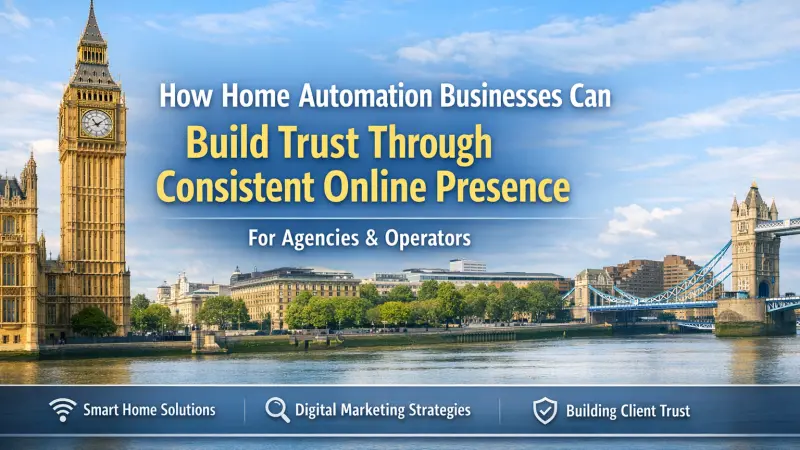
The home automation industry is growing fast. Homeowners are investing in smart locks, connected lighting, energy management systems, and fully integrated living environments. But with growth comes competition — and in a market where consumers are making significant financial decisions, trust is everything.

A polished installation job will only take your business so far if your online presence is inconsistent, outdated, or difficult to find. Potential customers often search online before making any contact. They read reviews, check websites, compare businesses, and form opinions within minutes. If your digital presence does not match the quality of your work, you risk losing leads before a single conversation happens.
This article walks through practical, proven strategies that home automation businesses can use to build and maintain a trustworthy, consistent online presence — one that converts curious visitors into confident customers.
Why Online Trust Matters for Home Automation Businesses
The Stakes Are Higher in Smart Home Services
Unlike buying a product off a shelf, hiring a home automation company involves letting someone into your home, trusting them with complex technology, and often committing to ongoing service relationships. Customers are cautious — and rightly so.
Research consistently shows that the majority of consumers research businesses online before making purchasing decisions. For high-value services like home automation, this research phase is even more thorough. Customers scrutinise websites, read through Google reviews, check social media activity, and look for any signs of credibility or red flags.
A business that looks inconsistent online — mismatched branding, a dormant website, no reviews, or conflicting contact information — creates hesitation. Even if your work is exceptional, that hesitation can be enough to push a potential customer towards a competitor.
The Connection Between Consistency and Credibility
Consistency signals stability. When a customer sees the same logo, the same tone of voice, the same core message, and the same contact details across your website, social media, and listings, it communicates that your business is organised, professional, and dependable.
This perception of reliability is a form of trust — and in the home automation space, where customers are spending thousands of pounds on connected technology, reliability is non-negotiable.
Building a Professional Website That Earns Trust
First Impressions Start With Your Website
Your website is the digital equivalent of your storefront. It is often the first place a potential customer lands after a search, and the impression it makes in the first few seconds will determine whether they stay or leave.
For home automation businesses, a strong website should clearly communicate what you do, where you operate, what sets you apart, and how easy it is to contact you. These are not complex requirements, but they are frequently neglected.
Key Elements of a Trust-Building Website
- Clear service descriptions: Explain each service — whether it is smart lighting, CCTV, AV systems, or full home integration — in plain, accessible language. Avoid jargon that confuses rather than impresses.
- Professional imagery: Use high-quality photos of real installations you have completed. Authentic visuals build more trust than generic stock photography.
- Contact information on every page: Make it effortless for customers to reach you. Display your phone number, email, and service area prominently.
- Case studies and project highlights: Showcase real projects with before-and-after details. This demonstrates capability and gives customers a sense of what to expect.
- SSL certificate and fast loading: A secure, fast-loading website signals technical competence — especially important for a technology-based business.
Mobile Responsiveness Is Non-Negotiable
A significant proportion of local service searches happen on mobile devices. If your website does not load cleanly on a smartphone, you are immediately creating friction for a large portion of your potential audience. A mobile-optimised site is not a bonus — it is a baseline requirement.
Establishing a Strong and Consistent Brand Identity
What Consistent Branding Actually Means
Branding consistency does not mean being rigid or corporate — it means ensuring that every touchpoint a customer encounters feels like it belongs to the same, coherent business. This includes your logo, colour palette, fonts, photography style, and the tone of language you use across all channels.
When a customer sees your Facebook post, visits your website, and receives a quote email,
each of those interactions should feel like they are communicating with the same company.
Practical Steps to Maintain Brand Consistency
- Create a simple brand guide: Document your logo usage, colours, fonts, and tone of voice. This does not need to be complex — even a one-page reference document helps keep everything aligned.
- Use the same profile image across all platforms: Your logo or a professional photo should appear consistently on Google Business Profile, social media accounts, and directory listings.
- Maintain consistent contact details: Your business name, address, and phone number (often called NAP) should be identical everywhere it appears online. Discrepancies here can confuse both customers and search engines.
- Develop a consistent voice: Whether you are writing a blog post, responding to a review, or posting on social media, the tone should feel like it comes from the same business personality.
Leveraging Customer Reviews to Build Social Proof
Why Reviews Are One of Your Most Powerful Trust Tools
In home services, word-of-mouth has always been king. Online reviews are the digital version of that recommendation — and they carry enormous weight. Studies suggest that the vast majority of consumers trust online reviews as much as personal recommendations from friends or family.
For home automation businesses, reviews serve a dual purpose: they build social proof for potential customers, and they signal to search engines that your business is active, relevant, and well-regarded.
How to Build a Healthy Review Profile
- Ask after every successful job: The simplest way to get more reviews is to ask for them. Most satisfied customers are happy to leave a review — they simply need to be reminded.
- Make it easy: Send a direct link to your Google review page via SMS or email shortly after completing a job. Remove every obstacle between the satisfied customer and the review.
- Respond to every review: Responding to positive reviews shows appreciation. Responding to negative reviews — calmly and professionally — shows accountability. Both build trust.
- Diversify your review presence: While Google is the priority, consider building a presence on Trustpilot, Checkatrade, or other relevant platforms where customers look for tradesperson recommendations.
Handling Negative Reviews Without Damaging Your Reputation
Every business receives criticism at some point. What matters is how you respond. A thoughtful, professional response to a negative review demonstrates maturity and customer focus. Potential customers reading that exchange are not just looking at the complaint — they are evaluating how you handle it. A composed, solution-oriented response can actually strengthen trust.
Content Marketing: Demonstrating Expertise Over Time
Why Regular Content Matters for a Trust-Building Strategy
Publishing regular, useful content — blog posts, how-to guides, project walkthroughs, or video demonstrations — positions your home automation business as an authority. Over time, this accumulation of knowledge-sharing content builds a body of work that signals expertise and commitment.
Content marketing is not about producing volume for the sake of it. A single well-written article that answers a common customer question is worth far more than a dozen thin, generic posts.
Content Ideas That Work for Home Automation Businesses
- Guides explaining how different smart home systems work (e.g., "What is a smart hub and do you need one?")
- Project case studies showing a real installation from consultation to completion
- FAQs addressing common concerns (e.g., "Is home automation worth the investment?")
- Tips for homeowners on maintaining and getting the most from their smart home systems
- Comparisons of popular platforms like Google Home, Amazon Alexa, and Apple HomeKit
SEO Benefits of Consistent Content
Beyond trust-building, consistent content production improves your visibility in search engine results. Each new article or guide is an additional opportunity to rank for search terms your potential customers are using. Over time, a well-maintained blog or resources section can become a significant source of organic traffic.
Social Media: Staying Visible and Approachable
Choosing the Right Platforms for Your Audience
Not every social media platform will be the right fit for a home automation business. The key is to focus on channels where your target customers — typically homeowners, property developers, or interior designers — are most active.
For most home automation businesses, Facebook, Instagram, and LinkedIn offer the best return on effort. Facebook enables community engagement and local advertising. Instagram is ideal for showcasing visually impressive installations. LinkedIn is valuable for connecting with commercial clients and trade professionals.
What to Post and How Often
- Project photos and videos: Show the work you are most proud of. Before-and-after transformations are particularly compelling.
- Educational content: Share short tips, product insights, or explanations of smart home technology. This positions you as knowledgeable without being salesy.
- Behind-the-scenes content: Show the team, the process, and the people behind the business. Humanising your brand builds approachability.
- Customer testimonials: Share written or video testimonials from happy clients (with their permission). Real voices carry authenticity.
Consistency matters more than frequency. Posting two or three times per week with quality content is significantly more effective than posting daily with filler material.
Google Business Profile Your Local Trust Anchor
Why Google Business Profile Cannot Be Overlooked
For any home automation business operating in a defined geographical area, Google Business Profile (formerly Google My Business) is one of the most powerful trust-building tools available. It is often the first thing a potential customer sees when they search for your business or search for services in your area.
A fully optimised, regularly updated Google Business Profile instantly communicates legitimacy. It shows your location, opening hours, contact information, website link, photos, and crucially — your reviews.
Optimising Your Google Business Profile
- Complete every section: Fill out your business description, service categories, service areas, and attributes fully. Incomplete profiles appear less trustworthy.
- Upload high-quality photos regularly: Add photos of completed projects, your team, and your equipment. Profiles with photos receive significantly more engagement.
- Post regular updates: Use the posts feature to share news, offers, or helpful content. This signals that the profile is actively managed.
- Respond to all reviews: As discussed earlier, engaging with reviews on this platform is particularly impactful, as Google reviews are often the most visible.
- Keep your information accurate: Ensure your address, phone number, and website are always up to date. Outdated information erodes trust quickly.
Common Mistakes Home Automation Businesses Make Online
Understanding what not to do is just as valuable as knowing best practices. Here are the most common pitfalls that undermine trust-building efforts:
- Neglecting the website for years at a time: An outdated website — with old pricing, obsolete services, or broken links — signals a lack of attention and professionalism.
- Ignoring negative reviews: Unaddressed negative reviews suggest the business does not care about customer feedback, which can be more damaging than the review itself.
- Inconsistent NAP details: Having different phone numbers or addresses on different platforms creates confusion and undermines search engine optimisation.
- Posting sporadically or not at all: Long gaps in social media activity or blog publishing suggest the business may be struggling or disengaged.
- No clear calls to action: Websites that make it difficult to contact the business, request a quote, or understand next steps create friction and lose conversions.
- Over-reliance on one channel: Trusting entirely on word-of-mouth or a single social platform is fragile. A multi-channel approach is more resilient.
Supporting Local Business Visibility Beyond Core Marketing Efforts
While a strong website, active social media, and a well-managed Google Business Profile form the core of any online trust strategy, there is a supporting layer of visibility that home automation businesses often overlook: structured business directory listings.
Being listed consistently across trusted online directories contributes to what might be called a credibility web — a network of consistent mentions across the internet that reinforces your business's legitimacy in the eyes of both search engines and prospective customers.
Platforms such as Local Page UK provide home automation businesses with a straightforward way to establish a structured local presence. Using a free company listing platform like this ensures your business name, contact details, and service information appear consistently in one more trusted location — which supports overall discoverability without requiring significant ongoing effort.
For businesses wanting to extend their reach further, the ability to list services uk directory entries allows you to appear in category-specific searches that a general web search might not surface. Homeowners frequently use directories to compare local specialists, particularly when they are in the research phase of a buying decision. Registering your business on a reputable business directory website acts as a quiet but consistent signal of legitimacy — not a replacement for active marketing, but a dependable supporting layer.
Being present on a quality business listings site contributes to the breadth of your online footprint. When multiple sources — your own website, your Google Business Profile, social media profiles, and directory entries — all point to the same consistent information, it strengthens trust signals across the board. This consistency is particularly valuable for local SEO, where search engines look for corroborating signals to determine a business's relevance and reliability in a specific geographic area.
Trust Is Built One Consistent Action at a Time
Building trust online is not a one-time project — it is an ongoing commitment. For home automation businesses, where customer decisions are
high-stakes and based on careful research, every element of your online presence contributes to the overall impression you make.
A professional website, a consistent brand identity, an active review profile, regular useful content, and a well-maintained Google Business Profile — these are not separate tasks but interconnected elements of a single trust-building strategy. Each one reinforces the others.
The businesses that will consistently win in this space are those that show up reliably, communicate clearly, and deliver on the promises their online presence makes. Start with one area, build momentum, and invest in your digital presence with the same care you invest in your installations.
Ready to take your online presence seriously? Start today by auditing your current digital footprint — check your website, review your social profiles, and ensure your business information is consistent everywhere it appears. Small improvements, made consistently, compound over time into a reputation that attracts and retains the right customers.
Frequently Asked Questions (FAQs)
1. How important is online presence for home automation businesses?
Extremely important. The majority of customers research businesses online before making contact. A professional, consistent online presence helps you appear credible, trustworthy, and worth hiring — especially for high-value smart home projects.
2. How do I get more Google reviews for my home automation business?
The most effective method is simply to ask. After completing a successful job, send the customer a direct link to your Google review page via text or email. Make the process as easy as possible and time your request while the positive experience is still fresh.
3. What should a home automation business website include?
At minimum: a clear description of your services, high-quality project photography, testimonials or case studies, transparent contact information, your service area, and an easy way to request a quote. Mobile responsiveness and fast loading speeds are also essential.
4. How often should I post on social media as a home automation business?
Two to three times per week is a realistic and effective frequency for most small to medium home automation businesses. Quality and consistency matter more than volume. Showing completed projects, sharing useful tips, and engaging with comments will drive more meaningful results than posting daily without purpose.
5. Does brand consistency really make a difference to customer trust?
Yes. When customers encounter a business that looks and sounds the same across all platforms, it creates a sense of reliability and professionalism. Inconsistency — different logos, mismatched information, varied tones — can suggest disorganisation, which undermines confidence.
6. What is NAP consistency and why does it matter?
NAP stands for Name, Address, and Phone Number. Consistency means these details are identical across your website, Google Business Profile, social media accounts, and any directory listings. Inconsistent NAP details confuse search engines and can reduce your local search visibility.
7. How do I handle a bad review professionally?
Respond promptly, remain calm, and acknowledge the customer's experience without being defensive. Offer to resolve the issue offline if appropriate. Potential customers who read your response will evaluate your professionalism and problem-solving approach — a well-handled negative review can actually strengthen your reputation.
8. Is content marketing worth the time investment for a home automation business?
Yes, over time. Well-written blog posts, guides, and case studies help your website rank for relevant search terms, demonstrate your expertise, and give potential customers more reasons to trust you. It is a longer-term strategy than paid advertising, but the compounding returns make it worthwhile.
9. How do I optimise my Google Business Profile?
Complete every field — service descriptions, categories, service areas, and attributes. Upload fresh photos regularly, respond to all reviews, post updates using the posts feature, and keep your contact information and opening hours accurate at all times.
10. Should I be on multiple social media platforms?
Rather than spreading yourself thin across every platform, focus on one or two where your target customers are most active. For most home automation businesses, Instagram and Facebook are the strongest starting points. Once you have consistent activity there, consider expanding.
11. What is the role of case studies in building trust?
Case studies give potential customers a realistic preview of what working with you looks like. They demonstrate your problem-solving process, the quality of your work, and the kind of results clients can expect. A well-written case study is one of the most persuasive pieces of content you can have on your website.
12. How can small home automation businesses compete online with larger firms?
Focus on local SEO, personalised customer service, and authentic storytelling. Larger firms often struggle with the genuine community connection and responsiveness that smaller businesses can offer. Showcasing your team, your local knowledge, and your real client relationships can be a significant differentiator.
13. How do I measure whether my online presence is improving trust?
Track metrics such as website enquiry rates, review volume and average rating, social media engagement, and organic search traffic over time. Improvements in these indicators suggest that your trust-building efforts are having an effect. Qualitative feedback from new clients about how they found you is also valuable.
14. Is paid advertising necessary for home automation businesses?
Not necessarily, but it can accelerate results in the short term. The strategies outlined in this article — consistent content, strong reviews, a well-maintained Google Business Profile — build organic trust over time without advertising spend.
Paid advertising can complement these efforts, particularly during slower periods or when launching in a new area.
15. How long does it take to see results from trust-building efforts?
It depends on your starting point and the consistency of your efforts. Some changes — like updating your Google Business Profile or responding to reviews — can have a fairly quick impact. Content marketing and organic SEO typically take several months to show meaningful results. Patience and consistency are the key variables.

Disclaimer: The information provided in this article is for general informational and research purposes only. Company details, features, services, and market positions may change over time. Readers are advised to visit official company websites and conduct independent research before making any business decisions or purchasing services.
Most Searchable Keywords
Recent Blogs

Related Listings
Categories
- Accountants (295)
- Advertising Agencies (559)
- Architects (149)
- Automobiles (377)
- Beauty (300)
- Carpenters (146)
- Cleaning Services (386)
- Dentists (189)
- Driving (62)
- Electricians (215)
- Energy (8)
- Event Organiser (685)
- Finance (599)
- Guide (3365)
- Health (2207)
- Information technology (206)
- Legal Services (353)
- Logistics (6)
- Maintenance (65)
- Manufacturing (35)
Sponsored Listings in Locksmith Services


Related Blogs

Gen Z Political Reporters and News Creators i...
Read this insightful article "Gen Z Political Reporters and News Creators in the UK" to expand your knowledge!

Famous Female Social Media Influencers Across...
Read this insightful article "Famous Female Social Media Influencers Across the UK" to expand your knowledge!

Your UK Sponsor Licence 2026 Step by Step Gui...
Read this insightful article "Your UK Sponsor Licence 2026 Step by Step Guide" to expand your knowledge!
Questions & Answers – Find What
You Need, Instantly!
How can I update my business listing?
Is it free to manage my business listing?
How long does it take for my updates to reflect?
Why is it important to keep my listing updated?
