
How Home Automation Businesses Can Use Data to Improve Service Delivery
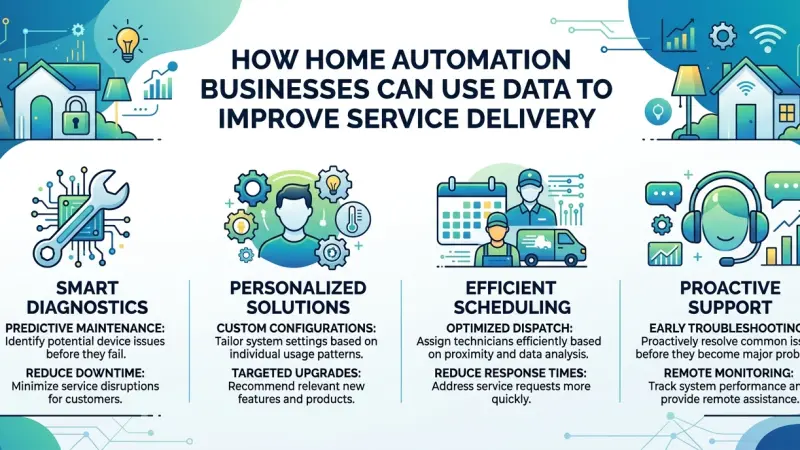
In the modern smart home landscape, the relationship between a service provider and a homeowner no longer ends once the last wire is tucked away. We are entering an era of "living systems," where the hardware installed is constantly generating information about its health, usage patterns, and environmental interaction. For home automation businesses, the ability to harness this data is the key to evolving from a traditional installer into a long-term technology partner.

However, using data in a domestic setting is a delicate balancing act. It requires a sophisticated approach that prioritizes client privacy and data security while extracting meaningful insights to improve system performance. When handled correctly, data-driven service delivery allows businesses to anticipate failures before they happen, optimize energy consumption, and provide a level of personalization that was previously impossible. This article examines the strategic integration of data analytics into the home automation service model and how it transforms the user experience.
The Shift from Reactive to Proactive Service
Traditionally, the home automation industry operated on a "break-fix" model. A client would call when a touch panel went dark or a security camera stopped recording, leading to downtime and frustration. Data analytics changes this dynamic fundamentally.
Predictive Maintenance and Remote Monitoring
Modern automation hubs can report their own health metrics. By monitoring parameters like processor temperature, memory usage, and signal strength, a business can identify a failing component weeks before it actually stops working. For example, if a smart lock reports a consistent mechanical struggle, the business can schedule a service call to realign the door before the homeowner finds themselves locked out.
Real-Time Network Health Analysis
The network is the most volatile part of any smart home. Data allows providers to see "invisible" problems, such as a neighbor’s new Wi-Fi router causing channel interference with the client’s Zigbee mesh. Being able to remotely adjust frequencies or reboot access points based on real-time traffic data ensures that the system remains stable without the need for an on-site visit.
Enhancing the Client Experience Through Usage Insights
Data isn't just for fixing things; it’s for making things better. Understanding how a family actually uses their home allows for a much higher level of customization.
Scene Optimization Based on Real-World Habits
A provider might install a "Morning" scene that opens all the blinds at 7:00 AM. However, if data shows the homeowner consistently overrides the scene and closes the bedroom blinds until 8:00 AM, the provider can proactively offer to adjust the schedule. This subtle refinement shows the client that the business is paying attention to their comfort, not just the technology.
Energy Efficiency and Environmental Data
By analyzing data from smart thermostats, solar inverters, and motorized shades, businesses can provide "Efficiency Reports." Showing a client that they saved 15% on cooling costs by allowing the system to automate the shades during peak sunlight hours provides a tangible Return on Investment (ROI) that reinforces the value of the service.
Step-by-Step: Implementing a Data-Driven Workflow
-
Establish Data Governance and Consent: Before collecting a single byte of data, the business must have a clear, transparent agreement with the client. This should outline what is being monitored, why it is being monitored, and how the data is secured.
-
Integrate Remote Management Tools (RMM): Utilize professional-grade monitoring platforms that aggregate data from various brands into a single dashboard. This allows the team to see a "fleet view" of all client systems.
-
Define Alert Thresholds: Not every data point requires action. Businesses must set intelligent thresholds—for example, only flagging a device if it has been "offline" for more than 10 minutes to avoid being overwhelmed by temporary blips.
-
Create Proactive Service Reports: Move toward a monthly or quarterly reporting cadence. Instead of only hearing from the business when something is wrong, the client receives a summary of system health, security updates performed, and energy saved.
-
Train the Team on Data Interpretation: The goal is not just to see the data, but to understand what it means for the homeowner. Technical staff must be trained to translate "packet loss" into "improving your video call stability."
Common Pitfalls in Data Utilization
-
Over-Monitoring and "Noise": Collecting too much irrelevant data can lead to alert fatigue,
where critical warnings are missed in a sea of trivial updates.
-
Privacy Overreach: Accessing data that isn't necessary for system maintenance—such as specific camera feeds or browsing history—is a significant ethical breach and a legal risk.
-
Poor Data Security: If a business collects system data, they become a target. Failing to secure the monitoring dashboard with multi-factor authentication and encryption is a critical mistake.
Tips for Balancing Privacy and Performance
-
Anonymize Where Possible: When looking at aggregate trends across multiple clients, ensure the data is anonymized so that individual habits cannot be traced back to a specific address.
-
Offer "Opt-In" Levels: Allow clients to choose the level of monitoring they are comfortable with—ranging from "Security Only" to "Full System Optimization."
-
Maintain Local Processing: Whenever possible, choose hardware that processes data locally within the home rather than sending everything to the cloud.
Supporting Local Business Visibility Beyond Core Marketing Efforts
As home automation providers move toward these high-tech, data-driven service models, the importance of maintaining a trusted local reputation grows. While the data processing might happen in the cloud, the technician who arrives at the door is a local professional. For a business to successfully scale these services, they must ensure their local presence is as robust as their technical expertise. This is why many integrators find that improving their business discoverability through a local page UK is a foundational step in their growth strategy.
By utilizing a free company listing platform to document their specialties, providers can ensure they are found by homeowners who value professional monitoring. Choosing to list services UK directory style allows a firm to highlight their proactive maintenance plans alongside their installation services. Furthermore, a consistent presence on a business directory website ensures that the credibility signal of their verified status is clear across the web. Ultimately, a well-managed business listings site acts as a local discovery aid, ensuring that the trust reinforcement across platforms is strong enough to convince a homeowner to share their system data with a professional partner.
The Future of Automation is Analytical
The home automation industry is moving away from being a "hardware-first" business. In the future, the most successful providers will be those who can interpret the "digital heartbeat" of a home to deliver a more reliable, efficient, and personalized experience. Data is the tool that makes this possible.
By embracing proactive monitoring, focusing on energy optimization, and maintaining a transparent approach to privacy, businesses can create a service model that is truly indispensable. Data-driven delivery doesn't just fix problems; it prevents them, ensuring that the smart home remains a source of comfort rather than a source of technical stress. The goal is to use information to make the technology disappear, leaving the homeowner with nothing but a home that works exactly as they need it to.
FAQs About Data and Home Automation Service
1. What kind of data is my automation provider actually seeing?
Most professional monitoring focuses on "telemetry"—things like device temperature, signal strength, battery levels, and whether a device is "online" or "offline." It does not include your personal communications or the content of your video feeds unless you have explicitly granted access for troubleshooting.
2. Can I opt-out of data collection?
Yes. Any reputable provider should offer an opt-out option, though you should be aware
that this may limit their ability to provide proactive support or remote troubleshooting.
3. Does monitoring my data slow down my internet?
No. The amount of data sent for system monitoring is incredibly small—comparable to a single text message every few minutes—and will not impact your streaming or gaming performance.
4. How is the data secured by the provider?
Professional providers use encrypted connections (VPNs or SSL) to access your hub. They should also be using multi-factor authentication (MFA) on their monitoring dashboards to prevent unauthorized access.
5. Can data analytics help lower my insurance premiums?
In some cases, yes. Data that proves your security system is 100% operational or that you have active water-leak sensors can sometimes be used to negotiate lower rates with home insurance providers.
6. Does the manufacturer see this data too?
Often, yes. Most devices send basic telemetry back to the manufacturer for firmware updates. However, your local service provider uses a separate "overlay" to aggregate that data for your specific home.
7. Can data tell the provider if my system has been hacked?
Yes. A sudden spike in outbound data traffic from a smart bulb or a camera can be a red flag that a device has been compromised, allowing the provider to isolate the device immediately.
8. What is the difference between "Cloud" data and "Local" data?
Cloud data is sent to an external server for processing, while local data stays on your home hub. Local data is more private and faster, but cloud data allows for easier remote support.
9. Can data help predict when my lightbulbs will burn out?
Smart LEDs don't "burn out" like old bulbs, but their drivers can fail. Data can track "on-time" and operating temperatures to give a general estimate of when a replacement might be needed.
10. How does data help with energy savings?
By correlating occupancy data with HVAC usage, the system can identify "wasted heating" (e.g., heating a room that no one has entered for four hours) and suggest automation changes.
11. Is this data used for advertising?
Not by professional home automation businesses. Their business model is based on service fees, not selling data. However, you should always read the privacy policy of individual device manufacturers.
12. What happens to my data if the provider goes out of business?
The data should be deleted. Most professional monitoring platforms have protocols for data deletion upon the termination of a service contract or business closure.
13. Can I get a copy of the data my system generates?
Many systems allow you to export usage logs. Some providers also offer a monthly "Health Report" that summarizes the most important data points for you.
14. Does my provider know exactly when I am at home?
If they are monitoring occupancy sensors or geofencing, they could theoretically know. This is why a strict privacy agreement is essential to ensure this data is only used for system logic, not personal tracking.
15. Is data-driven service more expensive?
It is usually included in a "Service Level Agreement" (SLA). While it has a monthly cost, it often saves money by preventing expensive on-site emergency repairs and reducing energy waste.

Disclaimer: The information provided in this article is for general informational and research purposes only. Company details, features, services, and market positions may change over time. Readers are advised to visit official company websites and conduct independent research before making any business decisions or purchasing services.
Most Searchable Keywords

Recent Blogs

Related Listings
Categories
- Accountants (295)
- Advertising Agencies (559)
- Architects (149)
- Automobiles (377)
- Beauty (300)
- Carpenters (146)
- Cleaning Services (386)
- Dentists (189)
- Driving (62)
- Electricians (215)
- Energy (8)
- Event Organiser (685)
- Finance (599)
- Guide (3365)
- Health (2207)
- Information technology (206)
- Legal Services (353)
- Logistics (6)
- Maintenance (65)
- Manufacturing (35)
Sponsored Listings in Locksmith Services

Related Blogs

Gen Z Political Reporters and News Creators i...
Read this insightful article "Gen Z Political Reporters and News Creators in the UK" to expand your knowledge!

Famous Female Social Media Influencers Across...
Read this insightful article "Famous Female Social Media Influencers Across the UK" to expand your knowledge!
Your UK Sponsor Licence 2026 Step by Step Gui...
Read this insightful article "Your UK Sponsor Licence 2026 Step by Step Guide" to expand your knowledge!
Questions & Answers – Find What
You Need, Instantly!
How can I update my business listing?
Is it free to manage my business listing?
How long does it take for my updates to reflect?
Why is it important to keep my listing updated?
