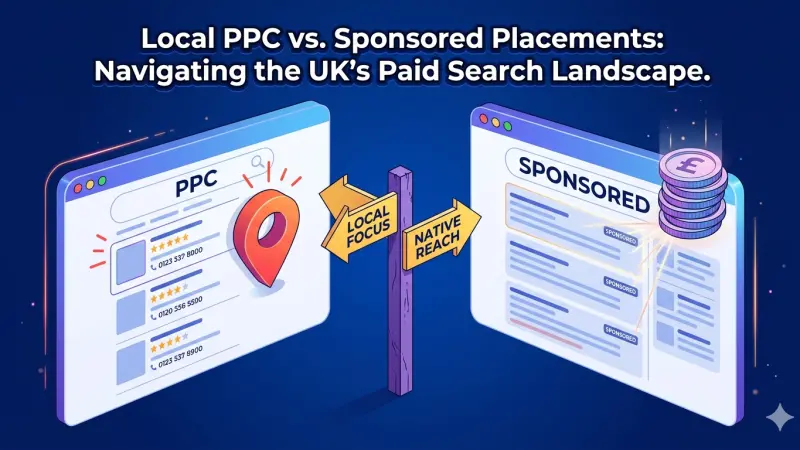

The United Kingdom's digital advertising ecosystem has undergone a seismic transformation. With business advertising UK spend projected to exceed £18.6 billion by 2025, local enterprises face an unprecedented choice: invest heavily in pay-per-click campaigns or explore the emerging world of sponsored placements. This decision carries significant implications for customer acquisition costs, brand visibility, and ultimately, business survival in an increasingly competitive marketplace.
British consumers have evolved dramatically in their digital behaviours. According to Ofcom's 2024 Communications Report, 94% of UK adults now use the internet daily, with local searches accounting for nearly half of all Google queries originating from British IP addresses. This shift represents both an opportunity and a challenge for businesses seeking to advertise your business UK effectively without exhausting marketing budgets on inefficient campaigns.
The post-cookie landscape, combined with stricter GDPR enforcement and the Advertising Standards Authority's evolving guidelines, has fundamentally altered how British businesses must approach paid visibility. Those who understand these changes and adapt their strategies accordingly will thrive; those who cling to outdated approaches risk being left behind in an increasingly sophisticated digital marketplace.
The UK Paid Search Evolution: What Changed
The Post-Cookie Landscape in Britain
Google's delayed but inevitable deprecation of third-party cookies in Chrome has sent shockwaves through the British advertising community. While Safari and Firefox had already implemented tracking restrictions, Chrome's dominant 65% market share in the UK means the impact will be seismic. For small business advertising UK operators who relied on retargeting and behaviour-based advertising, this shift demands a complete strategic overhaul.
First-party data strategies have emerged as the cornerstone of sustainable digital marketing in Britain. Businesses that invested in building email lists, customer relationship management systems, and direct relationships with their audiences now hold significant competitive advantages. Those who must now build these assets from scratch face a steeper climb, but the fundamentals remain accessible to committed operators.
UK Privacy Regulations Impact Survey 2024
Source: British Chamber of Commerce Digital Survey, Q4 2024
Consent Mode v3 and British Compliance
Google's Consent Mode v3 represents a fundamental shift in how British businesses must approach data collection. This framework automatically adjusts Google tag behaviour based on user consent status, creating significant measurement gaps for businesses that fail to achieve adequate consent rates. UK websites achieving less than 60% consent rates are reporting data loss of up to 40% in their analytics platforms, fundamentally undermining campaign optimisation efforts.
The Information Commissioner's Office has signalled increasingly strict enforcement of consent requirements, with several high-profile enforcement actions in 2024 targeting businesses using deceptive cookie consent interfaces. For local businesses, this means investing in compliant consent management platforms and designing user experiences that encourage rather than manipulate consent decisions.
Understanding Local PPC Versus Sponsored Placements
Pay-per-click advertising operates on an auction model where advertisers bid on keywords relevant to their products or services. When a user searches those terms, the highest bidders (factoring in quality scores) appear at the top of search results. The advertiser pays only when someone clicks their advertisement. This model rewards relevance, landing page quality, and strategic bidding—characteristics that favour sophisticated advertisers with substantial testing budgets.
Sponsored placements, by contrast, represent a fundamentally different approach. These are fixed-position advertisements on platforms, directories, and content networks where businesses pay for visibility rather than clicks. The business listing platform UK ecosystem has embraced this model, offering businesses predictable costs and guaranteed placement without the complexity of ongoing bid management.
Local PPC Advertising
- + Captures high-intent search traffic actively seeking services
- + Granular geographic targeting by postcode radius
- + Immediate results with proper campaign setup
- - Unpredictable costs due to auction dynamics
- - Requires ongoing management expertise
- - Click fraud and competitor clicking risk
Sponsored Placements
- + Fixed, predictable monthly costs
- + Guaranteed visibility without bidding wars
- + Brand awareness across multiple touchpoints
- - Lower intent compared to active search
- - Less granular targeting options
- - Requires quality creative assets
Mastering Local PPC for UK Business Growth
The Google Ads Local Framework
Google's local advertising ecosystem has evolved significantly to serve British businesses targeting geographic-specific customers. The platform now offers sophisticated tools for postcode-level targeting, local inventory advertising, and footfall attribution that were previously available only to enterprise advertisers. Understanding these capabilities is essential for any business seeking to maximise return on advertising investment.
Radius targeting by UK postcode enables businesses to draw precise catchment areas around their physical locations. A plumber in Manchester, for instance, might target a 15-mile radius, excluding areas where travel time would erode profitability. The key lies in understanding not just where potential customers live, but where they search from—recognising that mobile searches often occur near the service need location rather than the residential address.
The most successful local advertisers in our portfolio have moved beyond simple radius targeting. They understand commute patterns, competitor locations, and the psychology of local search behaviour. A restaurant in Birmingham discovered their highest-value customers were searching from office buildings during lunch hours, not residential areas—completely reshaping their geographic bidding strategy.
James Whitworth
Head of PPC, British Digital Marketing Association
Local Inventory Ads and Footfall Generation
Local Inventory Ads represent one of Google's most powerful tools for British retailers with physical locations. These advertisements display real-time product availability and pricing to nearby searchers, driving both online and offline conversions. The integration requires robust inventory management systems and product feed optimisation, but the conversion rate improvements—often 200-300% higher than standard search ads—justify the technical investment for suitable businesses.
Google Maps advertising has emerged as a critical channel for local visibility, particularly on mobile devices where Maps searches frequently precede navigation to physical locations. Businesses appearing in the top three map pack positions capture approximately 68% of clicks from local searches, making optimisation for this placement essential. This includes maintaining accurate Google Business Profile information, generating authentic reviews, and ensuring category selections match search intent.
Quality Score Mechanics for British Advertisers
Quality Score remains the single most influential factor in Google Ads economics. A business with a Quality Score of 9 pays roughly half the cost per click of a competitor with a score of 5 for identical keywords and positions. For British advertisers, this translates to thousands of pounds in monthly savings or dramatically increased visibility for fixed budgets.
Landing page relevance represents the primary opportunity for Quality Score improvement. British consumers exhibit distinct search behaviours and expectations compared to global averages. They expect transparent pricing in pounds sterling, clear contact information including UK phone numbers, and Trustpilot or Google review integration. Landing pages that demonstrate understanding of British consumer expectations consistently outperform generic templates.
Beginner Action Plan: First 30 Days
Verify ownership, complete all fields, upload high-quality photos, and ensure category accuracy.
Identify 20-50 keywords combining your service with UK locations. Include British spelling variations.
Define realistic service areas based on travel time, not aspiration. Exclude areas where you cannot compete.
Develop dedicated pages for major towns and cities in your service area with local content and testimonials.
British Dialect and Negative Keywords
One often overlooked aspect of UK PPC management is the importance of negative keywords accounting for British dialect variations. Terms like "pants" mean different things in British versus American English; "flat" versus "apartment" searches attract different audiences; and regional variations like "bap," "batch," or "roll" for bread products can dramatically affect relevance. Building comprehensive negative keyword lists prevents budget waste on irrelevant clicks while improving overall campaign quality metrics.
The Rise of Sponsored Placements in the UK Market
Beyond the Search Bar: Placement Diversity
The sponsored placement landscape in Britain has exploded beyond traditional search advertising into a diverse ecosystem of opportunities. UK retail media networks, including those operated by Tesco, Sainsbury's, and Boots, now offer sponsored product placements that reach consumers at the moment of purchase consideration. These networks command premium pricing but deliver exceptional conversion rates for consumer packaged goods and retail brands.
Content discovery platforms like Taboola and Outbrain have established significant UK publisher networks, offering sponsored content placements alongside editorial on sites including The Daily Mail, The Independent, and regional newspaper websites. For businesses with content marketing assets, these placements offer brand awareness and traffic at lower costs than traditional display advertising, though conversion rates typically lag behind search-focused alternatives.
4.2%
Avg conversion rate
0.8%
Avg conversion rate
2.6%
Avg conversion rate
Social Media Sponsored Placements for British Businesses
Meta's sponsored stories and feed placements remain dominant for B2C advertising in Britain, with the platform reporting over 45 million monthly active UK users across Facebook and Instagram. The platform's targeting capabilities, while diminished by privacy changes, still offer demographic, interest, and behaviour-based segmentation that surpasses most alternatives. British advertisers report particular success with Instagram placements for lifestyle, fashion, and food service businesses.
LinkedIn sponsored content has become essential for B2B lead generation in the British market. With over 33 million UK members, the platform offers unparalleled access to professional decision-makers. The cost per click is significantly higher than consumer platforms—often £5-15 for competitive B2B audiences—but the lead quality and deal values typically justify the investment for professional services, enterprise software, and industrial B2B advertisers.
Platform Selection Guide
Choosing the right platform depends on your business type and customer acquisition goals. For service businesses seeking predictable costs and guaranteed local visibility, UK online business directory placements offer an excellent starting point without the complexity of auction-based advertising.
Comparative ROI: Making the Right Investment Decision
Intent Versus Interest: The Fundamental Distinction
The critical difference between PPC and sponsored placements lies in user intent. Search advertising captures users actively seeking specific products or services—the "ready to buy" audience that represents immediate revenue opportunity. Sponsored placements, by contrast, reach users in awareness and consideration phases, building brand recognition that influences future purchase decisions.
For British businesses with limited budgets, this distinction should drive allocation decisions. If immediate revenue generation is essential—perhaps due to cash flow constraints or seasonal pressure—PPC investment typically delivers superior short-term returns. If the business can afford longer payback periods and seeks to build sustainable market presence, sponsored placements offer brand awareness benefits that compound over time.
High-Intent PPC Performance
Sponsored Placement Performance
Budget Allocation Strategies for British Businesses
Managing high cost-per-click rates in competitive UK industries requires strategic budget allocation. The legal, financial services, and insurance sectors face CPCs that regularly exceed £15-30 for premium keywords, making efficient budget management essential. Successful advertisers in these categories focus heavily on Quality Score optimisation, negative keyword management, and geographic bid adjustments to maximise value from limited click volumes.
Seasonal budgeting presents particular challenges for British businesses. Bank holidays, the Christmas trading period, and summer holidays create demand fluctuations that require proactive budget adjustment. Savvy advertisers increase budgets 2-3 weeks before anticipated demand peaks, allowing algorithms to learn and optimise before the critical conversion window arrives. Those who wait until demand materialises often find themselves competing for inventory at premium prices with poorly optimised campaigns.
We advise clients to adopt a 70/30 split between PPC and sponsored placements for the first six months. This captures immediate demand while building brand presence that reduces long-term customer acquisition costs. Businesses that invest only in PPC face perpetual bidding wars without the organic brand recognition that eventually lowers click costs.
Dr. Sarah Chen
Director of Digital Strategy, London School of Marketing
Navigating UK Advertising Regulations
ASA Compliance for Paid Media
The Advertising Standards Authority maintains strict oversight of all advertising in the UK, including digital and search advertising. Recent enforcement actions have targeted misleading claims in financial services advertising, hidden pricing in travel advertisements, and inappropriate targeting of vulnerable consumers. For businesses new to paid advertising, understanding these regulations is not optional—it is a legal requirement with significant financial and reputational consequences for violations.
Correct advertisement labelling has become increasingly important as platforms blend sponsored and organic content. The ASA requires clear identification of advertising content, whether through "Ad" labels, "Sponsored" disclosures, or similar designations. The distinction matters: "sponsored" implies editorial endorsement that may trigger additional requirements, while "advertisement" more clearly signals paid placement. Businesses should work with legal counsel to ensure their labelling practices meet current standards.
New 2026 Restrictions: HFSS Products
The UK government's restrictions on advertising foods high in fat, salt, and sugar (HFSS) come into full effect in 2025-2026. These regulations prohibit paid advertising of HFSS products before 9pm on television and entirely restrict online paid advertising. Businesses in the food and beverage sector must understand these regulations and prepare alternative marketing strategies.
GDPR and Data Ethics in Paid Advertising
Storing local lead data legally requires compliance with UK GDPR and the Data Protection Act 2018. Businesses collecting leads through paid advertising must maintain clear records of consent, purpose limitations, and data retention schedules. The right to erasure—commonly called the right to be forgotten—applies to CRM databases as well as marketing platforms. When a data subject requests deletion, businesses must remove their information across all systems, including email marketing lists, CRM records, and advertising platform audiences.
Marketing automation and opt-in laws present particular complexity for British advertisers. Electronic direct marketing requires consent under PECR (Privacy and Electronic Communications Regulations), which sits alongside GDPR requirements.
The consent must be specific, informed, and freely given—pre-ticked boxes and bundled consent with terms of service are explicitly prohibited. Businesses relying on legitimate interests rather than consent for B2B marketing should ensure their reasoning would withstand ICO scrutiny.
Technical Setup and Infrastructure for 2026
Tracking and Attribution Evolution
Server-side Google Tag Manager implementation has become essential for accurate measurement in the privacy-first era. By routing tracking data through your own servers before transmission to Google, businesses can maintain attribution accuracy while respecting user consent choices. This technical investment pays dividends through improved campaign optimisation data and reduced data loss from browser-based tracking restrictions.
Multi-touch attribution models have evolved significantly, moving beyond simplistic last-click attribution toward data-driven models that distribute credit across the customer journey. For local businesses with longer consideration cycles—home improvement, professional services, automotive—understanding the full path to conversion is essential for accurate budget allocation. A £500 lead might originate from a sponsored directory listing, be nurtured through email, and convert via a branded search—but last-click attribution would credit only the final search.
Offline Conversion Tracking
QR Codes: Track offline-to-online journey with unique campaign parameters
Call Tracking: Dynamic number insertion attributes phone leads to campaigns
In-Store: POS integration connects footfall to digital advertising
UK Call Tracking Essentials
Landline tracking: 01/02 numbers with call recording
Mobile tracking: 07 numbers for local trust signals
03 numbers: National presence with local rate calls
Average call value varies by sector: £45-250
Creative Assets for High Performance
Dynamic Search Ad copywriting requires a different approach than traditional creative development. The system automatically generates headlines from website content, making site copy optimisation as important as ad writing itself. British consumers respond positively to ads that demonstrate local knowledge, reference British culture appropriately, and avoid American spelling or terminology. Testing shows that ads using British English spellings generate 15-20% higher click-through rates than identical ads using American spellings for UK audiences.
Video advertising requirements for YouTube UK continue to evolve, with vertical video formats gaining prominence for mobile-first audiences. The platform now offers multiple placement options, from in-stream ads that play before content to discovery ads that appear in search results and recommendations. British viewers exhibit different skip behaviours than global averages, with higher completion rates for locally relevant content and lower tolerance for obvious American imports.
Integrating AI Into Your Paid Strategy
AI Overviews and the Future of Search Advertising
Google's AI Overviews—formerly Search Generative Experience—fundamentally changes how search results appear and how advertising integrates with them. When AI generates answers to queries, traditional organic results may be pushed below the fold, making paid placements even more valuable for visibility. British advertisers should anticipate that AI-generated answers will include shopping suggestions and local business recommendations, creating new advertising inventory opportunities.
Intent optimisation for UK AI search requires understanding how British users phrase queries conversationally. AI systems interpret natural language differently than keyword-based algorithms, rewarding comprehensive content that answers related questions. Businesses should develop content strategies that address the full spectrum of customer questions, building topical authority that AI systems recognise and reference.
AI-Powered Advertising Trends for 2026
Predictive Bidding
AI forecasts peak demand periods 2-4 weeks ahead, automatically adjusting bids for optimal timing.
Smart Negative Discovery
Machine learning identifies wasteful queries 3x faster than manual analysis, reducing budget waste.
Real-Time Creative Generation
Dynamic ad copy adapts to user context, weather, and local events without manual intervention.
Conversational Query Bidding
Long-tail voice searches captured through natural language campaign structures.
Smart Bidding Versus Manual Control in 2026
The debate between Smart Bidding adoption and manual control has largely been settled by data: campaigns using Google's Smart Bidding strategies consistently outperform manually managed campaigns for most advertisers. However, the nuance lies in understanding when manual intervention remains valuable. During periods of significant change—new product launches, market disruptions, or seasonal shifts—human oversight can identify patterns that algorithms miss.
Protecting brand voice in automated advertising requires proactive management. AI-generated copy can drift from brand guidelines, make claims that exceed regulatory comfort, or adopt tones inconsistent with brand positioning.
Businesses should implement approval workflows for AI suggestions, maintain comprehensive brand guidelines accessible to all team members, and regularly audit automated outputs for compliance and consistency.
Sector-Specific Strategies for UK Businesses
Local Service Businesses: Tradespeople and Professionals
Google Local Services Ads have transformed lead generation for British tradespeople. These pay-per-lead advertisements appear above traditional search results and include Google's verification badge, providing trust signals that significantly improve conversion rates. For UK plumbers, electricians, and locksmiths, LSAs often deliver superior ROI compared to traditional search advertising, though the verification process requires documented qualifications, insurance, and background checks.
Trust signals are particularly critical for legal and financial service advertisers in the UK. FCA-authorised businesses must include specific disclosures in their advertising, and professional service firms benefit enormously from third-party validation. Including logos from professional bodies, Trustpilot scores, and case study references in advertising creative dramatically improves engagement rates for high-value professional services.
Trade Service Benchmarks
Professional Services Benchmarks
UK E-commerce and Retail Advertising
Performance Max campaigns have become Google's recommended approach for e-commerce advertisers in Britain, combining shopping, search, display, YouTube, and discovery inventory into unified campaigns. While the loss of granular control concerns some advertisers, the machine learning optimisation typically delivers 15-30% improvements in conversion value for merchants with adequate product feeds and conversion tracking.
Amazon.co.uk sponsored brand placements represent essential advertising real estate for retail businesses, whether selling through Amazon or competing against it. The platform's advertising offerings have matured significantly, with sponsored brands, sponsored products, and sponsored display options providing full-funnel coverage. For British merchants, Amazon advertising offers exceptionally high purchase intent audiences, though the platform takes significant margins and limits brand building compared to owned channels.
Common Pitfalls to Avoid in the UK Market
Wasting Budget on Irrelevant Traffic
The broad match trap represents the single most common budget-wasting mistake among British advertisers. Google's broad match algorithm has expanded significantly, often matching queries with tenuous relevance to target keywords. A business bidding on "accountant London" might match to "accountancy courses London" or "accountant jokes"—neither representing potential customers. Careful match type selection, combined with comprehensive negative keyword lists, prevents this budget drain.
Geographic misalignment between the UK and Ireland causes significant issues for businesses targeting Britain. Northern Ireland's position creates unique complications, and businesses without proper exclusions may find their advertisements appearing to Irish audiences who cannot access their services. Similarly, businesses in Scotland, Wales, and Northern Ireland should verify their location targeting does not inadvertently exclude their home regions through overly restrictive settings.
Critical Warnings
Neglecting the Human Element
Over-reliance on AI-generated copy produces generic advertising that fails to differentiate British businesses from competitors using the same tools. The platforms' default suggestions incorporate learnings from all advertisers, producing homogenised advertising that sounds professional but lacks distinctive character. Businesses that invest in developing authentic brand voices and human-written copy consistently outperform those relying entirely on automated creative generation.
Slow lead response times represent perhaps the most costly human element failure. Research consistently shows that leads contacted within five minutes convert at dramatically higher rates than those contacted later. Yet many British businesses take hours or days to respond to online enquiries, allowing competitor outreach and customer cooling to destroy potential conversions. For service businesses in particular, lead response infrastructure matters as much as advertising strategy.
Building Your 2026 UK Paid Advertising Roadmap
The Hybrid Approach: Merging PPC and Sponsored Placements
The most successful British advertisers in 2026 will not choose between PPC and sponsored placements—they will integrate both into coherent full-funnel strategies. Search advertising captures immediate demand while sponsored placements build brand recognition that eventually reduces customer acquisition costs across all channels. This integrated approach recognises that today's brand awareness impression becomes tomorrow's branded search query.
For businesses beginning this journey, starting with a business listing uk provides a foundation of local visibility without budget commitment. As advertising sophistication grows, layering paid search for high-intent keywords while maintaining sponsored placement presence creates multiple touchpoints across the customer journey. The key lies in measuring the combined impact rather than evaluating channels in isolation.
Monthly Audit Checklist for UK Advertising Managers
Review all queries triggering ads. Add irrelevant terms to negative keyword lists. Identify new keyword opportunities from high-performing queries.
Identify keywords with Quality Scores below 7. Audit landing page relevance, ad copy alignment, and expected CTR. Implement improvements systematically.
Compare conversion rates and costs by UK region. Adjust bid modifiers for high-performing areas. Exclude consistently underperforming locations.
Monitor auction insights for new competitors and share changes. Review competitor ad copy and landing pages for strategic insights.
Future Trends: Voice and AR Advertising in Britain
Voice search advertising will emerge as a significant channel by 2027, with smart speaker penetration in UK households exceeding 50%. British users exhibit distinct voice search behaviours, favouring longer, conversational queries and local intent signals. Advertisers should begin developing content strategies that address the questions users ask Alexa and Google Assistant, positioning for the advertising opportunities that will inevitably follow.
Augmented reality advertising represents the next frontier for retail and service businesses. Google's visual search capabilities and AR try-on features create new advertising inventory for businesses with appropriate visual assets. British retailers should invest in high-quality product photography and 3D modelling to prepare for AR shopping experiences that will transform e-commerce within the next five years.
Key Takeaways
The post-cookie landscape demands first-party data strategies and Consent Mode v3 compliance for accurate measurement.
Local PPC captures high-intent search traffic while sponsored placements build brand awareness—successful strategies combine both.
Quality Score optimisation can halve your cost per click—landing page relevance and British English usage matter significantly.
Fixed-price directory placements offer predictable costs without bidding complexity, ideal for businesses seeking consistent visibility.
ASA compliance and GDPR requirements are non-negotiable—budget for legal review of advertising claims and data practices.
Lead response time within five minutes dramatically improves conversion rates—increase advertising investment only when response capacity exists.
Frequently Asked Questions
Related Resources
Browse UK Business Listings
Find local businesses across Britain
Advertising Packages
Compare visibility options for your business
Sponsored Booster Programme
Priority placement for early adopters