
Ltd vs. Limited: What’s the Difference?
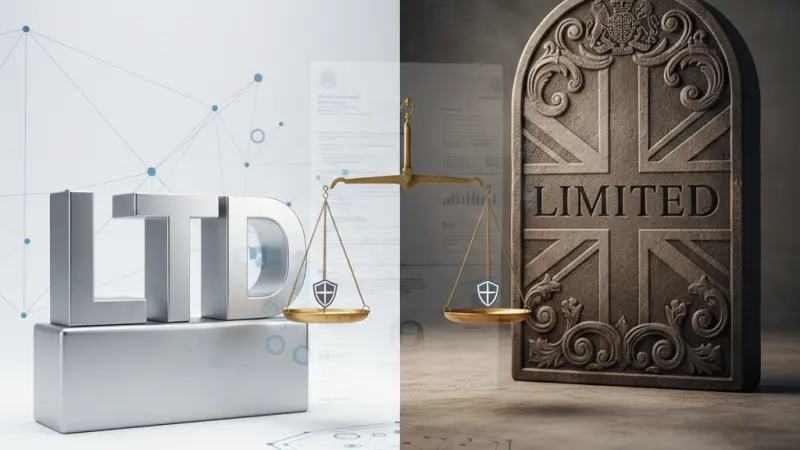
When embarking on the journey of entrepreneurship in the United Kingdom, one of the first major milestones is choosing a company name. While most founders spend weeks debating the "creative" part of the name, the suffix—Limited or Ltd—is often an afterthought. However, these three or seven letters carry significant legal weight.

In the UK, the suffix isn't just a label; it is a statutory requirement that communicates the legal structure of your business to the world. Whether you are a solo consultant or a growing tech firm, understanding the nuances between these terms is essential for compliance and branding.
The Legal Foundation: Section 59 of the Companies Act 2006
The requirement to use a suffix isn't a suggestion; it’s the law. Under Section 59 of the Companies Act 2006, all private companies limited by shares or guarantee must end their name with either "Limited" or its abbreviation, "Ltd."
Why Is This Required?
The primary purpose of this mandate is transparency. By including the suffix, you are providing a "public warning" to anyone doing business with you. It signals that:
The business is a separate legal entity from its owners.
The liability of the shareholders is "limited" to the amount they invested or guaranteed.
Personal assets of the directors and shareholders are generally protected if the company faces insolvency.
Without this suffix, creditors might wrongly assume they are dealing with a sole trader or a general partnership, where personal liability is unlimited.
Regional Variations: The Welsh Perspective
The UK celebrates its regional identities even in corporate law. If a company is registered as having its situation in Wales (a "Welsh company"), it has the legal right to use Welsh equivalents:
Cyfyngedig (equivalent to Limited)
Cyf. (equivalent to Ltd)
Ltd vs. Limited: Is There a Practical Difference?
The short answer is no. Legally, functionally, and technically, "Ltd" and "Limited" are identical.
| Feature | Limited | Ltd |
|---|---|---|
| Legal Status | Fully Compliant | Fully Compliant |
| Liability Protection | 100% | 100% |
| Companies House Acceptance | Yes | Yes |
| Perception | Traditional, Formal | Modern, Concise |
The Choice of Style
Choosing between the two is a matter of branding and aesthetics.
"Limited" is often perceived as more prestigious and established. It is frequently chosen by law firms, financial institutions, and traditional consultancies that want to convey a sense of permanence.
"Ltd" is sleek and modern. It fits better on business cards, social media handles, and digital logos where space is at a premium.
Are They Interchangeable?
While they represent the same legal status, consistency is key. When you register your company at Companies House, you must choose one.
If you register as "Blue Sky Ventures Limited," that full version is your official name.
However, the law generally allows you to use the abbreviation in daily operations. For example, a company registered as "Limited" can usually use "Ltd" on its shop sign. But for official documents (contracts, invoices, letterheads), it is best practice to use the exact version found on your Certificate of Incorporation to avoid any ambiguity.
Companies Without a Suffix
Not every limited company is forced to use a suffix. There are specific scenarios—usually involving non-profits or community organizations—where a company limited by guarantee can apply for an exemption.
Qualifying for Exemption
To drop the "Ltd" or "Limited," a company must prove to Companies House that its objects are focused on:
Promoting commerce, art, science, or education.
Charitable or community-benefit pursuits.
Religion or environmental protection.
The Strict Conditions
Exempt companies must adhere to rigid rules in their Articles of Association:
Profit Reinvestment: All income must be used to further the company’s objectives.
No Dividends: Members cannot receive any payments or dividends from profits.
Asset Dissolution: If the company closes, any remaining assets must be transferred to another body with similar charitable goals, rather than being split among members.
Other Suffixes You Might Encounter
While "Ltd" is the most common, the UK corporate landscape includes other structures:
PLC (Public Limited Company): For larger companies that offer shares to the general public. They must have a minimum share capital of £50,000.
LLP (Limited Liability Partnership): Commonly used by accountants and solicitors; it combines the flexibility of a partnership with limited liability.
CIC (Community Interest Company): A social enterprise that may use "C.I.C." to signal its commitment to social good.
Compliance and Brand Identity
Once you have selected your name and suffix, you must display it correctly to remain compliant with the Company, Limited Liability Partnership and Business (Names and Trading Disclosures) Regulations 2015.
Where your registered name must appear:
Business letters and order forms.
Emails and official websites.
Invoices, receipts, and cheques.
Outside every office or location where the business operates.
Failure to display the correct name can result in fines, though Companies House usually provides a window for correction.
How to Choose for Your Business?
If you are currently filling out your registration forms, ask yourself these three questions:
Does my logo look better with a short suffix? If so, choose "Ltd."
Is my industry high-end or traditional? If so, "Limited" might add a layer of perceived authority.
Is my company name already long? If your name is "The International Synchronized Logistics and Distribution Limited," adding the full word "Limited" might be a mouthful. "Ltd" would be a practical choice.
Promote Your Business with Local Page UK
Building a brand goes beyond choosing a name; it’s about being found by the right people. Whether you are registered as an Ltd or Limited, visibility is the lifeblood of your growth.
If you are looking for a reliable uk online business directory, Local Page UK is the premier platform to showcase your services. As a leading uk business directory, we help entrepreneurs bridge the gap between their services and local demand. Our uk local business directory is designed to help customers find local businesses uk with ease and speed.
By joining our local businesses list uk, your company gains authority. We cater to all niches, serving as a vital uk small business directory for startups, a robust uk b2b business directory for corporate services, and a trusted uk b2c business directory for consumer-facing brands.
When people search for a business directory uk online, they look for accuracy—which is exactly what our uk service providers directory provides. Get your uk business listings online today and see why we are the preferred local page uk business directory and the most visited uk business directory website.
Ready to start? You can secure a business listing uk right now. Our business listing uk options allow you to claim a business listing uk without any initial cost. As a top-tier business listing uk, we offer the best business listing uk experience. Whether you need a business listing uk or a business listing uk, our platform is built for you. Experience the benefits of a business listing uk and even find a business listing uk for city-specific growth. We are proud to offer the most comprehensive business listing uk.
Explore our local business listings uk to see how other professionals present their uk service listings. We provide uk verified business listings so that customers can trust uk top rated local businesses. From the uk home services directory to uk professional services listings, we cover every sector. Our uk trade services listings and uk local trades directory are perfect for contractors, while the local page uk listings section offers a deep dive into the uk local business search ecosystem.
What Professionals Often Want to Know
1. Can I change from "Limited" to "Ltd" after registration?
Yes, but it requires a formal name change through Companies House (Form NM01) and a special resolution from your shareholders.
2. Does using "Ltd" make my company look smaller?
Not necessarily. Many multi-billion pound tech companies use "Ltd" for its modern, digital-friendly feel.
3. Is "Limited" required for sole traders?
No. Sole traders should never use "Limited" or "Ltd," as they do not have limited liability. Doing so is fraudulent.
4. What happens if I forget the suffix on an invoice?
Technically, you are in breach of disclosure rules. While a single mistake rarely leads to a fine, repeated omission can lead to legal complications.
5. Can a Welsh company use both "Cyf" and "Ltd"?
A Welsh company can choose either, but its registered name must be in one language on the certificate.
6. Is "LTD" (all caps) different from "Ltd"?
No. Capitalization is generally ignored by Companies House for the purpose of the suffix.
7. Can I use "Limited" in my URL but "Ltd" on my logo?
Yes, this is very common and perfectly legal as long as the registered name is clear on the website footer.
8. Are charities "Limited"?
Many charities are "Limited by Guarantee," which means they have the legal protections of a company but no shareholders.
9. Why do some companies use "Inc" instead?
"Inc" (Incorporated) is a US term. UK companies cannot use "Inc" as their legal suffix.
10. Does the suffix affect my credit score?
The choice between "Ltd" and "Limited" does not affect your credit rating.
11. Do I need to use the suffix on social media?
It is not legally required for your profile name (e.g., @BrandName), but it should be in your bio or "About" section.
12. Can a Public Limited Company use "Ltd"?
No. A PLC must use "PLC" or "Public Limited Company" to distinguish it from private companies.
13. What is the most common suffix in the UK?
"Ltd" is more common in modern registrations due to its brevity.
14. Can I register a name without any suffix?
Only if you qualify for a specific exemption (usually for non-profits).
15. Does "Ltd" mean I don't have to pay debts?
It means your personal assets are protected, but the company is still liable for its debts.

Disclaimer: The information provided in this article is for general informational and research purposes only. Company details, features, services, and market positions may change over time. Readers are advised to visit official company websites and conduct independent research before making any business decisions or purchasing services.
Most Searchable Keywords
Recent Blogs



Categories
- Accountants (295)
- Advertising Agencies (559)
- Architects (149)
- Automobiles (375)
- Beauty (300)
- Carpenters (146)
- Cleaning Services (386)
- Dentists (189)
- Driving (61)
- Electricians (215)
- Energy (6)
- Event Organiser (683)
- Finance (594)
- Guide (3356)
- Health (2205)
- Information technology (206)
- Legal Services (352)
- Logistics (6)
- Maintenance (65)
- Manufacturing (35)
Sponsored Listings in Real Estate

Related Blogs

Things to Do with Kids in Reading for Memorab...
Read this insightful article "Things to Do with Kids in Reading for Memorable Family Days" to expand your knowledge!

Step by Step Guide to Claiming Free School Me...
Read this insightful article "Step by Step Guide to Claiming Free School Meals in the UK" to expand your knowledge!

Free Things to Do in Newport Explore Local At...
Read this insightful article "Free Things to Do in Newport Explore Local Attractions Today" to expand your knowledge!
Questions & Answers – Find What
You Need, Instantly!
How can I update my business listing?
Is it free to manage my business listing?
How long does it take for my updates to reflect?
Why is it important to keep my listing updated?
