
Managers Unpaid Overtime: The One Day per Week Gap
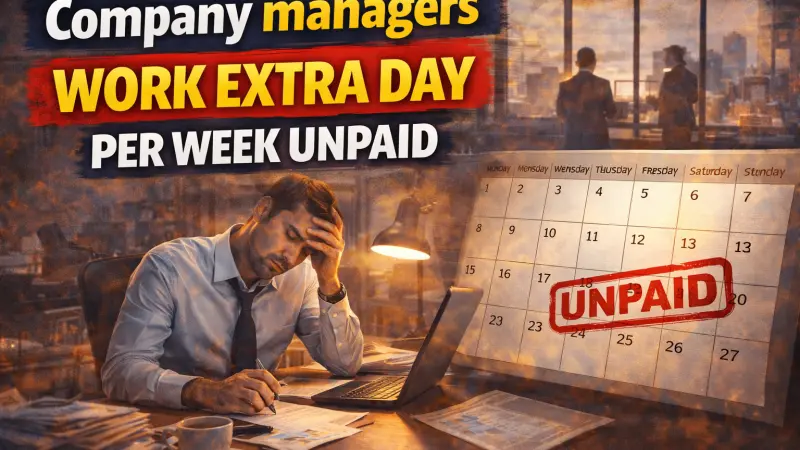
In 2026, the "always-on" culture has reached a breaking point for UK leadership. New data reveals that company managers are effectively giving away a full working day every week in uncompensated labor. While the standard work week remains 37 to 40 hours on paper, the reality for those in management is a "hidden day" of emails, strategy, and crisis management that never appears on a payslip.

The Statistics of the "Hidden Day"
Recent studies from 2025 and 2026 highlight a widening gap between contracted hours and actual time worked. Across the UK, managers are currently averaging between 4 and 8 hours of unpaid overtime per week.
Senior Leadership: For directors and senior managers, this figure often exceeds 10 hours, meaning they work the equivalent of 50 extra days per year for free.
The Industry Split: The "overtime epidemic" is most severe in the IT, professional services, and public sectors, where 35% of managers report regular unpaid weekend work.
Remote Work Paradox: Despite the flexibility of hybrid models, remote managers actually work 3.5 hours more per week than their office-based counterparts, as the lines between home and "the office" continue to blur.
Why Managers Are Working More
The reasons for this extra day of labor are rarely about choice and more often about systemic pressure.
"Leaver-Load": As companies lean out their workforces, the responsibilities of departed staff are frequently "absorbed" by remaining managers rather than being replaced.
Presenteeism 2.0: In a competitive job market, managers often feel a self-imposed pressure to be visible and responsive at all hours to prove their dedication.
Operational Friction: 28% of managers report that unrealistic workloads are the primary driver, stating they simply cannot complete their core duties within standard business hours.
The Productivity Trap
While employers might view "free labor" as a short-term financial win, the long-term impact on the UK economy is negative. Experts argue that widespread unpaid overtime masks underlying inefficiencies.
Burnout Epidemic: Chronic overwork is the leading cause of "brain drain" in the UK, with one in five managers considering leaving their roles in 2026 to escape excessive workloads.
Decreased Quality: Data shows that after the 45-hour mark, the quality of
decision-making and creative output plummets, leading to costly managerial errors.
The "Hustle" Cost: This culture of overwork is estimated to cost the UK economy billions in lost productivity due to stress-related absences and high staff turnover.
Legal Protections and 2026 Reforms
The legal landscape is shifting. Under the Employment Rights Act 2025 and subsequent 2026 updates, there is a renewed focus on "The Right to Disconnect."
The 48-Hour Limit: Under the Working Time Regulations, an employee cannot be forced to work more than 48 hours a week on average unless they have signed a specific "opt-out" agreement.
Minimum Wage Breaches: Even for salaried managers, if unpaid overtime pushes their effective hourly
rate below the National Minimum Wage, the employer is committing a legal breach.
Fair Work Reforms: New government consultations in 2026 are exploring mandatory "workload impact assessments" for management roles to ensure that "reasonable overtime" doesn't become a permanent 50-hour week.
Recommendations for Businesses
To break the cycle of unpaid overwork, forward-thinking UK firms are adopting new strategies:
Clear Boundaries: Establishing "blackout periods" where internal emails are discouraged after 6 PM.
Outcome-Based Tracking: Moving away from "hours at a desk" toward "results delivered," allowing managers to reclaim their time when objectives are met.
Time Off in Lieu (TOIL): Implementing formal systems where managers who work an extra day during a busy period are mandated to take that time back during quieter windows.
Summary
The "unpaid extra day" has become a subsidy for many UK businesses, but it is a subsidy that comes at the cost of managerial health and long-term retention. As 2026 progresses, the companies that thrive will be those that recognize that a well-rested manager is a more effective leader than one who is perpetually working for free.

Disclaimer: The information provided in this article is for general informational and research purposes only. Company details, features, services, and market positions may change over time. Readers are advised to visit official company websites and conduct independent research before making any business decisions or purchasing services.
Most Searchable Keywords

Recent Blogs



Related Listings


Categories
- Accountants (295)
- Advertising Agencies (559)
- Architects (149)
- Automobiles (377)
- Beauty (300)
- Carpenters (146)
- Cleaning Services (386)
- Dentists (189)
- Driving (62)
- Electricians (215)
- Energy (8)
- Event Organiser (685)
- Finance (599)
- Guide (3365)
- Health (2207)
- Information technology (206)
- Legal Services (353)
- Logistics (6)
- Maintenance (65)
- Manufacturing (35)

Sponsored Listings in Locksmith Services


Related Blogs

Gen Z Political Reporters and News Creators i...
Read this insightful article "Gen Z Political Reporters and News Creators in the UK" to expand your knowledge!

Famous Female Social Media Influencers Across...
Read this insightful article "Famous Female Social Media Influencers Across the UK" to expand your knowledge!

Your UK Sponsor Licence 2026 Step by Step Gui...
Read this insightful article "Your UK Sponsor Licence 2026 Step by Step Guide" to expand your knowledge!
Questions & Answers – Find What
You Need, Instantly!
How can I update my business listing?
Is it free to manage my business listing?
How long does it take for my updates to reflect?
Why is it important to keep my listing updated?
