
Registered Office vs. Business Address
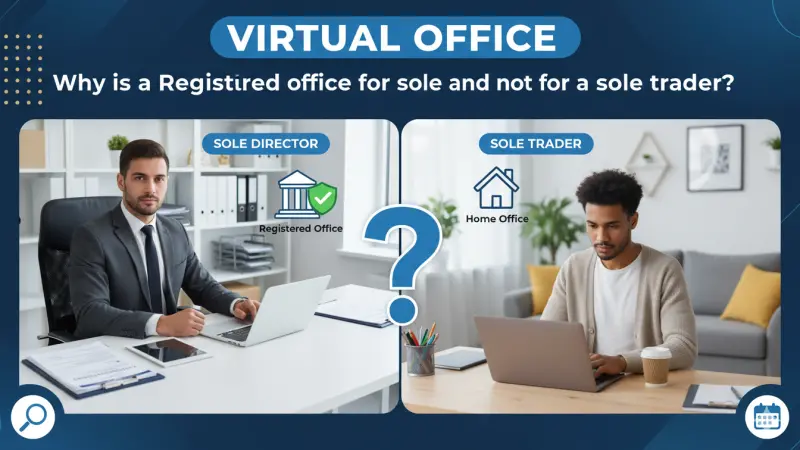
The distinction between a sole director of a limited company and a sole trader is one of the most fundamental concepts in UK business law. While both may involve a single individual running an enterprise, they operate under entirely different legal frameworks. The requirement for a "Registered Office" is not just an administrative preference; it is a statutory obligation born from the creation of a separate legal entity.

The Concept of Corporate Personality
The core reason a sole director needs a registered office lies in the "Salomon v A Salomon & Co Ltd" principle of 1897, which established that a limited company is a legal person in its own right. When you incorporate a company, you are creating a new "entity" that can own property, enter contracts, and be sued.
Because this entity—the company—is not a human being, the law requires it to have a fixed, physical location where it can "reside" in the eyes of the state. This is the Registered Office. It is the official address for the company itself, separate from the director’s home.
A sole trader, by contrast, has no separate legal personality. In the eyes of the law, the individual and the business are the same. Since the person already has a legal identity and a place of residence, there is no "new entity" that requires a separate registered home.
Companies House and the Public Register
Companies House is the registrar for all limited companies in the UK. Their primary mission is to ensure corporate transparency. To facilitate this, every limited company must appear on the public register. The Registered Office address is a mandatory part of this public record, ensuring that any member of the public, a creditor, or a government agency knows exactly where to find the company to deliver official documents.
Sole traders do not register with Companies House. Their business existence is recorded primarily with HMRC for tax purposes. Because HMRC’s records are private and not searchable by the general public, there is no "public register" requirement for a sole trader to provide a statutory office address.
Statutory Mail vs. General Correspondence
The Registered Office serves a very specific legal purpose: it is the destination for "statutory" mail. This includes:
Official notices from Companies House (e.g., late filing penalties or strike-off notices).
Legal summons and court documents (Service of Process).
HMRC Corporation Tax notifications.
For a sole director, missing this mail can lead to the company being dissolved or facing legal judgments. For a sole trader, all "business" mail is simply personal mail. HMRC sends Self Assessment letters directly to the individual at their home or known business address, but these are handled under personal tax laws rather than corporate legislation.
The Privacy Gap: Director vs. Sole Trader
One of the biggest practical differences involves privacy.
Sole Directors: Because the Registered Office is public, any director using their home address is effectively publishing their front door to the world. This is why many sole directors use a professional Registered Office service—to maintain their personal privacy while fulfilling their legal duty to the company.
Sole Traders: Since there is no public register, a sole trader’s home address remains off-record unless they choose to put it on their website or invoices. However, many sole traders still opt for a "Business Address" service to look more professional and to keep their home life separate from their work life, even though they aren't legally forced to have one.
Unlimited vs. Limited Liability
This address requirement is also linked to the "trade-off" for limited liability. When you act as a sole director, the law protects your personal assets from the company's debts. In return for this protection, you must provide a high level of transparency, including a public address and public accounts.
A sole trader accepts "unlimited liability," meaning their personal house and car are at risk if the business fails.
Because they take on all the risk personally, the law is more relaxed regarding their administrative requirements, such as the need for a formal registered office.
A Registered Office is a legal anchor for a limited company—a "person" made of paper that needs a physical home. A sole director is simply the manager of that entity. A sole trader is a person doing business, and since they already have a legal identity, the state sees no need to force them into the same rigid registration and office requirements.

Disclaimer: The information provided in this article is for general informational and research purposes only. Company details, features, services, and market positions may change over time. Readers are advised to visit official company websites and conduct independent research before making any business decisions or purchasing services.
Most Searchable Keywords

Recent Blogs



Related Listings


Categories
- Accountants (295)
- Advertising Agencies (559)
- Architects (149)
- Automobiles (377)
- Beauty (300)
- Carpenters (146)
- Cleaning Services (386)
- Dentists (189)
- Driving (62)
- Electricians (215)
- Energy (8)
- Event Organiser (685)
- Finance (599)
- Guide (3365)
- Health (2207)
- Information technology (206)
- Legal Services (353)
- Logistics (6)
- Maintenance (65)
- Manufacturing (35)

Sponsored Listings in Locksmith Services


Related Blogs

Gen Z Political Reporters and News Creators i...
Read this insightful article "Gen Z Political Reporters and News Creators in the UK" to expand your knowledge!

Famous Female Social Media Influencers Across...
Read this insightful article "Famous Female Social Media Influencers Across the UK" to expand your knowledge!

Your UK Sponsor Licence 2026 Step by Step Gui...
Read this insightful article "Your UK Sponsor Licence 2026 Step by Step Guide" to expand your knowledge!
Questions & Answers – Find What
You Need, Instantly!
How can I update my business listing?
Is it free to manage my business listing?
How long does it take for my updates to reflect?
Why is it important to keep my listing updated?
