
Sole Trader vs Limited Company: Differences Explained
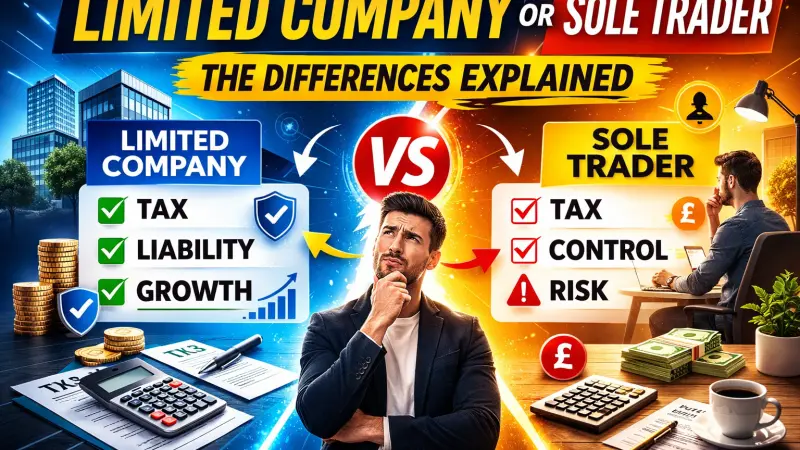
Choosing the right business structure is one of the most important decisions for anyone starting or running a business in the UK. The two most common options are operating as a sole trader or setting up a limited company. These structures differ significantly in legal status, financial responsibilities, tax obligations, administrative requirements and long-term flexibility. Understanding these differences can help you decide which path aligns with your business goals, risk tolerance, expected profits and growth plans. This comprehensive guide explains everything you need to know in clear detail so you can make an informed choice that supports your success in 2025 and beyond.
What is a Sole Trader?
A sole trader also known as self-employed is the simplest form of business structure. In this setup you and your business are legally the same entity. You make all the decisions keep all the profits after tax and handle everything personally. There is no separation between your personal finances and business finances. This structure is popular among freelancers consultants tradespeople and small service providers because it requires minimal paperwork to start. You can begin trading immediately using your own name or a trading name without any formal registration fee. However you must register with HMRC for Self Assessment if your annual turnover exceeds one thousand pounds in a tax year. Many people start as sole traders because the process is quick and low cost allowing them to focus on delivering services rather than dealing with complex compliance.
What is a Limited Company?
In contrast a limited company is a separate legal entity from its owners who are called directors and shareholders. The company has its own legal rights and responsibilities meaning it can enter contracts own assets employ staff and be sued independently of you. This separation provides limited liability protection which is one of the biggest advantages. Your personal assets such as your home or savings are generally protected if the company faces debts or legal issues as long as you act responsibly and do not engage in wrongful trading. To set up a limited company you must register with Companies House which involves choosing a unique company name appointing at least one director and filing incorporation documents. The official fee starts from around twelve pounds online though using an accountant or formation agent can cost between fifty and one hundred and fifty pounds. Once registered the company must follow strict rules including filing annual accounts confirmation statements and paying corporation tax.
Liability Protection: Unlimited vs Limited
One of the most critical differences between the two structures is liability. As a sole trader you have unlimited liability. This means you are personally responsible for all business debts and obligations. If your business runs into financial trouble creditors can pursue your personal assets to recover what they are owed. This risk makes sole trading suitable only if you operate in low risk industries or have adequate insurance such as public liability or professional indemnity cover. On the other hand a limited company offers limited liability. Shareholders are only liable up to the value of their shares which is usually just one pound for a small company. This protection gives peace of mind especially for businesses that deal with contracts suppliers or customers who might bring claims. However directors can still face personal liability in cases of fraud negligence or personal guarantees on loans so the protection is not absolute but it is far stronger than unlimited liability.
Setup Process and Costs
Setup and ongoing administration also vary greatly. Starting as a sole trader is free and straightforward. You simply notify HMRC when your income exceeds the threshold and begin keeping basic records of income and expenses. There is no need for separate company bank accounts though it is recommended for clarity. Annual obligations are limited to submitting a Self Assessment tax return by 31 January following the tax year. In comparison setting up a limited company requires more steps and costs. You register online with Companies House provide details of directors and shareholders and obtain a company number. After incorporation you must register for corporation tax with HMRC within three months of starting to trade. Ongoing admin includes preparing and filing statutory accounts which become public at Companies House filing a confirmation statement at least once a year maintaining proper payroll if you pay yourself a salary and submitting corporation tax returns. This increased paperwork often leads small business owners to hire accountants adding to costs but ensuring compliance. Non compliance with company law can result in fines or even director disqualification so the administrative burden is significantly higher for limited companies.
Taxation Comparison
Taxation represents one of the most complex and important differences and the choice can have a major impact on your take home pay. As a sole trader all business profits are treated as your personal income. You pay income tax at the prevailing rates after your personal allowance of twelve thousand five hundred and seventy pounds for the 2025/26 tax year. The basic rate is twenty percent on income from twelve thousand five hundred and seventy one pounds to fifty thousand two hundred and seventy pounds. Higher rate is forty percent up to one hundred and twenty five thousand one hundred and forty pounds and additional rate is forty five percent above that. You also pay Class 4 National Insurance contributions at six percent on profits between twelve thousand five hundred and seventy pounds and fifty thousand two hundred and seventy pounds and two percent above that threshold. Class 2 contributions are voluntary at around three pounds fifty per week to protect state benefits and pension. There is no corporation tax for sole traders and your accounts remain private between you and HMRC.
For a limited company the tax picture is different and often more flexible. The company pays corporation tax on its taxable profits at nineteen percent for profits up to fifty thousand pounds with marginal relief applying between fifty thousand and two hundred and fifty thousand pounds up to a main rate of twenty five percent. Directors typically extract profits through a combination of salary and dividends. A common strategy is to take a salary equal to the personal allowance of twelve thousand five hundred and seventy pounds which uses up your tax free amount and keeps employee National Insurance low.
The remaining profits after corporation tax are paid as dividends which attract dividend tax at eight point seven five percent for basic rate taxpayers thirty three point seven five percent for higher rate and thirty nine point three five percent for additional rate taxpayers after the five hundred pound dividend allowance. The company may also pay employers National Insurance on salaries above five thousand pounds. This salary plus dividend approach can be more tax efficient at certain profit levels but requires careful planning and professional advice.
Take-Home Pay Examples (2025/26 Tax Year)
To illustrate consider typical take home pay figures for the 2025/26 tax year based on optimal extraction methods. For twenty thousand pounds profit a sole trader might take home around eighteen thousand and sixty eight pounds while a limited company director takes home approximately seventeen thousand two hundred and sixty six pounds giving the sole trader an advantage of eight hundred and two pounds. At forty thousand pounds profit the sole trader takes home thirty two thousand eight hundred and sixty eight pounds compared to thirty two thousand and forty nine pounds for the limited company again favoring the sole trader by eight hundred and twenty pounds. At sixty thousand pounds the limited company edges ahead with forty six thousand eight hundred and thirty one pounds take home versus forty six thousand one hundred and eleven pounds for the sole trader. At higher levels such as one hundred thousand pounds the sole trader often retains an advantage of over two thousand pounds due to recent tax changes that have narrowed the gap. These figures assume standard allowances no additional income and optimal structuring for the limited company. Actual results vary based on individual circumstances expenses and whether employers allowance applies so consulting an accountant is essential.
Other Financial Considerations
Beyond basic tax there are other financial considerations. Sole traders can claim the trading allowance of one thousand pounds to avoid tax on very low income and benefit from straightforward expense deductions. Limited companies can claim more corporate reliefs but must follow stricter rules on claiming losses which can only be carried forward against future profits in most cases. VAT registration is the same for both at ninety thousand pounds turnover threshold allowing you to reclaim input VAT but charge output VAT. Pensions work differently too with limited companies able to make employer contributions that reduce corporation tax while sole traders contribute personally with tax relief at their marginal rate. Both structures allow for business expense claims but limited companies require more formal record keeping.
Privacy and Public Perception
Privacy and public perception form another key distinction. Sole trader accounts and tax details stay private shared only with HMRC unless you need to disclose them to banks or lenders. This suits those who value confidentiality. Limited company accounts even abbreviated ones are filed publicly at Companies House meaning anyone can view your turnover profits and balance sheet. This transparency can build credibility with clients suppliers and investors who see a limited company as more established and professional. Many larger contracts in sectors like IT construction or finance require suppliers to be limited companies for this reason. The professional image of a limited company can open doors to better opportunities and easier access to finance since lenders often prefer dealing with incorporated businesses that have limited liability.
Growth, Sale and Succession
Scaling the business selling it or passing it on also differs markedly. As a sole trader growth is limited by your personal capacity and the business effectively ends when you stop trading. Selling involves transferring assets and goodwill which can trigger capital gains tax and is more complicated. Passing the business to family or heirs requires careful estate planning. In a limited company shares can be sold or transferred easily allowing the business to continue independently of the founder. This makes it simpler to bring in investors raise capital through share issues or exit via sale. Multiple directors and shareholders are possible providing flexibility for partnerships or family businesses that sole traders cannot offer.
Advantages and Disadvantages Summary
Both structures have clear advantages and disadvantages that suit different situations.
Advantages of Sole Trader Complete control over decisions, minimal startup costs, lower ongoing admin, simpler tax filing, private finances, full retention of profits after tax, ease of starting or stopping trading. It is ideal for low risk low profit businesses or those testing an idea without heavy commitment.
Disadvantages of Sole Trader Unlimited personal liability, difficulty raising finance, potential perception as less professional,
higher personal tax rates at scale, challenges in selling or inheriting the business.
Advantages of Limited Company Limited liability protection, more tax planning options through salary and dividends, professional credibility, easier access to loans and investment, potential to scale or sell shares, better suitability for hiring employees. It protects personal wealth and supports long term growth.
Disadvantages of Limited Company Higher setup and ongoing costs, increased administrative burden, public disclosure of accounts, stricter legal responsibilities for directors, potential for higher overall tax at low profits if not structured well, more complex compliance that may require professional help.
When to Choose Each Structure
Deciding between the two depends on your specific circumstances. If your annual profits are below fifty thousand pounds and you prioritize simplicity and lower admin a sole trader structure is often more cost effective and straightforward. Many freelancers and small service providers thrive this way especially in the early stages. If you expect profits to grow above sixty thousand pounds regularly deal with higher risk contracts plan to hire staff or seek external funding a limited company offers better protection and efficiency. Businesses in regulated industries or those aiming for eventual sale almost always choose limited status. It is common to start as a sole trader and incorporate later when the time is right since switching is relatively straightforward though it involves transferring assets notifying HMRC and handling potential tax implications like capital gains on asset transfers.
How to Switch Structures
Switching from sole trader to limited company typically involves forming the new company opening a business bank account transferring assets and liabilities informing HMRC de registering as self employed and registering the company for corporation tax and PAYE if needed. Professional advice helps minimize tax on the transfer. The reverse switch from limited to sole trader is possible but less common and involves closing the company distributing assets and settling all obligations.
In conclusion the choice between limited company and sole trader comes down to balancing simplicity against protection and scalability. There is no one size fits all answer but by carefully weighing liability taxes admin credibility and your growth ambitions you can select the structure that best supports your business journey. Many entrepreneurs consult accountants or business advisors early to model their specific numbers and ensure compliance with current 2025/26 rules. Whatever you choose starting your business is an exciting step and the right structure will give you a solid foundation for success. With proper planning either option can lead to a thriving venture that meets your personal and financial goals.
15 FAQs
1. What is a sole trader? A sole trader is a self employed individual where the owner and
the business are legally the same with unlimited liability and simple tax reporting through Self Assessment.
2. What is a limited company? A limited company is a separate legal entity from its directors and shareholders offering limited liability and requiring registration with Companies House plus corporation tax.
3. What is the main difference between sole trader and limited company? The main difference is legal status sole trader has no separation from the owner while limited company is a distinct entity with limited liability.
4. Which structure has limited liability? Only the limited company provides limited liability protecting personal assets beyond the value of shares.
5. How do taxes differ between sole trader and limited company? Sole traders pay income tax and Class 4 National Insurance on all profits while limited companies pay corporation tax on profits and directors pay income tax on salary plus dividend tax on distributions.
6. Is it cheaper to set up as a sole trader? Yes setting up as a sole trader is free whereas a limited company costs from twelve pounds at Companies House plus possible agent fees.
7. Do limited companies have more admin? Yes limited companies require annual accounts confirmation statements and corporation tax returns making admin more complex and often requiring an accountant.
8. Are sole trader accounts private? Yes sole trader financial details remain private with HMRC unlike limited company accounts which are public at Companies House.
9. Can a sole trader hire employees? Yes a sole trader can hire employees but must handle payroll and employers liability insurance if applicable.
10. When should I switch from sole trader to limited company? Switch when profits regularly exceed fifty thousand to sixty thousand pounds when you need liability protection or when seeking investment or larger contracts.
11. Is a limited company more professional? Yes many clients and sectors view limited companies as more established and credible especially for larger projects.
12. How do I pay myself from a limited company? You can pay a salary through PAYE or dividends from after tax profits or a combination for tax efficiency.
13. What happens if my limited company goes into debt? Creditors can only claim against company assets not your personal ones unless you gave personal guarantees or acted improperly.
14. Can I change my business structure later? Yes it is possible and common to move from
sole trader to limited company or vice versa with proper procedures and HMRC notifications.
15. Should I consult a professional before choosing? Yes an accountant or business advisor can provide tailored advice based on your projected profits industry and personal circumstances to ensure the best decision.
Disclaimer: The information provided in this article is for general informational and research purposes only. Company details, features, services, and market positions may change over time. Readers are advised to visit official company websites and conduct independent research before making any business decisions or purchasing services.
Most Searchable Keywords
Recent Blogs


Related Listings

Categories
- Accountants (295)
- Advertising Agencies (559)
- Architects (149)
- Automobiles (377)
- Beauty (300)
- Carpenters (146)
- Cleaning Services (387)
- Dentists (189)
- Driving (62)
- Electricians (215)
- Energy (8)
- Event Organiser (686)
- Finance (602)
- Guide (3372)
- Health (2207)
- Information technology (206)
- Legal Services (353)
- Logistics (6)
- Maintenance (65)
- Manufacturing (35)
Sponsored Listings in Travel Agencies


Related Blogs

How Much Do UK Actors Really Earn Full Indust...
Read this insightful article "How Much Do UK Actors Really Earn Full Industry Breakdown" to expand your knowledge!

Blue Light Card UK 2026 Check Eligibility and...
Read this insightful article "Blue Light Card UK 2026 Check Eligibility and Claim" to expand your knowledge!

BBC Radio 1 DJs Net Worth Ranking Revealed
Read this insightful article "BBC Radio 1 DJs Net Worth Ranking Revealed" to expand your knowledge!
Questions & Answers – Find What
You Need, Instantly!
How can I update my business listing?
Is it free to manage my business listing?
How long does it take for my updates to reflect?
Why is it important to keep my listing updated?
