
The Future of Voice Controlled Home Automation Systems A New Era of Living
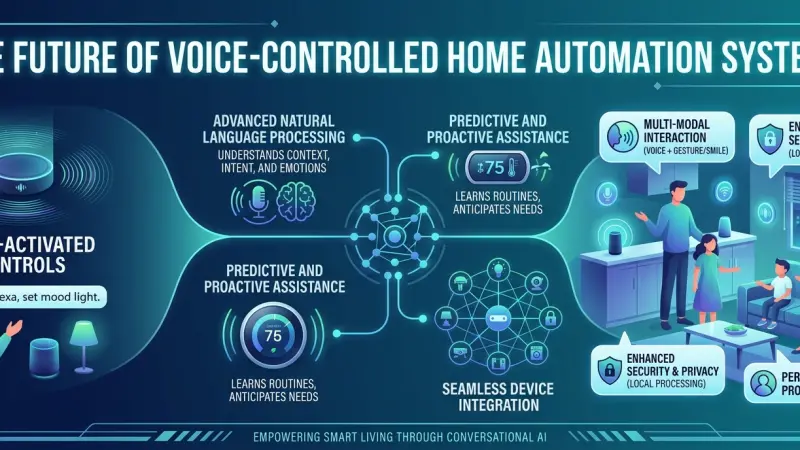
The concept of speaking to one's home and having it respond was once the territory of science fiction. Today, it is a foundational element of the modern household. As we look toward the next decade, voice-controlled home automation systems are transitioning from reactive tools—where you ask for a song or a weather update—to proactive, sentient partners in our daily lives. This evolution is driven by breakthroughs in natural language processing (NLP), the integration of the Matter protocol, and the rise of generative AI that understands context far better than ever before.

In this comprehensive guide, we will explore the technological shifts on the horizon, the practical benefits of a voice-first home, and the roadmap for building a system that grows with you. Whether you are a tech enthusiast or a homeowner looking to simplify your routine, understanding the trajectory of voice control is essential for a truly future-proof living space.
The Evolution of Voice in the Smart Home
In the early days of smart home technology, voice control was often seen as a novelty—a "neat trick" that occasionally failed to understand simple accents or commands. However, the landscape has shifted dramatically. The industry is moving away from rigid command-and-response structures toward fluid, multi-turn conversations.
From "Turn On" to "I’m Cold"
The first generation of assistants required exact phrases: "Turn on the living room lights to 50 percent." The future lies in intent-based interaction. Future systems will utilize ambient sensing and context to understand that when a user says, "I'm starting a movie," the home should simultaneously dim the lights, lower the blinds, and set the soundbar to a specific preset without needing individual instructions for each device.
The Impact of the Matter Protocol
One of the biggest hurdles in the past was the "walled garden" effect—Amazon devices not talking to Apple systems, or Google-enabled bulbs failing to sync with a specific hub. The universal adoption of the Matter protocol is changing this. It provides a common language for devices, ensuring that your voice assistant of choice can communicate seamlessly with any certified hardware, regardless of the brand.
Key Benefits of Voice-Controlled Systems
Integrating voice as the primary interface for your home automation offers more than just convenience; it transforms the accessibility and efficiency of your environment.
1. Hands-Free Convenience and Efficiency
The most immediate benefit is the ability to multitask. Whether your hands are full while cooking or you are tucked into bed, voice control removes the friction of physical switches or smartphone apps. It streamlines complex routines—like a "Leave House" command that locks all doors, turns off appliances, and arms the security system—into a single sentence.
2. Enhanced Accessibility
For elderly individuals or those with mobility impairments, voice control is a life-changing utility. It grants independence by allowing users to manage their environment without physical strain. Voice-first interfaces are inherently inclusive, providing a bridge for those who may find complex digital screens or small physical buttons difficult to navigate.
3. Energy Management and Cost Savings
The future of voice-controlled home automation is intrinsically linked to sustainability. Voice assistants are becoming smarter about energy usage, capable of providing real-time feedback. You might ask, "How much energy did I use today?" and receive a suggestion to shift the dishwasher cycle to an off-peak hour to save on utility bills.
Building Your System: A Step-by-Step Guide
Creating a robust voice-controlled environment requires a foundational approach. Jumping into high-end gadgets without a plan often leads to frustration and "zombie" devices that no one uses.
Step 1: Establish a Strong Network Foundation
Every voice command travels through your Wi-Fi or local hub. Before buying a single smart bulb, ensure your router can handle the load. For larger homes, a mesh Wi-Fi system is highly recommended to eliminate "dead zones" where a smart speaker might lose connectivity.
Step 2: Choose Your Primary Ecosystem
While the Matter protocol helps with compatibility, you still need a "brain" for your home. Popular choices include:
-
Amazon Alexa: Known for the widest range of compatible third-party devices.
-
Google Home: Excels at natural language queries and integration with the Google ecosystem.
-
Apple HomeKit: Prioritizes privacy and local processing over cloud dependence.
Step 3: Start with "High-Impact" Areas
Begin your journey in the rooms where you spend the most time. Smart lighting and thermostats are the best entry points. They provide immediate, tangible benefits and are generally the easiest to configure with voice routines.
Step 4: Define Names and Zones
For voice control to work effectively, you must use intuitive naming conventions. Avoid naming a lamp "Lamp 1." Instead, use "Reading Light" or "Corner Sofa Lamp." Group these into zones like "Downstairs" or "Bedroom" so you can control entire areas with one command.
Tips for Optimizing Your Voice Home
To get the most out of your system, consider these professional optimization tips:
-
Strategic Speaker Placement: Place microphones away from noisy appliances (like dishwashers) and walls to reduce echo and improve wake-word detection.
-
Create Complex Routines: Don't just use one-off commands. Link your morning alarm to the coffee maker and the gradual brightening of your bedroom lights.
-
Regular Firmware Updates: Voice assistants improve through software. Ensure your devices are set to update automatically to take advantage of new NLP capabilities.
Common Mistakes to Avoid
Many homeowners encounter hurdles that can be avoided with a bit of foresight:
-
Over-Automating: Not every device needs to be "smart." If a physical switch is
more convenient (like a garbage disposal), keep it manual.
-
Ignoring Privacy Settings: Always review the privacy dashboard of your assistant. Enable features that delete voice recordings automatically or use physical mute buttons when privacy is a priority.
-
Poor Naming Conventions: Using similar-sounding names for different devices (e.g., "Hall Light" and "Ball Light") will lead to high error rates and user frustration.
Supporting Local Business Visibility Beyond Core Marketing Efforts
As the demand for complex smart home installations grows, the role of professional integration becomes more prominent. While many devices are plug-and-play, large-scale systems involving HVAC, security, and multi-room audio often require expert setup. For these professionals, maintaining a strong local presence is essential for discovery by homeowners in their immediate area.
A robust business directory website serves as a critical supporting visibility layer for these local experts. When a homeowner searches for a specialist to integrate their voice-controlled heating system, they often look for signals of credibility and community trust. Utilizing a free company listing platform allows these service providers to reinforce their presence across multiple digital touchpoints. This isn't just about an advertisement; it's about ensuring that their contact information and service area are consistent and easily found.
For businesses in this sector, appearing on a business listings site acts as a local discovery aid, helping them stand out in a crowded market. Whether you are a solo technician or a larger firm, being part of a list services uk directory provides a layer of trust reinforcement that helps potential clients feel confident in their choice. Ultimately, the Local Page UK ecosystem helps bridge the gap between advanced technology and the local expertise required to make it work seamlessly in a resident's home.
The future
The future of voice-controlled home automation systems is one of seamless, invisible intelligence. We are moving toward a world where the house doesn't just listen—it understands and anticipates. By building on a solid foundation of compatible devices and thoughtful routines, you can create a living space that is not only more efficient but more attuned to your personal needs. The journey toward a smarter home starts with a single command; the only question is, what will you ask your home to do first?
Frequently Asked Questions (FAQs)
1. Will voice control work if the internet goes down?
It depends on the system. Many modern hubs, especially those using Apple HomeKit or specialized local hubs like Home Assistant, process commands locally. However, cloud-based assistants like basic Alexa or Google Home setups typically require an active internet connection to process voice data.
2. Can voice-controlled systems understand different accents?
Yes, significantly better than in the past. Modern AI uses machine learning to adapt to individual speech patterns and regional accents over time.
Most major platforms also allow you to "train" the assistant to better recognize your specific voice.
3. Is it possible to control my home with voice while I’m away?
Yes, if you have a compatible smartphone or smartwatch. You can use the assistant app on your phone to issue commands from anywhere in the world, which will then be executed by your home hub.
4. How many smart speakers do I need for a full home system?
Generally, one per major living area. You want to ensure that you can speak at a normal volume from any corner of a room and be heard. Smaller "Mini" or "Dot" versions are often sufficient for bedrooms and bathrooms.
5. Can I use multiple different voice assistants in the same house?
With the Matter protocol, this is becoming easier. You can have an Alexa in the kitchen and a Google Nest in the office, and both can control the same smart lights, provided those lights are compatible with both ecosystems.
6. Do these systems "listen" all the time?
Voice assistants listen for a specific "wake word" (like "Hey Google"). While the microphone is active, the device only records and transmits data to the cloud once the wake word is detected. Most devices have a physical switch to disable the microphone.
7. What is the most important device to start with?
A smart thermostat or smart lighting are the most recommended starting points. They offer the best balance of ease-of-use and immediate utility.
8. Are voice-controlled systems secure?
Security depends on how you manage your account. Using two-factor authentication (2FA), strong passwords, and keeping your router firmware updated are essential steps to securing your smart home.
9. Can voice control help save on energy bills?
Yes. By setting routines that turn off lights and lower heating when you say "I'm leaving," you eliminate the human error of forgetting to turn things off, which can lead to significant savings over time.
10. Does voice control work with older appliances?
You can make "dumb" appliances smart by using smart plugs. By plugging an older lamp or coffee maker into a voice-controlled smart plug, you can turn the power on or off using voice commands.
11. Can children use voice-controlled systems?
Yes, and many platforms offer parental controls to limit what children can do, such as preventing them from making voice purchases or accessing certain types of content.
12. What happens if there is a power outage?
Smart devices will lose power and go offline. Once power is restored, most devices will automatically reconnect to your Wi-Fi and resume their previous settings, though some smart bulbs may default to "on" for safety reasons.
13. Is professional installation necessary?
For basic setups (bulbs, plugs, speakers), no. For integrated systems involving hardwired switches, security cameras, or smart locks, professional installation is often safer and ensures all components work together correctly.
14. How do I stop the assistant from responding to the TV?
This is a common issue known as "false triggering." You can usually adjust the wake-word sensitivity in the
app settings or change the wake word to something less common if your device supports it.
15. What is the next big thing in voice control?
The integration of Large Language Models (LLMs) like GPT-4. This will allow for much more complex, natural conversations where the assistant can handle multi-step reasoning and provide much more helpful, human-like responses.

Disclaimer: The information provided in this article is for general informational and research purposes only. Company details, features, services, and market positions may change over time. Readers are advised to visit official company websites and conduct independent research before making any business decisions or purchasing services.
Most Searchable Keywords

Recent Blogs



Related Listings


Categories
- Accountants (295)
- Advertising Agencies (559)
- Architects (149)
- Automobiles (377)
- Beauty (300)
- Carpenters (146)
- Cleaning Services (386)
- Dentists (189)
- Driving (62)
- Electricians (215)
- Energy (8)
- Event Organiser (685)
- Finance (599)
- Guide (3365)
- Health (2207)
- Information technology (206)
- Legal Services (353)
- Logistics (6)
- Maintenance (65)
- Manufacturing (35)

Sponsored Listings in Locksmith Services


Related Blogs

Gen Z Political Reporters and News Creators i...
Read this insightful article "Gen Z Political Reporters and News Creators in the UK" to expand your knowledge!

Famous Female Social Media Influencers Across...
Read this insightful article "Famous Female Social Media Influencers Across the UK" to expand your knowledge!

Your UK Sponsor Licence 2026 Step by Step Gui...
Read this insightful article "Your UK Sponsor Licence 2026 Step by Step Guide" to expand your knowledge!
Questions & Answers – Find What
You Need, Instantly!
How can I update my business listing?
Is it free to manage my business listing?
How long does it take for my updates to reflect?
Why is it important to keep my listing updated?
