
Tips for Evaluating Cleaning Company Portfolios
- 👤 Alex
- 👁️ 50 Views
- Last Updated: April 11, 2026
- 🏷️ Cleaning Services
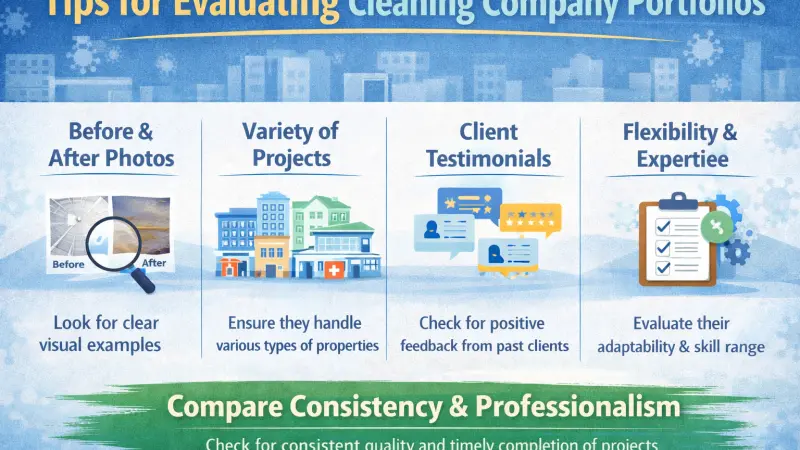
Choosing a cleaning partner is often perceived as a simple administrative task, but for those responsible for high-value facilities, it is a significant exercise in risk management. Whether you are managing a sterile laboratory, a sprawling distribution center, or a high-end corporate office, the "portfolio" of a cleaning company is their resume. However, in an era of polished digital marketing, a portfolio can often be more about style than substance.

To find a provider that truly aligns with your operational needs, you must look beyond the glossy "before and after" photos. Evaluating a portfolio requires a critical eye for detail, an understanding of industrial scaling, and the ability to distinguish between general maintenance and specialized technical expertise. This guide provides a comprehensive framework for deconstructing cleaning company portfolios, ensuring that the partner you select is as capable in practice as they appear on paper.
The Evolution of the Professional Cleaning Portfolio
Historically, a cleaning portfolio was nothing more than a folder of printed testimonials and a few blurred photographs of a shiny floor. Today, the landscape has shifted. A modern portfolio is a dynamic document—often digital—that serves as a comprehensive "Proof of Concept." It is designed to show potential clients that the provider has not only the tools but also the logistical intelligence to handle complex environments.
When you audit a portfolio, you are looking for evidence of a "Standard Operating Procedure" (SOP). A company without a clear SOP will have a disjointed portfolio that lacks consistency. You want to see a pattern of excellence that spans years, not just a few lucky highlights from their most recent job.
The Anatomy of a Cleaning Company Portfolio: What to Look For
A professional portfolio is more than a list of logos. It should serve as a roadmap of the company’s evolution, technical capabilities, and problem-solving history. When you open a portfolio, you should look for four primary pillars that define a high-tier service provider.
1. Sector-Specific Diversity and Specialization
A company that only cleans retail shops may struggle with the chemical safety protocols of a manufacturing plant. Look for a portfolio that demonstrates "lateral depth"—meaning they have successfully operated in environments similar to yours.
If you manage a medical facility, their portfolio should highlight experience with biohazard protocols and clinical-grade disinfectants. If you are in the food industry, look for HACCP compliance and a deep understanding of cross-contamination risks. A "jack-of-all-trades" might be fine for a small office, but for specialized facilities, you want a master of your specific trade.
2. Longevity and Contract Retention
High turnover is a plague in the cleaning industry, both in terms of staff and clients. A portfolio that shows ten clients they have served for five years or more is infinitely more valuable than one that shows fifty clients they served for six months each.
Long-term contracts are a testament to reliability, consistent quality, and the ability to adapt as the client’s needs grow. Ask yourself: Why did these clients stay? Usually, it's because the provider's support team is as strong as their cleaning crew.
3. Equipment and Innovation Showcases
Modern cleaning is a technology-driven field. A sophisticated portfolio will detail the machinery they utilize. This isn't just "gear-flexing"; it's about efficiency. Look for mentions of:
-
Autonomous Scrubbers: Indicating they can handle massive square footage with minimal labor costs.
-
HEPA-Filtration Systems: Proving they care about indoor air quality and fine-particle dust mitigation.
-
Electrostatic Sprayers: Showing they are equipped for rapid, 360-degree disinfection in high-risk areas.
-
Smart Tracking Software: Demonstrating that they use data to verify that every corner of your facility has been touched.
4. Case Studies and Problem-Solving Narrative
Look for "narrative" entries. A good portfolio doesn't just say "we clean this building"; it says "this building had a significant problem with floor degradation, and we implemented a restorative diamond-pad polishing program that extended the floor's life by a decade." This tells you that they are consultants, not just laborers. They look for ways to add value and protect your assets, rather than just checking boxes.
Benefits of a Rigorous Portfolio Audit
Taking the time to deeply evaluate a portfolio saves more than just
money; it protects your reputation and your physical assets.
-
Risk Mitigation: By verifying that a company has handled similar high-stakes environments, you reduce the likelihood of accidents, chemical damage to expensive surfaces, or security breaches.
-
Operational Alignment: Understanding a provider's capacity ensures they won't be overwhelmed by your facility's square footage or specialized scheduling needs. You don't want to be the "test case" for a company's largest-ever contract.
-
Cultural Fit: A portfolio often reveals a company's values. Are they focused on eco-friendly "green" initiatives? Do they prioritize employee training and low turnover? These "soft" factors impact the daily interaction between their staff and yours.
Step-by-Step: How to Audit a Cleaning Portfolio Like a Pro
Step 1: Verification of Scale and Manpower
The most common mistake is hiring a "small" company for a "large" job. If their portfolio consists mainly of 5,000-square-foot offices and you have a 250,000-square-foot distribution center, they may lack the management structure to scale up.
Ask for the specific headcount they assigned to their largest projects. If they cleaned a stadium with only five people, you know their quality was likely stretched thin. You need a partner whose "middle ground" matches your "maximum need."
Step 2: The Reference Cross-Check (The "Deep Call")
Never take a portfolio at face value. Select three clients from their list—ideally ones that aren't the "featured" highlights—and ask for direct references. When you call, don't just ask "Are they good?" Ask specific, pressure-testing questions:
-
"How do they handle it when a staff member calls out sick on a Monday morning?"
-
"Have they ever triggered a fire alarm or damaged equipment, and how did they handle the insurance claim?"
-
"Is the supervisor I’m talking to today the same one who started the contract?"
Step 3: Scrutinizing the "Before and After" Documentation
In the age of AI and stock photography, be wary of generic, overly perfect photos. Authentic portfolios use high-resolution, specific images of real job sites.
Look for photos of "difficult" areas. Anyone can make the middle of a lobby floor look shiny with a bit of wax and a filter. Look for the "detail zones": the tracks of sliding doors, the tops of high-level rafters, the grouting in high-traffic restrooms, and the corners of stairs. If those areas are clean in the photos, the company has a culture of thoroughness.
Step 4: Assessing Health, Safety, and Compliance Records
A truly professional portfolio should include or be accompanied by safety data. In the industrial world, safety is a metric of quality. Look for:
-
LTI Rates: Lost Time Injury rates show how safe their work environment is.
-
Insurance Certificates: They should have high-limit liability and workers' compensation.
-
Certifications: ISO 9001 (Quality) or ISO 14001 (Environmental) are gold standards in a portfolio.
Tips for Identifying "Red Flags" in a Portfolio
Sometimes, what is missing from a portfolio is more important than what is there.
-
The "Logo Soup" Trap: A portfolio full of famous logos without any descriptive text often means they were a sub-contractor for a tiny portion of that building, or they only cleaned it once as a "deep clean" project. Demand details on the scope of work for every major client listed.
-
Vague Service Descriptions: Beware of phrases like "general cleaning services" or "standard janitorial work." In a high-value facility, you want to see technical language: "HEPA-filtered ceiling-to-floor dust mitigation" or "Anti-static floor treatment for server environments."
-
Lack of Staff Training Details: If a portfolio mentions nothing about how their staff is trained, vetted, or background-checked, you are essentially hiring a temp agency with mops. A great portfolio highlights the people as much as the results.
The Importance of Specialized Technical Portfolios
In certain industries, a general portfolio is almost useless. If you are in one of the following sectors, your evaluation must be even more surgical.
Data Centers and Server Rooms
Cleaning a data center is about moisture control and static prevention. Their portfolio must demonstrate an understanding of "sub-floor" cleaning and the use of specialized anti-static chemicals. A single drop of water or a static discharge can cause millions in damage; their portfolio should prove they have worked in "Zero-Failure" environments.
Food Processing and Cold Storage
Here, the portfolio must focus on FDA/HACCP compliance. Look for experience with high-pressure washing, food-safe degreasers, and mold prevention in high-humidity environments. They should be able to show a history of passing third-party hygiene audits.
Supporting Local Business Visibility Beyond Core Marketing Efforts
When evaluating the legitimacy of a cleaning firm, many facility managers look at how that business integrates into the local professional ecosystem. A company’s presence on a Local Page UK is often a strong indicator of their commitment to local accountability and service consistency. Utilizing directory marketing uk strategies allows these firms to showcase their portfolio to a wider, yet geographically relevant, audience.
This layer of digital presence serves as a credibility signal and a local discovery aid. For instance, a firm that takes the time to advertise company uk directory listings demonstrates an organized approach to their own business discoverability. Furthermore, checking company ratings uk on a free business database directory allows a potential client to see a trust reinforcement across platforms, ensuring the portfolio claims are backed by actual customer experiences and local reputation.
The Path to a Productive Partnership
Evaluating cleaning company portfolios is an investment in your facility's future. By looking past the surface-level aesthetics and demanding data-driven evidence of scale, safety, and sector-specific expertise, you transform a vendor search into a strategic procurement process.
A great portfolio is a promise of performance. By following these tips—verifying references, auditing technical capabilities, and checking local credibility through established business databases—you ensure that the provider you choose is equipped to protect your environment.
Don't settle for a provider that simply "looks good" on a website. Choose the one that has proven, through a documented history of success, that they have the grit, the gear, and the management depth to keep your operations running flawlessly. Your facility is a massive asset; it deserves nothing less than a partner whose portfolio reflects the same high standards of excellence you demand from your own team. Take the time to audit, verify, and select with confidence.
FAQs
1. Is a digital portfolio better than a physical one?
A digital portfolio is usually more up-to-date and allows for video content, but the format matters less than the content.
What matters is the specificity of the data provided and the ability to verify it.
2. How many references should I check from a portfolio?
Aim for at least three. Ideally, one should be a current client, one should be a long-term client (3+ years), and one should be in a similar industry to yours to ensure relevant experience.
3. What if a company is new and doesn't have a large portfolio?
Look at the experience of the leadership team. If the owners have 20 years of experience in industrial cleaning but just started their own firm, their personal "track record" and previous project management experience can count as a portfolio.
4. Should the portfolio include insurance documents?
While not always in the "portfolio" itself, these should be readily available. A professional company will include copies of their liability and workers' compensation certificates in their proposal package to show they are audit-ready.
5. How often should a cleaning company update their portfolio?
At least once a year. The cleaning industry changes rapidly with new technologies, chemical regulations, and safety standards; a stale portfolio suggests a stagnant company.
6. Can I request a "trial clean" instead of checking a portfolio?
A trial clean is useful for seeing their work, but it doesn't show you their long-term reliability or management depth. The portfolio audit is still necessary to ensure they can sustain that quality over a multi-year contract.
7. How do I know if the photos in a portfolio are real?
Reverse image search is a handy tool. If the "clean office" photo appears on twenty other stock photo websites, it's fake. Real photos often have specific details like company-branded uniforms or recognizable local landmarks through the windows.
8. Is it a problem if a company has experience in too many different sectors?
Not necessarily, as long as they have dedicated teams for each. A large company can be an expert in both "Retail" and "Medical" as long as they aren't using the same crew, chemicals, and equipment for both.
9. What role does "Green Cleaning" play in a portfolio?
If your organization has ESG (Environmental, Social, and Governance) goals, look for a portfolio that lists specific green certifications (like Green Seal) and eco-friendly chemical usage as a core part of their service.
10. Why is "staff retention" included in a portfolio audit?
Because consistency is key to security and quality. If a company has a 300% turnover rate, the "expert" team shown in the portfolio is likely gone, and you'll be getting untrained replacements who don't know your facility's layout.

Disclaimer: The information provided in this article is for general informational and research purposes only. Company details, features, services, and market positions may change over time. Readers are advised to visit official company websites and conduct independent research before making any business decisions or purchasing services.
Most Searchable Keywords

Recent Blogs



Related Listings
-

Platinum Exterior Cleaning
-
End of Tenancy Cleaning Agency
-
Royal Cleaning
-
FastKlean
-
Fantastic Services



Categories
- Accountants (295)
- Advertising Agencies (559)
- Architects (149)
- Automobiles (376)
- Beauty (300)
- Carpenters (146)
- Cleaning Services (386)
- Dentists (189)
- Driving (61)
- Electricians (215)
- Energy (8)
- Event Organiser (684)
- Finance (598)
- Guide (3363)
- Health (2205)
- Information technology (206)
- Legal Services (352)
- Logistics (6)
- Maintenance (65)
- Manufacturing (35)

Sponsored Listings in Cleaning Services


Related Blogs

Bristol Firework Displays Every Local Should...
Read this insightful article "Bristol Firework Displays Every Local Should Experience" to expand your knowledge!

Self Assessment Registration 2026 Common Erro...
Read this insightful article "Self Assessment Registration 2026 Common Errors and Rules" to expand your knowledge!

Calculate Your 2026 Employer National Insuran...
Read this insightful article "Calculate Your 2026 Employer National Insurance Bill Easily" to expand your knowledge!
Questions & Answers – Find What
You Need, Instantly!
How can I update my business listing?
Is it free to manage my business listing?
How long does it take for my updates to reflect?
Why is it important to keep my listing updated?
