Have you ever unscrewed a light switch or opened a junction box only to be met with a confusing array of coloured cables? In the United Kingdom, understanding these colours is not merely a matter of curiosity; it is a fundamental safety requirement governed by strict national standards. Unlike a Hollywood thriller where cutting the wrong wire leads to a dramatic explosion, a mistake in your home’s wiring is more likely to result in a silent but deadly electrical fire or a fatal electric shock. Whether you are a homeowner, a DIY enthusiast, or a property manager, knowing the difference between a live, neutral, and earth wire is essential for maintaining a safe environment.

This comprehensive guide explores the evolution of UK electrical wiring colours, the transition from old standards to the current harmonised system, and the practical steps you must take to ensure your property remains compliant with the IET Wiring Regulations (BS 7671).
The Critical Role of Colour Coding in Modern Electrics
Electrical wiring is the invisible nervous system of any building. Because electricity itself is invisible, engineers and electricians rely on a visual language—colour coding—to identify the function of every conductor within a system. This system allows for the safe installation, maintenance, and repair of electrical circuits without the constant need for complex testing of every single inch of cable.
In the UK, the "language" of wiring is dictated by the British Standard BS 7671. However, as any experienced electrician will tell you, the colours you see are only as reliable as the person who installed them. While mass-produced items like modern appliances and ceiling fans are generally consistent, older UK homes often contain a "mixed" palette of wiring from different eras. Understanding these variations is the first step toward electrical literacy.
Current UK Wiring Colours The Harmonised System
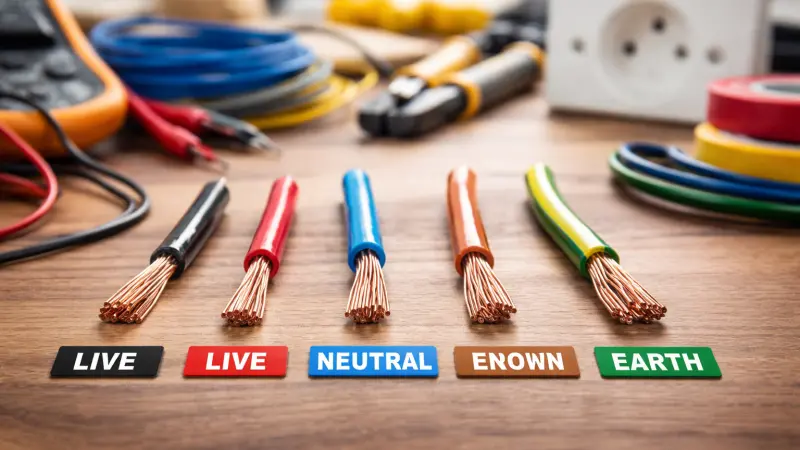
Since April 2004, the UK has followed a harmonised European standard for electrical wire colours. This change was implemented to ensure consistency across the EU and to reduce the risk of confusion for contractors working across borders. If your home was built or rewired after 2004, you will encounter the following colours:
- Brown (Live): This is the wire that carries the electrical current from the consumer unit (fuse box) to your device. It is "hot" and extremely dangerous to touch when the power is on.
- Blue (Neutral): The neutral wire completes the circuit by carrying the current back to the consumer unit. While it is designed to be at or near zero volts, it can still carry current and should always be treated with caution.
- Green and Yellow (Earth): This is the safety wire. Its sole purpose is to provide a low-resistance path to the ground if a fault occurs, preventing the metal casing of an appliance from becoming live and delivering a shock.
Single-Phase vs. Three-Phase Wiring
The colours mentioned above apply to standard "single-phase" residential wiring. In larger commercial or industrial settings in the UK, you may encounter "three-phase" power.
This is used for heavy machinery and large heating systems. In three-phase systems, the live wires are coloured Brown (L1), Black (L2), and Grey (L3), with Blue remaining as the Neutral.
The Legacy of Old UK Wiring Colours
If your property was built before 2004 and hasn't been fully rewired, you are highly likely to find the "Old British" colour scheme. This is where most confusion occurs during home renovations. Between 1970 and 2004, the standard UK colours were:
- Red (Live): Replaced by Brown.
- Black (Neutral): Replaced by Blue.
- Green and Yellow (Earth): Remained the same (though very old houses pre-1970 may have plain Green or even bare copper).
The danger arises when a "mixed" system exists. For instance, if you install a new modern light fitting (Brown/Blue) into an old circuit (Red/Black), you must correctly match Red to Brown and Black to Blue. Reversing these can lead to "reverse polarity," where a switch turns off the neutral rather than the live, leaving the appliance "live" even when it appears to be off.
The Earth Wire: Your Home’s Life Support System
The national electric code prioritises grounding above almost all other functions. The Green and Yellow earth wire is non-current-carrying under normal conditions. It acts as a bypass. If a live wire inside your toaster comes loose and touches the metal outer shell, the electricity will immediately flow through the earth wire back to the consumer unit. This surge of current will cause the Circuit Breaker (MCB) or Residual Current Device (RCD) to "trip," cutting off the power instantly.
In many UK homes, you may also see Bare Copper Wire. This is typically the earth conductor found inside "Twin and Earth" cables. When an electrician installs these into a socket or switch box, they must slide a Green and Yellow plastic sleeve (known as earth sleeving) over the bare copper to identify it correctly. Never leave earth wires bare, as they can accidentally touch live terminals.
Using Phasing Tape and Identification Sleeving
Errors in wiring are not always accidental; sometimes they are the result of practical limitations. For example, in a standard UK lighting circuit, an electrician might use a piece of "Twin and Earth" cable to run from the light to the switch. This cable contains a Brown and a Blue wire. However, in this specific "switch drop," both wires are actually carrying live current.
To comply with UK regulations, the electrician must place a small piece of Brown Sleeving or Brown Phasing Tape over the end of the Blue wire. This signals to any future person working on the circuit that "this Blue wire is actually
a switched-live, not a neutral." If you see a blue wire with a brown tab in your ceiling rose, do not remove it—it is a vital indicator of the wire's true function.
Why Professional Testing Outweighs Visual Inspection
As the "branch manager" mentioned in the original text rightly noted: "The colours are only as good as the electrician that used them." You should never assume a wire is safe just because of its colour. There are several reasons why colours can be misleading:
- Historical Errors: A previous homeowner may have performed "cowboy" DIY work, using whatever cable was available.
- Heat Damage: Overloaded circuits can cause insulation to fade or turn black, making it impossible to distinguish between brown and blue.
- Borrowed Neutrals: Complex lighting circuits sometimes "borrow" a neutral from another circuit, leading to unexpected voltages.
Before touching any wire, you must use a Two-Pole Voltage Tester or a Non-Contact Voltage Detector (often called a "volt stick"). Even after turning off the main isolator switch at the consumer unit, professional electricians will "Prove-Test-Prove" to ensure the circuit is truly dead.
The Top 10 Electrical Issues in UK Households
While wire colours are the primary identifier, they are often linked to broader systemic issues. Here are the most common reasons UK homeowners call out a Part P registered electrician:
- Tripping RCDs: Often caused by moisture in outdoor lights or faulty heating elements in kettles/washing machines.
- Flickering Lights: Usually a sign of a loose neutral connection in a ceiling rose.
- Burning Smell from Sockets: Indicates a loose connection causing "arcing," which generates intense heat and melts the plastic.
- Non-compliant Consumer Units: Old "fuse boxes" with rewireable wire don't offer the same protection as modern 18th Edition metal consumer units.
- Lack of Earthing: Many 1960s homes lack an earth connection in lighting circuits, making modern metal light fittings dangerous.
- Rodent Damage: Rats and mice in lofts frequently chew through the plastic insulation of cables.
- Overloaded Extension Leads: Plugging high-wattage appliances (like heaters) into multi-way adapters.
- DIY Gone Wrong: Attempting to add extra sockets without calculating the load on the ring main.
- Inadequate IP Ratings: Using indoor-rated switches or lights in bathrooms or gardens.
- Outdated Wiring: Rubber-insulated (VIR) or lead-sheathed cables that have reached the end of their 40-year lifespan.
UK Regulations and Compliance: Part P
In England and Wales, electrical safety is regulated under Part P of the Building Regulations. This law states that most electrical work in "special locations" (bathrooms, kitchens, and gardens) or any work involving a new circuit must be notified to Local Authority Building Control. By hiring a registered electrician (NAPIT or NICEIC), they can self-certify the work and provide you with an Electrical Installation Certificate (EIC). This document is essential when selling your home, as it proves the wiring matches the colour-coded safety standards required by law.
Frequently Asked Questions (FAQ)
Is it illegal to have old red and black wiring in my house?
No, it is not illegal. Old wiring is perfectly acceptable as long as it is in good condition and was installed according to the regulations at the time.
However, if you add a new circuit or perform significant renovations, that new section must use the modern brown and blue colours, and a "Caution: Mixed Colours" label must be attached to your consumer unit.
What happens if I mix up the brown and blue wires?
This creates "Reverse Polarity." While some appliances might still work, the internal fuse or switch will be on the neutral side. This means the appliance remains live even when switched off, posing a severe risk of electric shock to anyone cleaning or repairing the device.
Can I use black electrical tape to mark a neutral wire?
Under the old system, black was neutral. Under the new harmonised system, blue is neutral. While you can use black tape for insulation repairs, you should use Blue Phasing Tape or Blue Sleeving to identify a wire as a neutral to avoid confusion with the old live/neutral standards.
Why are some earth wires bare copper?
In standard "Twin and Earth" flat cable used in the UK, the earth wire is left uninsulated to save space and cost during manufacturing. It is mandatory for an electrician to add Green and Yellow sleeving to the visible ends of these wires during installation.
Do ceiling fans use different colours?
Many ceiling fans imported into the UK may have an additional Blue or Grey wire for the light kit, separate from the motor. Always refer to the manufacturer’s wiring diagram, as international products may not always perfectly align with UK domestic fixed-wiring colours.
Final Thoughts on Electrical Safety
Understanding UK electrical wire colours is an invaluable skill, but it is no substitute for professional expertise. Whether you are dealing with the modern Brown,
Blue, and Green/Yellow scheme or the legacy Red and Black system, the fundamental rule remains: Treat every wire as live until proven otherwise.
If you are planning home improvements, a loft conversion, or simply need to replace an old socket, take the time to inspect your wiring. If the insulation appears brittle, if you find old green "goo" leaking from cables (a sign of plasticiser migration), or if the colours don't make sense, call a qualified electrician. It is better to pay for a troubleshooting consultation than to risk the safety of your property and family.