
UK Retailers Report Biggest Price Drop Since 2006
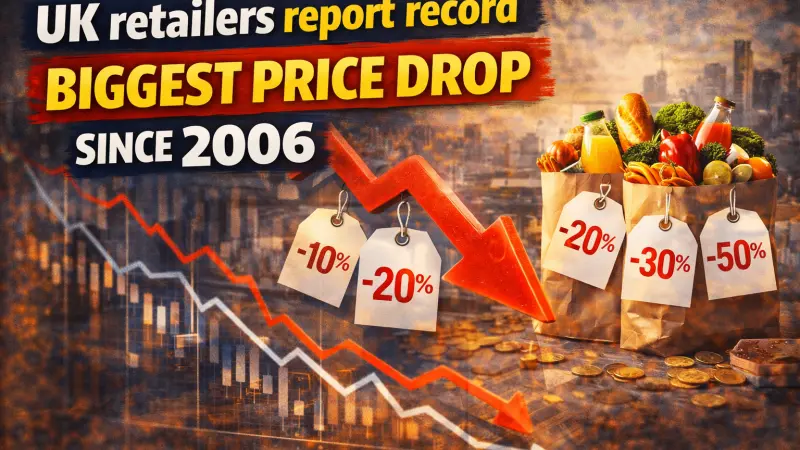
In a significant shift for the British economy, UK retailers have reported the largest annual decline in prices since 2006. According to the British Retail Consortium (BRC), aggressive competition among supermarkets and a dramatic cooling of food inflation have combined to create a "buyer's market" for the first time in nearly two decades.

The Scale of the Deflation
The latest industry figures show that overall shop prices fell by 1.8% year-on-year. This marks a historic low, surpassing previous records and signaling a major victory for consumer purchasing power.
Non-Food Sector: Prices in non-food categories—including furniture, clothing, and electronics—saw a massive 3.4% reduction.
Food Inflation: While food prices did not enter negative territory, inflation in this sector hit a record low of 0.6%, down significantly from the double-digit peaks seen in recent years.
Quarterly Trends: The data reflects a consistent downward trajectory throughout the first half of
the year, driven by lower import costs and improved supply chain stability.
The Supermarket Price War
The primary engine behind this record drop is the fierce competition between the UK’s major grocery chains. With market leaders like Tesco and Sainsbury’s fighting to protect their market share from discounters like Aldi and Lidl, the result has been a series of "aggressive" price cuts across essential items.
Leading the Charge: Tesco reported its largest drop in quarterly sales in 40 years earlier in the cycle, prompting a strategic pivot toward deeper discounts to win back footfall.
Essential Savings: Prices for bread, cereals, and dairy products have seen the most notable stabilizes, providing much-needed relief to lower-income households.
Driving Factors Behind the Decline
Several macroeconomic factors have converged to allow retailers to slash prices without completely eroding their margins:
1. Lower Import Costs As global commodity prices for wheat, oils, and energy have stabilized, the cost of importing goods into the UK has fallen. Retailers are now passing these savings directly to the consumer to stimulate demand.
2. Intense Market Competition The UK retail landscape is one of the most competitive in the world. Retailers are currently prioritizing "volume over value," meaning they would rather sell more items at a lower price than risk losing customers to a cheaper rival.
3. Consumer Spending Caution Despite the price drops, consumer confidence remains fragile. Shoppers are increasingly "intentional," delaying
large purchases to wait for sales events or switching to private-label brands to save money.
What This Means for the British Public
The immediate benefactor of this deflationary trend is the British public. With consumer inflation falling to a four-year low of 1.5%, households are seeing their disposable income stretch further for the first time in years.
Real Wage Growth: As price rises stay below wage increases, the "cost of living squeeze" is beginning to ease for many families.
Bank of England Outlook: These figures support the Bank of England's efforts to bring headline inflation back to its 2% target, potentially paving the way for further interest rate discussions later in 2026.
Future Outlook
While the record drop is welcome news, analysts warn that the retail sector remains in a "restructuring" phase. High business rates and rising labor costs mean that while prices are low for consumers, margins for retailers are incredibly thin. For the remainder of 2026, the industry expects "sticky" but low inflation, with the current price war likely to continue as brands fight for a shrinking pool of discretionary spend.

Disclaimer: The information provided in this article is for general informational and research purposes only. Company details, features, services, and market positions may change over time. Readers are advised to visit official company websites and conduct independent research before making any business decisions or purchasing services.
Most Searchable Keywords

Recent Blogs


Related Listings


Categories
- Accountants (295)
- Advertising Agencies (559)
- Architects (149)
- Automobiles (377)
- Beauty (300)
- Carpenters (146)
- Cleaning Services (386)
- Dentists (189)
- Driving (62)
- Electricians (215)
- Energy (8)
- Event Organiser (685)
- Finance (599)
- Guide (3365)
- Health (2207)
- Information technology (206)
- Legal Services (353)
- Logistics (6)
- Maintenance (65)
- Manufacturing (35)

Sponsored Listings in Locksmith Services


Related Blogs

Gen Z Political Reporters and News Creators i...
Read this insightful article "Gen Z Political Reporters and News Creators in the UK" to expand your knowledge!

Famous Female Social Media Influencers Across...
Read this insightful article "Famous Female Social Media Influencers Across the UK" to expand your knowledge!

Your UK Sponsor Licence 2026 Step by Step Gui...
Read this insightful article "Your UK Sponsor Licence 2026 Step by Step Guide" to expand your knowledge!
Questions & Answers – Find What
You Need, Instantly!
How can I update my business listing?
Is it free to manage my business listing?
How long does it take for my updates to reflect?
Why is it important to keep my listing updated?
