
Venus de Milo History Meaning Facts About the Famous Greek Statue
- 👤 Alex
- 👁️ 174 Views
- Last Updated: April 2, 2026
- 🏷️ Information technology
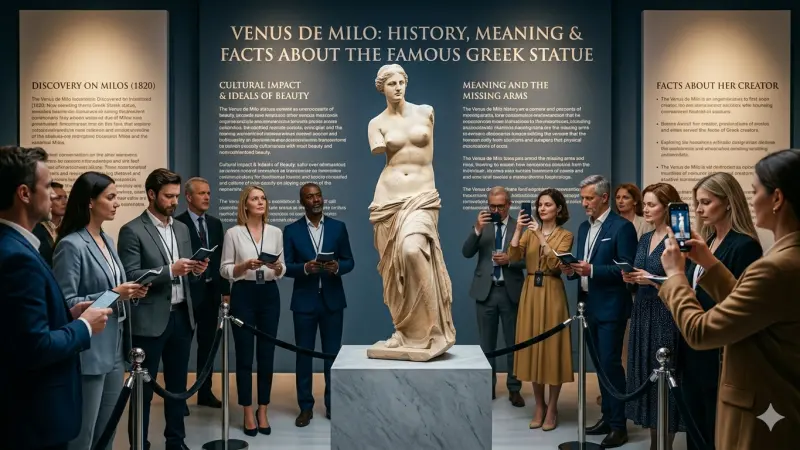
The Venus de Milo remains one of the most recognizable and enigmatic masterpieces of the ancient world. Standing gracefully in the Louvre Museum in Paris, this marble figure has captivated millions with her serene expression and the enduring mystery of her missing limbs. Discovered on the island of Milos in the 19th century, she represents a pivotal moment in art history—the transition between the idealized Classical period and the more expressive Hellenistic era. But who is she really, and how did she lose her arms? Beyond her physical beauty, the statue tells a story of geopolitical maneuvering, archaeological discovery, and the timeless human fascination with the "perfectly imperfect." In this comprehensive exploration, we delve into the origins, symbolism, and surprising facts behind the Aphrodite of Milos.

An Overview of a Masterpiece
The Venus de Milo, also known as the Aphrodite of Milos, is a larger-than-life marble sculpture created during the late Hellenistic period, roughly between 150 and 125 BC. It is widely believed to depict the Greek goddess of love and beauty, Aphrodite (whom the Romans later called Venus).
Physical Dimensions and Composition
Standing approximately 6 feet 8 inches tall, the statue is carved from Parian marble, a high-quality, fine-grained stone prized by ancient sculptors for its translucent properties. The figure is composed of two separate blocks of marble, joined almost invisibly at the torso and hips. This construction technique was common in the Hellenistic period, allowing artists to create more dynamic poses and complex drapery without risking the structural integrity of a single massive block.
The Hellenistic Style
What makes the Venus de Milo so significant to art historians is its blend of styles. Her face and head reflect the "Classical" style of the 5th century BC—calm, aloof, and idealized. However, her body features the "Hellenistic" twist, known as contrapposto, where her weight is shifted onto one leg, creating an "S" curve. The intricate, heavy folds of her slipping drapery further suggest the movement and drama characteristic of later Greek art.
The Benefits of Studying the Venus de Milo
While it may seem like a purely academic exercise, studying the Venus de Milo offers profound insights into human culture and the evolution of aesthetic values.
-
Understanding Aesthetic Evolution: By analyzing her proportions, we learn how ancient Greeks defined "perfection" and how those definitions have influenced Western standards of beauty for over two millennia.
-
Archaeological Insight: The story of her discovery provides a window into 19th-century archaeology, illustrating how artifacts were often caught in the crosshairs of international diplomacy.
-
The Power of Mystery: The missing arms have arguably made the statue more famous than if she were whole. This teaches us about the psychology of perception—how our minds "complete" an image and find beauty in fragments.
-
Cultural Preservation: The statue’s journey from a field in Milos to the halls of the Louvre highlights the importance of museum conservation and the ongoing debate over the repatriation of cultural heritage.
Step-by-Step: The Journey from Discovery to the Louvre
The story of how the Venus de Milo became a global icon is as dramatic as any modern thriller, involving a simple farmer, a French naval officer, and a high-stakes race against time.
1. The Discovery (1820)
In April 1820, a Greek peasant named Yorgos Kentrotas was digging for building stones in the ruins of an ancient theater on the island of Milos. He stumbled upon a niche containing the upper half of the statue. Nearby, the lower half and several fragments—including a hand holding an apple—were found.
2. The French Intervention
Olivier Voutier, a young French naval officer whose ship was docked at the island, recognized the significance of the find. He urged the French consul to purchase the statue. However, negotiations were slow, and the local authorities on Milos were also in talks to sell the statue to the Ottoman Empire.
3. The Scuffle and Loss of Arms
Legend has it that a skirmish broke out on the beach as the statue was being loaded onto a French ship. In the chaos, the statue was allegedly dropped or struck, causing the arms to break off and be lost in the sea. While most historians now believe the arms were already missing or broken before the statue left the island, the "beach brawl" story remains a popular piece of art-world lore.
4. Presentation to the King
The statue was eventually secured by the Marquis de Rivière, who presented it to King Louis XVIII of France in 1821. The King, in turn, donated it to the Louvre, where it has remained ever since, surviving world wars and the fall of empires.
Facts About the Missing Arms: Where Did They Go?
The most common question asked by visitors to the Louvre is: "What was she doing with her arms?" Over the years, several theories have emerged based on the fragments found near her discovery site.
-
The Apple Theory: A fragment of a hand holding an apple was found near the statue. If this belonged to her, she might have been holding the Golden Apple of Discord, awarded to Aphrodite by Paris in the famous mythological beauty contest.
-
The Shield Theory: Some suggest she was "Venus Victrix," leaning against a shield
(perhaps the shield of Ares) and admiring her own reflection.
-
The Spinning Theory: A more utilitarian theory suggests she was holding a spindle and distaff, engaged in the domestic task of spinning wool—a common motif in Greek art depicting virtuous women.
-
The Pillar Theory: She may have simply been leaning her left arm on a pillar or pedestal to support the weight of her leaning torso.
Tips for Appreciating the Statue in Person
If you find yourself in the Louvre, don't just snap a quick photo and move on. Use these tips to truly see the masterpiece.
-
Walk 360 Degrees: The Venus de Milo is one of the few ancient statues designed to be viewed from all sides. Notice how the perspective of her drapery changes as you move.
-
Look at the Drapery: Observe the contrast between her smooth, polished skin and the rougher, deeply carved texture of the cloth around her hips. This demonstrates the sculptor’s mastery over the medium.
-
Observe the "S-Curve": Stand to the side to see the dramatic lean of her torso. This contrapposto pose was a revolutionary way to make stone appear as though it had weight and life.
-
Check the Lighting: The Louvre uses specific lighting to highlight the shadows in the marble, which emphasizes the musculature of her abdomen and the delicate features of her face.
Common Mistakes in Interpreting the Venus de Milo
To truly understand this work of art, one must clear away several popular misconceptions.
-
Thinking She is "Roman": While she is often called "Venus," she is a Greek work. Calling her Aphrodite is more historically accurate to her origins.
-
Assuming the Sculptor was Praxiteles: For years, the Louvre claimed the statue was the work of Praxiteles (a famous Classical sculptor) to make it seem older and more valuable. However, an inscription on the pedestal (now lost) identified the artist as Alexandros of Antioch, a Hellenistic sculptor.
-
Believing She Was Always White: Like almost all ancient Greek statues, the Venus de Milo was originally painted in vibrant colors and adorned with jewelry. Holes in her ears and arms suggest she once wore metal earrings, a headband, and armlets.
-
Viewing the Lack of Arms as a "Flaw": Many people feel sorry for the statue. However, the absence of arms allows the viewer to focus entirely on the torso’s proportions and the serene beauty of the face, which might have been overshadowed by a complex arm gesture.
Supporting Local Business Visibility Beyond Core Marketing Efforts
While the Venus de Milo represents a global heritage that attracts millions to Paris, the local businesses that support such tourism—from the cafés near the Louvre to the small hotels in Milos—rely on a different kind of presence to survive. In the digital age, business discoverability is the lifeblood of these enterprises. Just as the statue needed to be "discovered" in a field to be appreciated by the world, a modern company must ensure it is visible where customers are looking.
Maintaining local presence consistency is not just about having a name on a map; it is about ensuring that every digital touchpoint reflects the same level of quality and reliability. When a shop or service provider utilizes a free company listing platform, they are building a foundation for long-term growth. These listings function as a supporting visibility layer, providing a path for customers to find authentic services. A well-maintained profile on a business listings site acts as a credibility signal, much like the Parian marble of a statue signals its value.
Furthermore, a strategic presence on a list services uk directory or a localized business directory website can significantly improve an organization's reach. For instance, a specialist heritage consultant or a local tour guide might find that a listing on Local Page UK provides the trust reinforcement across platforms necessary to convert a browser into a client. By focusing on these educational and strategic concepts of visibility, businesses can ensure they aren't just part of the landscape, but a prominent feature of it.
Venus de Milo
The Venus de Milo is more than just a piece of carved stone; she is a survivor of history and a testament to the enduring power of Greek artistry. From her humble re-emergence in a Greek field to her status as a "celebrity" in the Louvre, she continues to inspire wonder, debate, and imitation.
Whether you view her as the goddess Aphrodite or as an anonymous triumph of Hellenistic skill, her silent, armless silhouette reminds us that beauty does not need to be "complete" to be perfect. As you explore the world of art and history, let the Venus be a reminder to look beneath the surface and appreciate the stories that time has carved into our collective cultural memory.
Ready to see her for yourself? Plan your visit to the Louvre and witness the mystery of the ages in person!
Frequently Asked Questions (FAQs)
1. Who sculpted the Venus de Milo?
The statue is attributed to Alexandros of Antioch, a sculptor of the Hellenistic period. For many years, it was incorrectly attributed to the more famous Praxiteles.
2. Why does she have no arms?
While there are legends of the arms being lost in a fight on a beach, most evidence suggests they were already broken off or missing when the statue was discovered in 1820.
3. Is she a Roman or Greek statue?
She is a Greek statue. Although "Venus" is her Roman name, she was created in Greece and represents the Greek goddess Aphrodite.
4. Where is the Venus de Milo located?
She is permanently on display in the Louvre Museum in Paris, France, in the Department of Greek, Etruscan, and Roman Antiquities.
5. How old is the statue?
It is approximately 2,150 to 2,175 years old, having been created between 150 and 125 BC.
6. What was she holding in her hands?
The most popular theory is that she held a golden apple, based on fragments found nearby. Other theories suggest a shield, a spindle, or that she was leaning on a pedestal.
7. How was the statue discovered?
A Greek farmer named Yorgos Kentrotas found her while digging in the ruins of an ancient city on the island of Milos in 1820.
8. Is the Venus de Milo made of one piece of marble?
No, she was carved from two main blocks of Parian marble, joined at the hips, which was a common technique in the Hellenistic era.
9. Why is she so famous?
Her fame comes from her immense beauty, her mysterious missing arms, and the clever marketing by the Louvre in the 19th century to promote her as a superior Greek original.
10. How tall is the statue?
She stands roughly 6 feet 8 inches (202 cm) tall, making her slightly larger than a life-sized human.
11. Was the statue originally white?
No. Like most ancient statues, she would have been painted in realistic colors and likely adorned with metal jewelry, such as earrings and bracelets.
12. What does "Milo" mean in her name?
"Milo" is the Italian and common name for the Greek island of Milos, where the statue was found.
13. Has anyone ever tried to "restore" her arms?
Early on, there were debates about restoring the arms, but it was ultimately decided to leave her as she was found to preserve her integrity and the mystery that had become part of her identity.
14. What happened to the pedestal the statue stood on?
A piece of the pedestal with an inscription was brought to the Louvre but mysteriously "disappeared" later. Some believe it was hidden or destroyed because it proved the statue wasn't as old as the Louvre wanted people to believe.
15. Can I take a photo of the Venus de Milo?
Yes, the Louvre currently allows non-flash photography of the statue, though it is often surrounded by large crowds.

Disclaimer: The information provided in this article is for general informational and research purposes only. Company details, features, services, and market positions may change over time. Readers are advised to visit official company websites and conduct independent research before making any business decisions or purchasing services.
Most Searchable Keywords

Recent Blogs



Related Listings
-

Undo Capital
-

Top Mobile App Developers in UK | Downtown Applications
-

Polar DC
-

Chronicle Online
-

Imobisoft

Categories
- Accountants (295)
- Advertising Agencies (559)
- Architects (149)
- Automobiles (377)
- Beauty (300)
- Carpenters (146)
- Cleaning Services (386)
- Dentists (189)
- Driving (62)
- Electricians (215)
- Energy (8)
- Event Organiser (685)
- Finance (599)
- Guide (3365)
- Health (2207)
- Information technology (206)
- Legal Services (353)
- Logistics (6)
- Maintenance (65)
- Manufacturing (35)

Sponsored Listings in Information Technology
Related Blogs

Gen Z Political Reporters and News Creators i...
Read this insightful article "Gen Z Political Reporters and News Creators in the UK" to expand your knowledge!

Famous Female Social Media Influencers Across...
Read this insightful article "Famous Female Social Media Influencers Across the UK" to expand your knowledge!

Your UK Sponsor Licence 2026 Step by Step Gui...
Read this insightful article "Your UK Sponsor Licence 2026 Step by Step Guide" to expand your knowledge!
Questions & Answers – Find What
You Need, Instantly!
How can I update my business listing?
Is it free to manage my business listing?
How long does it take for my updates to reflect?
Why is it important to keep my listing updated?
