
Why Human-Centric Content Wins in the Age of AI
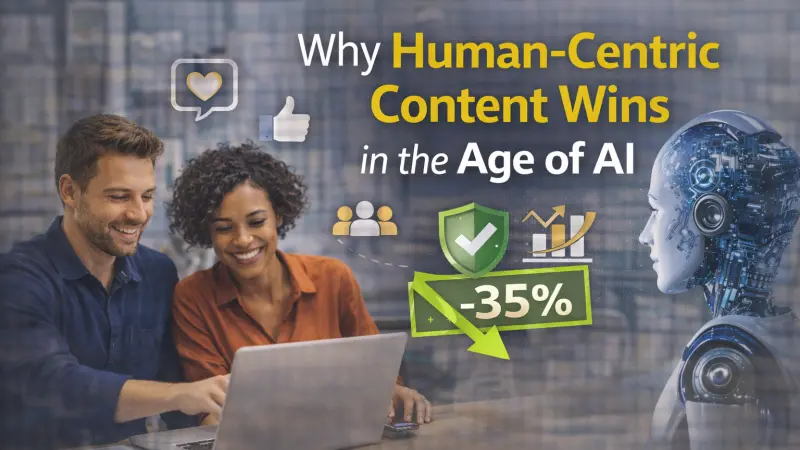
We are living through the most significant shift in content creation history. AI tools can now produce thousands of words in seconds. Yet, ironically, the demand for human connection in marketing has never been stronger. Human-centric marketing trends show us one undeniable truth: people still want to hear from people.

Audiences are getting smarter. They can sense when content feels manufactured. And when they do, they scroll right past it. That gap between AI-generated volume and genuine human value is where smart marketers are building their competitive edge. This article unpacks why authenticity has become the premium currency of modern content, and exactly how you can earn it.
Why Authenticity Matters More Than Ever
Before AI writing tools became mainstream, brands competed on quality and creativity. Now that content can be produced at industrial scale, the differentiator has shifted. Authenticity is no longer just a nice-to-have. It is a strategic advantage.
Consider this: according to the Edelman Trust Barometer, 81 percent of consumers say they need to trust a brand before making a purchase. Trust is built through real voices, real stories, and real expertise — not templated output.
Meanwhile, a study by Stackla found that 90 percent of consumers say authenticity is important when deciding which brands they support. That number has only climbed as AI content has flooded the internet.
The message is clear. Volume without authenticity is noise.
What Human-Centric Content Actually Means
Human-centric content is not just content written by humans. It is content designed around the lived experiences, emotions, and real needs of the audience. It prioritizes connection over conversion, empathy over efficiency, and meaning over metrics.
This includes:
- Storytelling that reflects real situations your audience faces
- Opinions and perspectives that only a human expert could offer
- Conversational tone that feels like a dialogue, not a broadcast
- Emotional resonance that makes the reader feel seen and understood
It does not mean rejecting AI entirely. Smart brands use AI as a production tool while keeping the human perspective at the core of every piece.
The Problem With Pure AI Content
AI-generated content has real strengths. It is fast, scalable, and consistent. But it has a fundamental limitation: it has no lived experience. It draws from patterns in existing data, which means it tends to produce content that sounds familiar, safe, and ultimately forgettable.
Research from Nielsen Norman Group found that users typically read only 20 to 28 percent of the words on any given webpage. That means your content has a narrow window to grab attention — and generic AI output rarely does.
The deeper problem is what some researchers are calling "content homogenization." When every brand uses similar AI tools with similar prompts, the output starts to look and feel the same. This is a massive opportunity for brands willing to invest in human voice and perspective.
Common signs that content lacks human depth:
- No personal examples or real-world context
- Vague claims without specific insight
- Tone that shifts inconsistently throughout
- Advice that could apply to anyone and therefore resonates with no one
The Authenticity Premium: What It Costs and What It Returns
Think of authenticity as an investment. Human-created or human-led content takes more time and care to produce. But the return on that investment is disproportionately high.
According to Content Marketing Institute, content marketing generates three times more leads than outbound marketing while costing 62 percent less. When that content is authentically human, those numbers improve further because it earns shares, builds loyalty, and drives return visits.
Here is a realistic scenario: two brands publish articles on the same topic. One is cleanly written by AI, optimized with keywords, and technically accurate. The other is written by a practitioner who has actually solved the problem being discussed.
They share a personal misstep, a counter-intuitive lesson, and a specific outcome. Which one gets bookmarked, shared in a Slack channel, and cited in someone else's article? Almost always the second one.
That is the authenticity premium in action.
Human-Centric Marketing Trends Shaping the Industry
The shift toward human-centric marketing is not just philosophical. It is showing up in measurable trends across industries.
1. The Rise of Creator-Led Content
Brands are partnering with individual creators and subject matter experts instead of relying purely on internal content teams or AI. Creators bring real audiences, genuine trust, and niche authority. According to Influencer Marketing Hub, the creator economy is projected to reach $480 billion by 2027.
2. First-Person Expertise Is Being Rewarded by Search Engines
Google's helpful content updates have explicitly rewarded content that demonstrates first-hand experience and expertise. The E-E-A-T framework, which stands for Experience, Expertise, Authoritativeness, and Trustworthiness, now plays a significant role in how content ranks. This is a direct signal from the world's largest search engine: human experience matters.
3. Community-Driven Content Is Growing
Brands are investing in forums, user communities, and peer-to-peer content spaces where real customers share real experiences. Platforms that facilitate genuine user voices consistently outperform broadcast-only models in both engagement and loyalty metrics.
4. Video and Audio Humanize the Brand
Formats that are harder to fake, like unscripted video, podcasts, and live sessions, are seeing strong growth because audiences trust what they can see and hear. According to HubSpot, short-form video delivers the highest ROI of any content format in 2024.
5. Transparency Is Becoming a Marketing Asset
Brands that openly share their processes, struggles, and behind-the-scenes realities are building stronger audience relationships. Radical transparency, once seen as risky, is now a brand-building strategy.
Practical Steps to Create More Human-Centric Content
Making this shift does not require abandoning efficiency. It requires being intentional about where the human element comes from and how it is preserved across your content process.
Step 1: Start With Real Insight, Not a Prompt
Before writing anything, ask: what do we actually know about this topic from direct experience? Interview your team. Talk to customers. Pull from support tickets and sales calls. This raw material is what makes content irreplaceable.
Step 2: Let Subject Matter Experts Lead
Even if a writer or AI assists with drafting, make sure a genuine expert is reviewing, shaping, and adding perspective.
Their voice and insights should be visible in the final piece.
Step 3: Write for One Person, Not an Audience Segment
Human-centric content speaks directly to a specific reader in a specific situation. The more precisely you understand that person, the more resonant your content becomes.
Step 4: Edit for Personality, Not Just Grammar
Generic content often results from editing that strips out personality in the name of polish. Let some rough edges remain. Let opinions show. Readers connect with perspective.
Step 5: Build Feedback Loops With Your Audience
Ask readers what questions they have. Respond to comments. Use real audience language in your content. This creates a living dialogue rather than a static broadcast.
Actionable Tips for Brand Teams
- Audit your last 10 pieces of content and ask: could this have been written about any brand? If yes, rewrite with specific examples.
- Create an internal voice guide that captures how your best human communicators speak, not just a brand style guide focused on grammar.
- Assign authorship to real people and include brief, genuine bios that build credibility.
- Use customer testimonials and case studies as content cornerstones, not afterthoughts.
- Prioritize depth over frequency. One genuinely useful piece outperforms ten thin ones every time.
Challenges Brands Face When Going Human-Centric
Shifting to a human-first content model is not without friction. Common challenges include:
Scaling without losing quality. Human-led content takes longer to produce. The solution is not to cut corners but to be more selective. Produce less, make it better, and amplify it further.
Organizational silos. Marketing teams often lack direct access to the product, service, or customer knowledge that makes content credible. Breaking down those silos is a prerequisite for authentic content.
Measuring soft outcomes. Human-centric content often builds trust and brand affinity before it drives conversions. Teams need to measure leading indicators like time on page, return visits, and social shares alongside traditional conversion metrics.
According to Demand Gen Report, 47 percent of buyers consume three to five pieces of content before engaging with a sales rep. That means the trust-building content you invest in today is directly influencing purchase decisions downstream.
The Future of Human-Centric Marketing
As AI tools become more sophisticated, the pressure to differentiate through humanity will only intensify.
The brands that thrive will be those that use AI to handle the mechanical and use human creativity to handle the meaningful.
Several emerging trends point toward where this is heading:
- Verified human authorship is likely to become a trust signal, similar to how verified accounts work on social platforms
- Interactive and personalized content experiences will raise the bar for what genuine engagement looks like
- Ethical AI use policies will become part of brand transparency, with audiences expecting brands to disclose how AI is used in their content
A Forrester report projects that by 2027, brands that fail to build authentic human connection in their content will see measurable declines in customer loyalty. The window to build this capability is now.
What to Take Forward
Human-centric marketing is not a rejection of technology. It is a commitment to keeping people at the center of every content decision. In a world flooded with AI output, the brands that lead with real expertise, real stories, and real empathy will capture attention, earn trust, and build the kind of loyalty that compounds over time.
The authenticity premium is real. It costs more to earn. And it pays back far more than it costs.
Questions You Might Have
1. What does human-centric content mean in marketing? Human-centric content prioritizes the real experiences, emotions, and needs of the audience. It focuses on genuine connection rather than just delivering information or driving conversions.
2. Why are human-centric marketing trends gaining momentum now? The rise of AI-generated content has made authenticity scarce and therefore more valuable. Audiences are increasingly able to distinguish between genuine human insight and templated output.
3. Can AI tools still be used in a human-centric content strategy? Yes. AI can assist with research, drafting, and optimization. The key is ensuring that human perspective, expertise, and voice remain at the center of the final content.
4. How does Google reward human-centric content? Google's E-E-A-T guidelines reward content that demonstrates first-hand experience, expertise, authority, and trustworthiness. These qualities are inherently tied to genuine human knowledge.
5. What industries benefit most from human-centric marketing? Any industry where trust matters, including healthcare, finance, education, professional services, and consumer goods, sees the strongest results from human-centric approaches.
6. How can small businesses compete with larger brands using AI at scale? Small businesses have a natural advantage: access to real, specific, personal stories. Leaning into that authenticity is more cost-effective than trying to compete on volume.
7. What is content homogenization and why is it a problem? Content homogenization occurs when too many brands produce similar-looking content using the same AI tools and prompts. It erodes differentiation and makes it harder for any single brand to stand out.
8. How do I measure the ROI of human-centric content? Track engagement metrics like time on page, scroll depth, return visits, and social shares alongside conversion data. Trust-building content often shows its ROI in long-term customer loyalty.
9. What role does storytelling play in human-centric marketing? Storytelling is central to human-centric content because it creates emotional resonance. Stories featuring real situations, outcomes, and people are far more memorable than data alone.
10. How often should brands publish human-centric content? Quality matters more than frequency. One deeply researched, genuinely insightful piece per week outperforms daily thin content in both search performance and audience trust.
11. What is the E-E-A-T framework and how does it relate to authenticity? E-E-A-T stands for Experience, Expertise, Authoritativeness, and Trustworthiness. It is Google's framework for evaluating content quality, and it strongly favors content grounded in real human knowledge and experience.
12. How can brands capture authentic expert voices at scale? Use structured interviews, recorded conversations, and collaborative review processes to extract expert insight and weave it into content even when the primary writer is not the expert themselves.
13. What is the creator economy and how does it support human-centric marketing? The creator economy refers to the ecosystem of independent content creators who build niche audiences through genuine expertise and personality. Brands partnering with credible creators gain access to pre-built trust.
14. Is authenticity in marketing just a trend or a long-term shift? It is a long-term structural shift driven by audience sophistication and the proliferation of AI content. The value of authentic human voice will increase as automated content becomes more abundant.
15. How do I audit my current content for authenticity? Read each piece and ask whether it reflects specific expertise, real examples, and a distinct perspective. If the content could have been published by any brand without modification, it likely lacks authentic human depth.
The age of AI has not diminished the power of human connection — it has amplified it. As content volume explodes across every channel, the scarcest and most valuable asset in marketing is genuine human insight, perspective, and empathy.
The brands that recognize this and build their content strategies around it will not just rank higher or get more clicks. They will earn something far more durable: real trust from real people.
Start by auditing what you are currently producing. Ask where the human element lives in your content process. Find your subject matter experts, give them a platform, and let their real knowledge shine through. The authenticity premium is there for the taking — but only for brands willing to invest in earning it.

Disclaimer: The information provided in this article is for general informational and research purposes only. Company details, features, services, and market positions may change over time. Readers are advised to visit official company websites and conduct independent research before making any business decisions or purchasing services.
Most Searchable Keywords

Recent Blogs



Related Listings


Categories
- Accountants (295)
- Advertising Agencies (559)
- Architects (149)
- Automobiles (377)
- Beauty (300)
- Carpenters (146)
- Cleaning Services (386)
- Dentists (189)
- Driving (62)
- Electricians (215)
- Energy (8)
- Event Organiser (685)
- Finance (599)
- Guide (3365)
- Health (2207)
- Information technology (206)
- Legal Services (353)
- Logistics (6)
- Maintenance (65)
- Manufacturing (35)

Sponsored Listings in Locksmith Services


Related Blogs

Gen Z Political Reporters and News Creators i...
Read this insightful article "Gen Z Political Reporters and News Creators in the UK" to expand your knowledge!

Famous Female Social Media Influencers Across...
Read this insightful article "Famous Female Social Media Influencers Across the UK" to expand your knowledge!

Your UK Sponsor Licence 2026 Step by Step Gui...
Read this insightful article "Your UK Sponsor Licence 2026 Step by Step Guide" to expand your knowledge!
Questions & Answers – Find What
You Need, Instantly!
How can I update my business listing?
Is it free to manage my business listing?
How long does it take for my updates to reflect?
Why is it important to keep my listing updated?
