
Zero Hours Contracts Rights Now and Future Changes
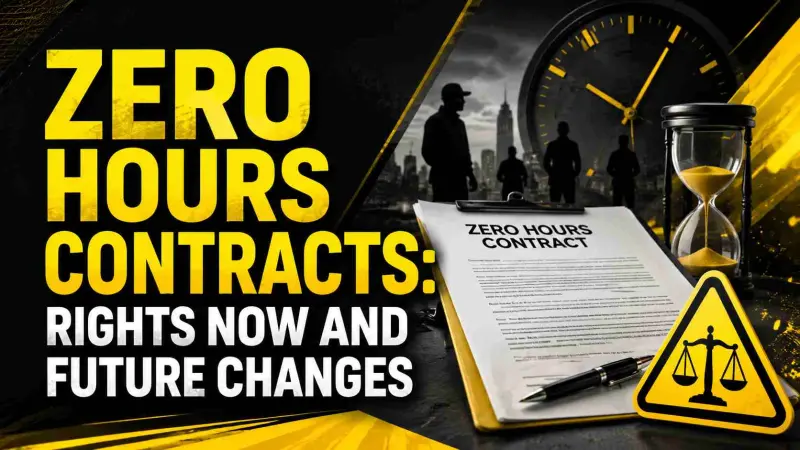
A zero hours contract does not mean you have zero employment rights. If you work under one in Great Britain, you can still be entitled to the National Minimum Wage, paid holiday, rest breaks and protection from discrimination, while your exact rights depend on whether you are legally a worker or an employee. Employers also cannot use an exclusivity clause to prevent a zero-hours worker from taking work elsewhere.
What is changing is the balance between flexibility and security. The Employment Rights Act 2025 has created a framework for new rights around guaranteed hours, reasonable notice of shifts and compensation when shifts are cancelled, moved or cut short at short notice. But those new zero-hours provisions are not yet in force. As of August 2026, the government is consulting on the detailed regulations, with the implementation timetable saying these measures are expected in 2027 but without a final commencement date yet.
That distinction matters. There is a big difference between rights you can enforce today and rights Parliament has legislated for but which still need regulations before they operate.
This guide explains both. It looks at what a zero-hours worker can expect now, what an employer can and cannot do, how holiday and sick pay work, what happens if shifts disappear, and how the coming reforms could change the deal for workers and businesses.
What are your zero hours contract rights now, and what is changing next?
What exactly is a zero hours contract?
A zero hours contract is generally an arrangement where the employer does not guarantee a minimum amount of work and the individual is not necessarily required to accept work offered. The legal label itself does not determine someone's employment status: a person working under a zero-hours arrangement may be a worker or an employee, depending on the actual relationship.
That distinction is one of the most important things to understand.
For example, imagine a care worker who is offered shifts each week. The employer does not promise any particular number of hours, and the worker can normally accept or decline individual shifts. The arrangement may be described as a zero-hours contract, but the worker can still have statutory employment protections.
The phrase "zero hours" describes the uncertainty around hours. It does not wipe away legal rights.
The Office for National Statistics continues to publish quarterly data on people reporting that they are employed on zero-hours contracts in their main job. Its current dataset is classified as official statistics in development, so figures should be treated with appropriate care and are subject to revision.
Are zero hours contracts legal in the UK?
Yes. Zero-hours contracts remain legal.
The government's reforms are not simply a blanket rule saying that every zero-hours contract must disappear. Instead, the Employment Rights Act 2025 establishes a framework intended to reduce what the government describes as one-sided flexibility, particularly where workers face unpredictable hours, late shift changes or cancellations.
The future system is therefore more nuanced than "zero-hours contracts are being banned".
Some people genuinely value the flexibility. A student may want occasional evening work. Someone approaching retirement may prefer to work only when convenient. Another person might combine several jobs.
The government's June 2026 consultation specifically recognises this issue and says workers who want to retain a zero-hours arrangement should be able to do so.
What rights do zero hours workers have right now?
If you are legally a worker, your zero-hours status does not remove basic workplace protections.
You can generally have rights including:
- National Minimum Wage protection
- paid statutory annual leave
- rest breaks
- protection from unlawful discrimination
- protection against unlawful deductions from wages
- protection as a whistleblower
- limits on average weekly working time
- certain statutory family-related payments and leave, depending on your circumstances and eligibility
Workers may also qualify for Statutory Sick Pay where the relevant conditions are met. HMRC specifically confirms that qualifying employees on zero-hours contracts can be entitled to SSP.
The key point is that irregular hours do not automatically mean irregular rights.
Worker or employee: why does your status matter?
Your employment status can make a major difference.
A worker normally receives a substantial set of statutory protections, but an employee has additional rights. GOV.UK notes, for example, that workers are usually not entitled to ordinary unfair dismissal protection, minimum notice periods when employment ends, statutory redundancy pay or certain other employee-only rights.
However, simply calling someone a "worker", "casual worker" or "zero-hours worker" does not settle the question.
The real working relationship matters.
Consider two people:
| Situation | Likely significance |
|---|---|
| Person genuinely chooses whether to accept occasional assignments | More consistent with worker status |
| Person is expected to perform work personally under significant employer control | Could indicate worker or employee status |
| Employer provides no guaranteed work | Consistent with a zero-hours arrangement |
| Contract says "zero hours" but actual relationship looks permanent and ongoing | Contract wording may not tell the whole story |
| Individual is genuinely self-employed | Different legal rights apply |
If you are unsure about your status, examine the contract alongside what actually happens at work. HMRC guidance specifically warns against assuming that a zero-hours arrangement cannot amount to an overarching employment relationship merely because there are no guaranteed hours.
Can your employer force you to accept work?
A genuine zero-hours arrangement normally gives the worker flexibility to accept or decline work.
GOV.UK describes the typical arrangement as one where the employer does not have to provide work and the worker does not have to accept it.
That does not mean every dispute over a shift is automatically unlawful. Your actual contract and employment status matter.
If your employer repeatedly says you are free to refuse shifts but then threatens you with dismissal, disciplinary action or other penalties whenever you decline them, that may raise questions about whether the practical relationship is really as flexible as the contract suggests.
Keep evidence if this happens. Save rotas, messages, emails and written instructions.
Can a zero hours employer stop you working somewhere else?
Generally, no.
The law prevents employers from enforcing exclusivity terms in zero-hours contracts that stop workers from looking for or accepting work elsewhere. GOV.UK says a worker can ignore a contractual clause that attempts to impose such a restriction.
This protection is particularly important because the financial risk of zero-hours work can fall heavily on the individual.
Suppose you are offered only eight hours one week. Your employer cannot simply insist that you remain available exclusively to them while giving you no guaranteed income.
You can seek additional employment, subject to the normal legal and contractual rules that may apply for legitimate reasons such as conflicts of interest, confidentiality or working-time limits.
Do zero hours workers get holiday pay?
Yes.
Most workers are entitled to 5.6 weeks of statutory paid holiday each year, although the calculation for irregular-hours workers differs from that used for regular-hours employees.
For leave years beginning on or after 1 April 2024, irregular-hours and part-year workers generally accrue statutory leave based on 12.07% of hours worked in each pay period, subject to the detailed rules.
For example, if an eligible irregular-hours worker works 30 hours during a pay period:
30 × 12.07% = 3.621 hours
The statutory accrual is then handled under the rounding rules.
There is another important point: employers can use rolled-up holiday pay for eligible irregular-hours and part-year workers, provided the legal requirements are followed. This means holiday pay can be added to regular pay rather than being paid when holiday is actually taken.
Do not assume that "holiday pay is included in my hourly rate" is automatically correct. The arrangement has to comply with the applicable rules, and your payslip and contract should make the payment clear.
What about sick pay?
A zero-hours arrangement does not automatically exclude you from Statutory Sick Pay.
Eligibility depends on the statutory rules and your employment status. HMRC confirms that qualifying employees on short-term and zero-hours contracts can be entitled to SSP.
The practical lesson is simple: if you become ill, do not assume that having irregular hours means you have no entitlement. Check the current SSP rules and your status.
Are zero hours workers protected by the National Minimum Wage?
Yes.
When you are working, you must generally receive at least the applicable National Minimum Wage or National Living Wage for the hours covered by the relevant minimum wage rules. The fact that the contract provides no guaranteed hours does not remove minimum-wage protection.
Employers cannot use "zero hours" as a reason to pay less than the legal minimum.
This can become complicated where there is unpaid waiting time, training, travel or other periods that may count as working time. If your pay appears unusually low compared with the hours you are required to spend working or available for work, keep detailed records and seek advice.
What happens if your employer cancels a shift?
This is one of the biggest weaknesses of the current system.
Under the existing zero-hours model, the lack of guaranteed work means that losing a future shift can have a significant financial effect. There is currently no general zero-hours entitlement to the new compensation scheme because that scheme has not yet come into force.
That is precisely what the forthcoming reforms are designed to address.
The Employment Rights Act 2025 provides for new rights relating to reasonable notice of shifts and payment when shifts are cancelled, moved or curtailed at short notice. The detailed rules will be established through regulations.
Imagine a worker arranges childcare around a confirmed six-hour shift. The employer cancels it the evening before. Under the future framework, circumstances such as this are intended to trigger a payment where the statutory conditions are met.
The exact amount, notice periods, thresholds and exceptions are not yet final.
That is why it would be misleading to tell workers in August 2026 that they already have a general legal right to cancellation compensation. They do not yet have that new statutory right.
What is changing under the Employment Rights Act 2025?
The reform has three major elements for zero-hours and similar arrangements.
| Future protection | What it is intended to do |
|---|---|
| Guaranteed hours | Give qualifying workers an offer of hours reflecting work regularly performed during a reference period |
| Reasonable shift notice | Give workers more predictable information about when they will work |
| Short-notice compensation | Provide payment where qualifying shifts are cancelled, moved or cut short at short notice |
These provisions are contained in the Employment Rights Act 2025, but the detailed rules still require regulations. The government's July 2026 consultation states that the measures have not yet taken effect.
How will the future right to guaranteed hours work?
The basic idea is that a qualifying worker who regularly works a certain pattern of hours should have an opportunity to obtain a contract reflecting those hours.
The government has indicated that the reference period is expected to be 12 weeks, although the precise operation of the scheme is being developed through consultation and regulations.
For example, suppose someone works:
- 18 hours in week one
- 22 hours in week two
- 20 hours in week three
- 24 hours in week four
and continues at broadly similar levels.
The future system is intended to give qualifying workers a route towards guaranteed hours reflecting their established working pattern, rather than leaving them permanently dependent on unpredictable offers.
However, this should not be interpreted as an automatic promise that every worker will receive exactly their average historical hours. The final regulations will determine the calculation, eligibility conditions and how offers operate.
Will every zero hours worker automatically get a fixed-hours contract?
No.
That is one of the most common misconceptions.
The reforms create a right to be offered guaranteed hours in qualifying circumstances, rather than simply converting every zero-hours contract into a conventional full-time job.
The government has also stated that people who value zero-hours flexibility will be able to retain it.
So the future system is better understood as giving qualifying workers more choice and predictability, rather than abolishing every form of flexible work.
What does "reasonable notice of shifts" mean?
The future legislation is intended to require reasonable notice of shifts and changes to shifts for qualifying workers.
The precise definition of "reasonable" will be important.
A shift offered several weeks ahead is obviously different from a message arriving at 6pm telling someone they must work at 7am the next morning.
The consultation is therefore dealing with details such as eligibility, notice periods and how the rules will work for different forms of employment, including agency workers.
For workers, the practical benefit could be significant because unpredictability has costs beyond lost wages.
A last-minute rota change can affect:
- childcare
- commuting
- education
- second jobs
- medical appointments
- household budgeting
- caring responsibilities
The government has specifically framed the reforms around giving workers greater security and predictability.
Will agency workers be covered?
The planned reforms also cover qualifying agency workers, although the government says the rights will operate differently for agency workers compared with directly engaged workers.
This matters because agency work can involve several parties: the worker, an employment business and the organisation where the work is performed.
The final regulations will determine how guaranteed-hours offers and shift-related protections operate across those relationships.
When will the new zero hours rules start?
As of 8 August 2026, there is no final commencement date for these specific zero-hours reforms.
The government's current implementation timetable lists the guaranteed-hours and reasonable-notice/short-notice-payment measures among changes expected in 2027, with timings to be updated following consultation.
The government launched its consultation on 2 June 2026 and updated it on 14 July 2026. The consultation is being used to determine the detailed regulations that will sit underneath the new statutory framework.
This is why workers and employers should be cautious about headlines claiming that the new rules have already started.
What should zero hours workers do now?
You do not need to wait for the reforms to protect your position.
Start by understanding your existing arrangement.
1. Check your contract
Look for:
- your employment status
- whether hours are guaranteed
- how shifts are offered
- cancellation provisions
- holiday arrangements
- sick pay provisions
- notice provisions
- any exclusivity wording
If the contract says you cannot work elsewhere, that deserves particular attention because zero-hours exclusivity restrictions are generally unenforceable.
2. Keep your own hours record
Do not rely solely on the employer's rota.
Keep a simple record of:
- shifts offered
- shifts accepted
- hours worked
- cancelled shifts
- changed shifts
- pay received
- holiday taken
- holiday pay
- messages about availability
This will become especially useful if you later need to establish your typical working pattern.
3. Check your payslips
Compare the hours you actually worked with what you were paid.
Also check whether holiday pay is separately identified where applicable.
If your hourly rate appears below the legal minimum after accounting for relevant working time, investigate it rather than assuming the zero-hours contract explains it.
4. Do not ignore repeated problems
If shifts are routinely cancelled after you have incurred costs, you are repeatedly denied holiday pay, or you are being penalised for taking other work, keep evidence.
A pattern is often more informative than one isolated incident.
What should employers do before the new rules arrive?
Businesses should not wait until the final regulations are published before thinking about their workforce.
Employers using zero-hours or similar arrangements should consider:
- auditing contracts
- checking worker and employee classifications
- reviewing exclusivity wording
- recording actual hours worked
- reviewing holiday-pay systems
- improving shift-management processes
- tracking cancellations and late changes
- identifying workers who regularly work predictable patterns
- modelling the financial effect of guaranteed-hours offers
- preparing managers for new notice requirements
This is particularly relevant to sectors such as hospitality, retail, care, leisure, events and seasonal businesses where demand can fluctuate.
The point is not necessarily to eliminate flexibility. It is to understand where the current arrangement creates risk for either side.
Are zero hours contracts good or bad?
Neither answer is universally correct.
Their value depends on how the arrangement works in practice.
| Feature | Potential advantage | Potential drawback |
|---|---|---|
| Flexible shifts | Workers can fit work around other commitments | Income may be unpredictable |
| No guaranteed hours | Employer can respond to changing demand | Worker may struggle to budget |
| Ability to decline work | Useful for students or people with other commitments | Refusing too much work may affect future opportunities in practice |
| Multiple employers | Can help workers build income | Coordinating schedules can be difficult |
| Variable staffing | Useful for seasonal businesses | Late cancellations can create financial and operational problems |
The future reforms are aimed largely at the last part of that equation: reducing situations where flexibility benefits one side while transferring most of the uncertainty to the other.
What are the biggest mistakes workers make?
One common mistake is assuming that a zero-hours contract means "no rights".
It does not.
Another is assuming the opposite: that having a zero-hours contract automatically gives you every employee right. Your employment status still matters.
Other mistakes include:
- failing to check holiday pay
- accepting an incorrect exclusivity clause
- not keeping records of cancelled shifts
- confusing a government proposal with a current legal entitlement
- assuming the contract title determines employment status
- failing to keep payslips and rotas
- waiting too long to raise a workplace dispute
Good records can make a major difference.
What does the future of zero hours work look like?
The direction of travel is clear even though some details remain unsettled.
The government's policy is moving towards a model where flexibility remains available but workers who regularly work predictable patterns have greater access to predictable hours and advance information. The Employment Rights Act 2025 provides the legislative foundation, while 2026 consultation is being used to develop the practical rules.
That could change the conversation around flexible work.
Instead of asking whether zero-hours contracts should simply exist or disappear, the more useful question is likely to become:
How much flexibility should each side have, and who should bear the cost when plans change?
Technology will also play a role. Digital rotas, scheduling platforms and workforce-management software can make it easier for employers to forecast demand and give workers earlier notice. But technology cannot by itself solve the legal or financial problems created by unpredictable work.
For workers, the safest approach is to understand the rights that exist today while keeping an eye on the regulations that will determine how the new rights operate.
For employers, preparation is equally important. Businesses that know their actual staffing patterns now will be better positioned to adapt when the guaranteed-hours and shift-notice rules come into force.
Key Insights
- A zero-hours contract does not mean zero rights. Workers can still have National Minimum Wage, holiday, rest-break and discrimination protections.
- Employment status matters. A zero-hours worker may be a worker or an employee, and the distinction affects the rights available.
- You can generally work elsewhere. Exclusivity clauses in zero-hours contracts cannot normally prevent a worker from taking another job.
- Holiday entitlement still applies. Irregular-hours workers have specific rules for calculating statutory leave and holiday pay.
- New guaranteed-hours rights are not active yet. The Employment Rights Act 2025 creates the framework, but regulations are still being developed.
- Future rules target shift uncertainty. The reforms include reasonable notice and compensation for qualifying short-notice cancellations, changes and curtailments.
- Keep evidence now. Records of shifts, hours, cancellations and pay can help demonstrate how your arrangement actually operates.
- 2027 is the key period to watch. The government's current timetable expects the new zero-hours measures in 2027, but the precise start date remains to be confirmed.
FAQ
1. Can my employer make me work on a zero-hours contract?
A zero-hours contract generally does not guarantee work, and the typical arrangement allows the worker to accept or decline offered work. However, the actual contractual relationship matters, so check the terms and how the arrangement operates in practice.
2. Can I have two jobs on a zero-hours contract?
Generally, yes. Employers cannot enforce an exclusivity term in a zero-hours contract that prevents you from looking for or accepting work elsewhere. Other legitimate contractual obligations, such as confidentiality, can still apply.
3. Do zero-hours workers get paid holiday?
Yes. Most workers are entitled to 5.6 weeks of statutory paid holiday, although irregular-hours workers have specific rules for calculating their entitlement and holiday pay.
4. Do zero-hours workers get sick pay?
A qualifying employee on a zero-hours contract can be entitled to Statutory Sick Pay. Eligibility depends on the statutory conditions and the person's employment circumstances.
5. Can my employer cancel a zero-hours shift without paying me?
Under the current system, there is not yet a general statutory compensation right covering all cancelled zero-hours shifts. The Employment Rights Act 2025 introduces a future framework for payment when qualifying shifts are cancelled, moved or curtailed at short notice.
6. Are zero-hours contracts being banned?
No. The government's reforms are designed to address exploitative forms of insecure work while retaining flexibility for people who want it. Zero-hours arrangements are not simply being abolished.
7. Will I automatically get fixed hours under the new law?
No. The future rules create a right to guaranteed-hours offers for qualifying workers based on their working pattern during a reference period. They do not simply convert every zero-hours worker into a fixed-hours employee.
8. What is the expected reference period for guaranteed hours?
The government has indicated that a reference period is expected to be 12 weeks, but the detailed rules will be established through regulations. Workers should therefore avoid treating the 12-week figure as a fully operational entitlement yet.
9. When will the new zero-hours rights start?
As of August 2026, the exact commencement date has not been confirmed. The government's latest implementation timetable places guaranteed-hours and shift-notice reforms in 2027, with timing to be updated following consultation.
10. Does a zero-hours contract mean I am self-employed?
No. A zero-hours arrangement can involve a worker or employee. Employment status depends on the actual legal and working relationship, not simply the contract's title.
11. Do zero-hours workers get the National Minimum Wage?
Yes. When covered by the National Minimum Wage rules, workers on zero-hours arrangements must receive at least the applicable minimum rate for qualifying working time.
12. How is holiday calculated for irregular-hours workers?
For relevant leave years beginning on or after 1 April 2024, statutory holiday for irregular-hours and part-year workers is generally accrued at 12.07% of hours worked in a pay period, subject to the detailed rules.
13. Can my employer stop giving me shifts because I refuse one?
The answer depends on the contract, employment status and circumstances. A genuine zero-hours arrangement normally allows work to be accepted or declined, but a pattern of retaliation or other unlawful treatment may raise separate legal issues. Keep written evidence of what happens.
14. Will agency workers receive the new protections?
Qualifying agency workers are included in the planned reforms, although the government says the rules will operate differently for agency workers than for directly engaged workers. The final regulations will provide more detail.
15. What should I do if I think my zero-hours rights are being breached?
Start by collecting your contract, payslips, rotas, shift messages, holiday records and evidence of cancellations or disciplinary action. Then check which rights apply to your employment status and consider getting advice from an appropriate employment-rights service or legal professional.
Final Thoughts
Zero-hours contracts are not disappearing overnight, and they do not mean workers have no protection.
Right now, the basic rules remain important: minimum wage protection, paid holiday, rest breaks, discrimination protection and the ability to work elsewhere can all apply. Your employment status determines which additional rights you receive.
Next, the Employment Rights Act 2025 is set to change the balance between flexibility and security. Qualifying workers will have new rights relating to guaranteed hours, reasonable notice of shifts and compensation for certain short-notice changes. But those provisions are still being developed and are not yet operational as of August 2026.
For workers, the smartest move is not to wait for the new law. Understand your current contract, check your holiday and pay, keep records of your hours and cancellations, and do not assume that "zero hours" means "zero protection."
For employers, the message is equally practical: start examining real working patterns now. The businesses best prepared for the next phase of employment law
will be those that already understand who works for them, how many hours they actually work and how often shifts change.
The future of flexible work is unlikely to be about choosing between complete flexibility and fixed hours. The bigger change is likely to be making flexibility fairer and more predictable for both sides.
Disclaimer: The information provided in this article is for general informational and research purposes only. Company details, features, services, and market positions may change over time. Readers are advised to visit official company websites and conduct independent research before making any business decisions or purchasing services.
Most Searchable Keywords
Recent Blogs


Related Listings
Categories
- Accountants (295)
- Advertising Agencies (559)
- Architects (149)
- Automobiles (377)
- Beauty (300)
- Carpenters (146)
- Cleaning Services (387)
- Dentists (189)
- Driving (62)
- Education (1)
- Electricians (215)
- Energy (8)
- Event Organiser (687)
- Finance (602)
- Guide (3439)
- Health (2207)
- Information technology (206)
- Legal Services (361)
- Logistics (6)
- Maintenance (65)
Sponsored Listings in Legal Services

Related Blogs

When Is My MOT Due Free Check and Common Fail...
Read this insightful article "When Is My MOT Due Free Check and Common Failures" to expand your knowledge!

Lost V5C Log Book Cost Timescale and Rules
Read this insightful article "Lost V5C Log Book Cost Timescale and Rules" to expand your knowledge!

Intensive Driving Courses: Costs Pass Rates a...
Read this insightful article "Intensive Driving Courses: Costs Pass Rates and Who They Suit" to expand your knowledge!
Questions & Answers – Find What
You Need, Instantly!
How can I update my business listing?
Is it free to manage my business listing?
How long does it take for my updates to reflect?
Why is it important to keep my listing updated?
