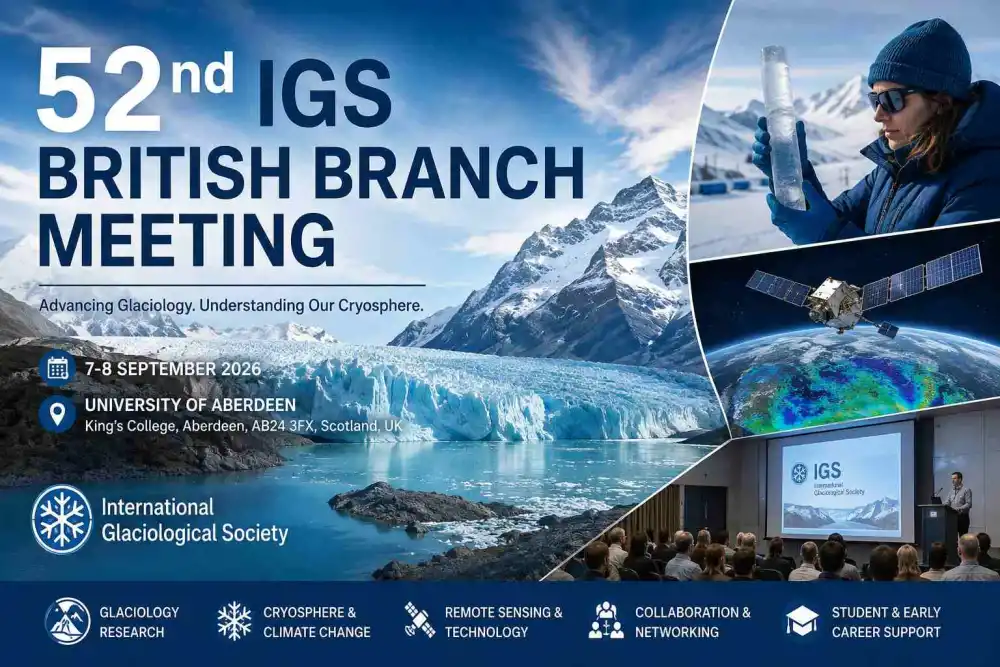
The 52nd IGS British Branch Meeting is the principal annual gathering of the British Branch of the International Glaciological Society (IGS) and one of the most important UK-based meetings dedicated to glaciology, cryosphere science, and climate research. Scheduled for 7-8 September 2026 at the University of Aberdeen, this conference brings together researchers, academics, students, and environmental professionals who study snow, glaciers, ice sheets, sea ice, and the broader cryosphere.
Hosted by the Cryosphere & Climate Change Research Group (CCCG) at the University of Aberdeen, the meeting provides a collaborative forum for presenting new scientific findings, discussing emerging environmental challenges, and strengthening research partnerships across the United Kingdom and the international glaciology community. The event is fully in person and includes scientific sessions, networking opportunities, refreshments, and a conference dinner as part of the registration package.
International Glaciological Society
The International Glaciological Society was founded in 1936 to advance the scientific understanding of snow and ice in all its forms. Headquartered in Cambridge, United Kingdom, the society supports global research through conferences, symposia, workshops, publications, and professional networking initiatives. The British Branch annual meeting is one of the society's longest-running regional scientific events and serves as a key platform for UK cryosphere research.
Why this conference matters
Glaciers and ice sheets are among the most sensitive indicators of climate change. Their rapid transformation affects sea-level rise, freshwater resources, weather systems, ecosystems, and global climate feedbacks. The IGS British Branch Meeting provides a dedicated space for researchers to share new observations, modeling approaches, remote sensing techniques, and field-based discoveries that improve our understanding of Earth's changing cryosphere.
The Aberdeen meeting is particularly significant because it is hosted by a research group with expertise in cryosphere-climate interactions, polar processes, and environmental change. Attendees gain access to cutting-edge research discussions that are directly relevant to climate policy, environmental monitoring, and future scientific collaboration.
Key themes and scientific focus
The conference is expected to cover a wide range of contemporary glaciological topics, including:
Glacier and ice-sheet dynamics
Researchers will present studies on glacier flow, ice deformation, grounding-line processes, and the evolution of polar ice sheets under changing climatic conditions.
Climate change and the cryosphere
Sessions will explore how atmospheric warming, ocean interactions, and changing precipitation patterns influence glaciers, snow cover, and sea ice across polar and alpine regions.
Remote sensing and geospatial analysis
Modern cryosphere science increasingly relies on satellite observations, airborne surveys, drones, and geospatial modeling. The conference will highlight advances in Earth observation technologies and data analysis methods.
Field measurements and polar expeditions
Scientists involved in Arctic and Antarctic field campaigns will discuss measurement techniques, instrumentation, and logistical challenges associated with cryosphere research.
Early-career research and education
A strong emphasis is placed on supporting PhD students, postdoctoral researchers, and early-career scientists, providing opportunities to present research, receive feedback, and build professional networks within the glaciological community.
Conference highlights
Attendees can expect several valuable features throughout the two-day program:
-
Scientific presentations from leading UK and international glaciologists.
-
Specialized sessions on cryosphere and climate change research.
-
Networking opportunities with researchers from universities and research institutions.
-
Student presentation and early-career engagement activities.
-
Collaborative discussions on future glaciology and polar research initiatives.
These elements make the meeting highly relevant for both established researchers and those beginning careers in environmental and cryosphere science.
Who should attend?
The event is designed for professionals and students involved in snow, ice, and climate research. It is particularly suitable for:
-
Glaciologists and cryosphere scientists.
-
Climate and environmental researchers.
-
Polar and Arctic/Antarctic specialists.
-
University faculty and geoscience academics.
-
PhD candidates, postgraduate students, and early-career researchers.
Because the meeting encourages interdisciplinary participation, professionals working in remote sensing, hydrology, geography, geology, environmental modeling, and climate policy will also find significant value in attending.
Venue overview: University of Aberdeen
The University of Aberdeen is one of the United Kingdom's oldest and most respected research universities. Located in Aberdeen, Scotland, the institution has a strong international reputation in geosciences, environmental research, and polar studies.
The conference venue at King's College provides lecture facilities, research-oriented meeting spaces, and easy access to accommodation and transportation within the city. Aberdeen's strong connections to marine, environmental, and energy research make it a fitting location for discussions on climate change and cryosphere science.
Networking and collaboration opportunities
One of the greatest strengths of the IGS British Branch Meeting is the opportunity to build relationships across the UK and international glaciology community. Participants can engage with:
-
University research groups.
-
Polar research institutes.
-
Government environmental agencies.
-
Climate monitoring organizations.
-
International collaborators working across Arctic, Antarctic, and alpine environments.
The conference dinner and informal social events provide additional opportunities for collaboration, mentorship, and research partnership development.
Registration information
According to the University of Aberdeen conference listing, the event is paid, with registration fees that include refreshments, lunch, and the conference dinner. A pre-conference social gathering is scheduled for the evening before the main meeting, offering attendees an additional opportunity to connect with fellow researchers.
Research impact and future directions
The discussions held at the 52nd IGS British Branch Meeting contribute directly to ongoing efforts to understand glacier retreat, ice-sheet stability, sea-level rise, and climate feedback mechanisms. Research presented at IGS meetings frequently informs peer-reviewed publications, collaborative grant proposals, and international scientific assessments.
As climate change accelerates across polar and mountain regions, conferences such as this play a crucial role in coordinating scientific responses, sharing observational data, and developing innovative methods for monitoring the cryosphere.
Travel and accommodation
Aberdeen is well connected by air, rail, and road from major UK cities including London, Edinburgh, Glasgow, and Manchester. The university area offers a range of hotels, guesthouses, and student accommodation options within convenient distance of the conference venue.
Participants traveling from overseas can access Aberdeen through Aberdeen International Airport or via connecting rail services from other UK transport hubs.
Why attend the 52nd IGS British Branch Meeting?
For anyone involved in glacier, snow, ice-sheet, or climate research, this conference represents an exceptional opportunity to engage with the UK's leading cryosphere scientists, present new research, explore emerging technologies, and develop collaborations that extend beyond the meeting itself. The combination of scientific excellence, academic networking, and environmental relevance makes the 52nd IGS British Branch Meeting one of the most valuable glaciology events taking place in the United Kingdom in 2026.
Whether you are an experienced researcher, a postgraduate student, or an environmental professional seeking insight into the future of cryosphere science, the Aberdeen meeting offers a focused and highly respected platform for advancing knowledge and collaboration in one of the world's most important climate research disciplines.
Key Event Highlights
Venue & Location Info
Timings
Entry Fees
Event Type
Estimated Turnout & Audience
Community Reviews
James Turner
Sarah Collins
Oliver Bennett
Emma Hughes
How was your experience?
Share your thoughts with the community. Your reviews help others discover the best local events.
Write a Review