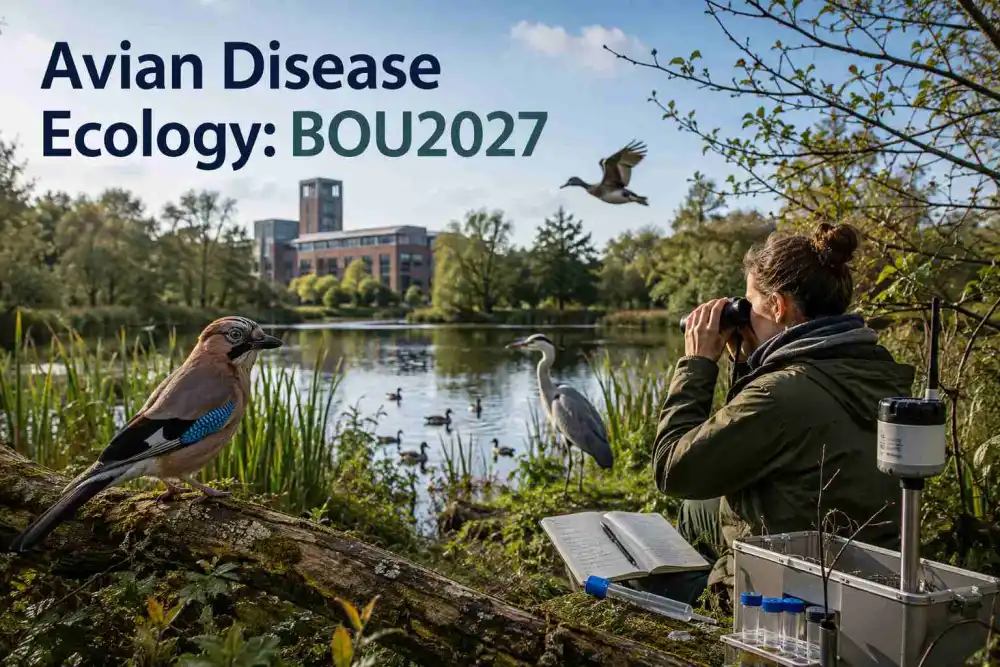
The Avian Disease Ecology | #BOU2027 conference is an upcoming international ornithology meeting organised by the British Ornithologists' Union. The event will take place from 6 to 8 April 2027 at the University of Nottingham in the United Kingdom, with additional participation available through Zoom and the BOU's parallel Bluesky programme.
The central theme of the conference is “Avian disease ecology: combining avian ecology and OneHealth to understand and mitigate disease.” This theme reflects the growing importance of understanding disease as part of the wider ecological systems in which birds live.
Bird health is closely connected to habitat conditions, climate, pollution, species interactions, migration, parasites, pathogens and human activity. Disease can affect individual birds, populations and entire ecosystems, while some pathogens can also have implications for domestic animals and human health.
The conference provides a specialist platform for researchers, conservation professionals and wildlife-health experts to examine these connections and discuss how scientific knowledge can contribute to effective disease prevention and conservation management.
Understanding Avian Disease Through Ecology
Avian disease cannot always be understood by studying pathogens alone. Disease outcomes are influenced by interactions between birds, their environment and other organisms.
Factors such as population density, food availability, habitat quality, migration behaviour and environmental stress can all influence susceptibility to disease. A bird population experiencing habitat degradation, for example, may face additional pressures that influence its ability to withstand infection.
The BOU2027 conference takes an ecological approach to these questions. It aims to bring together researchers studying birds and disease so that disease processes can be examined within their wider environmental context.
This perspective is particularly important as ecosystems undergo rapid environmental change. Changes in land use, climate, pollution and species distributions can create new ecological conditions in which diseases may behave differently.
The Importance of the One Health Approach
One of the defining features of BOU2027 is its emphasis on One Health.
One Health recognises that the health of humans, animals and ecosystems is interconnected. For avian disease research, this approach is especially relevant because birds can interact with people, livestock, wildlife and shared environments.
Some birds can act as reservoirs or vectors for pathogens that have implications beyond wild bird populations. Understanding these relationships requires collaboration between ornithologists, epidemiologists, veterinarians, conservation scientists and other specialists.
The BOU specifically identifies OneHealth approaches to disease prevention as one of the areas covered by the conference.
This interdisciplinary perspective can help researchers move towards more effective approaches to monitoring and mitigating disease.
Birds as Reservoirs and Vectors
A key area of discussion at the conference will be the role of birds as reservoirs and vectors for zoonotic pathogens and antimicrobial resistance.
Birds interact with a wide variety of environments during their lives. Migratory species can travel across national borders and encounter different habitats, host species and environmental conditions.
These movements can make birds important subjects for understanding how pathogens are maintained and transported through ecosystems.
Studying birds in this context can provide useful information for wildlife conservation while also contributing to broader disease surveillance.
However, understanding these relationships requires careful ecological research. Researchers need to consider bird behaviour, migration routes, population structure, pathogen characteristics and environmental conditions together.
Bird Movement and Disease Transmission
Bird movement is another important theme of the conference.
Migration, dispersal and local movements can influence how pathogens spread through bird populations and across geographical areas. The timing and direction of bird movements may affect where and when birds encounter infected individuals or contaminated environments.
Behaviour can also influence disease transmission. Birds may gather at feeding areas, wetlands, nesting colonies or other locations where many individuals interact.
The BOU lists bird movements and behaviour as factors shaping transmission and epidemiology among the conference topics.
Understanding these relationships can help researchers develop better disease models and surveillance strategies.
Identifying and Measuring Infection
Reliable disease research depends on effective methods for identifying and quantifying infection.
BOU2027 includes research on methods for identifying and quantifying parasite and pathogen infection.
Modern wildlife disease research can involve field sampling, laboratory analysis, molecular methods, ecological modelling and long-term population monitoring.
Each method provides different information. Combining multiple approaches can provide a more complete picture of how diseases affect bird populations.
The development of reliable detection methods is particularly important when infections are difficult to observe directly. Some pathogens may have subtle effects, while infected birds may show few obvious symptoms.
Improved methods can therefore help researchers identify disease patterns before they result in significant population-level consequences.
Parasites and Vector-Borne Diseases
Parasites represent another major component of avian disease ecology.
Birds can host a variety of parasites, including organisms that may influence health, reproduction and survival. Some parasites are transmitted directly between hosts, while others depend on vectors or environmental conditions.
The BOU has identified vector-borne diseases and parasites as an explicit topic for BOU2027.
Studying these systems can reveal how environmental changes influence disease risk. Temperature, rainfall, habitat structure and host availability can all affect vectors and parasites.
This is another area where ecological research and disease research need to work together.
Susceptibility and Resistance
Not all birds respond to infection in the same way.
Differences in genetics, age, behaviour, nutritional condition, immunity and environmental exposure can influence susceptibility and resistance.
BOU2027 specifically includes research into the drivers of susceptibility and resistance.
Understanding why some individuals or populations are more vulnerable than others can be important for conservation.
If certain populations have reduced resilience to disease, conservation strategies may need to take disease risk into account alongside habitat protection and population management.
Research into resistance can also help scientists understand how populations respond to repeated exposure to pathogens.
Disease and Conservation Management
Disease management is increasingly relevant to wildlife conservation.
When disease affects a threatened species, conservation organisations may need to consider whether intervention is necessary. Decisions could involve monitoring populations, managing habitat conditions, controlling disease vectors or reducing other environmental pressures.
The conference specifically includes mitigation of avian disease in conservation management among its research themes.
This is important because disease management can be complicated. Intervention needs to be scientifically justified and carefully designed to avoid creating additional ecological problems.
Conservation decisions also need to consider long-term population dynamics rather than focusing only on individual infected birds.
Pollution and Non-Infectious Disease
Disease ecology is not limited to infectious pathogens.
The BOU2027 programme also considers non-infectious disease, including disease caused by pollution, as well as interactions between pollution and pathogen infection.
Pollution can affect birds directly or indirectly. Environmental contaminants may influence physiological condition, reproduction or immune responses.
These effects may also interact with infectious disease. A population exposed to environmental stressors could potentially respond differently to infection than a population living under less stressful conditions.
Studying these interactions is therefore important for understanding the combined pressures facing modern bird populations.
Environmental Change and Emerging Risks
Bird populations are living through a period of significant environmental change.
Changes in climate, habitat availability, pollution and species distributions can alter relationships between hosts, pathogens and vectors.
These changes may create new disease risks or modify existing ones. Migratory patterns may shift, species may move into new areas and interactions between different populations may change.
For conservation scientists, understanding these changes is important because disease may become one component of a much larger set of pressures affecting biodiversity.
BOU2027 provides an opportunity to consider these issues from both ecological and health perspectives.
Interdisciplinary Scientific Collaboration
One of the major strengths of a conference focused on avian disease ecology is the opportunity to connect different scientific disciplines.
Ornithologists may contribute knowledge about bird populations and behaviour. Disease ecologists can investigate pathogen transmission. Veterinary researchers can contribute expertise in animal health, while epidemiologists can examine disease patterns.
Conservation scientists can help translate research findings into practical management strategies.
Bringing these perspectives together can lead to better research questions and more comprehensive approaches to wildlife disease.
The BOU's Scientific Programme Committee includes researchers from institutions such as the University of Salford, Bangor University, Keele University, University of Leeds and Biomathematics and Statistics Scotland.
Presentations, Posters and Bluesky Participation
BOU2027 is designed to support several forms of scientific communication.
The BOU has opened a call for abstracts covering talks, posters and Bluesky-only presentations. The organisation states that speakers and poster presenters are expected to attend in person, while Bluesky presenters can deliver their presentation as a six-post thread without needing to register for the conference.
This structure allows researchers to communicate their findings through traditional conference formats while also making selected content accessible through social media.
The BOU explains that its parallel Bluesky format is intended to improve accessibility and broaden the reach of its conferences.
Hybrid and Accessible Participation
The conference will combine an in-person event at the University of Nottingham with online participation through Zoom.
This hybrid structure can make the meeting more accessible to researchers who cannot travel to Nottingham. It can also help international participants engage with the scientific programme without necessarily making an international journey.
The BOU has increasingly incorporated online and social-media elements into its conference programme as part of its effort to create inclusive events.
The University of Nottingham's University Park campus provides an established academic setting for the event. The campus is located at University Park, Nottingham, NG7 2RD.
Opportunities for Early-Career Researchers
BOU conferences can also provide valuable opportunities for early-career researchers.
Presenting research at a specialist scientific meeting can help researchers develop communication skills, receive feedback and build professional connections.
For doctoral students and postdoctoral researchers working on avian ecology, wildlife disease or conservation, a conference focused specifically on disease ecology can provide an especially relevant audience.
Poster presentations and social-media presentations also provide alternative ways to communicate research findings.
Why Avian Disease Ecology Matters
Avian disease is an increasingly important component of modern conservation science.
Birds are affected by pathogens, parasites, environmental contaminants and other health pressures. At the same time, bird movements and ecological relationships can connect disease processes across landscapes and borders.
Understanding these processes requires more than isolated disease testing. It requires knowledge of ecology, behaviour, population dynamics, environmental change and host-pathogen interactions.
That is why the interdisciplinary approach of BOU2027 is significant.
By combining avian ecology with One Health, the conference encourages participants to examine disease as part of a wider ecological system.
Key Event Highlights
- Explores how avian biodiversity may change over the next 30–50 years.
- Examines climate change, pollution, habitat decline and disease pressures.
- Covers advances in bird monitoring and future-focused technologies.
- Brings together researchers, conservationists, modellers, data specialists and policymakers.
- Includes a workshop focused on the future of avian research, conservation and management.
Venue & Location Info
Timings
Entry Fees
Event Type
Estimated Turnout & Audience
Community Reviews
How was your experience?
Share your thoughts with the community. Your reviews help others discover the best local events.