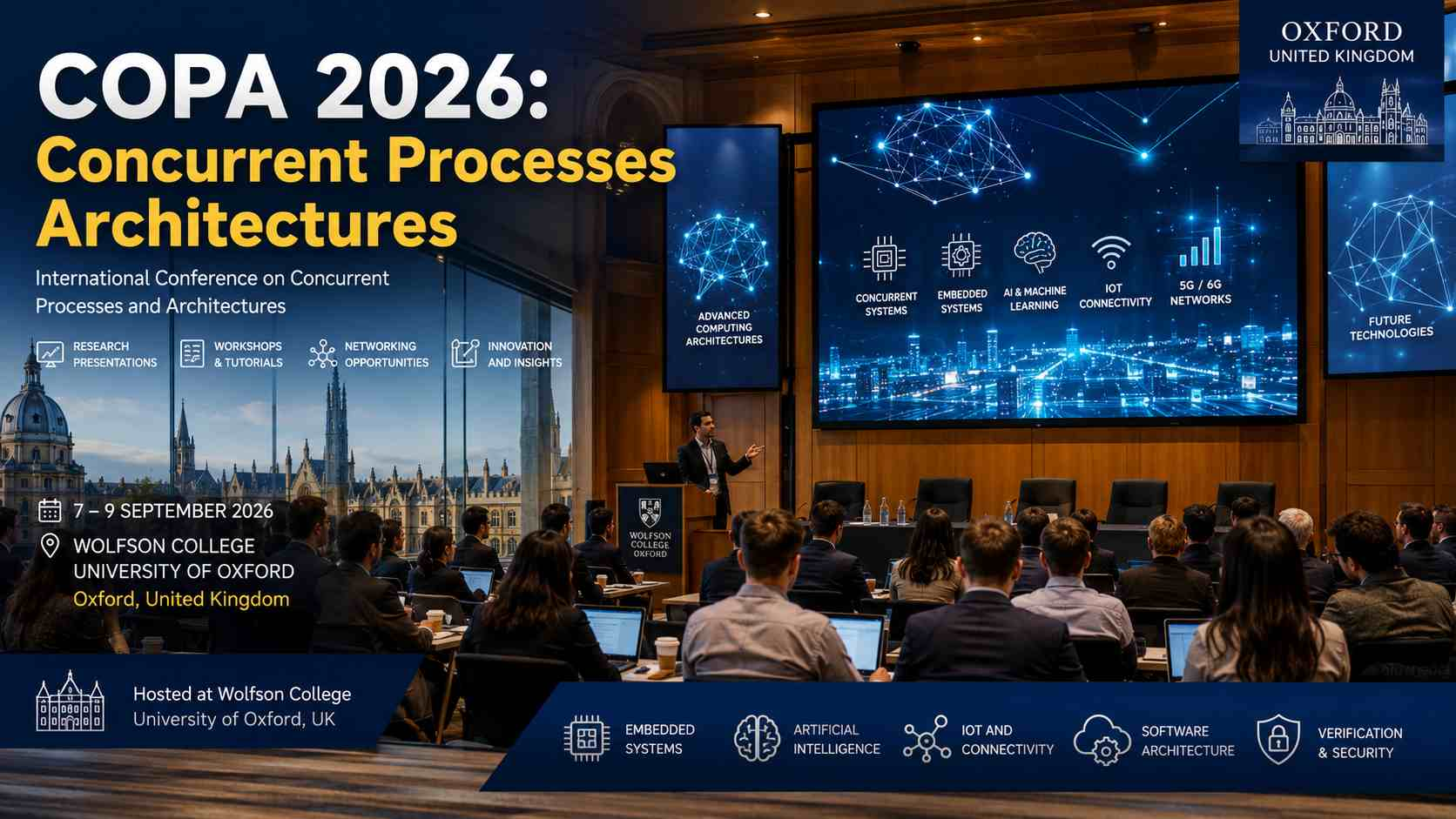
COPA 2026: 2026 Concurrent Processes Architectures is an upcoming international conference bringing together researchers, academics, technology professionals and specialists working across concurrent computing, embedded systems, software architecture and advanced computational technologies. The event is scheduled to take place from 7 to 9 September 2026 at Wolfson College, University of Oxford, in Oxford, United Kingdom. The conference is listed through the EasyChair Conference System and is designed to provide a professional environment for the presentation and discussion of emerging research and practical developments in modern computing architectures.
As computing systems continue to become more distributed, connected and intelligent, the need for efficient concurrent processes and dependable architectures is increasingly important. Modern applications frequently require multiple processes to operate simultaneously across interconnected hardware and software environments. From embedded devices and Internet of Things platforms to artificial intelligence systems and future telecommunications infrastructure, concurrency is now an essential part of technological development.
COPA 2026 offers an opportunity to explore these developments from both theoretical and practical perspectives. Its broad technical scope makes it relevant to professionals and researchers who want to understand how concurrent processes can be designed, implemented, modelled, verified and applied to real-world systems.
Conference Focus
The central focus of COPA 2026 is the development and application of technologies related to concurrent processes and architectures. The conference programme is expected to address research topics spanning computer hardware, software engineering, embedded technologies and intelligent systems.
One important area is hardware-software co-design. As computing platforms become increasingly complex, software and hardware can no longer always be developed independently. Effective co-design approaches can help researchers and engineers optimise system performance, resource utilisation and reliability.
The conference also addresses reconfigurable computing and synchronous message exchange. These areas are important for systems that must process information efficiently while responding to changing workloads and operating conditions.
Another major theme is the modelling and model-driven development of concurrent software architectures. With distributed systems becoming more widespread, reliable methods for designing and managing complex software environments are increasingly valuable.
COPA 2026 also highlights verification and analysis of concurrent systems. Verification plays a critical role in ensuring that complex systems behave correctly, particularly where multiple processes operate simultaneously and interact with each other.
Embedded Systems and Intelligent Technologies
Embedded systems are another significant area of interest for the conference. These systems are found in numerous products and services, including industrial equipment, connected devices, automotive technologies and consumer electronics.
The growing integration of embedded technologies with artificial intelligence and machine learning is creating new opportunities for innovation. AI-enabled embedded systems can support intelligent decision-making closer to the point where data is generated, potentially reducing latency and improving operational efficiency.
COPA 2026 provides a forum for researchers to explore these developments and examine how concurrent architectures can support increasingly sophisticated embedded applications.
The event also considers massively parallel computing and supercomputing architectures. These technologies are particularly relevant for applications involving large-scale computation, scientific modelling, data processing and artificial intelligence.
IoT, 5G and Future 6G Technologies
The rapid growth of the Internet of Things has increased the demand for architectures capable of managing large numbers of connected devices. IoT environments generate substantial quantities of data and often require systems to process information efficiently and reliably.
The conference programme includes applications of concurrent processes to IoT, as well as hardware and software requirements associated with 5G and future 6G technologies. These areas are important because next-generation communication networks will need to support increasingly large numbers of devices and services.
Future 6G environments are expected to introduce new requirements around connectivity, intelligent networking, automation and distributed computing. Research into concurrent processes can contribute to the development of architectures capable of supporting these demanding environments.
Participants attending COPA 2026 can therefore gain insight into how concurrency and distributed architectures may contribute to the future of connected technology.
Artificial Intelligence and Machine Learning
Artificial intelligence and machine learning are increasingly influencing the development of modern computing systems. COPA 2026 includes AI and machine learning in concurrent systems among its areas of interest, highlighting the relationship between intelligent algorithms and advanced computational architectures.
AI applications often involve significant computational workloads and may require multiple processes to operate simultaneously. Efficient concurrency can therefore play an important role in improving system responsiveness and scalability.
The conference provides an opportunity to examine how AI and machine learning can be integrated into concurrent systems. Researchers may explore new approaches for distributed AI, intelligent embedded platforms and high-performance computing.
The combination of AI with concurrent architectures is particularly relevant to industries developing autonomous systems, intelligent devices and advanced data-processing platforms.
Blockchain and Emerging Computing Applications
Blockchain is another emerging technology area identified within the conference topics. Blockchain systems depend on distributed architectures and complex computational processes, making concurrency an important consideration for scalability and performance.
Discussions around blockchain may provide insights into how distributed processing techniques can support secure and reliable applications. The interaction between blockchain, AI and advanced computing architectures represents an area of growing research interest.
The conference's broad technical scope allows participants to consider how multiple emerging technologies can work together. This interdisciplinary approach can encourage new research directions and innovative applications.
Workshops and Tutorials
In addition to research papers and presentations, COPA 2026 welcomes workshops and tutorials covering relevant areas of concurrent systems, embedded technologies and advanced computing. These sessions can provide opportunities for participants to explore specialised topics in a focused environment.
Workshops are particularly valuable for researchers who want to discuss emerging ideas, experimental approaches and practical challenges. Tutorials can also help participants develop a deeper understanding of specific technical concepts.
For early-career researchers and postgraduate students, these sessions can provide useful opportunities to learn from established experts and connect with researchers working on related topics.
Research and Academic Networking
International conferences such as COPA 2026 provide an important platform for academic and professional networking. Participants can meet researchers from different institutions and countries, exchange ideas and identify potential areas for collaboration.
Networking is particularly valuable in fast-moving fields such as artificial intelligence, embedded systems, IoT and advanced computing. New research partnerships can emerge when professionals with complementary expertise come together to discuss common challenges.
The Oxford setting also provides an academically significant environment for knowledge exchange. Hosting the event at Wolfson College, University of Oxford, offers attendees an opportunity to participate in a conference within one of the world's best-known university cities.
Who Should Attend?
COPA 2026 is relevant to a wide range of participants. Computer science researchers can benefit from discussions about concurrency, computational architectures and software systems. Embedded systems specialists may find value in sessions focused on hardware-software integration and intelligent embedded applications.
Software engineers and architects can explore approaches to designing and verifying concurrent systems. AI and machine learning researchers can examine the relationship between intelligent algorithms and high-performance or distributed computing environments.
The event may also be valuable for postgraduate students and doctoral researchers seeking to present their work, receive feedback and develop professional connections.
Industry professionals working in IoT, telecommunications, embedded computing, software development and advanced technology may also find the conference relevant to their professional interests.
Knowledge Exchange and Innovation
One of the main benefits of attending a specialised conference is the opportunity to learn about emerging research before it becomes widely adopted. COPA 2026 brings together several technology areas that are likely to influence the future of computing.
Concurrent architectures are becoming increasingly important as applications become more distributed. AI is creating new computational requirements, while IoT is increasing the number of connected devices. At the same time, 5G and future 6G networks are creating new possibilities for connected services.
Bringing these topics together encourages cross-disciplinary knowledge exchange. Researchers can consider how solutions developed in one area might be applied to another.
For example, techniques used in concurrent software development may have applications in IoT infrastructure. Similarly, advances in embedded AI may contribute to intelligent telecommunications systems. Such connections can encourage innovative research and practical technological development.
Professional Development
Attending COPA 2026 can also support professional development. Presenting research at an international conference allows academics and professionals to communicate their work to a specialist audience.
For students and early-career researchers, conference participation can help develop presentation skills, receive feedback and build confidence in communicating technical research.
Professionals can use the event to stay informed about developments in concurrent processes, embedded technologies and intelligent systems. Exposure to new research can help organisations identify emerging technologies and consider potential applications within their own projects.
The event can therefore serve as both a knowledge-sharing platform and a professional development opportunity.
Oxford as the Conference Destination
Oxford provides a distinctive setting for an international academic conference. The city has a long association with education, research and intellectual exchange, making it a natural destination for an event focused on advanced computing research.
Participants travelling to the conference can combine professional activities with the opportunity to experience Oxford's historic academic environment. The event venue, Wolfson College, is part of the University of Oxford and provides an appropriate setting for academic discussions and networking.
For international delegates, Oxford's location also makes it accessible from London and other parts of the United Kingdom. This can make the conference a practical destination for participants travelling from different regions.
Final Thoughts
COPA 2026: 2026 Concurrent Processes Architectures represents an upcoming opportunity for researchers, academics, technology professionals and industry specialists to explore developments in concurrent systems and advanced computing architectures.
With topics covering hardware-software co-design, embedded systems, verification, IoT, 5G, future 6G, blockchain, artificial intelligence and machine learning, the event offers a broad programme relevant to many areas of modern technology. Its focus on both theoretical research and practical applications makes it suitable for professionals interested in the future of computing systems.
Scheduled for 7–9 September 2026 at Wolfson College, University of Oxford, the conference provides an opportunity for knowledge exchange, research presentation, networking and professional development. Researchers can use the event to share findings, while industry professionals can explore emerging technologies and potential applications.
As computing continues to move toward more connected, distributed and intelligent environments, concurrent processes will remain a critical area of research and innovation. COPA 2026 provides a timely forum for discussing these developments and considering how new architectures can support the next generation of technology.
For participants interested in concurrent computing, embedded systems, artificial intelligence, machine learning, IoT and advanced software architectures, the event offers a valuable opportunity to engage with current research and connect with an international community of specialists.
Key Event Highlights
- International conference focused on concurrent processes and architectures.
- Covers hardware-software co-design and reconfigurable computing.
- Explores concurrent software architecture modelling and verification.
- Examines IoT, 5G, future 6G, AI and machine learning applications.
- Provides opportunities for research presentations, workshops and tutorials.
Venue & Location Info
Timings
Entry Fees
Event Type
Estimated Turnout & Audience
Community Reviews
James Turner
Sarah Collins
Oliver Bennett
Emma Hughes
How was your experience?
Share your thoughts with the community. Your reviews help others discover the best local events.
Write a Review