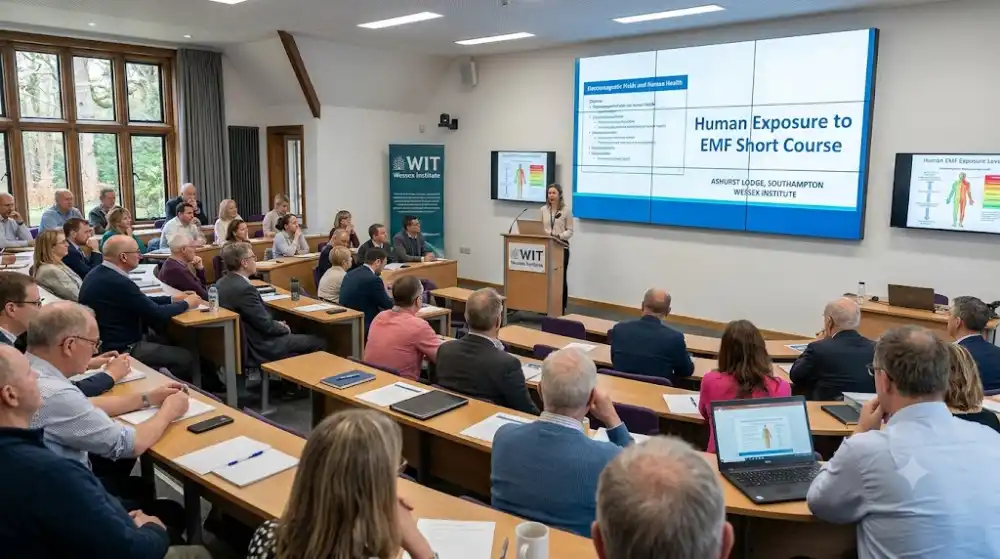
The Short Course on Human Exposure to Electromagnetic Fields, expertly organized by the prestigious Wessex Institute, provides an exhaustive and advanced exploration of electromagnetic phenomena within contemporary environments. With the rapid global expansion of wireless telecommunications infrastructure, high-voltage power transmission systems, and advanced medical diagnostic devices, understanding the complex biological interactions between human populations and electromagnetic fields has become an absolute necessity. This intensive three-day educational program offers professional engineers, academic researchers, regulatory authorities, and public health specialists an exceptional platform to study the foundational physics, complex coupling mechanisms, and established biological impacts of electromagnetic fields, spanning from static frequencies up to the high-frequency microwave spectrum. Conducted at the historic and serene Ashurst Lodge campus located in Southampton, United Kingdom, the course seamlessly blends rigorous theoretical frameworks with practical computational dosimetry. Participants gain critical, up-to-date insights into international safety guidelines, strict exposure limits, and regulatory compliance frameworks that govern modern technological and industrial installations globally.
Core Curriculum and Dosimetry Fundamentals
The academic curriculum is meticulously designed to guide attendees progressively from fundamental electromagnetic theory to sophisticated internal and external dosimetry techniques. Day one establishes robust core concepts in computational electromagnetics, reviewing essential numerical methods such as the Finite Element Method and the Boundary Element Method, which serve as the backbone for modern field analysis. Attendees comprehensively analyze incident field dosimetry, exploring low-frequency and high-frequency assessment methodologies for electrical power lines, substation transformers, and cellular base station antenna systems. The second day transitions smoothly into internal dosimetry, examining both simplified canonical body models and advanced, highly realistic human body representations. Special technical focus is dedicated to specific absorption rates, thermal dosimetry procedures, and detailed evaluations of human head, brain, eye, and whole-body exposure under diverse operational conditions. This structured learning progression ensures that all delegates master both complex theoretical calculations and rigorous practical measurement methodologies essential for professional safety assessments.
Biomedical Applications and Advanced 5G Safety
Moving well beyond standard environmental exposure evaluations, the latter portion of the comprehensive curriculum highlights cutting-edge biomedical applications and vital hot topics in modern telecommunications safety engineering. Attendees examine the fundamental principles of transcranial magnetic stimulation, transcranial electrical stimulation, nerve fiber excitation, and specialized therapeutic electrotherapy techniques. Furthermore, the program addresses the growing field of stochastic bioelectromagnetics, introducing advanced stochastic collocation methods for uncertainty quantification and sensitivity analysis within complex biological models. A core highlight of the final sessions is the dedicated analysis of human exposure to modern 5G communication systems. Industry experts guide participants step-by-step through incident and internal dosimetry procedures, calculating complex power densities, evaluating localized surface temperature increases, and reviewing safety compliance strategies for next-generation wireless networks. This forward-looking curriculum equips engineering and medical professionals to address emerging technological challenges safely and effectively.
Practical Learning and Professional Advantages
Designed specifically to bridge academic research and practical industrial application, this specialized short course delivers profound professional value across multiple engineering, medical, and environmental disciplines. Attendees benefit directly from interactive problem-solving sessions, comprehensive digital study materials, and direct intellectual engagement with world-class international specialists, including prominent lecturing faculty from European universities. Professionals who complete this rigorous training are significantly better equipped to design compliant electrical infrastructures, evaluate environmental health risks accurately, and implement robust safety standards in corporate, clinical, or regulatory settings. Furthermore, the collaborative workshop environment fosters invaluable international networking opportunities, enabling participants to establish enduring professional relationships with peers, researchers, and industry leaders dedicated to advancing safety and health standards in modern electromagnetic engineering and technological design.
Key Event Highlights
-
Comprehensive analysis of electromagnetic coupling mechanisms from static to high-frequency ranges.
-
In-depth coverage of computational electromagnetics including Finite Element and Boundary Element methods.
-
Detailed exploration of internal and external dosimetry using realistic human body models.
-
Specialized focus on biomedical applications such as transcranial magnetic stimulation and thermal dosimetry.
-
Cutting-edge insights into human exposure assessment and safety compliance for 5G communication systems.
Venue & Location Info
Timings
Entry Fees
Event Type
Estimated Turnout & Audience
Community Reviews
How was your experience?
Share your thoughts with the community. Your reviews help others discover the best local events.