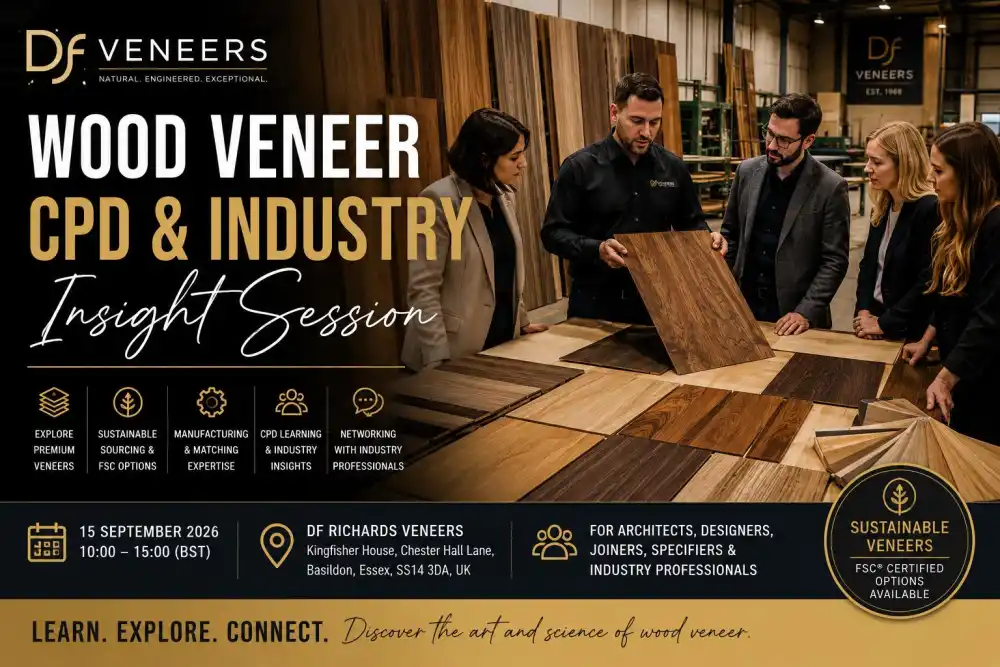
The Wood Veneer CPD & Industry Insight Session is designed as a professional learning and networking opportunity for people working with timber, interior finishes, furniture, architecture, cabinetry, doors, panels and specialist joinery. Hosted at the DF Richards Veneers facility in Basildon, Essex, the session provides an opportunity to explore the characteristics, applications and considerations involved in selecting and specifying wood veneer for commercial and residential projects.
DF Richards Veneers describes itself as a long-established wood veneer merchant and layon manufacturer based in Basildon, with more than 50 years of international veneer sourcing experience. Its website highlights a broad range of veneer products, manufacturing capabilities and specialist services for professional customers. The company also states that its Basildon facility includes dedicated classrooms and that it hosts veneer inspections and Veneer CPD sessions by appointment.
The proposed session is particularly relevant to architects, interior designers, furniture designers, joinery companies and other professionals who need to understand how veneer can be selected and specified effectively. It offers an opportunity to move beyond simply viewing veneer as a decorative surface and instead consider the technical, visual, manufacturing and sustainability factors that influence the success of a finished project.
Understanding Wood Veneer
A key focus of the event is developing a better understanding of wood veneer and its role in modern design and manufacturing. Veneer allows designers and manufacturers to bring the visual character of natural timber into furniture, doors, wall panels, cabinetry and architectural interiors while offering flexibility in how timber surfaces are selected and presented.
Participants can learn about the visual differences between various species and veneer cuts, including the way grain direction, colour, figure and natural variation influence the appearance of a finished surface. Understanding these differences is essential when specifying materials for projects where consistency, character or a particular visual effect is required.
DF Richards offers a wide selection of natural and engineered veneers, with products available for different design requirements. Its online range includes materials such as oak, walnut, rosewood, elm and other veneer types, demonstrating the variety available to professional specifiers.
The session can help attendees understand why the right veneer should be selected according to the intended application rather than simply based on colour or appearance. Factors such as grain orientation, sheet size, matching requirements, durability expectations and project scale can all influence the suitability of a particular veneer.
Veneer Selection for Design Projects
Selecting veneer for a project requires careful consideration of both aesthetic and practical requirements. During the session, participants can explore how professionals approach veneer selection for different environments and applications.
For an interior designer, the visual character of the timber may be the primary consideration. A project may require a calm, uniform appearance or a more expressive natural grain. Architects may need to coordinate veneer across doors, wall panels and built-in furniture, while furniture manufacturers may require specific matching patterns to achieve a consistent and premium appearance.
The event can provide valuable insight into how veneer samples should be assessed and compared before a final specification is made. Attendees can consider how lighting, surrounding materials and the scale of a project can affect the perceived appearance of wood.
The opportunity to physically examine veneer samples can be especially useful. Digital images and screens cannot always reproduce the subtle variations in grain, texture and colour that are visible in real timber materials. By viewing physical samples, professionals can gain a more accurate understanding of how a selected veneer may perform visually within a finished design.
Layon Manufacturing and Veneer Matching
Another important element of the session is understanding how individual veneer leaves can be processed and combined to create larger finished surfaces.
DF Richards explains that its manufacturing operation includes specialist equipment for cross-cutting, veneer joining, stitching, edge gluing, end binding and cutting. The company also describes matching methods that can be used for single doors, repeated pairs, panels and side panels.
This knowledge can be particularly valuable for architects, designers and joinery professionals working on large or highly detailed projects. Matching veneer correctly can have a significant effect on the visual quality of a finished installation.
The session provides an opportunity to understand the practical considerations involved in creating veneer layons and achieving specific visual outcomes. Depending on the design brief, projects may require symmetrical arrangements, repeated patterns, directional grain or more distinctive layouts.
DF Richards also highlights bespoke services for specialist requirements, including bi-directional grain boardroom tables and chevron-effect layons. These examples demonstrate how veneer can be adapted to achieve distinctive architectural and furniture designs.
Natural, Engineered and Dyed Veneers
Modern veneer specifications can involve different material types, each offering distinct characteristics.
Natural veneer showcases the authentic appearance and variation of real timber. Engineered veneer can provide greater consistency and repeatability, making it useful for projects where a uniform appearance is required across larger areas. Dyed veneers offer additional colour possibilities and can help designers achieve a particular aesthetic direction.
DF Richards' product catalogue includes natural, engineered and dyed veneer options, with its website also highlighting reconstituted veneer products. This range gives professional users more flexibility when selecting materials for specific design briefs.
Understanding the differences between these categories can help attendees make more informed decisions. A project that requires a highly consistent grain pattern may benefit from an engineered option, while a luxury furniture piece may call for the unique character of a natural veneer.
Sustainability and Responsible Sourcing
Sustainability is an increasingly important consideration in architecture, interiors and furniture manufacturing. Professionals are often expected to understand where materials come from and how responsible sourcing can contribute to more sustainable project decisions.
DF Richards states that it works to meet applicable environmental legislation and promotes effective forestry management. The company also highlights FSC-certified veneer options and references FSC certification within its business information.
The session can therefore help participants consider sustainability as part of the material specification process. Rather than focusing exclusively on appearance and cost, designers and specifiers can consider sourcing information, certification and the environmental expectations of their clients.
This topic is particularly relevant for commercial projects, public buildings, hospitality environments and high-profile residential developments where sustainability requirements may form part of the overall project brief.
Practical Knowledge for Architects and Designers
For architects and designers, the value of the session lies in connecting material knowledge with real-world project requirements.
A stronger understanding of veneer can help professionals communicate more effectively with manufacturers, suppliers and joinery contractors. It can also reduce uncertainty during the specification process by helping designers understand the practical implications of their material choices.
Participants can explore questions around sample approval, matching, grain direction, surface appearance and large-format applications. This knowledge may be useful when preparing specifications, discussing material options with clients or coordinating with specialist manufacturers.
The session is also an opportunity to ask questions directly and gain practical insight from professionals with extensive experience in the veneer industry.
Industry Networking and Professional Development
In addition to technical learning, the event can provide a valuable networking environment for professionals working across connected areas of the design and manufacturing industry.
Architects may benefit from meeting specialist suppliers. Interior designers can exchange ideas about material trends and applications. Furniture and joinery professionals can explore potential supplier relationships and discuss technical requirements.
Because the veneer industry connects multiple disciplines, events of this type can encourage useful conversations between people involved at different stages of the project lifecycle.
For professionals looking to improve their knowledge of wood materials, the event can also serve as a practical development opportunity. Participants can gain insight into current veneer products, manufacturing methods and material considerations while building relationships with other industry professionals.
Why Attend
The proposed Wood Veneer CPD & Industry Insight Session offers a focused opportunity to develop practical knowledge of a specialist material that plays an important role in architecture, furniture and interior design.
Attendees can expect to gain a stronger understanding of veneer selection, explore different material categories, learn about manufacturing and matching processes, and consider sustainability when specifying timber products.
The event's Basildon location is also convenient for professional visitors. DF Richards states that its 16,000 sq. ft. factory is located just off the A127 and is approximately a five-minute taxi journey from Basildon railway station. The company recommends booking appointments in advance for visits and CPD sessions.
For anyone involved in specifying, designing, manufacturing or installing veneered products, the session presents an opportunity to connect material knowledge with practical project requirements.
With its combination of professional education, technical insight, product exploration and networking, the event can serve as a valuable introduction to the possibilities of modern wood veneer and its applications across the built environment and furniture industries.
Key Event Highlights
- Introduction to natural, engineered and dyed wood veneers
- Expert guidance on veneer selection for interior projects
- Insights into veneer matching, jointing and layon manufacturing
- Discussion of sustainable sourcing and FSC-certified veneer options
- Practical opportunity to explore veneer samples and manufacturing capabilities
Venue & Location Info
Timings
Entry Fees
Event Type
Estimated Turnout & Audience
Community Reviews
James Turner
Sarah Collins
Oliver Bennett
Emma Hughes
How was your experience?
Share your thoughts with the community. Your reviews help others discover the best local events.
Write a Review