About Llangollen – History and Culture
Llangollen is a historic market town in Denbighshire, Wales, nestled in the beautiful Dee Valley. Its origins date back to the 6th century when Saint Collen founded a church here. The town grew around the river crossing and later became a coaching stop on the route between London and Holyhead. The 18th century saw the arrival of the 'Ladies of Llangollen', Lady Eleanor Butler and Sarah Ponsonby, who lived at Plas Newydd and attracted literary figures like Wordsworth and Shelley.
The town played a role in the Industrial Revolution, with the Llangollen Canal built to transport limestone and slate. The railway arrived in the 19th century, boosting tourism. Today, Llangollen is known for its cultural festivals, including the International Musical Eisteddfod, which promotes peace and harmony through music and dance. The town retains its Welsh character, with many residents speaking Welsh and a strong sense of community.
Modern Llangollen balances tourism with local life. The town is a gateway for outdoor activities in the Dee Valley and Snowdonia. Heritage attractions like Dinas Bran Castle and the Llangollen Railway draw visitors. The town's cultural identity is celebrated through events, museums, and traditional architecture. Llangollen is a vibrant example of Welsh heritage in the 21st century.
- Dinas Bran Castle – 13th-century hilltop ruins
- Plas Newydd – historic home of the Ladies of Llangollen
- Llangollen Railway – heritage steam train through the Dee Valley
- Pontcysyllte Aqueduct – UNESCO World Heritage Site (nearby)
- Llangollen Bridge – 16th-century stone bridge over the Dee
- St Collen's Church – medieval parish church
- Llangollen Canal – narrowboat cruising and towpath walks
- Valle Crucis Abbey – 12th-century Cistercian abbey ruins
- Carrog Station – authentic Victorian station on the heritage railway
- Horseshoe Falls – picturesque weir on the Dee
Did You Know? – Facts about Llangollen
Llangollen is a town of many surprises. Its name derives from Welsh 'llan' (church) and 'Collen', a saint. The town's famous Eisteddfod was started after World War II to promote peace. The Ladies of Llangollen were two Irish women who eloped and lived together for 50 years, creating a salon for intellectuals. The River Dee is renowned for fishing and white-water sports.
The Llangollen Railway is one of the UK's most scenic heritage lines. The Pontcysyllte Aqueduct is the longest and highest aqueduct in Britain. Dinas Bran Castle inspired poetry and paintings. The town has a strong literary tradition, with connections to George Borrow and J.R.R. Tolkien. Llangollen is also a centre for Welsh language and culture.
- Llangollen was a filming location for the TV series 'The Hairy Bikers' and 'Great British Railway Journeys'.
- The town has a microclimate, often milder than surrounding areas.
- Llangollen hosted the National Eisteddfod in 1908 and 2008.
- The 'Llangollen Cannon' – a replica gun fired during festivals.
- The town has a traditional May Day celebration with a maypole.
- Llangollen was mentioned in the Domesday Book.
- The Dee Valley is an Area of Outstanding Natural Beauty.
- Llangollen has its own town crier.
- The Llangollen Food Festival is one of Wales' largest.
- Cyclist Tom James, Olympic gold medallist, grew up near Llangollen.
- The town's railway station opened in 1862.
- Llangollen has a unique 'Gorsedd Stones' circle in a nearby field.
Geography and Climate of Llangollen
Llangollen sits in the Dee Valley at the confluence of the River Dee and the River Eglwyseg. The town is surrounded by hills, including the Eglwyseg Rocks and the Berwyn Mountains. The landscape is characterised by steep wooded valleys, limestone escarpments, and pastureland. The Dee Valley is a designated Area of Outstanding Natural Beauty (AONB).
The climate is temperate maritime, with mild summers and cool winters. Rainfall is moderate, but the valley can be wetter than the coast. The town is sheltered from strong winds by the hills. Snowfall is occasional in winter but rarely lasts long. The best visiting months are April to October.
- Location: Denbighshire, North Wales, 53°N 3°W
- River Dee flows through the town
- Nearby hills: Llantysilio Mountain, Cyrn y Brain, Ruabon Mountain
- Average summer temperature: 15-20°C
- Average winter temperature: 2-7°C
- Annual rainfall: approx 800-1000 mm
- Snowfall: 10-15 days per year on high ground
- Sunshine: 1,400 hours per year
Things to Do in Llangollen
Llangollen offers a wealth of activities for visitors and residents. From outdoor adventures to cultural experiences, there is something for everyone. The town is a hub for walking, cycling, water sports, and heritage tourism. The following sections highlight key aspects of leisure in Llangollen.
Food & Dining
Llangollen's dining scene reflects its Welsh heritage and modern tastes. Traditional pubs serve hearty meals like Welsh cawl (lamb stew) and rarebit. There are also fine dining restaurants, cafes, and fish and chip shops. Local produce includes lamb, cheese, and seafood from the Welsh coast.
The town has several award-winning eateries. The Corn Mill is a popular riverside pub. The Gales of Llangollen offers classic British cuisine. For afternoon tea, try the Chainbridge Hotel or Cafe Cwtch. The annual Llangollen Food Festival showcases local producers. Vegetarian and vegan options are growing.
- Welsh lamb – local speciality
- Llangollen rarebit – Welsh rarebit with local cheese
- Bara brith – traditional fruit loaf
- Welsh cakes – griddle scones
- Laver bread – seaweed delicacy
- Anglesey oysters – from nearby coast
- Tywyn fish and chips – seaside tradition
- Cawl – hearty lamb and vegetable soup
- Welsh whiskey – distilled in Llangollen area (Penderyn)
- Local cheeses: Caerphilly, Perl Wen, Y Fenni
- Craft ales from local breweries
Festivals & Events
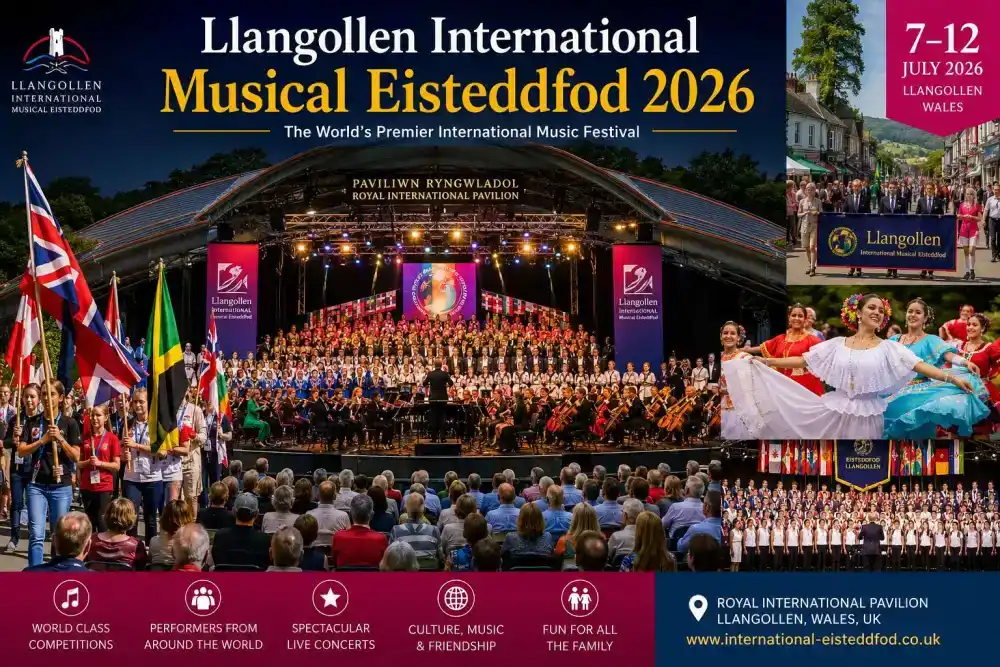
Llangollen is famous for its festivals. The Llangollen International Musical Eisteddfod is the biggest, attracting performers from around the world. It runs for a week in July, with competitions, concerts, and a parade. The Llangollen Fringe Festival (June) offers alternative music, comedy, and arts. The Llangollen Food Festival (October) celebrates local produce and cooking.
Other events include the Llangollen Railway Gala, the May Day Fair, and the Christmas Market. The town also hosts the Dee Valley Walking Festival in spring and autumn. The Llangollen Eisteddfod Peace Message is a global initiative. These events draw thousands and boost the local economy.
- Llangollen International Musical Eisteddfod (July)
- Llangollen Fringe Festival (June)
- Llangollen Food Festival (October)
- Dee Valley Walking Festival (May & September)
- Llangollen Railway Steam Gala (April & September)
- May Day Fair & Maypole Dancing
- Christmas Market and Lights Switch-On
- St David's Day celebrations (March 1st)
- Llangollen Arts Festival (various dates)
- River Dee Raft Race (Charity event)
- Llangollen Classic Car Show (Summer)
Cultural Attractions
Llangollen's cultural attractions include historic houses, museums, and heritage sites. Plas Newydd is a must-see, with its Gothic-style architecture and gardens. The Llangollen Museum tells the town's history, from the Ladies to the railway. Dinas Bran Castle offers panoramic views and a sense of medieval times.
The Llangollen Railway is a living museum, with steam trains operating along the Dee Valley. The canal and aqueduct are engineering marvels. The town also has a small cinema, community arts centre, and several art galleries. The Welsh language is visible on signs and heard in daily life, adding cultural richness.
- Plas Newydd – historic house and gardens
- Llangollen Museum – local history exhibits
- Dinas Bran Castle – hillfort and medieval ruins
- Llangollen Railway – heritage steam railway
- Pontcysyllte Aqueduct – UNESCO site (3 miles away)
- Valle Crucis Abbey – Cistercian abbey ruins
- Horseshoe Falls – man-made weir
- Llangollen Community Centre – events and exhibitions
- St Collen's Church – historic church with stained glass
- Llangollen Arts Centre – temporary exhibitions
Outdoor Activities
The Dee Valley is a paradise for outdoor enthusiasts. The River Dee offers white-water rafting, kayaking, and fishing. Hiking trails include the Offa's Dyke Path, the Dee Valley Way, and climbs up Dinas Bran. Cycling is popular on quiet lanes and mountain bike trails in Snowdonia.
Llangollen also has a golf course, tennis courts, and a leisure centre. Horse riding is available on local farms. The area is a designated dark sky location for stargazing. Canoeing and stand-up paddleboarding are growing. The Llangollen Canal is perfect for narrowboat trips and towpath walks.
- White-water rafting on the River Dee (Town Falls)
- Kayaking and canoeing
- Fishing (salmon, trout) – permits required
- Offa's Dyke Path – long-distance trail passes through
- Dee Valley Way – scenic riverside walk
- Dinas Bran Castle walk – steep but rewarding
- Llangollen Golf Club – 18-hole parkland course
- Mountain biking in Snowdonia nearby
- Horse riding – several stables
- Narrowboat hire on the Llangollen Canal
- Cycling along the canal towpath
- Stargazing – dark sky area
Economy and Key Industries
Llangollen's economy is driven by tourism, retail, and services. The town is a major visitor destination in North Wales, with the Eisteddfod and heritage railway attracting significant revenue. Tourism supports many local businesses, including hotels, B&Bs, restaurants, and shops. The canal and aqueduct are also key attractions.
Agriculture remains important in the surrounding valley, with sheep farming and some dairy. Small-scale manufacturing includes food processing and crafts. Professional services such as law, accounting, and real estate are present. The public sector provides jobs in education, healthcare, and local government.
Recent developments include investment in digital infrastructure for remote working. The Llangollen Railway is a major employer and volunteer organisation. The town has a growing arts and crafts sector, with galleries and workshops. The economy is relatively stable but seasonal, with peak tourism in summer. Efforts are underway to extend the season through festivals and events.
- Tourism – main economic driver
- Retail – independent shops, cafes, and galleries
- Agriculture – sheep and cattle farming
- Heritage railways – Llangollen Railway
- Food and drink – local produce, brewing
- Arts and crafts – pottery, painting, textiles
- Professional services – legal, financial
- Public sector – schools, health, council
- Construction and trades
- Digital and remote work – growing sector
Where to Live in Llangollen
Llangollen offers a mix of housing from historic stone cottages to modern estates. The town centre is compact, with many properties along the river and hillsides. Popular residential areas include the town centre itself, the outskirts towards the A5, and nearby villages like Llangollen Rural. Housing is generally affordable compared to England, but prices have risen due to demand from second home buyers.
Neighbourhoods vary from quiet lanes to busier streets. The area around the railway station is convenient. The Panorama area offers views over the valley. The village of Llantysilio is just west, with access to the aqueduct. For a more rural feel, consider smaller settlements like Carrog or Glyndyfrdwy.
Living in Llangollen means embracing a close-knit community. Many residents are Welsh-speaking or bilingual. The town has good schools, a health centre, and amenities. Property types include terraced houses, detached homes, and stone cottages. Some historic houses require renovation. The second home market has led to concerns about affordability for locals.
- Town centre – shops and restaurants within walking distance
- Llangollen Estate – modern housing on the edge of town
- Panorama – scenic views, quiet residential road
- Abbey Road – near Valle Crucis and countryside
- Llantysilio – village near the Horseshoe Falls
- Carrog – charming village with railway station
- Glyndyfrdwy – more rural, along the Dee
- A5 corridor – convenient for commuting
- Riverside – properties along the Dee
- Hillside – terraces on the valley slopes
Formalities and Visas in Llangollen
As part of the United Kingdom, Llangollen follows UK immigration rules. Visitors from EU, EEA, and Swiss countries (except Ireland) need to check visa requirements post-Brexit. Most short-term visitors (up to 6 months) from many countries, including the US, Canada, Australia, and Japan, do not need a visa for tourism. Non-visa nationals must have a valid passport.
For longer stays, work, or study, appropriate visas are needed. The UK points-based system includes Skilled Worker, Family, and Student visas. EU citizens can apply for the EU Settlement Scheme to retain residency rights. Those moving for work often need sponsorship from an employer. The Home Office handles applications.
Residents must register with the NHS for healthcare. They also need a National Insurance number for work or benefits. Driving licenses from EU countries can be exchanged for a UK license. Others may need to take a test. The Llangollen area has a local council office for permits and registrations.
- Short-term visitors: 6 months without visa (many nationalities)
- Standard Visitor visa: for longer stays, business, or study
- Skilled Worker visa: requires job offer from licensed sponsor
- Health and Care Worker visa: faster route for medical professionals
- Student visa (Tier 4): for courses at universities or colleges
- Family visa: for partners or dependents of UK residents
- EU Settlement Scheme: for EU/EEA/Swiss citizens living in UK
- Indefinite Leave to Remain: after 5 years of residency
- British citizenship: after meeting requirements (ILR, language test, etc.)
- Biometric residence permit: required for some visas
- Customs regulations: no restrictions on personal goods within UK
- Register with local GP for NHS access
- Apply for National Insurance number
Working in Llangollen
The job market in Llangollen is largely focused on tourism, hospitality, retail, and services. Many jobs are seasonal, especially in summer. Teaching and public sector roles provide stable employment. There are opportunities in heritage, such as the Llangollen Railway. Some residents commute to larger towns like Wrexham or Chester, or even further to Manchester.
Self-employment and small businesses are common, particularly in tourism, crafts, and consulting. The gig economy is growing, with remote work options increasing since the pandemic. Welsh language skills are an asset, especially in customer-facing roles. The average salary is lower than UK average, but cost of living is modest.
Professional culture in Llangollen is friendly and informal. Networking through local business groups and events is important. The town has a dedicated job centre for advice. Many find work through word-of-mouth. Entrepreneurs can benefit from Welsh Government support.
- Tourism and hospitality – hotels, B&Bs, restaurants
- Retail – shops, galleries, farm shops
- Education – primary and secondary schools
- Healthcare – GP surgeries, community health
- Heritage – Llangollen Railway, museums
- Agriculture – farming in the valley
- Construction and trades
- Remote work – IT, writing, digital services
- Professional services – accounting, law (limited local)
- Arts and crafts – pottery, illustration, woodwork
- Public transport – bus and train operators
- Community organisations – charities, festivals
Studying in Llangollen
Llangollen has primary and secondary education. Ysgol Dinas Bran is the secondary school, offering Welsh and English streams. Primary schools include Ysgol Bro Dyfrdwy and Ysgol Bryn Collen. There are no universities in Llangollen itself. Higher education options are in Wrexham (Glyndŵr University) or farther afield in Bangor, Aberystwyth, or Chester.
For adult education, there are local community courses and Welsh language classes. The Llangollen Library provides resources. The town is a good place for students who prefer a quiet environment. Many students from the area commute to colleges and universities. The Llangollen Railway offers apprenticeships in engineering and heritage tourism.
Student life in Llangollen is low-key. There are no large student unions, but community activities are available. Accommodation for students is usually in shared houses or lodgings. The cost of living is lower than in big cities. Studying in Llangollen offers access to nature and a supportive community.
- Ysgol Dinas Bran – comprehensive secondary school (ages 11-18)
- Ysgol Bro Dyfrdwy – primary school (Welsh medium)
- Ysgol Bryn Collen – primary school (English medium)
- Glyndŵr University, Wrexham – 12 miles away
- Bangor University – 45 miles
- University of Chester – 25 miles
- Adult learning – Llangollen Community Centre
- Welsh language courses – various levels
- Apprenticeships – Llangollen Railway, local businesses
- Library services – study space, internet access
- Private tutoring available
- Student discounts: use NUS or student ID
- Part-time work opportunities in tourism
Finance and Banks in Llangollen
Llangollen has bank branches including Barclays and Lloyds, which offer personal and business accounts. There are also building societies and a post office that provides basic banking. Most transactions are digital, and cash machines are available. Online banking is widely used. International transfers can be done through banks or specialist services.
For taxes, the UK system applies: income tax, national insurance, and council tax. The tax year runs April-April. Self-assessment is needed for self-employed. VAT registration is mandatory for businesses with turnover above £85,000. Financial advice is available from local advisors.
- Barclays Bank – on Castle Street
- Lloyds Bank – on Princess Street
- Santander – limited services (mobile branch)
- Halifax – available online
- Post Office – banking services
- Cash machines: several in town centre
- Digital banking apps: Monzo, Starling, Revolut popular
- Currency: Pound Sterling (GBP)
- International transfers: TransferWise, PayPal
- Tax: HMRC for income tax, self-assessment
- Council tax: paid to Denbighshire County Council
- Financial advisors: local independent firms
Health Care in Llangollen
Llangollen has a health centre (Llangollen Health Centre) offering GP services, minor surgery, and clinics. Residents register with the NHS and receive free primary care. The nearest hospital is in Wrexham (Maelor Hospital) for emergencies and specialist care. There is also a minor injuries unit in Llangollen.
Dental services are available, but NHS dentists may have waiting lists. Pharmacies in town provide prescriptions and advice. The Welsh Ambulance Service responds to emergencies. For mental health, services are provided by Betsi Cadwaladr University Health Board. Private healthcare is available in larger cities.
- Llangollen Health Centre – GP surgery on Market Street
- Minor injuries unit (limited hours)
- Wrexham Maelor Hospital – A&E and specialist care (12 miles)
- Dental surgeries: several private, few NHS
- Pharmacies: Boots, Rowlands, local pharmacy
- Opticians: Specsavers, independent
- Mental health support: local community team
- Health visitors and midwives
- Physiotherapy: available via GP referral
- Chiropodist, osteopath: private
- Health promotion: NHS Wales 111 online
Accommodation in Llangollen
Visitors have many options: hotels, B&Bs, guesthouses, self-catering cottages, and camping. Popular hotels include the Royal Hotel, The Hand Hotel, and the Chainbridge Hotel. Several B&Bs offer personal service with breakfast. Self-catering cottages are ideal for families or longer stays. The Llangollen Railway also has a holiday carriage.
For residents, buying a home is typical. Renting is available but less common. Prices for houses average around £200,000-£300,000. Renting a two-bedroom flat can cost £500-£700 per month. The market is competitive due to demand from second home buyers. New developments are limited.
- Hotels: Royal Hotel (3-star), Hand Hotel (historic), Chainbridge (riverside)
- B&Bs: Kynaston House, Gales of Llangollen (rooms), Bryn Derwen
- Self-catering: Bridge End Cottage, Ty Isa, Canal View
- Camping: Riverside Caravan Park, Wern Caravan Park
- Youth hostel: Llangollen hostel – budget option
- Long-term rentals: limited stock; check Rightmove, Zoopla
- Buying: typical prices £200k-£350k for terraced/semi
- Council tax: Bands B-D typical
Planning Your Move to Llangollen
Moving to Llangollen requires planning for housing, employment, and settling in. Check visa and residency requirements if moving from abroad. Visit the town first to get a feel for areas. Secure accommodation before arrival, especially in peak season. Arrange school places for children.
Register with a GP and dentist as soon as possible. Set up bank accounts and utilities. Transfer driving licenses if needed. Learn about local services, transport, and community groups. Welsh culture is strong; basic knowledge of Welsh names and phrases is appreciated. Prepare for a slower pace of life.
- Research local housing market – use online portals
- Visit in different seasons to understand weather
- Check school catchments if children
- Apply for visas (if needed) well in advance
- Notify HMRC and DVLA of change of address
- Arrange removal services or hire van
- Set up utilities – water, electricity, gas, broadband
- Register with local GP and dentist
- Open a UK bank account (bring proof of address)
- Get a UK driving license (exchange or test)
- Register to vote – local council
- Join community groups – Llangollen Community Forum
- Learn some Welsh – even simple greetings
- Arrange pet travel if applicable
Leisure in Llangollen
Evenings in Llangollen are relaxed. Pubs like The Corn Mill, The Sun, and The Bridge End offer local ales and often live music. There is a cinema (with live screenings), a theatre at the community centre, and occasional concerts. The Llangollen Railway offers evening dining trains.
Shopping includes independent boutiques, gift shops, art galleries, and a weekly market (Mondays). There is a small supermarket (Co-op) and local butchers. The town is bike-friendly and walkable. For more extensive nightlife, Wrexham or Chester are nearby.
- The Corn Mill – riverside pub with beer garden
- The Sun pub – live music on weekends
- Bridge End Hotel – traditional pub food
- Llangollen Cinema – shows films and live events
- Llangollen Community Centre – theatre, club nights
- Shopping: Castle Street, Princess Street – independent shops
- Llangollen Market – Mondays on Parade Ground
- Art galleries: Llangollen Gallery, Studio 19
- Library – events and book clubs
- River walks and parks
Transportation Options in Llangollen
Llangollen is well-connected by road via the A5, which links to Shrewsbury, Oswestry, and Holyhead. The B5105 connects to Ruthin. The town is served by bus services (Arriva Wales) to Wrexham, Chester, and Ruthin. The Llangollen Railway offers heritage services between Llangollen and Corwen, but not for regular commuting.
The nearest mainline railway station is in Ruabon (6 miles) with services to Birmingham and Chester. Wrexham General station (12 miles) has services to London, Manchester, and Holyhead. The nearest airport is Liverpool John Lennon (50 miles) or Manchester Airport (60 miles). Driving is the most convenient way to reach Llangollen.
- A5 road – main artery through town
- B5105 – to Ruthin and the Clwydian Range
- Bus services: X5 to Wrexham, 2C to Chester
- Llangollen Railway – heritage, not regular transport
- Ruabon station – 6 miles, frequent trains
- Wrexham General – 12 miles, intercity services
- Liverpool John Lennon Airport – 50 miles
- Manchester Airport – 60 miles
- Local taxis – several companies
- Car rental – available in Wrexham
- Cycling – popular, but hills require fitness
Everyday Life in Llangollen
Daily life in Llangollen is tranquil. Most errands can be done on foot in the compact town centre. The pace is slower than cities. Neighbours are friendly. Community events are frequent. The town is safe, with low crime. Traffic can be busy in summer due to tourists.
There is a library, post office, and leisure centre. Schools are within walking distance. The River Dee provides a scenic backdrop. Many residents volunteer for festivals or heritage groups. Public services are good. The Welsh language adds cultural richness.
- Low crime rates – very safe
- Friendly community – strong social fabric
- Compact town centre – walkable
- Leisure centre with swimming pool
- Library with public computers
- Post office on Castle Street
- Supermarket (Co-op) and local shops
- Parks: Riverside Park, Sports Field
- WiFi: public hotspots in some areas
- Delivery services: Amazon, food deliverers limited
- Parking: pay and display, residents permits
Cost of Living in Llangollen
Llangollen is less expensive than UK average, but more than some rural Welsh towns. Housing is the biggest cost, with rents slightly lower than national average. Utilities are typical. Food and dining are reasonably priced. Transport costs are lower if you live locally, but car ownership is almost essential.
A single person can live on £1,200-£1,500 per month including rent. For a family, expect £2,500-£3,500. Council tax is Band B-D typical (£1,200-£1,800 per year). Heating costs can be higher in winter due to valley location.
- Rent: 1-bed flat £450-£600; 2-bed house £600-£800
- Buy: average house £200k-£300k
- Utilities: gas/electric £100-£200 per month
- Council tax: Band B approx £1,200/year
- Food: groceries £250-£400/month for two
- Dining out: main course £12-£20
- Transport: petrol/diesel 140p/L (approx)
- Public transport: bus fare £2-£5 local
- Childcare: £5-£6 per hour childminder
Places to Visit in Llangollen
Llangollen is surrounded by attractions. The Pontcysyllte Aqueduct is a UNESCO World Heritage Site, where you can walk or take a narrowboat across the channel 126 feet above the Dee. The Horseshoe Falls is a beautiful weir built for the canal. Dinas Bran Castle offers stunning valley views. Valle Crucis Abbey is a serene ruin.
The Llangollen Railway takes you on a scenic journey to Corwen. Plas Newydd has lovely gardens and a fascinating history. The town itself is a delight, with its bridge, riverside walks, and independent shops. For more, visit the nearby Chirk Castle (National Trust) or Erddig (National Trust). Snowdonia is a short drive away.
Outdoor attractions include the Egwyseg Rocks, a limestone escarpment popular with climbers. The Berwyn Mountains offer wild hiking. The canal towpath is perfect for cycling. Wildlife watching includes red kites, otters, and salmon. The area is a haven for photographers.
For families, the Llangollen Railway offers special events. There is also a farm park and a pottery. The Llangollen Museum is small but informative. Evening walks are lovely along the river. The town is a base for exploring North Wales.
- Pontcysyllte Aqueduct – 3 miles, walk across the aqueduct
- Horseshoe Falls – 2 miles, scenic weir
- Dinas Bran Castle – 15-minute walk from town centre
- Valle Crucis Abbey – 2 miles, Cistercian ruins
- Llangollen Railway – station in town, round trips
- Plas Newydd – historic house and gardens
- Chirk Castle – 8 miles, medieval castle
- Erddig – 12 miles, 18th-century house near Wrexham
- Egwyseg Rocks – 3 miles, climbing and walking
- Berwyn Mountains – 10 miles, hiking
- Snowdonia National Park – 30 miles, attractions
- Llangollen Museum – in town centre
- Llangollen Bridge – historic crossing
- Riverside walks – along the Dee
News & Testimonies
Recent news from Llangollen includes the restoration of Dinas Bran Castle paths, new community initiatives, and the continuation of the Eisteddfod. The Llangollen Railway has received funding for bridge repairs. The town is focusing on sustainable tourism and protecting its heritage.
Residents often praise the community spirit and natural beauty. Some note the limited job market and reliance on tourism. Newcomers find the welcome warm but needing patience to integrate. Testimonies highlight the quality of life, safety, and access to outdoor activities.
- Llangollen Eisteddfod continues to attract global performers
- New cycling paths along the canal planned
- Housing development applications debated by locals
- Local cafe owners report successful season
- Resident quotes: 'A wonderful place to raise a family.'
- Newcomer: 'The community was so welcoming.'
Forum Topics on Living in Llangollen
Online forums about Llangollen frequently ask about moving to the area, best schools, and cost of living. People discuss the best places to eat and walk. Many seek advice on finding rentals or buying property. Others share experiences of retirement in

 Verified