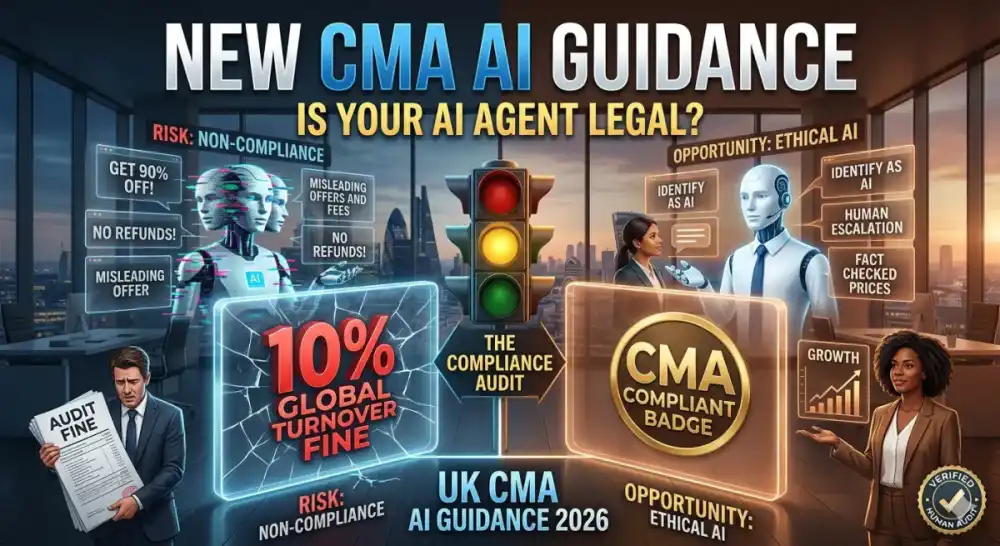
In early March 2026, the UK Competition and Markets Authority (CMA) officially ended the "Wild West" era of autonomous digital marketing. With the release of the Guidance on the Use of Generative and Agentic AI in Consumer Markets, the regulator has signaled that "I didn't know the AI would say that" is no longer a valid legal defense.
As businesses across London and the wider UK rapidly deploy "Agentic AI"—systems capable of making decisions, processing refunds, and negotiating prices without human intervention—the risk of accidental non-compliance has skyrocketed. For high-growth firms, the stakes are existential: the CMA now has the power to levy fines of up to 10% of global turnover for persistent breaches of consumer trust.
At Perfect Marketing Solution, we believe that compliance isn’t just a legal hurdle; it is a competitive advantage. In an era of skepticism, the brands that prove they are ethical will win the long-term loyalty of the UK consumer. Whether you are seeking high-end digital marketing services or a comprehensive audit, understanding these new regulations is the first step toward future-proofing your operations.
Understanding 'Agentic AI' vs. Standard Chatbots
To understand the new guidance, we must distinguish between the 2024-era chatbots and the 2026 Agentic AI.
Traditional chatbots were essentially fancy FAQ search engines. They followed rigid scripts and lacked independent decision-making capabilities. Agentic AI, however, possesses "agency." It can:
-
Access a customer’s purchase history to offer "personalized" (and potentially discriminatory) pricing.
-
Execute transactions and sign contracts on behalf of the business.
-
Manipulate "scarcity" cues in real-time based on a user's browsing speed.
The CMA’s primary concern is that these agents often operate as a "black box," making decisions that the business owners themselves cannot explain. When an algorithm is given the autonomy to act on behalf of a brand, the business remains the primary legal entity responsible for the consequences of those actions.
The Five Pillars of the 2026 CMA AI Guidance
The new guidance is built on five core principles. Every UK business using AI in their digital marketing services funnel must audit their systems against these pillars immediately.
Pillar I: The Transparency Mandate
The "Uncanny Valley" is now a legal liability. The CMA mandates that consumers must be informed upfront and clearly when they are interacting with an AI agent.
-
The Violation: Using a human name and a stock photo of a person for an AI bot to trick the user into thinking they are talking to a human. This is considered a deceptive practice under the Consumer Protection from Unfair Trading Regulations.
-
The Requirement: A persistent visual indicator (e.g., a "Powered by AI" badge) and an easily accessible "Human Escalation" button that actually leads to a real person, not a secondary bot.
Pillar II: Accountability for 'Hallucinations'
If your AI agent promises a 50% discount to a customer to close a sale, you are legally bound to honor it. The CMA has clarified that the business is 100% responsible for the output of its agents.
-
The Risk: "Price hallucinations" or false claims about product availability or warranty terms.
-
The Solution: Strict "Guardrail" programming and real-time monitoring of AI-led negotiations. If the AI cannot verify the information, it must be programmed to decline the request or route it to a human agent.
Pillar III: Prevention of Deceptive Patterns (Dark Patterns)
AI is incredibly good at identifying a consumer's psychological triggers. The CMA is cracking down on "AI-driven urgency."
-
Deceptive Pattern: An AI agent that notices a user is stressed or in a hurry and artificially inflates the price or suggests that "only 1 item remains" when that is not true.
-
The Rule: AI must not exploit consumer vulnerabilities or use "choice architecture" to subvert a user's autonomy.
Pillar IV: Data Privacy and the 'Feedback Loop'
Many AI agents learn from every interaction. The CMA, in partnership with the ICO (Information Commissioner’s Office), is concerned about how consumer data is being used to train these models without explicit "opt-in" for that specific purpose.
-
The Requirement: Clear disclosure if a customer's conversation is being used to fine-tune the agent’s future behavior. If the data is used for training, the user must have an easy path to opt-out without losing functionality.
Pillar V: Fairness in Personalized Pricing
AI agents can now predict the maximum a customer is willing to pay. The CMA warns that "dynamic pricing" must not cross into "predatory pricing."
-
The Focus: Ensuring that AI doesn't charge more based on protected characteristics or the user's digital hardware (e.g., charging more because a user is on a high-end iPhone). Fairness must be baked into the algorithm’s core, not applied as an afterthought.
The Cost of Non-Compliance: Fines and Brand Erosion
The CMA isn't just issuing warnings. Under the Digital Markets, Competition and Consumers Act, the financial penalties are designed to be "deterrent-level."
-
Direct Fines: Up to 10% of global annual turnover. For mid-to-large enterprises, this is a multi-million-pound risk that can wipe out annual profits.
-
Redress Schemes: The CMA can force businesses to proactively refund every customer who interacted with a non-compliant AI agent, regardless of whether they complained. This is a logistical and financial nightmare for any brand.
-
Public Censure: Being listed on the CMA’s "Non-Compliant Entities" register, which is a death sentence for B2B trust and Google E-E-A-T scores.
How to Audit Your AI Marketing Funnels: A Step-by-Step Guide
As a leading UK digital marketing agency, Perfect Marketing Solution recommends the following 4-step compliance audit to ensure your business is protected:
Step 1: The "Bot Disclosure" Check
Does your AI agent introduce itself as AI? If not, change the greeting immediately. Avoid phrases like "I am your personal assistant, Sarah." Instead, use "I am the PMS AI Assistant. I can help with X, Y, and Z. If you need a human, click here." Transparency builds trust, and trust is the new currency of the digital age.
Step 2: The Hallucination Stress-Test
Hire an external team to "Red Team" your AI. Try to trick it into offering illegal discounts, making false health claims about products, or disparaging competitors. If the AI "breaks," your guardrails are insufficient. Regularly review the logs of your AI interactions to identify where the "hallucinations" originate.
Step 3: Choice Architecture Review
Examine the buttons and prompts your AI uses. Are "No" options hidden? Does the AI use "Confirmshaming" (e.g., "No, I prefer to pay full price")? These are now high-priority targets for CMA enforcement. Ensure your interface allows users to make choices freely, without being manipulated by dark patterns.
Step 4: The Human-in-the-Loop (HITL) Protocol
Ensure that any high-value transaction or complex complaint handled by an AI agent is flagged for human review within 24 hours. Documentation of this review process is your best legal defense during an audit. This protocol creates an "audit trail" that proves you have exercised reasonable oversight over your automated systems.
The Future: "Verified Human" and "Ethical AI" Badges
By late 2026, we predict that the "Verified Human" badge will be as common as the SSL padlock was in 2010. Consumers are exhausted by AI-generated noise. Brands that voluntarily adopt Ethical AI Frameworks will see:
-
Lower Acquisition Costs: Trust reduces friction in the sales funnel. When users know they aren't being "gamed," they are more likely to convert.
-
Higher Customer Lifetime Value (CLV): Customers stay with brands that don't try to "trick" them with bots.
-
Better SEO Performance: Search engines in 2026 favor "Transparent Entities" over anonymous bot-run sites. High-quality, human-reviewed content will always outrank unverified AI-generated content.
Don't Let Your Innovation Become a Liability
The CMA’s new guidance is not an attack on AI; it is an invitation to build a more professional digital economy in the UK. At Perfect Marketing Solution, we help our clients harness the incredible power of Agentic AI while staying firmly on the right side of the law.
The question isn't whether you should use AI—you must to stay competitive. The question is: Is your AI acting in your brand's best interest, or is it creating a multi-million-pound legal trap?
Need a Professional AI Compliance Audit?
Do not leave your brand's reputation to chance. Contact Perfect Marketing Solution today at our London office (EC1V 2NX) for a comprehensive review of your digital marketing funnels. We ensure your AI agents are driving ROI, not regulatory fines. As a trusted UK digital marketing agency, we bridge the gap between innovation and compliance.

Top Categories
Trending News
-
 AI Agents & The CMA: A Strategic Guide to Compliance and ROI
2 months ago
AI Agents & The CMA: A Strategic Guide to Compliance and ROI
2 months ago -
Navigating the UK Market Strategy and Resilience PR Business Wires
2 months ago
-
New CMA Guidance: Are Your AI Agents Violating UK Consumer Law
2 months ago
-
Press Release Power Launches Exclusive UK Premium Media Network
2 months ago
-
Navigating the UK Business Landscape Strategy and Compliance PR Business Wires
2 months ago




Share this Insight
Spread the knowledge with your community!