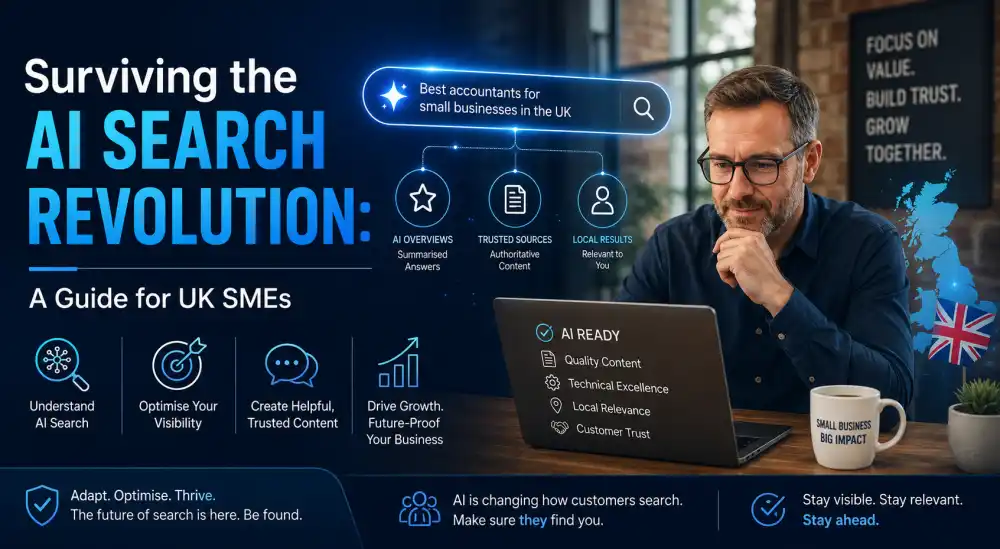
The search engine landscape is no longer just about blue links and traditional rankings. As we move further into 2026, the integration of generative AI into search (often seen as AI Overviews) has fundamentally altered the path from a user's query to a business's front door. For UK-based SMEs, this represents a pivotal moment. The old playbook of "keywords and backlinks" is being superseded by a focus on entity authority, semantic relevance, and user intent.
At Rank Locally UK, we are helping businesses navigate this transition. It isn't about fighting the AI; it is about providing the data and trust signals that AI systems rely on to suggest your business as the "correct" answer.
The New Reality: Search Is Becoming "Answer-First"
In the past, Google’s primary goal was to guide users to a website where they could find their own answers. Today, Google—and its AI models—aims to provide the answer directly on the search results page.
If your business relies on being the "go-to" expert in your local area, you need to ensure that your business information is structured, accurate, and accessible. If you aren't visible in the AI's summary, you aren't visible at all.
1. From Keywords to Entities
Search engines have evolved from matching text strings to understanding "entities." An entity is a person, place, or business that Google recognizes as having a specific identity. If you want to rank, you must be a recognized entity in your industry and location. This is achieved through consistent NAP (Name, Address, Phone) data, active reviews, and a robust digital footprint across reputable UK directories.
2. The Role of Schema Markup
If AI is "reading" the web to answer user questions, it needs structured data to understand what your site is saying. Schema markup acts as the "metadata" for your content. Whether you provide Local SEO services or run a local cafe, implementing LocalBusiness schema is no longer optional—it is a technical requirement for visibility in AI-enhanced results.
Actionable Strategy: Future-Proofing Your Presence
To thrive in the AI-search era, your strategy must be multifaceted.
A. Prioritize Reputation Management
AI models are heavily weighted toward trust. They prioritize businesses with verified, consistent, and positive sentiment. Your Review Management strategy is now a critical SEO lever. A business with hundreds of positive reviews on Google Business Profile is more likely to be cited by an AI engine than a business with sporadic, unmanaged feedback.
B. High-Quality, User-First Content
AI systems are now better than ever at detecting "keyword stuffing." They prioritize content that directly answers customer pain points. When writing for your site, don't write for the algorithm; write for the human who is asking the question.
If you need help aligning your content with these new standards, our Strategic SEO Consulting team specializes in mapping user intent to your business goals.
C. Technical Foundation
An AI cannot recommend a site that is broken. Google’s crawlers are increasingly unforgiving of slow load times, poor mobile UX, and security flaws. Regular Technical SEO Audit procedures are necessary to ensure your site is "crawlable" by the advanced bots that feed the AI engines.
Why "Bespoke" Matters More Than Ever
In an automated world, generic content is invisible. Whether it is an article about "The Best Ways to Insulate a UK Home" or a landing page for your specific service, it needs to offer unique insights. We encourage our clients to use Bespoke content strategies that highlight their team’s expertise, their specific project history, and their deep roots in their local community.
Preparing for the Future
As we look toward the remainder of 2026, the winners in the local search game will be those who embrace transparency. By clearly marking up your data, maintaining impeccable reputation signals, and providing genuine value to your community, you can ensure your business remains the local answer when people ask, "Where can I find..."
Frequently Asked Questions
1. What are AI Overviews and how do they impact my rankings?
AI Overviews are summaries generated by Google's AI at the top of search results. They can potentially answer a user's question without them clicking a link, making it more important to be the "source" the AI cites.
2. Does AI replace the need for traditional SEO?
No, it evolves it. You still need technical health, quality content, and authority, but these factors must now be presented in a way that AI systems find easy to parse.
3. How does voice search impact UK local SEO?
Voice search is usually conversational. Optimizing for "near me" and specific, long-tail questions (e.g., "Best emergency plumber near London Bridge") helps capture these voice-driven queries.
4. Should I change my content style to be more robotic for AI?
Absolutely not. AI is trained to prioritize "helpful" content. Use natural, conversational language that answers specific customer questions directly.
5. How does schema markup actually help?
Schema provides machine-readable labels for your data. It tells Google "this is my price," "this is my review count," and "this is my physical address," ensuring accuracy in AI-generated summaries.
6. Is link building still effective in the AI era?
Yes, but the quality requirement is higher. Contextual, relevant links from local UK organizations are far more valuable than broad, spammy links.
7. What is the biggest risk for brick-and-mortar stores?
The biggest risk is being "invisible" to search engines due to outdated or inconsistent information. If the AI doesn't know you exist or where you are, it won't recommend you.
8. How does Rank Locally UK use AI to help my business?
We use data-driven tools to audit your current visibility, identify content gaps, and ensure your site’s technical structure meets the highest standards for AI-crawlers.
9. Is it better to spend money on PPC or Organic SEO in 2026?
They serve different purposes. PPC provides immediate traffic, but organic SEO provides long-term trust and domain authority. A balanced approach is usually the most cost-effective.
10. What is the one thing I must do today to prepare?
Audit your Google Business Profile. Ensure all your information is accurate, consistent, and that you have a plan in place to actively manage your reviews.
Top Categories
Trending News
-
 AI Agents & The CMA: A Strategic Guide to Compliance and ROI
2 months ago
AI Agents & The CMA: A Strategic Guide to Compliance and ROI
2 months ago -
Navigating the UK Market Strategy and Resilience PR Business Wires
2 months ago
-
New CMA Guidance: Are Your AI Agents Violating UK Consumer Law
2 months ago
-
Press Release Power Launches Exclusive UK Premium Media Network
2 months ago
-
Navigating the UK Business Landscape Strategy and Compliance PR Business Wires
2 months ago





Share this Insight
Spread the knowledge with your community!