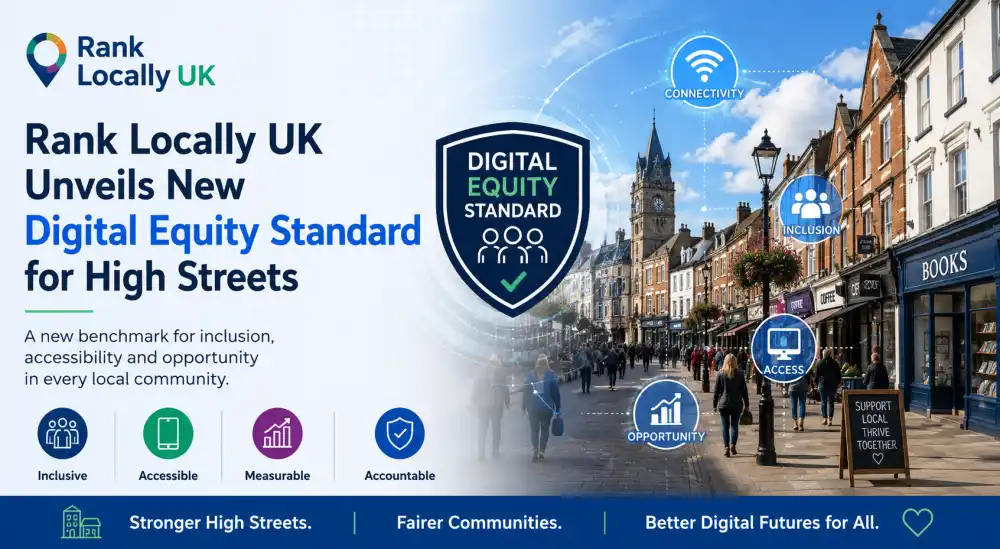
LONDON, UK — Rank Locally UK, the nation’s leading authority in hyper-local digital strategy, has today announced the formal launch of the "High Street Digital Equity Standard." This new industry-first framework is designed to provide independent retailers, tradespeople, and hospitality venues with the defensive infrastructure necessary to remain visible in an era of rapid AI-driven search centralization.
As the Google March 2026 Core Update continues to reshape how information is consumed, the "Digital Divide"—the gap between those who understand AI-agent logic and those who don't—has become the single greatest threat to the UK's independent commercial ecosystem. The Digital Equity Standard is a set of rigorous technical benchmarks intended to ensure that a local shop’s presence is as discoverable, trustworthy, and actionable as that of any national conglomerate.
The Looming Crisis: The "AI-Driven Digital Divide"
The rapid evolution of Agentic AI—systems that perform tasks on behalf of users rather than just listing links—has created a "Zero-Click" environment that disproportionately affects smaller businesses. When a user asks an AI assistant to find "the best local boutique for handmade gifts," the AI effectively filters the results. If a business does not provide the specific "entity data" that AI models require to build trust, that business is effectively omitted from the final recommendation.
"For too long, the 'Digital Divide' has been treated as a luxury problem," says the Lead Strategist at Rank Locally UK. "In 2026, it is an existential threat. Our local high streets are the lifeblood of the UK economy, yet they are currently being systematically filtered out of the AI decision-making process. The 'High Street Digital Equity Standard' is our response—a formal, actionable, and transparent set of protocols that allows the 'little guy' to compete with the 'big guys' on the most advanced technology platforms in the world."
The 5 Pillars of the Digital Equity Standard
The High Street Digital Equity Standard provides a holistic approach to online presence, moving beyond legacy SEO tactics. It is built upon five foundational pillars, each addressing a specific area where independent businesses are currently losing ground to national chains with massive data-science departments.
1. Entity-First Documentation
AI does not "read" websites; it understands "entities." The Standard requires that every local business marks up its digital identity—its opening hours, product inventory, historical relevance, and service area—in the specific machine-readable language (Schema.org) that AI agents demand.
2. Transactional Interoperability
A business must be "ready for action." The Standard benchmarks the ability of a business to accept bookings, inquiries, or inventory checks directly within the platforms users are already using, rather than forcing the user through the friction of navigating a slow-loading website.
3. AI-Compliance (DUAA 2025)
Navigating the Data (Use and Access) Act (DUAA) is no longer optional. This pillar of the Standard ensures that every independent business is handling customer data with enterprise-grade security, preventing legal exposure while fostering the consumer trust required for AI-driven purchase decisions.
4. Hyper-Local Entity Mapping
To survive, businesses must dominate their "Micro-Catchment." The Standard mandates that a business’s digital presence reflects the specific geographic context of its high street, ensuring that it appears for the "near me" and "in the borough of" queries that drive high-intent local footfall.
5. Verification of Authenticity
The final pillar is designed to leverage the biggest advantage of the independent retailer: local trust. The Standard creates a protocol for embedding "social proof"—reviews, community mentions, and local news coverage—into the business’s "Digital Knowledge Graph," giving AI models proof that the business is a genuine, valued member of its community.
Democratizing Digital Power
The "High Street Digital Equity Standard" is not a proprietary black-box solution; it is a movement. By standardizing the way independent businesses present themselves online, Rank Locally UK aims to create a "High Street Ecosystem" where independent shops can collectively signal their importance to AI models.
"Think of this as the new health and safety inspection for the internet," the Lead Strategist adds. "Just as we expect our restaurants to meet hygiene standards, we should expect our digital storefronts to meet 'Equity Standards.' When independent businesses speak the same digital language, the algorithms start to listen."
The "Digital Equity" Manifesto: A Call to Action
The initiative is backed by a 15-point Manifesto that outlines the rights and digital responsibilities of every independent business owner in the UK. This manifesto argues that:
-
Local businesses deserve access to the same visibility tools as national chains.
-
Data privacy (via DUAA 2025) is a core component of business value, not a technical tax.
-
AI platforms have a responsibility to show unbiased, locally-relevant information.
By adopting this Standard, independent retailers are not just fixing their websites; they are joining a collective of businesses committed to staying relevant for the next decade of technological change.
How to Apply for the "Digital Equity" Assessment
Independent UK businesses are invited to undergo a "Digital Equity Gap Analysis" to see how they measure up against the new Standard. Businesses that meet the criteria will be listed on the Digital Equity Registry, a growing directory of AI-optimized, high-street businesses that local communities can rely on.
Frequently Asked Questions
1. What is the Digital Equity Standard?
It is a comprehensive framework that outlines the exact technical and operational steps independent businesses must take to remain visible and competitive in the age of AI search.
2. Is this different from traditional SEO?
Yes. Traditional SEO focuses on "keywords" and "links." The Digital Equity Standard focuses on "entities," "data structure," and "transactional readiness" for AI agents.
3. Why is this initiative important for the UK High Street?
AI search engines often prioritize larger, national brands because they have better-structured data. This standard levels the playing field for the independent sector.
4. Does this involve a membership fee?
No. The initial Gap Analysis is provided as a service to the community to promote widespread adoption of these critical standards.
5. How does this protect me from the DUAA 2026?
The Standard includes a compliance layer that ensures your data collection processes (like lead forms or booking systems) are aligned with the new legal requirements established in 2026.
6. What happens if I fail the "Gap Analysis"?
You are provided with a clear, step-by-step remediation plan to fix the gaps, regardless of your current technical skill level.
7. Is this relevant if I don’t have a website?
Yes. For businesses without a traditional website, the Standard provides guidelines for optimizing your "Digital Home," such as your Google Business Profile and social media hubs.
8. How does AI affect local footfall?
When AI agents provide the "best answer" directly in the search results, fewer people are clicking through to your site. The Standard helps you "capture" the intent and conversion before that click ever happens.
9. Can I implement these standards myself?
Absolutely. We provide the documentation and the "How-To" blueprints for business owners to follow, though you can also hire our team to manage it for you.
10. What is "Hyper-Local Entity Mapping"?
It is the process of defining your business in the context of your specific street, borough, and neighborhood, ensuring you are the "go-to" for locals, not just strangers.
11. Is this initiative backed by Google?
No, this is an independent private sector initiative led by Rank Locally UK, though it strictly follows the guidelines and best practices released by major search platforms.
12. Why "Zero-Click" is a problem?
In a Zero-Click economy, you don't get website traffic. You get "Action Traffic"—booked appointments, orders placed, or directions requested. The Standard optimizes your presence for these actions.
13. Does this help with Voice Search (Siri/Alexa)?
Yes. Voice search is a major component of the Standard. When you structure your data for "Entities," you become the primary answer for voice-based queries.
14. What if I am a service-based business, not a shop?
The Standard is universal. Whether you are a plumber, a baker, or a solicitor, your "digital entity" needs to be understood by AI.
15. How do I join the Digital Equity Registry?
Once you have completed the audit and reached the minimum threshold of the Standard, your business is automatically eligible for inclusion in our nationwide registry.
About Rank Locally UK
Rank Locally UK is a London-based digital agency at the forefront of the "Hyper-Local Dominance" movement. With a focus on the intersection of community-based commerce and advanced AI, the agency helps independent businesses across the UK reclaim their digital presence. Founded in London’s "Silicon Roundabout," the agency is committed to ensuring that the British High Street remains the heart of our economy, regardless of how the search landscape changes.
Media Contact: Name: Press Office, Rank Locally UK
Address: 124 City Road, London, EC1V 2NX
Email: [email protected]
Phone: +91 - 9990546116
Website:https://ranklocally.uk
Top Categories





Share Release
Official announcement for public distribution.