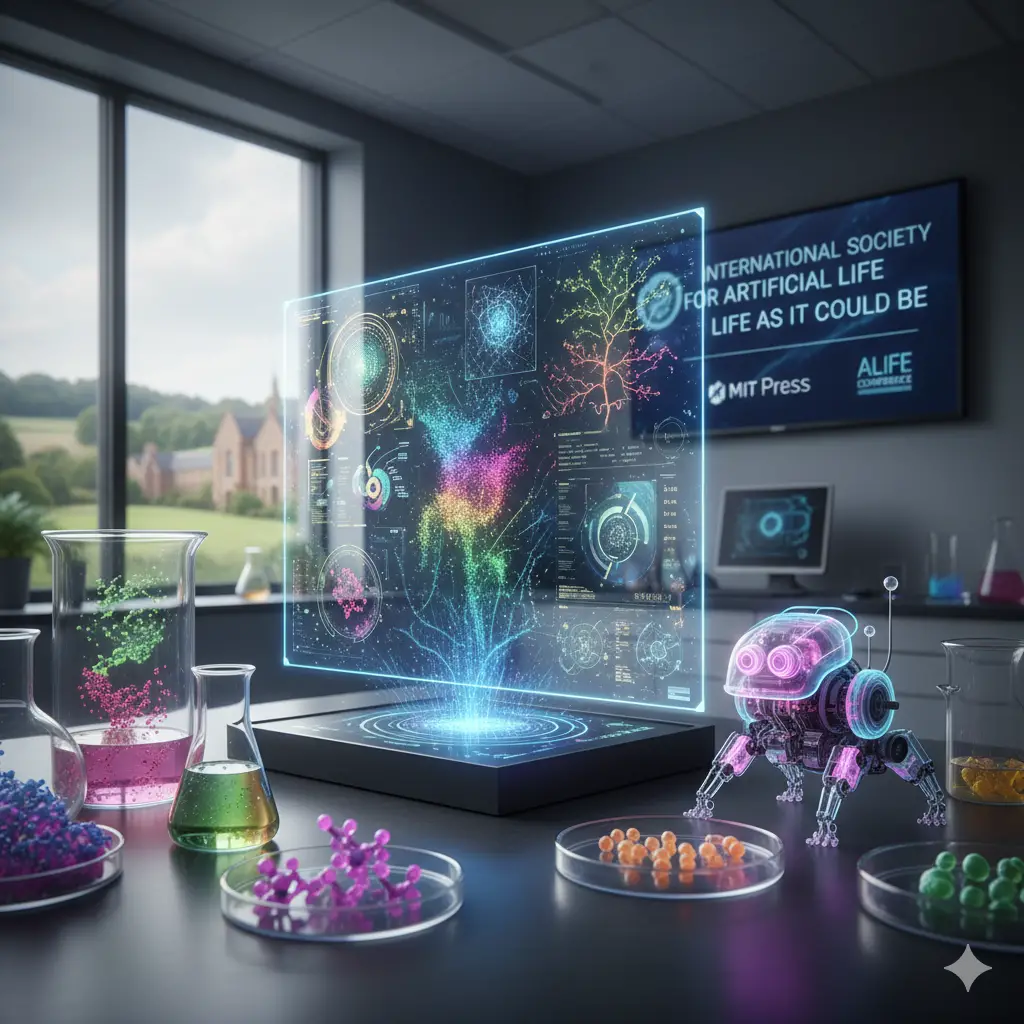
The quest to define "life" has historically been the domain of biology, confined to the carbon-based organisms found on Earth. However, the International Society for Artificial Life (ISAL) has spent decades expanding this definition, shifting the focus from "life as we know it" to "life as it could be." As the premier global professional organization for the interdisciplinary field of Artificial Life (ALife), ISAL serves as the foundational pillar for scientists, engineers, and philosophers who seek to replicate the fundamental properties of living systems through synthetic means.
Headquartered in Brighton, United Kingdom, at the University of Sussex, ISAL is not merely a scientific society; it is the administrative and intellectual heart of a movement that bridges the gap between biological theory and digital synthesis.
The Origins of Artificial Life: From Santa Fe to the Global Stage
The formalization of Artificial Life as a rigorous academic discipline is largely credited to Christopher Langton, the founding president of ISAL. While the roots of the field reach back to the cybernetics of the 1940s and the cellular automata of John von Neumann, it was Langton’s inaugural workshop at the Los Alamos National Laboratory in 1987 that unified these disparate threads.
By 1991, the International Society for Artificial Life was officially established to provide a permanent home for this growing community. Today, ISAL oversees the flagship ALife Conference series and the prestigious Artificial Life journal, published by MIT Press. These platforms ensure that research into self-replication, open-ended evolution, and emergent complexity remains peer-reviewed, accessible, and cutting-edge.
The Three Pillars of ALife: Soft, Hard, and Wet
ISAL promotes research across three distinct but overlapping methodologies, often referred to as the "Soft, Hard, and Wet" branches of Artificial Life:
-
Soft ALife (Computational Modeling): This involves software-based simulations where digital "organisms" evolve and interact. It is the birthplace of evolutionary computation and swarm intelligence, providing insights into how complex global behaviors emerge from simple local rules.
-
Hard ALife (Evolutionary Robotics): In this domain, researchers build physical machines—robots—that exhibit life-like behaviors such as adaptation, autonomous navigation, and collective coordination.
-
Wet ALife (Synthetic Biology): Perhaps the most challenging frontier, Wet ALife involves the biochemical synthesis of life-like systems in a laboratory. This includes research into protocells and the origins of life on a molecular level.
Why Join ISAL? Global Membership and Programs
For researchers and students, ISAL membership offers more than just professional affiliation. It provides a gateway to the "last grand challenges" of science. Members gain access to:
-
Global Networking: Connection with a worldwide community of experts in synthetic biology, computational modeling, and the philosophy of life.
-
Academic Support: Digital access to conference proceedings and professional networking forums.
-
Student Travel Fellowships: Ensuring the next generation of researchers can present their work at international summits.
-
Annual Excellence Awards: Recognition for groundbreaking contributions to the field, fostering a culture of innovation and scientific rigor.
Bridging Technology and Philosophy
Artificial Life is as much a philosophical endeavor as it is a technical one. ISAL members frequently tackle questions regarding the nature of consciousness, the ethics of creating synthetic entities, and the "Strong ALife" hypothesis—the idea that a computer simulation could, in principle, be literally alive.
By hosting discussions on emergent behavior and the transition from non-living to living matter, ISAL ensures that the development of synthetic intelligence is grounded in a deep understanding of natural biological principles.
Contact and Administrative Information
-
Headquarters: Department of Informatics, University of Sussex, Falmer, Brighton, BN1 9RH, UK.
-
Website: https://alife.org
-
Email: secretary@alife.org
-
Helpdesk: 01273606755
Frequently Asked Questions
1. What is the main mission of the International Society for Artificial Life (ISAL)?
ISAL is dedicated to promoting research and education in the field of Artificial Life. Its mission is to support the study of "life as it could be" through computational, robotic, and synthetic biological methods, fostering a global community of interdisciplinary researchers.
2. Who founded ISAL and when?
The society was founded in 1991, following the momentum generated by the first Artificial Life workshop organized by Christopher Langton in 1987. Christopher Langton is recognized as the founding president.
3. What is the difference between Artificial Intelligence (AI) and Artificial Life (ALife)?
While AI focuses on replicating human-like intelligence and cognitive tasks, ALife focuses on replicating the processes of living systems, such as evolution, self-organization, metabolism, and reproduction. ALife often uses a "bottom-up" approach to see how intelligence emerges from life-like interactions.
4. Where is the ISAL headquarters located?
The administrative hub is located at the Department of Informatics, University of Sussex, in Brighton, United Kingdom.
5. How can I publish research with ISAL?
ISAL supports researchers through its official publication, the Artificial Life journal (MIT Press), and the annual ALife Conference proceedings. Researchers can submit their work during the annual call for papers.
6. Does ISAL offer memberships for students?
Yes, ISAL has a robust global membership program that includes specific support for students, such as travel fellowships and access to the ERA (Emerging Researchers in Alife) group.
7. What are the "Soft, Hard, and Wet" categories of ALife?
-
Soft: Computer simulations and digital evolution.
-
Hard: Robotics and physical hardware.
-
Wet: Synthetic biology and biochemical life-like systems.
8. Is ISAL a non-profit organization?
Yes, ISAL is a registered 501(c)(3) non-profit scientific organization with an international board of directors.
9. What payment methods are accepted for ISAL membership?
ISAL accepts Credit/Debit cards, PayPal, and Bank Transfers (BACS/Swift).
10. How can I stay updated on ALife research?
You can subscribe to the ALife Newsletter via the official website or follow ISAL’s social media channels, including their active LinkedIn group.