
Articles for Perfect Marketing Solution
Explore 3 business insights in all locations
Insider
Share Your Business Story
Reach our community by sharing your business insights, expert guides, or success stories on the world's most trusted local platform.
Write Your Article Now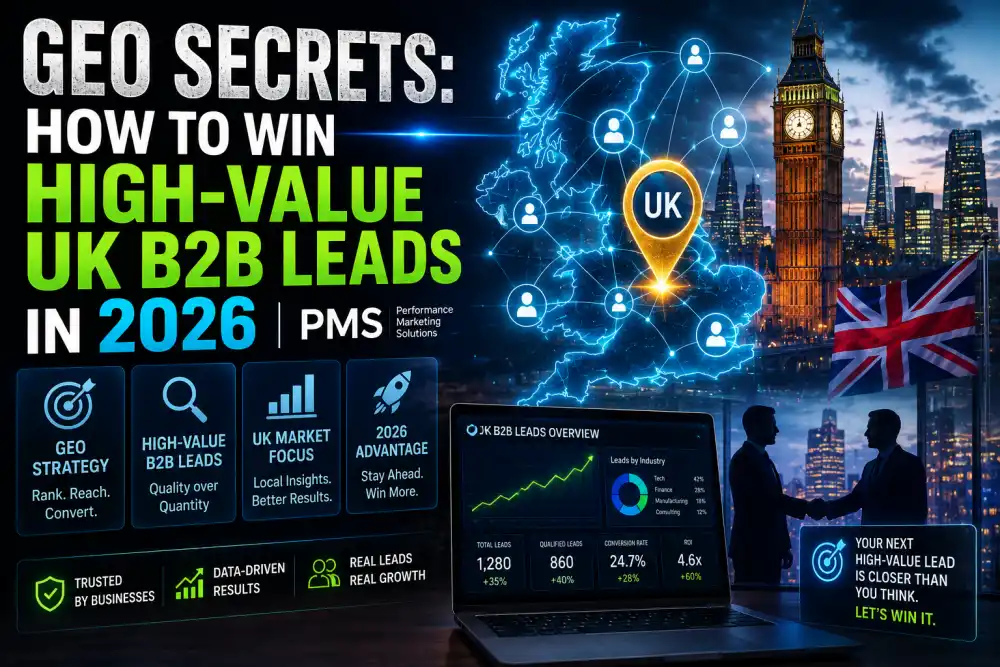
Advertising Agencies
Jun 29, 2026
GEO Secrets: How to Win High-Value UK B2B Leads in 2026 | PMS
As we progress through 2026, the foundational mechanics of the UK digital landscape have undergone their most severe disruption since the dawn of the internet. For digital marketing service providers and enterprise B2B brands, traditional search engine optimization (SEO) is no longer a standalone strategy.
The traditional "blue links" page is rapidly ceding ground to conversational summaries, structured citations, and personalized intelligence agents. Whether a buyer uses Gemini, ChatGPT Search, Perplexity, or Microsoft Copilot, search has transitioned from index-matching to synthesis-curating.
To thrive, forward-thinking UK firms are pivoting toward Generative Engine Optimization (GEO). This is the strategic process of optimizing content specifically to be retrieved, synthesized, and cited by Generative AI models. In a marketplace where high-value B2B contracts range from $\pounds 50,000$ to $\pounds 2.5\text{M}+$, being left out of an LLM’s structured recommendation can cause an enterprise to become virtually invisible.
Below, we break down the definitive GEO playbook designed to capture premium UK business-to-business leads.
The Death of the CTR Funnel: The Rise of "Zero-Click" Primacy
In legacy search, a B2B firm could win a prospect by securing a top 3 spot on Google, commanding a Click-Through Rate (CTR) of up to $25\%$. In 2026, conversational interfaces handle more than $60\%$ of research-driven B2B queries directly within the interface.
When a UK procurement director asks an AI assistant: "Which digital marketing service providers in London have proven expertise in scaling fintech SaaS companies post-Brexit?", they do not get ten links. They receive a concise, comparative summary citing three specific agencies, citing precise case studies, compliance records, and verified reviews.
If your brand is not part of this synthesized output, your organic lead pipeline drops to zero. GEO is the methodology that ensures you are in that paragraph.
The Three Pillars of 2026 Generative Engine Optimization
To optimize for LLMs, brands must move beyond keyword density and focus on semantic signals, factual density, and entity authority.
1. Information Gain and Factual Density
LLMs are designed to summarize existing online consensus, but they are increasingly programmed to avoid "recirculating generic noise." This has been heavily emphasized by updates from search engines designed to flag unoriginal content.
To stand out, your content must present a high ratio of unique data points per paragraph. This is calculated using the Information Gain formula:
(I(G) = -\sum_{i=1}^{n} P(x_i) \log_2 P(x_i))
Where the value of $I(G)$ is determined by how much new, non-redundant information your content introduces to the global index.
How to apply this: Include proprietary industry surveys, localized UK market statistics (such as ONS datasets), and unique mathematical modeling of your services' ROI.
2. Semantic Triples and Structured Schema
Unlike human readers who scan headings, LLM crawlers ingest content in "Semantic Triples": Subject - Predicate - Object.
For example:
Subject: Perfect Marketing Solution
Predicate: delivers
Object: enterprise B2B lead generation
By writing with semantic clarity and embedding robust JSON-LD schema (specifically Organization, Service, and Product schemas), you allow the AI engines to map your brand's capabilities directly into their internal Knowledge Graphs.
3. Trust-Weighted Contextual Co-Occurrences
AI engines build credibility profiles for brands based on where and how they are mentioned across the web. If your brand co-occurs with highly authoritative UK entities (such as British chambers of commerce, major national news outlets, or official industry regulators) within professional discussions, the generative model learns to associate your business with premium execution.
Building a Conversational Citation Strategy
Getting listed in an AI engine's citations requires high-value reference signals. Below is a comparative look at what traditional search engines prioritize versus what 2026 generative engines demand.
Optimization Factor
Legacy SEO Priority
Generative Engine (GEO) Priority
Primary Goal
Keyword-to-URL matching
Information synthesis & citation
Authority Indicator
Raw domain authority, backlink volume
Named entity profiles, citation trust
On-Page Format
Structured landing pages, high keyword usage
Conversational dense blocks, Q&As, tables
Local Signals
NAP (Name, Address, Phone) consistency
Regional regulatory context, ONS data ties
Conversion Focus
CTA click-through rate
Mention depth in comparison prompts
Tracking Metrics
Rank tracking, Organic impressions
Share of Model (SOM), citation frequency
To win these citations, SEO service providers must construct a digital footprint that leaves no room for AI "hallucination." Every claim your business makes—such as "we improved lead generation by $150\%$ for UK enterprise clients"—must be backed up by a link to a verified case study, client testimonial, or third-party audit.
Case Study: Driving $180\%$ Lead Growth via GEO in the London Tech Sector
In late 2025, a premier B2B logistics and tech infrastructure company based in Birmingham struggled to attract enterprise leads through traditional organic search. They partnered with an elite SEO service provider to implement a strict GEO model.
The Strategy: The brand ceased targeting generic high-volume keywords like "B2B logistics UK." Instead, they published comprehensive, highly structured whitepapers on navigating complex regulatory compliance frameworks (e.g., custom changes at Felixstowe and Dover post-2025). They used dense semantic markup, expert author profiles with schema, and answered 50 highly specific user queries in their niches.
The Result: By early 2026, the brand achieved a $45\%$ Share of Model (SOM) in conversational search tools when queried about UK logistics solutions. This shift translated to a $180\%$ surge in high-value, inbound, qualified demo requests from decision-makers who discovered the company directly through Perplexity and Gemini citations.
The GEO Blueprint for UK B2B Enterprises
To stay ahead of the competition, marketing executives should adopt the following action plan immediately:
Conduct a Share of Model (SOM) Audit: Prompt major LLMs with your target audience's research-stage queries. Keep track of whether your business is mentioned and, if so, what context is being supplied.
Optimize for Conversational Search Intent: Structure your high-value pages with explicit, highly focused question-and-answer sections. Ensure the questions perfectly mirror how a senior executive would query an AI assistant.
Deploy Schema Markups Universally: Use nested schema to link authors to their verified professional entity profiles (such as LinkedIn, Google Scholar, and established industry directories).
Incorporate Original, Verifiable Data: Publish internal statistics, quarterly economic reviews, or industry-specific indexes. AI engines naturally favor original sources when synthesizing analytical or comparative queries.
The Path to Digital Primacy
In 2026 and beyond, survival in B2B digital marketing belongs to the brands that command presence inside conversational synthesis engines. By building a robust, authentic, and semantically optimized authority footprint, you secure an unassailable advantage over those stuck in old-school keyword patterns.
At Perfect Marketing Solution, we help businesses construct robust, GEO-optimized digital assets that command authority in AI searches. By aligning human-led strategy with modern algorithmic design, we position your business to attract, engage, and convert high-value UK B2B prospects.
Stop hoping your brand ranks on a list of blue links. Ensure your business is the answer the machine gives.
London
35 Views
Advertising Agencies
Jun 29, 2026
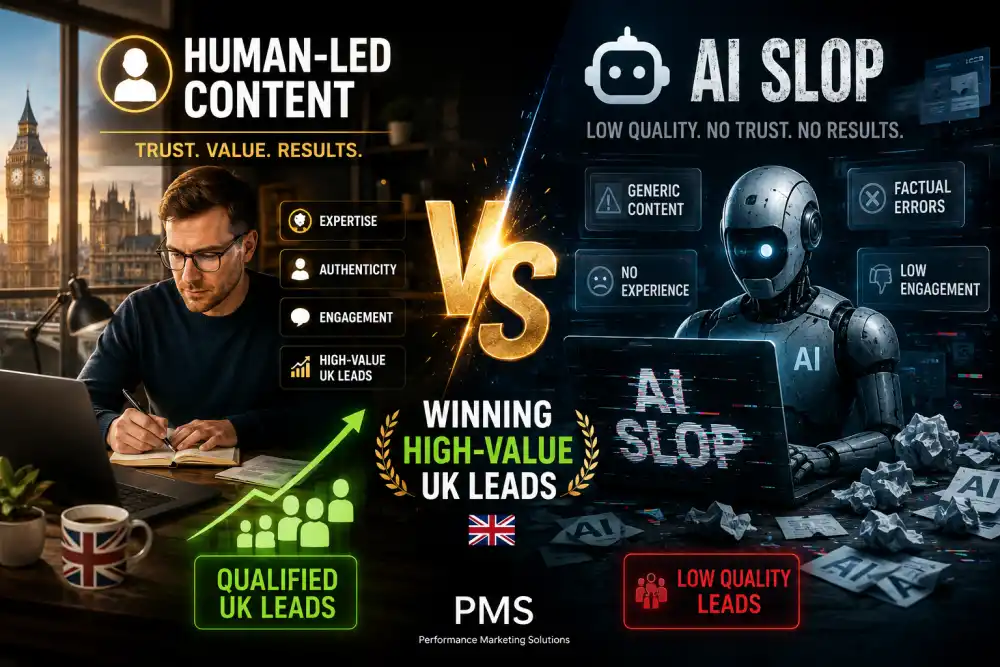
Human-Led Content vs AI Slop: Winning High-Value UK Leads | PMS
In the last 24 months, the UK digital landscape has undergone a radical transformation among digital marketing service providers. With the mainstreaming of hyper-efficient Large Language Models (LLMs), the barrier to entry for content production has effectively vanished. In 2026, an estimated $90\%$ of online content is partially or fully AI-generated.
While this has led to a "productivity boom," it has simultaneously created a "trust deficit." For UK-based digital marketing firms chasing high-value leads—contracts worth $\pounds 10,000$ to $\pounds 1\text{M}+$—the "one-click" article is no longer a competitive advantage; it is a liability. This phenomenon, colloquially known in the industry as "AI-Slop," refers to the high-volume, low-insight, repetitive content that floods search results and LinkedIn feeds.
The data for 2026 is clear: Authenticity is the new premium. High-value leads in the UK are increasingly "voting with their attention," ignoring automated output in favor of content that demonstrates real-world lived experience. This article explores why a human-led strategy is the only way to secure a high ROI in the age of automation.
The Mechanics of "AI-Slop" and Why It Fails the UK Market
To understand the ROI of authenticity, we must first define why its opposite fails. AI-slop isn't just "bad writing"; it's context-free writing.
The "Reversion to the Mean"
AI models predict the next most likely word based on historical data. By definition, they are designed to produce the "average" answer. For a London-based fintech firm or a Manchester manufacturing giant, "average" doesn't close deals. High-value B2B buyers look for the outlier insight—the strategy that no one else has thought of. When every competitor is publishing the exact same synthetically compiled listicles, your brand ceases to exist as an individual entity; it becomes background noise.
The Linguistic "Uncanny Valley"
British consumers and corporate buyers are historically more skeptical of "polished" corporate speak than their US counterparts. In 2026, the UK audience has developed a "sixth sense" for AI-generated phrasing. Words like delve, testament, leverage, in conclusion, tapestry, and moreover have become instant red flags.
When a UK prospect detects the robotic rhythm of an unedited AI draft, the psychological impact is immediate: “If they didn't care enough to write this, why should I care enough to read it?” Trust is lost before the pitch even begins.
The E-E-A-T Paradigm: Google’s 2026 Quality Filter
By 2026, Google’s search algorithms and AI Overviews (SGE) have become highly sophisticated at detecting "Information Gain." They are no longer merely indexing keywords; they are measuring the actual delta of unique value that a piece of content adds to the web.
Experience: The Missing Link in AI
The "First E" in E-E-A-T—Experience—has become the primary differentiator for any modern SEO service provider. An automated system can explain “how to manage a supply chain,” but it cannot describe the specific, messy challenges of navigating an unexpected strike at the Port of Felixstowe or dealing with post-Brexit customs compliance at Dover.
The Human-Led Advantage: Human writers can include personal anecdotes, "lessons learned," failures, and specific UK-centric cultural nuances that AI cannot replicate.
The Result: Google prioritizes content that offers new information, not just a synthesis of what is already existing on the web.
Authority and the "Entity" Score
In 2026, SEO is entirely "Entity-based." Google links content to a verified human author. If your UK business blog is authored by "Admin" or a faceless brand name, your authority score will stagnate. High-value leads want to see a Thought Leader—a CEO, a Director, or a Senior Consultant—whose digital footprint proves they are a real person with real skin in the game.
Calculating the ROI of Authenticity vs. AI-Slop
Many UK marketing managers are seduced by the low cost of AI content. However, when we look at True ROI, the numbers tell a completely different story.
Metric
AI-Slop (Low Cost)
Human-Led (Authentic)
Cost Per Article
$\pounds 5$ - $\pounds 20$
$\pounds 300$ - $\pounds 800$
Organic Reach
High volume, Low ranking
Moderate volume, Top 3 ranking
Lead Quality
Low-intent "Clickers"
High-intent "Decision Makers"
Conversion Rate
$<0.5\%$
$3.5\%$ - $8\%$
Brand Equity
Diluted / Ignored
Strengthened / Trusted
Long-term Value
Becomes obsolete quickly
Becomes an "Evergreen" asset
The "Trust Multiplier"
A high-value lead doesn't just need information; they need certainty. In B2B, the "cost of a wrong decision" is high. If an enterprise buyer hires the wrong logistics firm or cybersecurity agency, it could cost them their job.
An authentic, human-led whitepaper serves as a "trust bridge." It proves that your company has the intellectual capacity to solve the client's problem. AI-slop, conversely, suggests a company that prioritizes short-term shortcuts—not a trait people look for in a service provider charging premium rates.
GEO: Generative Engine Optimization in 2026
As we move away from traditional blue links toward AI-summarized answers (Gemini, Perplexity, ChatGPT Search), the rules of engagement have changed. This is GEO (Generative Engine Optimization).
To be cited as a source by an AI assistant in 2026, your content must be:
Factually Dense: Filled with original data, proprietary research, and UK-specific statistics.
Uniquely Positioned: Providing a sharp "Point of View" (POV) that differs from the generic web consensus.
Structured for Citation: Using clear semantic headings and explicit "Subject-Predicate-Object" declarations.
AI assistants are programmed to avoid "hallucinations." They prefer to cite human experts who provide verifiable, original evidence. When you lead with human expertise, you are not just ranking on search engine result pages; you are becoming the core "knowledge base" for the AI engines that high-value leads use to conduct their market research.
Case Study: The "Human-First" Pivot
A mid-sized UK recruitment consultancy recently switched from publishing 20 AI-generated blogs a month to just 2 "Expert Insight" articles monthly.
The Content: Deep-dives into the actual impact of 2026 UK labor laws on the tech sector, co-authored by their Senior Partner and a labor economist.
The Result: While total organic traffic dropped by $30\%$, inbound high-ticket inquiries for C-suite roles increased by $115\%$.
The Lesson: High-value leads do not want more content; they want better content that directly addresses their highly specific, localized, and timely problems.
How to Build an Authentic Content Engine (The Hybrid Model)
We are not suggesting you abandon AI entirely. Instead, use the "Human-Led, AI-Assisted" framework, which maximizes both speed and depth.
Phase 1: Human Strategy ($80\%$ of Value)
Identify the "Pain Point": What are UK CFOs, CTOs, or decision-makers actually worried about this week? (e.g., specific interest rate changes, compliance updates, or regional market shifts).
The Interview: Record a 15-minute "brain dump" from your internal Subject Matter Expert (SME). This captures raw, original thoughts, unique metaphors, and real-world experience.
Phase 2: AI Enrichment ($20\%$ of Effort)
Drafting: Use AI to transcribe the SME interview and organize the talking points into a logical, highly readable structural outline.
Research Assistance: Use AI to source supporting UK government data, Office for National Statistics (ONS) records, or market reports to back up the human's claims.
Phase 3: Human Polish & Fact-Check
Nuance Check: Ensure the tone is "British Professional"—authoritative but accessible, avoiding aggressive Americanisms or over-the-top hype.
E-E-A-T Injection: Add a personal "Founder's Note" or a detailed case study snippet from a recent project completed in London, Birmingham, or Manchester.
The Competitive Advantage of Being "Real"
As we head toward 2027, the "novelty" of generic AI content has completely worn off. The UK market is entering a "Verification Era." Buyers are overwhelmed by information but starved for true wisdom.
At Perfect Marketing Solution, we believe that the highest ROI in digital marketing doesn't come from the most powerful GPU—it comes from the most powerful human perspective. By investing in human-led content, you aren't just "doing SEO"; you are building an uncopyable brand asset that protects you from the commoditization of the digital age.
If you want high-value leads, stop contributing to the slop. Start leading the conversation.
Actionable Next Steps for Your Brand:
Audit Your Blog: Delete or "humanize" any $100\%$ AI-generated posts published between 2024 and 2025.
Define Your SME: Identify who in your company is the "face" of your expertise.
Localize Everything: Ensure every piece of content references UK-specific regulations, cities, challenges, or industry events.
London
37 Views

Advertising Agencies
Mar 21, 2026
ROI of Human-Led Content vs AI Slop | UK B2B Leads | PMS
In the last 24 months, the UK digital landscape has undergone a radical transformation among digital marketing service providers. With the mainstreaming of hyper-efficient Large Language Models (LLMs), the barrier to entry for content production has effectively vanished. In 2026, an estimated 90% of online content is partially or fully AI-generated.
While this has led to a "productivity boom," it has simultaneously created a "trust deficit." For UK-based digital marketing firms chasing high-value leads—contracts worth £10,000 to £1M+—the "one-click" article is no longer a competitive advantage; it is a liability. This phenomenon, colloquially known in the industry as "AI-Slop," refers to the high-volume, low-insight, repetitive content that floods search results and LinkedIn feeds.
The data for 2026 is clear: Authenticity is the new premium. High-value leads in the UK are increasingly "voting with their attention," ignoring automated output in favor of content that demonstrates real-world lived experience. This article explores why human-led strategy is the only way to secure a high ROI in the age of automation.
The Mechanics of "AI-Slop" and Why It Fails the UK Market
To understand the ROI of authenticity, we must first define why its opposite fails. AI-slop isn't just "bad writing"; it's context-free writing.The "Reversion to the Mean"
AI models predict the next most likely word based on historical data. By definition, they are designed to produce the "average" answer. For a London-based fintech firm or a Manchester manufacturing giant, "average" doesn't close deals. High-value B2B buyers look for the outlier insight—the strategy that no one else has thought of.
The Linguistic "Uncanny Valley"
British consumers are historically more skeptical of "polished" corporate speak than their US counterparts. In 2026, the UK audience has developed a "sixth sense" for AI-generated phrasing. When a prospect detects the robotic rhythm of an unedited AI draft, the psychological impact is immediate: “If they didn't care enough to write this, why should I care enough to read it?”
The E-E-A-T Paradigm: Google’s 2026 Quality Filter
By 2026, Google’s search algorithms and AI Overviews (SGE) have become highly sophisticated at detecting "Information Gain."
Experience: The Missing Link in AI
The "First E" in E-E-A-T—Experience—has become the primary differentiator. An AI SEO service provider can explain "how to manage a supply chain," but it cannot describe the specific challenges of navigating a strike at the Port of Felixstowe in 2025.
Human-Led Advantage: Human writers can include anecdotes, "lessons learned," and specific UK-centric cultural nuances that AI cannot replicate.
The Result: Google prioritizes content that offers new information, not just a synthesis of what’s already on the web.
Authority and the "Entity" Score
In 2026, SEO is "Entity-based." Google links content to a verified human author. If your UK branch’s blog is authored by "Admin" or a faceless brand name, your authority score will stagnate. High-value leads want to see a Thought Leader—a CEO, a Director, or a Senior Consultant—whose digital footprint proves they are a real person with real skin in the game.
Calculating the ROI of Authenticity vs. AI-Slop
Many UK marketing managers are seduced by the low cost of AI content. However, when we look at True ROI, the numbers tell a different story.
Metric
AI-Slop (Low Cost)
Human-Led (Authentic)
Cost Per Article
£5 - £20
£300 - £800
Organic Reach
High volume, Low ranking
Moderate volume, Top 3 ranking
Lead Quality
Low-intent "Clickers"
High-intent "Decision Makers"
Conversion Rate
<0.5%
3.5% - 8%
Brand Equity
Diluted / Ignored
Strengthened / Trusted
Long-term Value
Becomes obsolete quickly
Becomes an "Evergreen" asset
The "Trust Multiplier"
A high-value lead doesn't just need information; they need certainty. In B2B, the "cost of a wrong decision" is high. An authentic, human-led whitepaper serves as a "trust bridge." It proves that the company has the intellectual capacity to solve the client's problem. AI-slop, conversely, suggests a company that prioritizes shortcuts—not a trait people look for in a £50k/year service provider.
GEO: Generative Engine Optimization in 2026
As we move away from traditional blue links toward AI-summarized answers (Gemini, Perplexity, ChatGPT Search), the rules of engagement have changed. This is GEO.
To be cited as a source by an AI assistant in 2026, your content must be:
Factually Dense: Filled with original data and UK-specific statistics.
Uniquely Positioned: Providing a "Point of View" (POV) that differs from the consensus.
Structured for Citation: Using clear headings and "Semantic Triples" (Subject-Predicate-Object).
AI assistants are programmed to avoid "hallucinations." They prefer to cite human experts who provide verifiable evidence. When you lead with human expertise, you aren't just ranking on Google; you are becoming the "knowledge base" for the AI that high-value leads use to do their research.
Case Study: The "Human-First" Pivot
A mid-sized UK recruitment consultancy recently switched from publishing 20 AI-generated blogs a month to 2 "Expert Insight" articles monthly.
The Content: Deep-dives into the impact of 2026 UK labor laws on the tech sector, written by their Senior Partner.
The Result: While total traffic dropped by 30%, inbound enquiries for C-suite roles increased by 115%. * The Lesson: High-value leads don't want "more" content; they want "better" content that solves their specific, local, and timely problems.
How to Build an Authentic Content Engine (The Hybrid Model)
We are not suggesting you abandon AI. Instead, use the "Human-Led, AI-Assisted" framework.
Phase 1: Human Strategy (80% of Value)
Identify the "Pain Point": What are UK CFOs or CTOs actually worried about this week?
The Interview: Record a 15-minute "brain dump" from your internal Subject Matter Expert (SME). This captures original thoughts, unique metaphors, and "Experience."
Phase 2: AI Enrichment (20% of Effort)
Drafting: Use AI to transcribe the interview and create a structural outline.
Research: Use AI to find supporting UK government data or market reports to back up the human's claims.
Phase 3: Human Polish & Fact-Check
Nuance Check: Ensure the tone is "British Professional"—authoritative but accessible, avoiding Americanisms or over-the-top hype.
E-E-A-T Injection: Add a personal "Founder’s Note" or a case study snippet from a recent London project.
The Competitive Advantage of Being "Real"
As we head toward 2027, the "novelty" of AI content has worn off. The UK market is entering a "Verification Era." Buyers are overwhelmed by information but starved for wisdom.
Perfect Marketing Solution believes that the highest ROI in digital marketing doesn't come from the most powerful GPU—it comes from the most powerful human perspective. By investing in human-led content, you aren't just "doing SEO"; you are building an uncopyable brand asset that protects you from the commoditization of the digital age.
If you want high-value leads, stop contributing to the slop. Start leading the conversation.
Actionable Next Steps for Your Brand:
Audit Your Blog: Delete or "humanize" any 100% AI-generated posts from 2024-2025.
Define Your SME: Identify who in your company is the "face" of your expertise.
Localize Everything: Ensure every piece of content references UK-specific regulations, cities, or industry events.
London
41 Views
- Prev
- 1
- Next
Share This Page
My Page
Scan QR to open
Barcode