
Articles for Press Release Power
Explore 3 business insights in all locations
Insider
Share Your Business Story
Reach our community by sharing your business insights, expert guides, or success stories on the world's most trusted local platform.
Write Your Article Now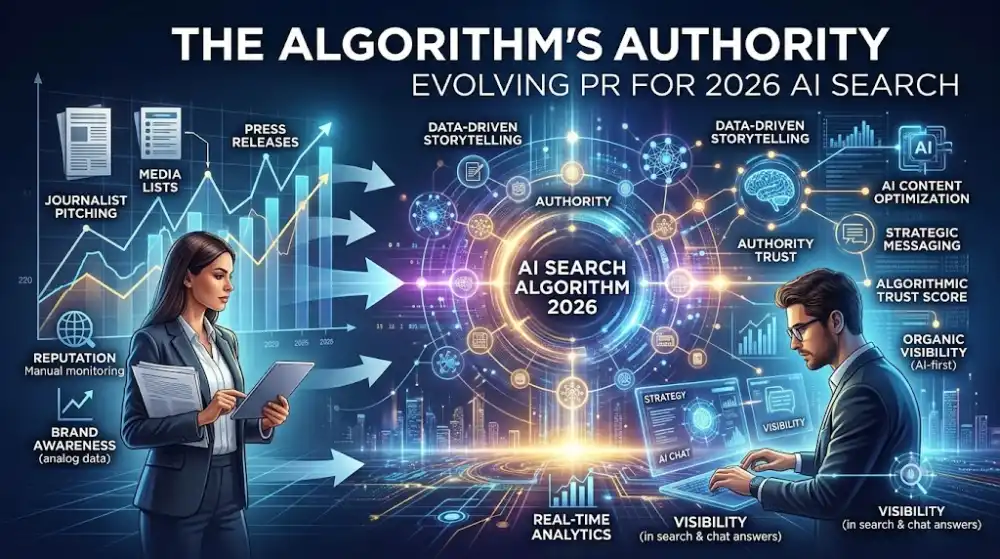
Advertising Agencies
Jun 26, 2026
The Algorithm's Authority: Evolving PR for 2026 AI Search
In the modern 2026 search environment, an AI doesn't just look for links; it maps "Entities." Every piece of content you distribute must help the machine build a clearer picture of your brand. If your Press release distribution strategy remains focused on loose link-building, you are missing the opportunity to influence the Knowledge Graph.
To build Algorithmic Authority, your news must be:
Entity-Consistent: Every release should use identical descriptors for your brand, your leadership, and your core services to avoid confusing the AI.
Context-Rich: Embed your news within established industry trends so the AI can place your brand on the map of "relevant experts."
Engineering Your News for Synthesis
When an AI engine summarizes an industry, it performs a data triage. It selects facts that are easily verifiable and dismisses "fluff." By utilising professional Press release services, you can ensure your data is delivered in a format that AI can ingest without difficulty.
Designing the "Synthesizable" Release
The Factual Lead: Abandon clever hooks in favor of clear, 25-word summaries that define the "Who, What, and Where." This is the content the AI will lift directly into its summary.
Structured Data Anchors: Include specific performance metrics—such as percentage improvements or verifiable audit data—that provide a "hard anchor" for the AI to cite.
Standardized Boilerplates: Treat your company description like a piece of code. Keeping this consistent across all channels helps the AI lock in your company's official "identity."
The Competitive Edge of Localised Authority
In the UK market, algorithmic authority is highly localized. Global press release distribution platforms provide the reach needed to saturate the digital record with news that is verified by regional industry outlets. This creates a feedback loop where the AI identifies your brand as the "go-to" source for regional expertise, significantly increasing your chances of appearing in location-specific AI overviews.
Frequently Asked Questions
1. What is "Algorithmic Authority"?
It is the status where an AI identifies your brand as the most reliable, verified source of information on a specific topic, leading it to consistently cite your brand in its summaries.
2. Is SEO dead in 2026?
No, it has evolved into a hybrid model involving SEO (for technical discoverability) and GEO (for citation-based synthesis). You need both to remain visible.
3. Why is entity consistency so important?
AI models use data to build a Knowledge Graph. If you refer to your company using three different names or industry descriptions, the AI may fail to attribute authority to your entity correctly.
4. How does a press release signal trust to an AI?
It acts as a primary source document. Because it contains official contact information and corporate identity details, it is ranked higher for trustworthiness than casual content.
5. Should I avoid "clever" copywriting?
Not entirely, but keep it out of the lead. Your primary goal is to be "factually dense." Use your brand voice in the secondary paragraphs, but ensure the lead is purely functional.
6. How do I track algorithmic visibility?
Look for "Direct Search" growth and monitor your brand mentions within AI Overviews. If your name appears as the source for industry answers, your PR strategy is working.
7. Is a high-authority publication link still valuable?
It is more valuable than ever. These links act as "trust endorsements" from sites the AI already trusts, effectively passing that authority to your brand entity.
8. How does multimedia content influence AI?
AI models now utilize video-to-text transcription. Including a short, fact-based video summary in your release gives the AI another medium from which to extract your brand's expertise.
9. Why does my UK presence matter for search?
Search engines heavily weigh regional signals. By distributing news through UK-based channels, you signal to the algorithm that your expertise is geographically relevant.
10. What is the single biggest "Trust Signal" for 2026?
Verifiability. Any claim in your press release should be backed by a clear source, data point, or professional quote that an AI can link back to your official presence.
London
31 Views
Advertising Agencies
Jun 26, 2026
Mastering Content Citations: The Ultimate PR-AI Synergy Guide
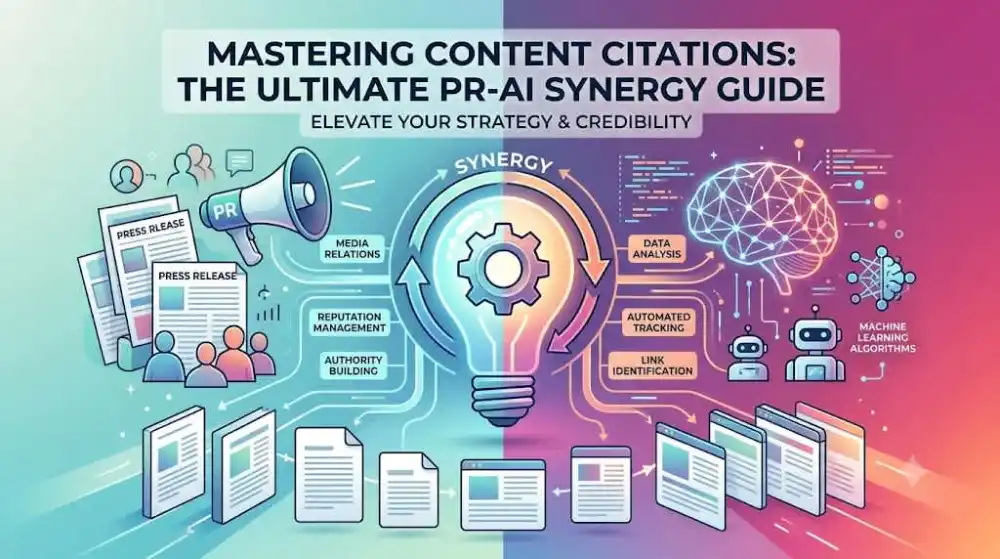
In the past, success was measured in sessions. Today, it is measured in mentions. When an AI synthesis engine—like those powering Google’s Search Generative Experience or various enterprise tools—decides which brand is the answer to a user's question, it chooses based on the strength of your "digital fingerprint."
Leveraging professional Press release services is the most effective way to strengthen that fingerprint. It provides the AI with:
Verifiable Truth: A source of truth that is harder for an LLM to hallucinate over than user-generated social content.
Contextual Alignment: By using specific, industry-relevant terminology, you tell the AI exactly which topics your brand owns.
The "Source-First" Mindset
To be the brand the AI cites, you must move from a promotional tone to a "source-first" tone. When you write a press release, ask yourself: Does this provide the AI with a clear, factual answer to a likely user question?
Tactical Steps for Citation Excellence
Structure for Extraction: Use bullet points, clear subheadings, and short, dense paragraphs. AI models value content that is easy to scan and segment.
The Power of the Data Point: AI models don't just want marketing slogans; they want data. If you are announcing a new UK product, don't just call it "innovative." Provide the specific capacity, speed, or efficiency metric that proves it.
Entity Linking: Use your press release to bridge the gap between your brand entity and your service entity. Ensure your company boilerplate is updated and syndicated consistently across all distribution channels.
The Visibility Paradox
There is a natural concern that if the AI answers the user’s question directly, the user will never visit the website. This is the "Zero-Click" reality. However, the paradox is this: by failing to appear in the AI summary, you become invisible to the high-intent user.
Global press release distribution is critical to this success as it signals your brand as a localized expert, especially in the UK market. Appearing in the summary—even without a direct click—creates a powerful "brand-recall" effect. Over time, this leads to a surge in direct branded searches, which is the ultimate, high-quality signal for long-term SEO.
FAQ
1. Is a backlink still important for PR?
Yes, but its role has changed. Backlinks act as "signals of trust" that validate your brand for the AI. A backlink from a high-authority UK publication tells the search model that your press release is a verified, trusted source.
2. How do I get an AI model to use my press release as a primary source?
Consistency and fact-density are key. By regularly distributing news that is packed with technical specifications and verifiable facts, you build a trail of evidence that the AI uses to build its Knowledge Graph.
3. Does tone of voice affect AI citation?
Yes. AI models are trained on professional datasets. Using an overly "salesy" or "clickbaity" tone can actually decrease your likelihood of being cited, as it flags the content as promotional rather than informational.
4. Can my press release influence Google’s Knowledge Panel?
It is one of the most effective ways to do so. A consistent stream of press releases that clearly defines your entity—such as your headquarters, leadership team, and primary industries—helps Google solidify your official profile.
5. How does Multimedia PR assist in citation?
AI models are increasingly multimodal. They don't just "read"; they "watch." If your press release includes a video that concisely explains a concept, the AI is much more likely to pull content from your brand than from a competitor that only provides text.
6. Is GEO (Generative Engine Optimization) a replacement for SEO?
Think of it as the next level of SEO. GEO focuses on how to be the "answer" in a summary, whereas traditional SEO focuses on the link. You need both to dominate the search results.
7. Why is the UK market unique for this strategy?
UK-specific publications carry significant weight with search engines. Distributing through UK-based outlets helps algorithms identify your brand as a localized expert, increasing your chances of ranking in location-specific AI overviews.
8. What is the most common mistake in modern PR?
The most common mistake is writing for humans only. If your press release ignores structured data, subheadings, and clear fact-density, it will be ignored by the algorithms that now curate search results.
9. How do I measure the success of a citation-led PR campaign?
Track your "Brand Mentions" in AI tools and observe changes in your "Direct Traffic." A rise in direct searches for your brand name after a PR distribution campaign is a strong indicator of successful AI-driven brand awareness.
10. How often should I release news for maximum AI visibility?
Frequency matters, but accuracy is paramount. A high-quality, data-dense press release once a month is infinitely more effective for AI citation than a weekly stream of low-value, speculative news.
London
30 Views
Advertising Agencies
Mar 23, 2026
How Press Releases Impact Search Rankings In The Era of AI-Driven Search
For decades, SEO was a game of keywords and backlinks aimed at securing a spot in the "ten blue links." In 2026, search has shifted from a retrieval model to a synthesis model. When a user asks, "What are the best sustainable logistics solutions for 2026?", they don't just get a list of websites; they get a cohesive, AI-generated summary.
Press release distribution has become the secret weapon for appearing in these summaries. Why? Because AI models prioritize verified, structured, and authoritative information. Unlike a blog post that might be speculative, a press release is an official corporate record. AI "Answer Engines" crave this level of certainty to avoid "hallucinations" (generating false information).
High CTR Keywords to Watch:
AI-driven search optimization
Generative Engine Optimization (GEO) strategies
How to get cited by ChatGPT and Gemini
The Mechanics: Why AI Models Love Press Releases
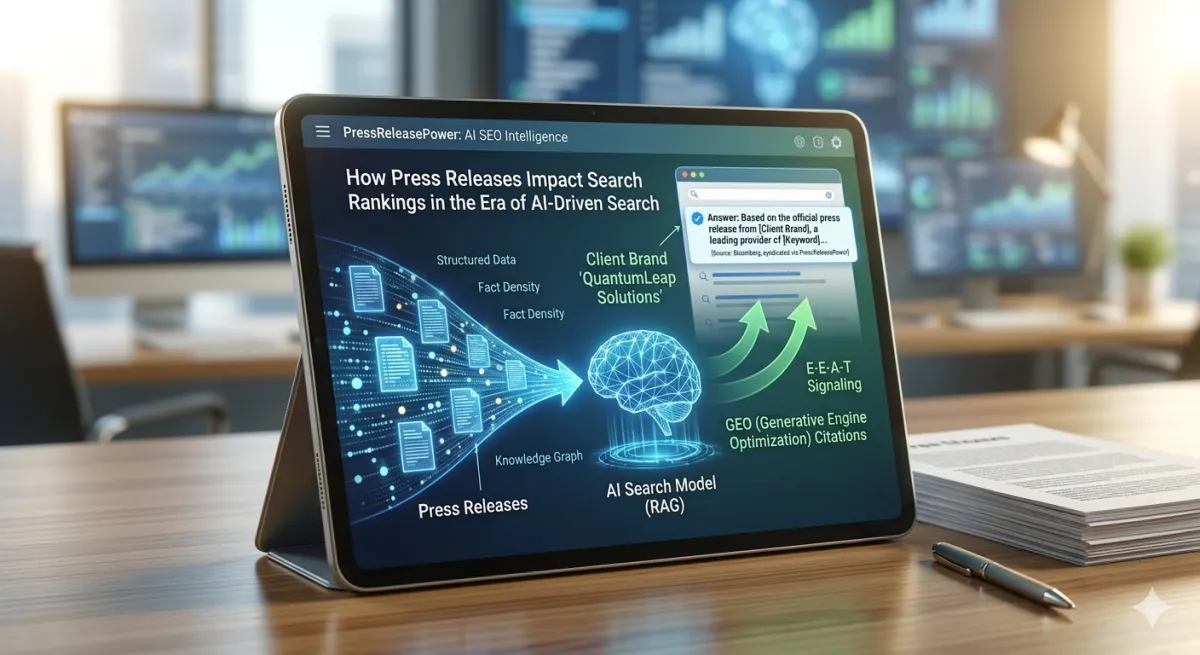
To understand how press releases impact search rankings, we must look at how Large Language Models (LLMs) like GPT-4 and Gemini 1.5 Pro ingest data. They use a process called Retrieval-Augmented Generation (RAG).
When an AI receives a query, it "retrieves" the most relevant and trustworthy data from the web before "generating" an answer. Press releases are high-value targets for RAG because:
Structured Data: They follow a predictable inverted-pyramid format (Who, What, Where, When, Why).
Fact-Density: They are packed with dates, statistics, and executive quotes—the exact "data nuggets" AI needs to build an answer.
Entity Reinforcement: They clearly define "Entities" (your brand name, CEO, and products), helping the AI’s Knowledge Graph understand exactly who you are.
Boosting E-E-A-T: The Ultimate Ranking Factor in 2026
Google’s E-E-A-T (Experience, Expertise, Authoritativeness, and Trustworthiness) is the filter through which all AI search results must pass. Press release services are the most direct way to signal these four pillars:
Experience: Quotes from project leads or engineers in a release prove first-hand involvement.
Expertise: Deep technical details in a product launch release demonstrate industry mastery.
Authoritativeness: When your news is syndicated on high-authority domains like Bloomberg, Yahoo Finance, or Press Release Power, it signals to AI that you are a "go-to" source.
Trustworthiness: Official announcements, backed by a corporate boilerplate and contact information, are the highest form of digital trust.
Pro Tip: In 2026, 89% of journalists and AI crawlers consider the press release as the most trusted source of organizational news.
Generative Engine Optimization (GEO): The New SEO
Traditional SEO was about traffic.GEO is about citations. If an AI summary mentions your brand but doesn't link to you, you’ve lost the conversion. A well-optimized press release ensures that when an AI summarizes your industry, your brand is the one it cites as the source.
How to Optimize Your Press Release for GEO:
Use Definition-First Writing: Start every section with a clear, standalone sentence that defines the topic. (e.g., "Quantum Encryption is a security protocol that...")
Include Factual Anchors: Instead of saying you are "the best," say you "increased efficiency by 42% according to the 2026 Q1 Audit."
Implement FAQ Schema: Modern press releases should include a "Quick Facts" or FAQ section. This mirrors the way AI provides answers, making it easy for the bot to "copy-paste" your info into a search overview.
The Power of Syndication and the "Brand-Keyword" Association
One of the most effective ways to improve search visibility is to force an association between your brand and a specific high-value keyword.
In the AI era, if thousands of searchers query "[Your Brand] + Sustainable Packaging", AI models begin to associate your brand as the "owner" of that topic. Global press release distribution triggers this behavior. By flooding the digital record with news connecting your brand to "Sustainable Packaging," you influence the AI’s training data and its real-time retrieval logic.
Zero-Click Searches: Surviving the 80% Drop
Recent data shows that zero-click searches (where the user gets the answer on the Google results page without clicking) now account for nearly 80% of informational queries.
If users aren't clicking through to your website, your presence in the AI Overview is your only chance at brand recall. A press release ensures your "Brand Narrative" is the one being summarized. Even if they don't click, they see your name as the authoritative source, which builds top-of-funnel awareness that eventually leads to direct branded searches.
Multimedia PR: Winning the Visual AI Search
AI-driven search isn't just text. Google Lens and visual search tools are integrated into the search experience.
Alt-Text Optimization: Every image in your press release must have descriptive, keyword-rich alt-text.
Video Embeds: AI models can now "watch" and transcribe video content. Including a 60-second video summary in your release significantly boosts your chances of appearing in "Video Overviews."
Checklist For Writing the Perfect 2026 Press Release
To ensure your content ranks and gets cited, follow this technical checklist:
Element
Optimization Requirement
Headline
Under 70 characters, includes primary keyword, formatted as an "Answer."
Lead Paragraph
Must answer the 5 W’s in the first 25 words for AI extraction.
Subheadings
Use H2 and H3 tags containing long-tail, conversational keywords.
Quotes
Attributed to real people with Linked-In profiles (signals E-E-A-T).
Boilerplate
Must include "Entity" details: headquarters, founding year, and key industries.
Links
1-2 "Deep Links" to specific resource pages, not just the homepage.
The Future of PR is Algorithmic
The impact of press releases on search rankings has never been more significant, but the goalposts have moved. In 2026, you aren't just writing for a journalist at a desk; you are writing for an algorithm that is trying to synthesize the world's information.
By focusing on structured data, factual density, and high-authority distribution, you can ensure your brand isn't just "indexed"—it's "referenced." In the age of AI, citations are the new currency, and the press release is the mint.
London
27 Views
- Prev
- 1
- Next
Share This Page
My Page
Scan QR to open
Barcode