
Articles for University of Cambridge
Explore 1 business insights in all locations
Insider
Share Your Business Story
Reach our community by sharing your business insights, expert guides, or success stories on the world's most trusted local platform.
Write Your Article Now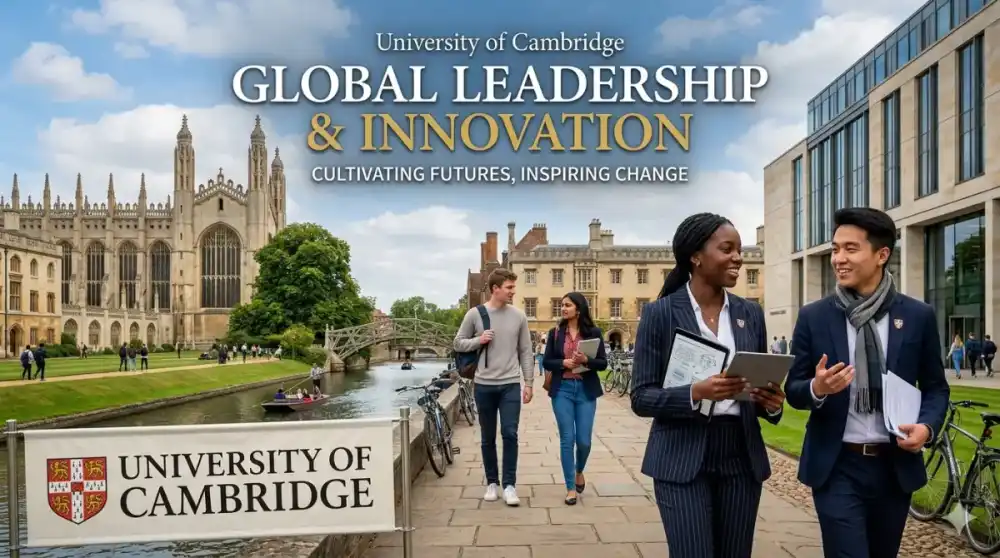
Educational Services
Apr 08, 2026
University of Cambridge: Global Leadership & Innovation
The University of Cambridge, situated in the historic heart of the United Kingdom, stands as a beacon of intellectual achievement and scientific discovery. Founded in 1209 by a group of scholars from Oxford, it has evolved over eight centuries into one of the world's most influential higher education and research institutions. Today, the University is a self-governed community of scholars, comprising 31 autonomous Colleges and over 150 Departments and Faculties.
This article provides a deep dive into the unique ecosystem of Cambridge, from its transformative educational model to its role as a global engine for economic and technological growth.
The Collegiate System: A Unique Academic Framework
Unlike many global universities, Cambridge operates on a collegiate system. This structure is the cornerstone of the Cambridge experience, fostering interdisciplinary collaboration and providing a "home away from home" for over 24,000 students.
The 31 Autonomous Colleges
Each of the 31 colleges is an independent institution with its own property, income, and character. Whether it is the historic grandeur of King's College (located near the iconic King's College Chapel) or the modern, graduate-focused environment of Wolfson College, every student belongs to a smaller, supportive community.
Key Roles of the Colleges:
Admissions: Colleges are responsible for selecting undergraduate students.
Supervisions: The world-renowned "supervision" system provides small-group teaching (often 1-on-1 or 2-on-1) with leading experts.
Accommodation and Welfare: Students live, eat, and socialize within their college, supported by Tutors and Directors of Studies.
Global Leadership in Research and Innovation
The University of Cambridge is synonymous with the "Freedom of Thought and Expression" that drives its mission. With more Nobel Prize winners than any other single institution, its research impact is felt in every corner of the globe.
Tackling Global Challenges
Cambridge researchers are at the forefront of solving the most pressing issues of the 21st century:
Climate Change: Through initiatives like the Cambridge Institute for Sustainability Leadership (CISL), the university is scaling climate solutions and driving market transformations.
Artificial Intelligence: Exploring the future of AI, Cambridge focuses on ethical frameworks and the integration of machine learning into healthcare and social sciences.
Global Health: The Cambridge Biomedical Campus is a world leader in clinical medicine and biotechnology, producing breakthroughs in oncology and infectious diseases.
The "Cambridge Cluster" (Silicon Fen)
One of the most successful technology hubs in the world, the Cambridge Cluster (often called Silicon Fen), bridges the gap between academic research and commercial application. Valued at over £176 billion in 2026, the ecosystem is a testament to the university's commitment to innovation.
Bridging Academia and Industry
The university encourages entrepreneurship through Cambridge Enterprise, which helps staff and students commercialize their ideas. Major global tech firms—including ARM, AstraZeneca, and Microsoft Research—are headquartered or have major hubs within the 50-mile service area radius of the city.
Academic Programs and Excellence
The University offers a wide range of Undergraduate and Postgraduate degree programs across all major disciplines.
STEM and Clinical Medicine
Cambridge is a global powerhouse in STEM (Science, Technology, Engineering, and Maths). The School of Clinical Medicine provides world-class training, utilizing facilities like Addenbrooke’s Hospital to offer hands-on medical education.
Humanities and Social Sciences
The university’s heritage in the humanities remains unparalleled, with libraries like The UL (University Library) housing millions of volumes, including rare manuscripts that have shaped human history.
Cambridge University Press & Assessment
As a brand association, Cambridge University Press & Assessment extends the university’s reach globally. It is a leader in academic publishing and English language assessment, with its certifications recognized by over 25,000 organizations worldwide.
Student Life and Amenities
Life at Cambridge is not just about academic rigor; it is about holistic development.
Museums and Gardens: The Fitzwilliam Museum and the University Botanic Garden offer cultural and natural enrichment for students and the public.
Sports and Societies: From rowing on the River Cam to participating in the Cambridge Union (the world's oldest debating society), students have access to hundreds of extracurricular activities.
Libraries: With over 100 libraries, students have access to one of the most comprehensive academic resource collections in existence.
Commitment to Diversity and Accessibility
Cambridge continues to expand its reach, welcoming students from over 150 countries. Through the Cambridge Trust, over 22,000 scholarships have been awarded to ensure that the brightest minds can study at Cambridge, regardless of their financial background.
Business Information Summary
Feature
Details
Headquarters
The Old Schools, Trinity Lane, Cambridge, CB2 1TN
Founder
Association of Scholars from Oxford (1209)
Employees
~12,000
Specialization
STEM, Clinical Medicine, Humanities, AI
Contact
01223337733 / reception@admin.cam.ac.uk
Social Media
Instagram: @cambridgeuniversity
Frequently Asked Questions
1. How do I apply to the University of Cambridge?
For undergraduate courses, applications must be submitted via UCAS by the January 14 deadline for 2026 entry. Postgraduate applications are handled through the university's Applicant Portal.
2. What is the "Collegiate System"?
It is a structure where students belong to both the University (for lectures and exams) and one of 31 autonomous Colleges (for accommodation, dining, and small-group teaching).
3. What are the accepted payment methods for tuition?
The University accepts Bank Transfers (BACS/Swift), Credit/Debit Cards, Student Finance England (SFE), Sponsorship, and PayPal for specific services.
4. What is the "Cambridge Cluster"?
Also known as Silicon Fen, it is the high-tech hub surrounding Cambridge that includes thousands of technology and biotechnology companies, many of which originated from the University.
5. Does Cambridge offer scholarships for international students?
Yes, the Cambridge Trust and programs like the Gates Cambridge Scholarship provide extensive funding for international students from over 150 nations.
6. What are the working hours for the central administration?
The central administration at The Old Schools operates Monday–Friday, 09:00 – 17:00. However, colleges and libraries often operate on 24-hour or extended schedules.
7. Can I visit the University of Cambridge libraries?
The University Library (The UL) and various department libraries are primarily for members of the University, but many offer access to visiting scholars and researchers by appointment.
8. What certifications does the University hold?
The University is incorporated by Royal Charter (RC000646), is a registered charity, and is a member of the Russell Group and the G8 Research Group.
9. What makes Cambridge's teaching unique?
The supervision system is its primary differentiator, offering regular small-group or one-on-one sessions with experts to delve deep into the subject matter.
10. How many Nobel Prizes have been awarded to Cambridge members?
Cambridge members have won more Nobel Prizes than any other single institution, with over 120 laureates affiliated with the university.
Cambridge
8 Views
- Prev
- 1
- Next
Share This Page
My Page
Scan QR to open
Barcode