
AI in Dating How Web Technology Transforms UK Romance
- 👤 Tim David
- 👁️ 282 Views
- Last Updated: March 19, 2026
- 🏷️ Information technology
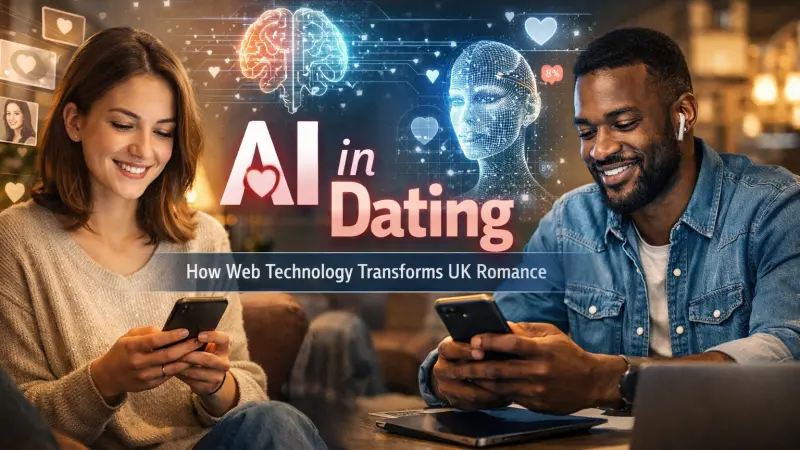
Did you know that according to recent social trends in the United Kingdom, over one-third of all modern relationships now begin through a digital interface? For the millions of UK professionals, contractors, and service providers who balance demanding work schedules with personal lives, the mechanism of meeting a partner has shifted from chance encounters in physical spaces to highly engineered digital experiences. While the early days of online dating were defined by rudimentary search filters, we are now entering an era defined by artificial intelligence and advanced web systems that operate beneath the surface of the familiar "swipe" interface.
The evolution of courtship has never been static. It has always mirrored the broader cultural and technological shifts of the day. In the Victorian era, letters carried romance across counties, where the pace of connection was dictated by the post. By the late 20th century, telecommunications added the emotional weight of late-night telephone calls, introducing voices and immediate emotional nuance to the mix. Today, the shift is quieter but arguably more profound: we are moving away from database-driven matching toward an era of predictive emotional alignment and sophisticated behavioural analysis.
The Evolution of Digital Matchmaking: From Filters to Intelligence
In the initial phase of online dating, platforms functioned as basic directories. Users would manually input explicit criteria such as age, geographic distance, and a handful of surface-level interests. The matching process felt somewhat random, often resulting in "dating fatigue" as users sifted through hundreds of profiles that looked correct on paper but failed to spark genuine interest in person. This "catalogue" approach to romance often ignored the complexities of human personality and the subtle nuances of attraction.
Today's platforms have moved beyond these visible filters. Instead of asking users what they think they want, modern systems observe how they actually behave. This shift is powered by machine learning algorithms that track "implicit signals" that most users never notice. By analysing interaction patterns, the system builds a far more accurate profile of a person's preferences than a simple questionnaire ever could. For instance, a user browsing a high-end switzerland dating site might notice that their suggestions become more refined over time; this is not a coincidence, but the result of the system learning from repeated micro-reactions.
Implicit Signal Tracking and Behavioural Analysis
Modern web infrastructure allows dating platforms to monitor a staggering array of data points. These implicit signals form the foundation of modern compatibility models. Key metrics include:
- Dwell Time: The exact duration a user spends viewing a specific profile or reading a biography, which is a far more accurate indicator of interest than a binary swipe.
- Interaction Velocity: The speed at which a user responds to messages and the frequency of their interactions, which can signal varying levels of engagement and enthusiasm.
- Linguistic Tone: The specific word choices and conversational rhythm employed during initial exchanges, which AI can use to predict long-term verbal chemistry.
- Lifestyle Synchronicity: Matching users based on the times of day they are active, which often correlates with professional roles and personal habits.
This data allows platforms to transition from endless scrolling to curated introductions. Profiles are no longer just images; they are data-rich nodes in a complex network of compatibility. As a result, the user experience feels more intuitive. Instead of being presented with volume, users are presented with relevance, which is particularly valuable for busy UK professionals who view their time as a precious commodity.
Web Infrastructure and Real-Time Personalisation
The technical backbone of modern dating relies on real-time personalisation and adaptive interfaces. In the UK, where high-speed mobile connectivity is ubiquitous, platforms can adjust their suggestions based on immediate context. The interface you see on a Monday morning might differ significantly from the one you see on a Friday evening, reflecting the different social and emotional needs that arise throughout the week.
Furthermore, cloud-based architectures allow these systems to process vast amounts of interaction data instantly. Every reaction, every skipped profile, and every message sent contributes to a global model of compatibility that is constantly being refined.
This fluid matching system ensures that the platform evolves alongside the user. As a person's life circumstances or dating goals change, the algorithm adapts, ensuring that the technology remains a helpful guide rather than a rigid filter.
Emotional AI and the Science of Chemistry
Perhaps the most fascinating development in the sector is the rise of emotional AI. Artificial intelligence is now capable of analysing the "flow" of a conversation to determine its health. Is the exchange balanced, or is one party doing all the talking? Is the tone playful or serious? These language tools detect compatibility through communication style rather than shared hobbies alone. This is a critical distinction, as two people might share an interest in "hiking" but have completely incompatible ways of expressing themselves or managing conflict.
By identifying these nuances early, AI can reduce the likelihood of "mismatched" dates. For example, some companies, including SoulMatcher, are at the forefront of combining deep psychological research with algorithmic precision. The focus here shifts from maximizing "app time" to maximizing "meaningful pairing." For the user, this means that technology is finally beginning to resemble a thoughtful human matchmaker—one that understands that true connection is found in the gaps between the data points.
Micro-Interactions as Predictors of Success
Micro-interactions, such as the timing of a response or the use of specific emojis, are now part of a broader compatibility model. If User A typically responds within five minutes and User B typically takes five hours, the system may flag this potential friction point early. By matching people with similar "digital cadences," platforms can foster smoother initial connections, which is essential for building the trust required to take a relationship from the screen to the real world.
Predictive Compatibility: The Future of Connection
The next frontier for AI-driven dating is predictive modelling that looks beyond present preferences. These systems are being designed to study long-term patterns, evaluating how two personalities might grow together over time. Instead of focusing solely on who a person finds attractive today, the system estimates the potential for a lasting partnership based on behavioural trends and value alignment.
This approach changes the fundamental goals of the platform. Success is no longer defined by "user retention" in the traditional sense, but by the quality and longevity of the relationships formed. When a platform learns from positive outcomes—such as two users who successfully form a bond—those insights are fed back into the recommendation engine to refine future matches for the entire community. This creates a virtuous cycle of improvement that benefits all users.
Authenticity in the Age of Smart Algorithms
For UK users, authenticity and security remain paramount concerns. The rise of AI has, fortunately, provided new tools to protect the integrity of the dating space. AI-driven image verification tools can now detect edited photos or "deepfakes" with remarkable accuracy, while behavioural analysis can flag unusual activity that might indicate a fraudulent account. Voice and video checks are also becoming standard features, providing an extra layer of reassurance for users.
Beyond security, AI is also helping users present their best, most authentic selves. Smart profile tools can suggest better phrasing for biographies or highlight a user's genuine strengths based on their communication style.
This encourages clarity over exaggeration, turning digital dating spaces into reflections of real personality rather than curated stages. This move toward transparency is vital for building a community of trust, particularly for professional users who are wary of the "smoke and mirrors" often associated with online platforms.
The Impact on UK Service Providers and Professionals
The transformation of dating tech has direct implications for UK SMEs and independent contractors. Many of these individuals work in the "gig economy" or run their own businesses, meaning their social time is often fragmented. The efficiency provided by AI-driven matchmaking allows them to pursue personal happiness without sacrificing professional productivity. Furthermore, the emphasis on data privacy and security aligns with the rigorous standards expected by UK service providers in all areas of digital life.
As we look toward the future, it is clear that technology is not replacing the human element of romance; it is refining the path that leads people to it. Human chemistry remains unpredictable and personal, and technology cannot—and should not—attempt to create genuine emotion. What it can do, however, is reduce the "noise" of the search, surfacing the compatibility that might otherwise remain hidden in a crowded digital landscape.
Conclusion
The future of dating in the United Kingdom will likely feel increasingly intuitive and personalised. Beneath each simple match suggestion, layers of quiet analysis work in the background to ensure that your time is spent with people who truly align with your lifestyle and values. While the tools we use to find love have changed—from handwritten letters to sophisticated neural networks—the fundamental human desire for connection remains unchanged. The intelligence supporting our search is simply becoming sharper, more perceptive, and more aligned with the complexities of real-world relationships.
Frequently Asked Questions
How does AI actually predict compatibility?
AI predicts compatibility by analysing both explicit data (interests and preferences) and implicit data (behavioural patterns). By looking at how you interact with the app, the speed
of your responses, and your linguistic style, the system compares your "digital fingerprint" with others to find a statistical match for long-term harmony.
Is my data safe on AI-driven dating platforms in the UK?
UK-based dating platforms must adhere to strict GDPR (General Data Protection Regulation) standards. Most reputable AI platforms use anonymised data to train their algorithms, ensuring that your personal identity is protected while the system learns to provide better matches.
What is "Emotional AI" in the context of dating?
Emotional AI refers to systems that use Natural Language Processing (NLP) to understand the sentiment, tone, and rhythm of a conversation. It helps determine if two people share conversational chemistry, which is often a better indicator of a successful date than shared hobbies.
Can AI help identify "catfishing" or fake profiles?
Yes. Modern AI tools are used to verify images in real-time and detect patterns of behaviour that are typical of bots or scammers. This includes flagging accounts that send too many messages too quickly or those whose profile pictures appear elsewhere on the web.
Why is the focus shifting from "swiping" to "curated introductions"?
The shift is driven by "choice overload." Users are tired of endless scrolling without results. Curated introductions use AI to present fewer, higher-quality options, saving time for the user and increasing the likelihood of a meaningful connection.
Disclaimer: The information provided in this article is for general informational and research purposes only. Company details, features, services, and market positions may change over time. Readers are advised to visit official company websites and conduct independent research before making any business decisions or purchasing services.
Most Searchable Keywords
Recent Blogs


Related Listings

Categories
- Accountants (295)
- Advertising Agencies (559)
- Architects (149)
- Automobiles (377)
- Beauty (300)
- Carpenters (146)
- Cleaning Services (387)
- Dentists (189)
- Driving (62)
- Education (1)
- Electricians (215)
- Energy (8)
- Event Organiser (687)
- Finance (602)
- Guide (3482)
- Health (2207)
- Information technology (206)
- Legal Services (361)
- Logistics (6)
- Maintenance (65)
Sponsored Listings in Information Technology



Related Blogs

Ghost Brokers Fake Car Insurance Scam Explain...
Read this insightful article "Ghost Brokers Fake Car Insurance Scam Explained" to expand your knowledge!

UK Baby Names Fastest Rising and Falling Name...
Read this insightful article "UK Baby Names Fastest Rising and Falling Names" to expand your knowledge!

How to Claim for Pothole Damage From Your Cou...
Read this insightful article "How to Claim for Pothole Damage From Your Council" to expand your knowledge!
Questions & Answers – Find What
You Need, Instantly!
How can I update my business listing?
Is it free to manage my business listing?
How long does it take for my updates to reflect?
Why is it important to keep my listing updated?
