
Australia Tropical Cyclone Red Sky Causes Impact Latest Updates
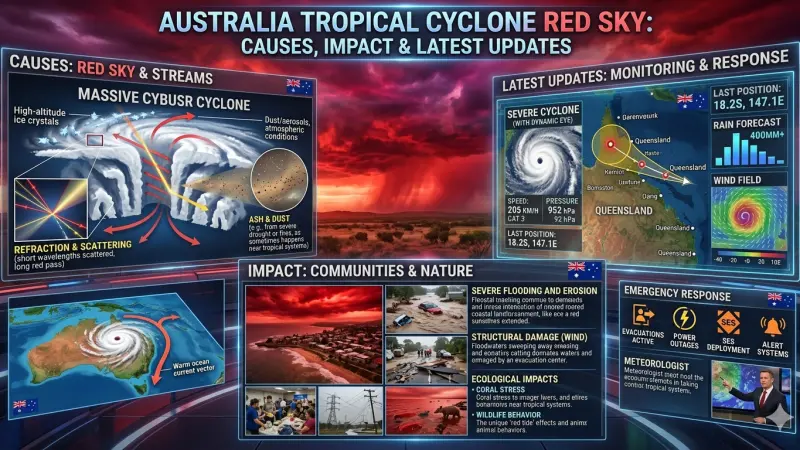
In late March and April 2026, residents across Western Australia witnessed a breathtaking yet unsettling meteorological event: a blood-red sky that appeared to transform day into an eerie twilight. This phenomenon, primarily linked to the progression of Severe Tropical Cyclone Narelle, has sparked global curiosity and scientific inquiry. While "red sky at morning" is an age-old maritime proverb, the 2026 event was driven by a rare intersection of cyclonic intensity, geological composition, and atmospheric physics.

As the cyclone tracked along the Pilbara and Gascoyne coasts, it didn't just bring wind and rain; it fundamentally altered the visual spectrum of the atmosphere. Understanding the causes and impacts of these "Red Sky" cyclones is essential for both safety and scientific literacy. This article provides an in-depth analysis of the 2026 events, the underlying science of light scattering, and the broader implications for Australian communities and infrastructure.
The 2026 Phenomenon: An Overview
The "Red Sky" event of March 27, 2026, was centered around the coastal towns of Denham, Shark Bay, and Karratha. As Severe Tropical Cyclone Narelle intensified to a Category 4 system offshore, the sky transitioned from a standard grey to an intense, saturated crimson. Unlike a typical sunset, this coloration persisted for hours, creating a "dystopian" aesthetic that dominated social media feeds globally.
Meteorologists noted that while dust storms are common in the Australian outback, the combination of cyclonic wind speeds and the specific moisture content of the incoming storm created a uniquely dense aerosol layer. This layer acted as a filter, allowing only the longest wavelengths of light to penetrate the heavy cloud cover associated with the cyclone’s outer bands.
Scientific Causes: Why the Sky Turns Red
The primary cause of the red sky during an Australian cyclone is the suspension of iron-rich dust in the atmosphere. The Pilbara region is world-renowned for its red soil, which has oxidized over millions of years (effectively "rusting"). When a cyclone like Narelle approaches, its powerful inflow of winds—often exceeding 100 km/h even before landfall—acts as a massive vacuum, lifting millions of tons of this fine, ferruginous silt into the air.
The Role of Cloud Cover
Under a clear sky, dust might simply look like a brown haze. However, during a tropical cyclone, a thick "blanket" of altostratus and cirrus clouds forms. This cloud cover prevents direct "spotlight" sunlight from reaching the ground. Instead, the clouds act as a diffuser, spreading the filtered red light evenly across the landscape. This creates the "omnipresent" red glow where shadows disappear and the entire environment takes on a monochromatic hue.
Impact of Tropical Cyclone Narelle on Australia
The impact of the 2026 "Red Sky" cyclone was both environmental and economic. While the visual spectacle was harmless, the underlying storm system caused significant disruption across several sectors.
-
Infrastructure: High winds and storm surges damaged marinas in Exmouth and disrupted power grids across the Gascoyne region.
-
Agriculture: In Carnarvon, banana plantations reported up to 80% crop loss due to wind-shear and flooding.
-
Industry: Australia's two largest liquefied natural gas (LNG) plants were forced to suspend operations as a safety precaution, impacting global energy supply chains.
-
Health: The high concentration of airborne dust triggered respiratory warnings for vulnerable populations, including those with asthma or chronic obstructive pulmonary disease (COPD).
Atmospheric Dynamics: Mie vs. Rayleigh Scattering
To understand why the sky isn't its usual blue, we must look at light scattering.
Rayleigh Scattering (Normal Sky)
Usually, the atmosphere is filled with small gas molecules. These molecules scatter shorter wavelengths of light (blue and violet) more efficiently. This is why a clear day produces a blue sky.
Mie Scattering (Cyclone Sky)
When larger particles—like the iron-rich dust particles of Western Australia—enter the atmosphere, Mie scattering takes over. These particles are much larger than gas molecules and are roughly the same size as the wavelength of red light. Consequently, they scatter the longer wavelengths (reds and oranges) toward the observer while absorbing or blocking the shorter blue wavelengths. During Cyclone Narelle, the density of these particles reached a "saturation point" where the blue spectrum was entirely removed from the visual field.
Step-by-Step: How a Red Sky Cyclone Develops
-
Cyclogenesis: A tropical low-pressure system forms over warm Indian Ocean waters.
-
Inland Wind Draw: As the system intensifies, it begins drawing air from the arid Australian interior toward the eye of the storm.
-
Dust Elevation: The high-velocity winds pick up dry, iron-rich topsoil from the Pilbara.
-
Aerosol Concentration: The dust is carried ahead of the rain bands, staying in the "dry" sector of the storm's circulation.
-
Atmospheric Filtering: Sunlight hits the dust layer at a low angle (or through cloud diffusion), leaving only red light visible to residents on the ground.
-
Washout: As the core of the cyclone arrives, rain "scrubs" the atmosphere, bringing the dust to the ground and returning the sky to a standard stormy grey.
Safety Tips and Common Preparation Mistakes
Preparation Tips
-
Seal Openings: Use weather stripping or damp towels to block fine dust from entering the home during the "Red Sky" phase.
-
Air Filtration: Run HEPA filters if available to manage the increased particulate matter.
-
Secure Loose Items: The red sky is a precursor to high winds. Secure outdoor furniture immediately.
Common Mistakes
-
Ignoring the Warning: Many people see the red sky as a photo opportunity and remain outdoors. The dust is a sign of extreme wind activity; you should seek shelter.
-
Poor Ventilation Control: Leaving windows cracked "for air" during a dust-laden cyclone can ruin electronics and cause indoor health hazards.
-
Assumption of Safety: Some assume the red sky means the storm is "just dust." In 2026, the red sky was often followed by Category 3+ wind speeds within hours.
Supporting Local Business Visibility Beyond Core Marketing Efforts
In the wake of severe weather events like the 2026 tropical cyclones, maintaining local presence consistency becomes a vital recovery strategy for the regional economy. When a natural disaster disrupts traditional operations, a business's digital footprint serves as its primary lifeline to the community. Business discoverability is not merely a marketing goal during these times; it is a critical component of logistical coordination, allowing residents to identify which essential services remain operational.
Utilizing a business directory website ensures that a company’s operational status and contact information remain accessible even if their physical storefront is temporarily closed. This layer of trust reinforcement across platforms acts as a credibility signal to both customers and relief agencies. By ensuring that information is updated on a business listings site, owners can provide a supporting visibility layer that aids in long-term resilience.
Strategically, using a free company listing platform allows small enterprises in affected regions to maintain their digital relevance without incurring additional overhead during a financial crisis. Furthermore, the ability to list services uk directory or similar regional hubs like Local Page UK helps bridge the gap between emergency closure and reopening. These platforms function as a local discovery aid, reinforcing the community’s ability to find and support home-grown businesses as they navigate the complexities of post-cyclone reconstruction.
Frequently Asked Questions (FAQs)
-
Was the 2026 Australian red sky dangerous?
The color itself is a harmless optical effect, but the dust causing it can be a respiratory irritant, and it indicates that a severe cyclone is imminent.
-
How long does a red sky usually last during a cyclone?
It typically lasts from 2 to 6 hours, usually occurring just before the heavy rain bands arrive to "wash" the air.
-
Does a red sky always mean a cyclone is coming?
No. Red skies can also be caused by bushfires or standard dust storms. However, in 2026, the specific timing and cloud structure were directly tied to Cyclone Narelle.
-
Why is the dust in Australia so red?
The soil contains high levels of iron oxide (rust), which has built up over millions of years of geological weathering.
-
Can I fly a drone in a red sky cyclone?
No. The combination of high winds and fine dust can cause immediate mechanical failure and is a violation of CASA safety regulations during severe weather.
-
What is "Mie scattering"?
It is a type of light scattering that occurs when atmospheric particles are similar in size to the wavelength of the light hitting them.
-
Did the red sky affect the 2026 harvest?
Indirectly, yes. The storm system that caused the red sky also brought the winds that devastated banana and pastoral crops.
-
Is a red sky the same as a "Blood Moon"?
No. A Blood Moon is caused by the Earth's shadow during a lunar eclipse, whereas a red sky is caused by local atmospheric particles.
-
What should I do if I have asthma during a red sky event?
Stay indoors, close all windows, and ensure your rescue inhaler is accessible, as the airborne dust is a significant trigger.
-
Where was the red sky most intense in 2026?
The towns of Denham and Karratha in Western Australia saw the most saturated crimson colors.
-
Can the red sky be seen from space?
Satellites can detect the dust plumes, but the specific "red glow" experienced on the ground is an atmospheric effect best seen from below the cloud deck.
-
Does the "red sky at morning" proverb work in Australia?
Yes, it often holds true in mid-latitude regions where weather systems move west to east, though cyclones can follow more complex paths.
-
Is this phenomenon becoming more common?
Climate models suggest that as the interior of Australia becomes more arid, the frequency of dust-laden storms may increase.
-
How do I clean up red dust after a cyclone?
Wait until the winds have fully died down, then use a low-pressure hose to wash exterior surfaces before scrubbing.
-
Will the red sky affect my solar panels?
Yes, a thick coating of red dust can reduce solar efficiency by 30% or more until the panels are cleaned.
Australia Tropical Cyclone Red Sky
The Australia Tropical Cyclone Red Sky of 2026 stands as a powerful reminder of the intersection between geology and meteorology. While the sight of a blood-red horizon was visually stunning, it served as a precursor to the raw power of Cyclone Narelle. By understanding the science of Mie scattering and the role of iron-rich dust, we can better appreciate these rare events while respecting the atmospheric warnings they provide. As the 2026 season concludes, the resilience of Australian communities and the clarity of scientific communication remain the most effective tools against the unpredictability of the elements.

Disclaimer: The information provided in this article is for general informational and research purposes only. Company details, features, services, and market positions may change over time. Readers are advised to visit official company websites and conduct independent research before making any business decisions or purchasing services.
Most Searchable Keywords

Recent Blogs
-

Explore Supermarkets in Chepstow and the Surrounding Wye Valley
-
Elite Guide to Taxi and Private Hire Services in Hereford
-
Explore Fuel and Roadside Convenience Across Beckington Today
-
Explore Abergavenny Tyre Services with Expert Local Fitters
-
Claim Your HMRC UK Tax Refund Before Application Deadlines






Categories
- Accountants (295)
- Advertising Agencies (559)
- Architects (149)
- Automobiles (376)
- Beauty (300)
- Carpenters (146)
- Cleaning Services (386)
- Dentists (189)
- Driving (61)
- Electricians (215)
- Energy (7)
- Event Organiser (683)
- Finance (597)
- Guide (3358)
- Health (2205)
- Information technology (206)
- Legal Services (352)
- Logistics (6)
- Maintenance (65)
- Manufacturing (35)

Sponsored Listings in Accountants

Related Blogs
Explore Supermarkets in Chepstow and the Surr...
Read this insightful article "Explore Supermarkets in Chepstow and the Surrounding Wye Valley" to expand your knowledge!

Elite Guide to Taxi and Private Hire Services...
Read this insightful article "Elite Guide to Taxi and Private Hire Services in Hereford" to expand your knowledge!
Explore Fuel and Roadside Convenience Across...
Read this insightful article "Explore Fuel and Roadside Convenience Across Beckington Today" to expand your knowledge!
Questions & Answers – Find What
You Need, Instantly!
How can I update my business listing?
Is it free to manage my business listing?
How long does it take for my updates to reflect?
Why is it important to keep my listing updated?
