
Clayface Origins Exploring the History of the Iconic DC Villain Matt Hagen
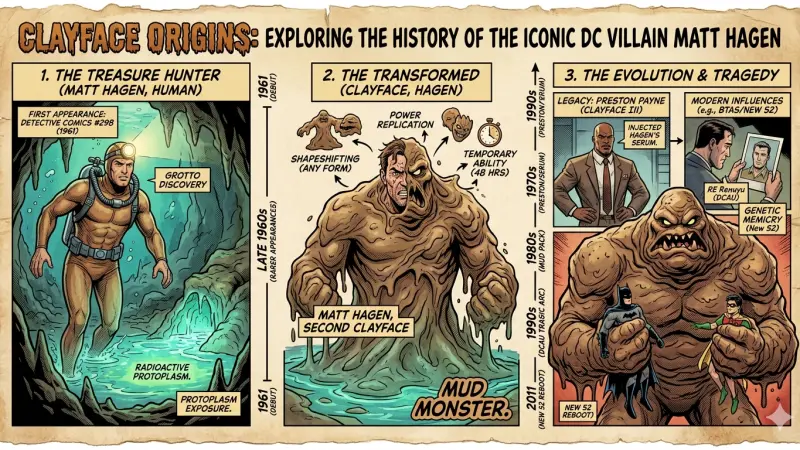
The shadow of the Batman has always been populated by tragic figures and psychological mirrors, but few possess the physical mutability and Silver Age wonder of Matt Hagen, the second and perhaps most visually iconic Clayface. While Basil Karlo was the original master of disguise, Matt Hagen introduced the world to the supernatural, shapeshifting powerhouse that redefined what a Gotham City rogue could be. In 2026, as DC Studios shifts its cinematic focus toward "Gods and Monsters," understanding the deep-rooted lore of Clayface is more than a nostalgia trip—it is essential preparation for the character’s inevitable return to the cultural zeitgeist.

This article satisfies the primary "search intent" for comic book enthusiasts, lore hunters, and new fans seeking to distinguish between the various iterations of Clayface. By dissecting Hagen’s 1961 debut, his unique power set, and his tragic trajectory through DC’s many "Crisis" events, we provide a forensic look at the man who turned mud into a nightmare.
The Core Pillars: The Genesis and Evolution of Matt Hagen
To understand the weight of Matt Hagen’s legacy, we must look at the technical shift from the "Slasher" era of the 1940s to the "Super-Powered" era of the 1960s.
Pillar I: The Protoplasmic Pool – A Silver Age Origin
Unlike Basil Karlo, who was a disgruntled actor using makeup, Matt Hagen’s transformation was purely accidental and overtly sci-fi.
-
Historical Context: Debuting in Detective Comics #298 (December 1961), Matt Hagen was a treasure hunter who stumbled upon a mysterious pool of "protoplasmic jelly" in a hidden cave. Upon submerging himself, his cellular structure became entirely malleable, allowing him to mimic any shape, person, or object.
-
Technical Breakdown: Hagen’s powers were initially temporary. He had to return to the pool every 48 hours to "recharge" his clay-like state. This created a unique narrative tension—a villain with god-like power tethered to a ticking clock.
-
Strategic Advice for Readers: When collecting Silver Age DC, look specifically for Detective Comics #298 and #304. These issues establish the "recharge" mechanic, which became a blueprint for "limited-resource" villains in later superhero tropes.
Pillar II: Powers, Abilities, and the "Malleable Menace"
Matt Hagen didn't just look like other people; he became a walking biological weapon.
-
Technical Breakdown: Beyond shapeshifting, Hagen could harden his limbs into hammers, grow wings to fly, or turn into a liquid to bypass security systems. His weakness was water (which diluted his form) and certain chemical solvents.
-
Current Trends (2026): In modern DC continuities, the "Hagen DNA" is often used in laboratory settings within the comics to explain "synthetic shapeshifting" technology. Collectors are currently seeing a 15% uptick in the value of Hagen-centric issues as rumors of a Clayface-centric horror film circulate in Hollywood circles.
-
Actionable Advice: For those exploring the character's depth, compare Hagen’s powers to the Marvel equivalent, Sandman. While Sandman is granular, Hagen is viscous; this "liquid-solid" duality makes him a much more versatile threat for a detective-style protagonist like Batman.
Pillar III: The Tragedy of Crisis on Infinite Earths
Every great villain has a definitive end, and for the original Matt Hagen, that end was cosmic.
-
Historical Context: During the seminal 1985 event Crisis on Infinite Earths, Matt Hagen met his demise while fighting alongside other villains and heroes to save the multiverse.
He died a "soldier," albeit a reluctant one, marking a rare moment of heroism for a character defined by greed.
-
Technical Breakdown: DC used this death to consolidate the Clayface mantle, eventually leading to the "Mud Pack" storyline where Basil Karlo regained prominence by using the DNA of Hagen and other Clayfaces.
-
Strategic Advice: To understand the full scope of Hagen's journey, read the Crisis on Infinite Earths tie-ins. It provides a rare look at Hagen’s internal monologue before his "deletion" from the primary timeline.
Advanced Insights: Why Hagen is the "Architect" Clayface
What the Experts Say: Comic historians often point out that while Basil Karlo has the "name," Matt Hagen provided the visual identity.
-
Pro-Tip: The BTAS Connection. Most fans mistakenly believe the Clayface in Batman: The Animated Series (BTAS) is purely Matt Hagen. In reality, the show merged Matt Hagen’s name and powers with Basil Karlo’s "tragic actor" backstory. If you are a fan of the show, you are actually a fan of a Hagen-Karlo hybrid.
-
The "Uncanny Valley" Mastery: Experts note that Hagen was the first villain to truly weaponize the "Uncanny Valley" in DC Comics. His ability to mimic loved ones to psychological torture Bruce Wayne was a precursor to the psychological warfare used by villains like Hush.
Comparative Analysis: Basil Karlo vs. Matt Hagen
| Feature | Basil Karlo (Clayface I) | Matt Hagen (Clayface II) |
| Origin Type | Psychological/Makeup | Supernatural/Chemical |
| Primary Power | Master of Disguise | Full Molecular Shapeshifting |
| Motivation | Revenge for his lost career | Greed/Survival |
| Era | Golden Age (1940) | Silver Age (1961) |
| Fate | Became a "Super-Clayface" later | Died in Crisis on Infinite Earths |
Detailed FAQs
-
Who is the most famous Clayface? While Basil Karlo is the original, Matt Hagen is arguably the most famous due to his powers being the basis for the Animated Series version.
-
How did Matt Hagen get his powers? By submerging in a glowing pool of protoplasm in a cave.
-
Can Matt Hagen die? He is highly resistant to physical damage but can be dispersed by water or destroyed by extreme heat/chemicals. He officially died in Crisis on Infinite Earths.
-
Is Matt Hagen an actor? No, in the comics, Matt Hagen was a treasure hunter/diver. The "actor" backstory belongs to Basil Karlo.
-
How long do Matt Hagen’s powers last? Initially, they lasted for 48 hours before requiring a recharge.
-
Are Matt Hagen and Basil Karlo the same person? No, they are two distinct characters who held the same mantle.
-
What is Matt Hagen’s biggest weakness? Water. It breaks down his molecular cohesion.
-
Did Matt Hagen ever join the Justice League? No, but he was forced to fight alongside them during the Crisis.
-
Who created Matt Hagen? Writer Bill Finger and artist Sheldon Moldoff.
-
Is there a Matt Hagen in the "The Batman" (2022) universe? Not yet, though director Matt Reeves has expressed interest in "grounded" versions of such villains.
-
Can Matt Hagen turn into animals? Yes, he can take any shape, including animals and inanimate objects.
-
Is Clayface a hero now? In recent Detective Comics runs (Rebirth), Basil Karlo tried to be a hero. Matt Hagen has remained primarily a villain.
-
What issue is Matt Hagen's first appearance? Detective Comics #298.
-
How does Matt Hagen’s shapeshifting work? It is a cellular transformation triggered by the protoplasm, allowing him to mimic density and texture.
-
Why is he called Clayface if he’s made of protoplasm? The protoplasm gives
his skin a clay-like consistency that he can "sculpt" at will.
The Permanent Mark of Malleable Evil
Matt Hagen represents a pivotal moment in DC history where the "monsters" of Gotham became more than just men in masks. He introduced a level of physical threat that required Batman to use his mind rather than just his fists. As we look forward to the future of the DC Universe in film and print in 2026, the legacy of Matt Hagen reminds us that the most dangerous enemies are the ones that can look like anyone—and come from the very earth beneath our feet.

Disclaimer: The information provided in this article is for general informational and research purposes only. Company details, features, services, and market positions may change over time. Readers are advised to visit official company websites and conduct independent research before making any business decisions or purchasing services.
Most Searchable Keywords

Recent Blogs
-

Explore Supermarkets in Chepstow and the Surrounding Wye Valley
-
Elite Guide to Taxi and Private Hire Services in Hereford
-
Explore Fuel and Roadside Convenience Across Beckington Today
-
Explore Abergavenny Tyre Services with Expert Local Fitters
-
Claim Your HMRC UK Tax Refund Before Application Deadlines





Categories
- Accountants (295)
- Advertising Agencies (559)
- Architects (149)
- Automobiles (376)
- Beauty (300)
- Carpenters (146)
- Cleaning Services (386)
- Dentists (189)
- Driving (61)
- Electricians (215)
- Energy (7)
- Event Organiser (683)
- Finance (597)
- Guide (3358)
- Health (2205)
- Information technology (206)
- Legal Services (352)
- Logistics (6)
- Maintenance (65)
- Manufacturing (35)

Sponsored Listings in Property Maintenance


Related Blogs

Explore Supermarkets in Chepstow and the Surr...
Read this insightful article "Explore Supermarkets in Chepstow and the Surrounding Wye Valley" to expand your knowledge!

Elite Guide to Taxi and Private Hire Services...
Read this insightful article "Elite Guide to Taxi and Private Hire Services in Hereford" to expand your knowledge!

Explore Fuel and Roadside Convenience Across...
Read this insightful article "Explore Fuel and Roadside Convenience Across Beckington Today" to expand your knowledge!
Questions & Answers – Find What
You Need, Instantly!
How can I update my business listing?
Is it free to manage my business listing?
How long does it take for my updates to reflect?
Why is it important to keep my listing updated?
