
Deepfake Risks Protecting UK Businesses from AI Video Scams
- 👤 Tim David
- 👁️ 71 Views
- Last Updated: March 27, 2026
- 🏷️ Information technology
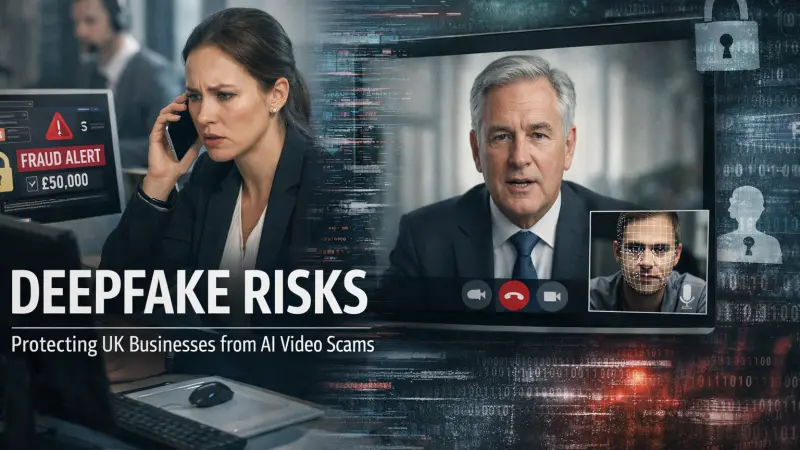
Imagine receiving a high-priority video call from your Managing Director on a Friday afternoon, requesting an urgent transfer of funds to secure a new international contract. The voice is unmistakable, the facial expressions are familiar, and the sense of urgency is palpable. Yet, despite the visual evidence, the person on the screen does not exist; they are a sophisticated digital construct generated by artificial intelligence. This scenario is no longer the province of science fiction; it is a burgeoning reality for Small and Medium-sized Enterprises (SMEs) across the United Kingdom.

As AI-generated video technology becomes increasingly mainstream, its intuitive nature and ease of use have captivated the public. While many use these tools for creative expression or harmless social media content, the underlying technology—often referred to as "synthetic media"—presents a significant and evolving threat landscape. For UK business owners, contractors, and service providers, understanding the "dark side" of AI-generated content is no longer optional; it is a critical component of modern risk management and cybersecurity.
The Proliferation of Synthetic Media in the UK
The rapid advancement of generative AI has democratised the creation of high-quality video content. Tools that once required Hollywood-level budgets and months of post-production are now available to anyone with a standard internet connection. This accessibility is a double-edged sword. While it empowers marketing departments and educators, it also provides a low-cost, high-reward toolkit for malicious actors.
In the UK, we are witnessing a surge in deepfake media appearing on major social platforms. Many users, particularly those who are less "tech-savvy," find it increasingly difficult to distinguish between authentic footage and AI-generated fabrications. This gap in digital literacy is being exploited to manipulate vulnerable individuals, disseminate misinformation, and orchestrate complex financial scams. The mesmerising capabilities of this software often distract from its potential for harm, creating an environment where skepticism is frequently overridden by visual "proof."
Understanding the Corporate Threat Landscape
For the UK's SME sector, the primary concern regarding AI-generated videos is their deployment in social engineering attacks. Unlike traditional phishing emails, which may contain grammatical errors or suspicious links, a deepfake video carries a psychological weight that is much harder to ignore.
1. Business Email Compromise (BEC) 2.0
Business Email Compromise (BEC) has long been a thorn in the side of British finance departments. However, the integration of synthetic media has evolved this threat into what experts call "BEC 2.0." Threat actors can now scrape public videos of company executives from LinkedIn or YouTube to train AI models.
These models produce "deepfake" videos or audio clips used to bypass traditional verification steps. When a "Director" appears on a screen or speaks via a voice note, employees are significantly more likely to circumvent standard security protocols to fulfill a request.
2. Identity Theft and "Imposter" Hiring
A particularly concerning trend for UK service providers and recruiters is the rise of identity theft in the remote hiring process. There have been documented cases where threat actors use AI-generated avatars and voice modulation during video interviews to secure positions within sensitive industries. In some instances, these "imposters" have been linked to state-sponsored activities, including efforts to infiltrate UK tech firms to exfiltrate data or establish long-term access to secure networks. For contractors, this means the very identity of their collaborators must now be subject to more rigorous verification.
3. Fake Job Offers and Reputation Damage
Criminals are also using deepfakes to target job seekers. By impersonating reputable UK recruiters or CEOs of well-known firms through video messages, they can lure candidates into sharing sensitive personal information or paying "onboarding fees." Furthermore, if a business's executive is "deepfaked" into saying something controversial or damaging, the resulting reputational fallout can be instantaneous and difficult to rectify, even after the video is proven to be false.
The Mechanism of Exploitation: Bypassing Guardrails
Reputable technology companies such as OpenAI and Meta have implemented built-in guardrails designed to prevent the creation of malicious content. These filters are intended to block the generation of non-consensual imagery, political misinformation, or fraudulent materials. However, the cybersecurity community has noted that these protections are not infallible.
Through techniques known as "jailbreaking," malicious users can manipulate AI prompts or exploit vulnerabilities in the software to bypass safety filters. Additionally, many open-source AI models exist without any guardrails at all. These "unfettered" tools allow threat actors to feed real images and videos into generators to produce blackmail material or highly personalised scams. In the UK, this has already manifested in disturbing ways within educational settings, where teenagers use the technology for bullying or extortion—a trend that serves as a grim precursor to how these tools are being adapted for professional blackmail.
Societal Implications and the Erosion of Truth
Beyond the immediate financial risks to businesses, the prevalence of AI-generated videos creates an environment where "fake news" can thrive. In a democratic society like the UK, the ability to distinguish fact from fiction is paramount, especially during election cycles or periods of economic volatility.
Deepfakes can influence stock markets by showing fake interviews with high-profile CEOs or mislead voters with fabricated statements from political figures. When the public can no longer trust their eyes and ears, the result is a "liar's
dividend"—a phenomenon where actual truth is dismissed as "fake" because the possibility of fabrication is so high. For SMEs, this erosion of trust complicates everything from brand messaging to client relationships.
Spotting the Signs: A Technical Checklist for UK Professionals
While AI is becoming more sophisticated, there are often telltale signs that a video is not what it seems. UK businesses should train their staff to look for the following discrepancies:
- Source Verification: Always verify the origin of the media. If a video purportedly shows a major news event or a government announcement, check reputable UK outlets like the BBC or Reuters. Genuine news organisations have dedicated verification teams.
- Facial Transitions: Observe the transitions between facial expressions. In many deepfakes, the movement between a smile and a neutral face may appear "jumpy" or unnaturally fast.
- Skin Texture and Consistency: Look closely at the skin. Is it unnaturally smooth, or do wrinkles appear and disappear inconsistently? Check if the skin tone remains uniform across different lighting conditions within the video.
- Micro-movements and Shadows: Pay attention to the smallest details. Do the shadows on the face align with the light source in the background? Does the hair move naturally, or does it seem like a static "helmet" that doesn't react to movement?
- Digital Artefacts: Zoom in on the edges of the face and neck. You may see blurring, pixelation, or "doubling" where the AI-generated face meets the real background.
- The "Hand" Test: AI often struggles with complex geometry. Inspect fingers, nails, and any text visible in the background. If a person moves their hand across their face, look for "glitching" or the hand momentarily disappearing.
- Audio-Visual Sync: Check if the movement of the lips is perfectly in sync with the audio. In many deepfakes, there is a slight "lag" or the mouth shapes do not quite match the phonetic sounds.
Strategic Recommendations for UK SMEs
To mitigate the risks associated with AI-generated scams, UK businesses should move toward a "Zero Trust" architecture regarding digital communications. This does not mean operating in a state of constant suspicion, but rather implementing robust verification processes.
Implementation of Out-of-Band Verification
If a request for sensitive data or financial transfer is made via video or audio, the recipient should perform "out-of-band" verification. This involves contacting the requester via a different, pre-established channel—such as a direct phone call to a known number or a secure internal messaging system—to confirm the request's validity.
Staff Awareness and Training
Cybersecurity is as much about people as it is about technology. Regular training sessions that showcase current deepfake examples can help employees develop a "gut instinct" for when something feels off. Encouraging a culture where employees feel safe to double-check "urgent" requests from superiors is one of the most effective defences against social engineering.
Policy Development
Contractors and service providers should update their service level agreements (SLAs) and internal policies to include protocols for digital identity verification.
For high-stakes projects, consider using multi-factor authentication (MFA) for all video conferencing platforms and ensuring that "identity proofing" is part of the onboarding process.
Conclusion
The rise of AI-generated video is a testament to human ingenuity, but its potential for misuse represents a significant challenge for the UK’s digital economy. By staying informed, implementing rigorous verification protocols, and fostering a culture of digital skepticism, UK businesses can enjoy the benefits of AI while protecting themselves from its darker applications. In the age of synthetic media, the old adage "seeing is believing" is no longer enough; we must now "verify to believe."
Frequently Asked Questions
What is a deepfake?
A deepfake is a type of synthetic media where the likeness of one person is replaced with another using artificial intelligence and machine learning. This results in highly realistic video or audio that can make individuals appear to say or do things they never actually did.
How can deepfakes harm my UK business?
Deepfakes are primarily used in Business Email Compromise (BEC) scams to trick employees into making unauthorised payments. They can also be used for identity theft during recruitment, spreading misinformation to damage your brand's reputation, or blackmailing executives.
Are there laws in the UK against deepfakes?
The UK's Online Safety Act includes provisions to tackle harmful content, including non-consensual deepfakes. Additionally, using deepfakes for fraud or extortion is covered under existing legislation like the Fraud Act 2006. However, enforcement remains a challenge due to the global nature of the internet.
Can standard antivirus software detect deepfake videos?
Traditional antivirus software is designed to detect malicious code (malware), not visual fabrications.
While some specialised cybersecurity firms are developing AI-detection tools, the best defence remains human vigilance and strict verification protocols.
What should I do if I suspect a video call is a deepfake?
Do not share any sensitive information or commit to any financial transactions. End the call and contact the individual or organisation directly through a trusted, alternative method, such as a known office telephone number or a secure internal chat system, to verify the request.

Disclaimer: The information provided in this article is for general informational and research purposes only. Company details, features, services, and market positions may change over time. Readers are advised to visit official company websites and conduct independent research before making any business decisions or purchasing services.
Most Searchable Keywords

Recent Blogs


Related Listings
-
Undo Capital
-

Top Mobile App Developers in UK | Downtown Applications
-

Polar DC
-

Chronicle Online
-

Imobisoft

Categories
- Accountants (295)
- Advertising Agencies (559)
- Architects (149)
- Automobiles (377)
- Beauty (300)
- Carpenters (146)
- Cleaning Services (386)
- Dentists (189)
- Driving (62)
- Electricians (215)
- Energy (8)
- Event Organiser (685)
- Finance (599)
- Guide (3365)
- Health (2207)
- Information technology (206)
- Legal Services (353)
- Logistics (6)
- Maintenance (65)
- Manufacturing (35)

Sponsored Listings in Information Technology
Related Blogs

Gen Z Political Reporters and News Creators i...
Read this insightful article "Gen Z Political Reporters and News Creators in the UK" to expand your knowledge!

Famous Female Social Media Influencers Across...
Read this insightful article "Famous Female Social Media Influencers Across the UK" to expand your knowledge!

Your UK Sponsor Licence 2026 Step by Step Gui...
Read this insightful article "Your UK Sponsor Licence 2026 Step by Step Guide" to expand your knowledge!
Questions & Answers – Find What
You Need, Instantly!
How can I update my business listing?
Is it free to manage my business listing?
How long does it take for my updates to reflect?
Why is it important to keep my listing updated?
