
Display Ads vs Search Ads 2026: The Ultimate Strategy Guide
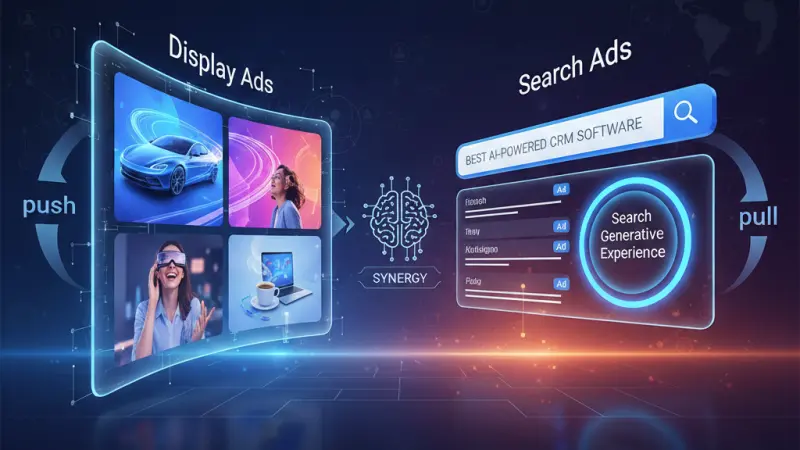
In the rapidly shifting landscape of 2026, where AI-driven search and immersive digital experiences dominate, choosing between display advertising and search advertising is no longer a binary decision. It is about understanding the "push" and "pull" mechanics of the modern web to ensure your budget yields the highest possible Return on Ad Spend (ROAS).
1. What is Display Advertising in 2026?
Display advertising is a visual-first marketing method designed to place your brand in front of users while they consume content across the internet. Unlike search ads, which wait for a user to ask a question, display ads "push" your message to targeted audiences based on their behavior, interests, and demographics.
In 2026, display advertising has moved far beyond simple static banners. It now encompasses:
Rich Media & Interactive Ads: Banners that expand or allow users to interact with a product 3D model.
Programmatic Video: High-definition video snippets that play within news articles or social feeds.
Native Placements: Advertisements that mirror the editorial look and feel of the website they inhabit, reducing "ad blindness."
By utilizing networks like the Google Display Network (GDN) or specialized programmatic platforms, businesses can reach over 90% of internet users across millions of websites and apps.
2. What is Search Advertising (PPC) Today?
Search advertising, often referred to as Pay-Per-Click (PPC), allows your business to appear at the very moment a user expresses intent. When someone types a query into a search engine like Google or Bing, search ads appear at the top of the Search Engine Results Page (SERP).
In the current era of AI-powered search (Search Generative Experience), search ads have become more conversational. They often appear alongside AI-generated summaries, providing direct solutions to complex, long-tail queries. These ads are marked with a subtle "Sponsored" or "Ad" label, but they are designed to look nearly identical to organic results to maintain a seamless user experience.
3. How Do Display Ads Work? The Push Strategy
Display advertising operates on a passive discovery model. Imagine walking through a shopping mall; you aren't looking for a specific store, but a vibrant window display catches your eye. That is exactly what a display ad does online.
The Mechanism of Modern Display
Targeting Parameters: Instead of keywords, display ads rely on Audience Signals. You can target users based on their "In-Market" segments (people currently researching cars), "Affinity" groups (fitness enthusiasts), or specific "Demographics" (parents aged 30–45 in London).
Contextual Intelligence: Advanced AI now analyzes the sentiment and topic of a webpage in real-time. If a user is reading an article about "Sustainable Gardening," your ad for organic fertilizer appears instantly.
The Bidding Process: Most display ads are bought through Real-Time Bidding (RTB). In the milliseconds it takes for a page to load, an automated auction occurs to decide which ad gets the spot.
4. How Do Search Ads Work? The Pull Strategy
Search advertising is the ultimate "Pull" strategy. It pulls the customer toward your business because they are already looking for what you offer. This makes search ads incredibly high-intent.
The PPC Workflow
Keyword Selection: You bid on terms like "emergency plumber near me" or "best CRM for small business."
The Auction: When a search is performed, the search engine looks at your Bid Amount and your Quality Score (a metric of how relevant and helpful your ad is).
Payment on Action: You only pay when someone actually clicks your ad. This makes it a highly measurable and cost-effective way to drive immediate traffic.
In 2026, Google’s AI Max for Search has simplified this by automatically expanding search terms
to match the user's "Search Intent" rather than just the exact words they typed.
5. Display Ads vs. Search Ads: When to Use Each
Choosing the right tool depends entirely on your marketing goals. Here is a breakdown of the ideal use cases:
Choose Display Advertising When:
You Want to Build Brand Awareness: If you are launching a new brand or product that people don't know to search for yet, display ads create that initial spark.
Your Product is Visual: Fashion, travel, and luxury goods perform exceptionally well with high-quality imagery and video.
You Have a Long Sales Cycle: For B2B software or high-end real estate, display ads keep your brand "top of mind" during a month-long decision process.
You Want to Retarget: Remind users who visited your site but didn't buy to come back and finish their purchase.
Choose Search Advertising When:
You Need Immediate Leads: If you provide an "on-demand" service (locksmiths, towing, urgent repairs), search ads are non-negotiable.
You Have a Limited Budget: Search ads allow you to focus only on users with the highest intent, minimizing wasted spend.
You Want to Support SEO: If your website isn't ranking on page one organically yet, search ads give you an instant "front-row seat" on the SERP.
6. The Power of Synergy: How They Interact
The most successful digital marketers don't choose one over the other; they use both in a unified "Full-Funnel" strategy.
The Billboard Effect
Studies show that users who see a display ad are 55% more likely to eventually click on a search ad from the same brand. The display ad creates familiarity (The Billboard), and the search ad provides the destination (The Storefront).
Retargeting Integration
A user searches for "Running Shoes" and clicks your Search Ad.
They browse your site but don't buy.
For the next week, they see your Display Ads featuring those exact shoes on their favorite news sites.
This constant presence dramatically increases the likelihood of a final conversion.
7. Advanced Tips for 2026 Success
Focus on "Attention Metrics": In 2026, clicks aren't enough. Use tools that measure "dwell time" on your display ads to see if people are actually looking at them.
Leverage First-Party Data: With the decline of third-party cookies, use your own customer email lists to create "Lookalike Audiences" for display campaigns.
Optimize for Conversational Search: Ensure your search ad copy sounds natural and answers questions, matching the way people talk to AI assistants.
A/B Test Creatives: Use AI to generate 10 variations of a display banner
and let the algorithm determine which visual resonates most with your audience.
Elevate Your Presence with Local Page UK
In the competitive landscape of digital marketing, visibility is everything. Whether you are running complex ad campaigns or looking for organic growth, being listed on a reputable uk business directory is the foundation of local SEO success.
Local Page UK serves as the premier uk online business directory, helping customers find local businesses uk with ease. If you want to increase your digital footprint without the high cost of PPC, a business listing uk is your best starting point. Our uk local business directory provides a robust platform for local businesses list uk, ensuring your company appears in local business listings uk.
Small businesses often struggle with visibility, but with our uk small business directory, you can gain the exposure you deserve. We offer a business listing uk service that includes a business listing uk to boost your local rankings. For those looking for professional connections, our uk b2b business directory and uk b2c business directory cater to every industry.
Join the business directory uk online community today. Secure your business listing uk spot and get featured in our uk service providers directory. From uk business listings online to uk service listings, we provide the tools for uk verified business listings that customers trust.
Whether you are seeking uk top rated local businesses, a uk home services directory, or uk professional services listings, Local Page UK is the ultimate uk business directory website. Don't miss out on the benefits of a business listing uk or a business listing uk. Start your business listing uk journey now and be part of the most comprehensive local page uk listings available for uk local business search.
What Professionals Often Want to Know
1. Which is cheaper: Search or Display?
Generally, Display Ads have a much lower Cost-Per-Click (CPC) than Search Ads. However, Search Ads often have a higher Conversion Rate, making the "Cost per Acquisition" comparable.
2. Can I run both ads on the same budget?
Yes, you can use "Performance Max" campaigns in Google Ads, which automatically distribute your budget across both Search and Display networks based on performance.
3. What is a "View-Through Conversion"?
This happens when a user sees your display ad, doesn't click, but later visits your site and converts through another channel (like direct typing or search).
4. Do display ads work for B2B?
Absolutely. Display ads are vital for B2B to stay top-of-mind during long procurement processes and to target decision-makers on professional news sites.
5. How do I prevent my display ads from appearing on "junk" sites?
Use "Placement Exclusions" and "Content Suitability" settings to ensure your ads only appear on reputable, high-quality websites.
6. What is the ideal click-through rate (CTR) for search ads?
In 2026, a CTR of 3% to 5% is considered healthy for most industries, though "Brand" campaigns often see CTRs above 10%.
7. Why is my Quality Score important?
A higher Quality Score reduces your CPC. It tells the search engine your ad is highly relevant to the user, so you are rewarded with lower prices.
8. Are banner ads still effective with ad blockers?
While some users use blockers, the rise of "Acceptable Ads" and native advertising ensures that display marketing remains a multi-billion dollar industry with massive reach.
9. How long should I run a campaign before seeing results?
For Search, you can see traffic instantly. For Display (awareness), you should allow at least 30 to 60 days to gather enough data for AI optimization.
10. What is "Remarketing"?
Remarketing is a display tactic that specifically targets people who have already visited your website, "following" them with ads to encourage a return visit.
11. Does search advertising help my organic SEO?
Indirectly, yes. Increased traffic and brand recognition from ads can lead to more branded organic searches and social mentions, which are positive SEO signals.
12. What is "Contextual Targeting"?
It is placing ads on pages that have content relevant to your product (e.g., a diaper ad on a parenting blog) without relying on the user's personal data.
13. Can I use video in search ads?
No, search ads are primarily text-based. However, Video Ads are a core part of Display and Social networks.
14. What are "Sitelink Extensions"?
These are additional links below your main search ad that take users to specific pages (like "Contact Us" or "Pricing"), increasing your ad's size and CTR.
15. Is AI making advertising harder or easier?
Easier for strategy, harder for competition. AI handles the "grunt work" of bidding, but it requires humans to provide high-quality "Creative" and "Brand Voice."
Disclaimer: The information provided in this article is for general informational and research purposes only. Company details, features, services, and market positions may change over time. Readers are advised to visit official company websites and conduct independent research before making any business decisions or purchasing services.
Most Searchable Keywords
Recent Blogs


Related Listings

Categories
- Accountants (295)
- Advertising Agencies (559)
- Architects (149)
- Automobiles (377)
- Beauty (300)
- Carpenters (146)
- Cleaning Services (387)
- Dentists (189)
- Driving (62)
- Electricians (215)
- Energy (8)
- Event Organiser (686)
- Finance (602)
- Guide (3374)
- Health (2207)
- Information technology (206)
- Legal Services (354)
- Logistics (6)
- Maintenance (65)
- Manufacturing (35)
Sponsored Listings in Travel Agencies


Related Blogs

Meet the Fair Work Agency Changing UK Work Ru...
Read this insightful article "Meet the Fair Work Agency Changing UK Work Rules in 2026" to expand your knowledge!

Collective Redundancy Errors Now Carry Higher...
Read this insightful article "Collective Redundancy Errors Now Carry Higher 2026 Penalties" to expand your knowledge!

Explore Dog Friendly Walks in the Cotswolds f...
Read this insightful article "Explore Dog Friendly Walks in the Cotswolds for 2026" to expand your knowledge!
Questions & Answers – Find What
You Need, Instantly!
How can I update my business listing?
Is it free to manage my business listing?
How long does it take for my updates to reflect?
Why is it important to keep my listing updated?
