
Driverless Cars on UK Roads by 2026
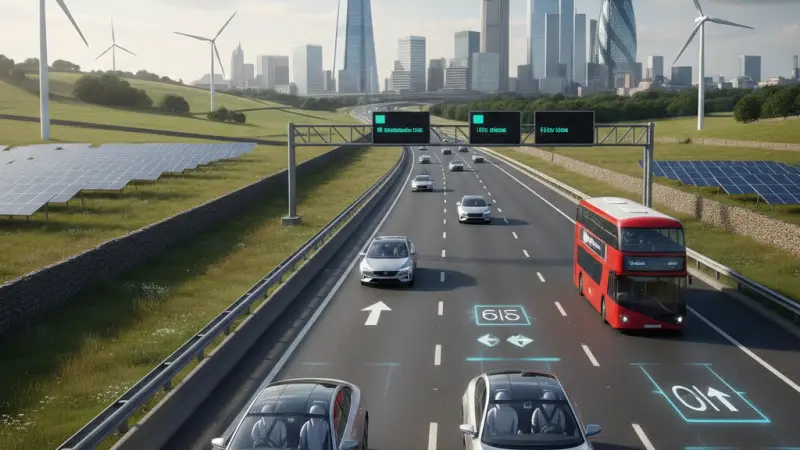
By Spring 2026, the first commercial automated passenger services (APS)—commonly known as robotaxis—are scheduled to begin operating on public roads in London and other major UK hubs. This follows the landmark Automated Vehicles Act 2024, which established a world-leading legal framework for self-driving technology, shifting liability from the "user-in-charge" to the manufacturers and insurers when a vehicle is in autonomous mode.

For architects and urban designers across the UK, this is no longer a futuristic concept but a looming regulatory and design reality. The integration of Level 4 and Level 5 autonomous vehicles (AVs) will fundamentally alter how we calculate land value, design residential frontages, and plan commercial density. This guide explores how your practice can leverage this shift to drive high-value enquiries and secure a competitive edge in the evolving UK development landscape.
What is the Automated Vehicles Act 2024 and Why Does It Matter Now?
The Automated Vehicles Act 2024 provides the legal certainty required for the commercial deployment of self-driving vehicles by 2026. It distinguishes between "driver assistance" and "self-driving," ensuring that when a vehicle is authorised as autonomous, the person in the seat is not responsible for its conduct.
For the architectural profession, this legislation is the "green light" for developers to begin de-risking projects that move away from traditional car-centric layouts. The government’s ambition is for the UK to capture a significant share of a projected £42 billion sector by 2035. As an architect, understanding the secondary legislation being finalised in 2026 allows you to advise clients on "future-proofing" their schemes against shifting Planning Policy Guidance (PPG) and local Transport Assessments.
The End of the Private Garage?
As autonomous ride-sharing increases, the necessity for a traditional "two-car garage" in suburban residential developments is diminishing. We are moving toward a model where the "front door experience" is prioritised over the driveway.
Will self-driving cars eliminate residential parking requirements?
While not immediate, the shift toward shared autonomous fleets suggests that local authorities will likely reduce minimum parking standards for new builds. This allows architects to reclaim significant square footage—often the most valuable part of a site—for additional living space, home offices, or enhanced green infrastructure.
Adaptive Frontages: Architects should now consider "drop-off zones" rather than long-term parking bays.
Repurposed Space: Converting what would have been a garage into a high-spec "garden room" or internal annexe increases the Gross Internal Area (GIA) and, subsequently, the project’s ROI.
The Death of the Multi-Storey Car Park?
The most profound impact of driverless cars in 2026 and beyond will be felt in our city centres. Research suggests that shared autonomous vehicles could reduce the need for urban parking by up to 90%.
How should architects design commercial parking today for a driverless 2030?
Architects should propose "convertible" parking structures. Current designs often feature sloped floors and low ceiling heights that make future conversion nearly impossible. By designing with flat floor plates, higher floor-to-ceiling heights (approx. 3.5m), and centralised structural cores, you can ensure a car park built in 2026 can be converted into an office, a logistics hub, or residential units by 2040.
Strategic Considerations for Urban Projects:
Kerbside Management: The kerb will become the most contested piece of real estate. Architects must design sophisticated "active travel" interfaces where AVs, cyclists, and pedestrians interact safely.
Digital Traffic Regulation Orders (TROs): The 2024 Act mandates the digitalisation of TROs. Architects will need to collaborate with BIM (Building Information Modelling) specialists to ensure site access points are digitally visible to autonomous fleet mapping systems.
Enhancing Project ROI Through Autonomous Readiness
Demonstrating "Autonomous Readiness" is a powerful tool for winning tenders and securing planning permission in contested UK councils.
Visibility & Enquiries: Position your practice as a specialist in "Tech-Enabled Urbanism." Developers are
looking for consultants who understand how the 2026 rollout affects long-term asset value.
Booked Projects: By advising clients on how to reclaim land from parking for "higher and better use" (e.g., more units or better amenities), you directly improve their development appraisals. This level of strategic insight converts a standard fee proposal into a high-value partnership.
Promoting Your Practice in the New Digital Economy
As the UK economy becomes increasingly decentralised and tech-driven, your practice’s digital visibility is as important as your physical portfolio. Connecting with local developers and B2B partners requires a presence where they are searching.
Growth Insight: To expand your reach among UK developers and contractors, ensure your practice is listed on a reputable uk online business directory. High-quality backlinks from a uk business directory or a uk local business directory can significantly boost your practice's local SEO, making it easier for clients to find local businesses uk.
If you are looking to feature in a comprehensive local businesses list uk, appearing in a uk small business directory or a specialist uk b2b business directory is essential. For those serving residential clients, a uk b2c business directory ensures you are visible to homeowners. Using a business directory uk online or a uk service providers directory helps build the "Trust, Authority, and Expertise" signals that answer engines (AEO) look for.
Maximise your uk business listings online by joining the local page uk business directory, a premier uk business directory website.
Secure Your Online Presence
For a limited time, you can secure a business listing uk on this business listing uk. A business listing uk on a business listing uk is an easy win for SEO. Whether you want a business listing uk or a business listing uk, this business listing uk opportunity via the business listing uk is invaluable. Even if you are a specialist, such as seeking a business listing uk or a business listing uk, visibility starts here.
Explore existing local business listings uk and uk service listings to see how others are positioned. From uk verified business listings to finding uk top rated local businesses, the uk home services directory and uk professional services listings are the go-to resources. Whether it is uk trade services listings or the uk local trades directory, the local page uk listings facilitate a better uk local business search experience for your future clients.
Service-Related Questions & Answers
1. When will driverless cars be legal on UK roads?
The Automated Vehicles Act 2024 is already law. Commercial "robotaxi" services are expected to launch in trials and limited services starting in Spring 2026.
2. Who is liable if a driverless car crashes in the UK?
Under the 2024 Act, if a vehicle is in self-driving mode, the manufacturer or the "Authorised Self-Driving Entity" (ASDE) is liable, not the person in the driver's seat.
3. Will I need a driving licence for a self-driving car?
For "No User-in-Charge" (NUiC) vehicles, passengers will not need a licence. However, for vehicles that
require a human to take over in emergencies, a valid licence remains necessary.
4. How does this affect UK building regulations?
While Part S (Infrastructure for charging electric vehicles) is the current focus, we anticipate future updates to Part M and Part M4(2/3) to account for autonomous drop-off accessibility.
5. Can I reduce the number of parking spaces in my current planning application?
You must still follow the Local Plan, but many councils are now open to "car-free" or "car-lite" developments if supported by a robust Transport Assessment citing the 2026 AV rollout.
6. What are "Digital TROs"?
Digital Traffic Regulation Orders are electronic versions of road rules (speed limits, parking restrictions) that autonomous cars read to navigate safely.
7. Will autonomous vehicles be electric?
Yes, the vast majority of AV development in the UK is tied to the 2035 zero-emission vehicle mandate.
8. Is London the only city getting driverless cars?
No. While London and Oxford are lead test sites, the government has
invited cities across the UK to participate in technical trials.
9. How do driverless cars "see" the road?
They use a combination of LiDAR, radar, cameras, and AI software to create a 360-degree map of their surroundings.
10. What is a "robotaxi"?
It is a shared, autonomous vehicle that functions like a traditional taxi but without a human driver.
11. Will driverless cars increase traffic congestion?
In the short term, "empty miles" (cars driving without passengers) could increase congestion, but long-term platooning and smarter routing are expected to reduce it.
12. Can self-driving cars handle UK weather?
Current trials in rainy conditions (like London) are helping refine sensors to handle typical UK weather patterns.
13. What happens to insurance premiums?
Liability shifts to the manufacturer, which is expected to simplify the claims process for individuals, though commercial insurance for fleet operators will be a major new market.
14. Are there "levels" of autonomy?
Yes, Level 4 (High Automation) and Level 5 (Full Automation) are the targets for the 2026 UK rollout.
15. How can architects prepare?
Start designing for "de-paving"—reclaiming tarmac for green space—and ensure all new parking structures are built for future repurposing.

Disclaimer: The information provided in this article is for general informational and research purposes only. Company details, features, services, and market positions may change over time. Readers are advised to visit official company websites and conduct independent research before making any business decisions or purchasing services.
Most Searchable Keywords

Recent Blogs



Related Listings

Categories
- Accountants (295)
- Advertising Agencies (559)
- Architects (149)
- Automobiles (377)
- Beauty (300)
- Carpenters (146)
- Cleaning Services (386)
- Dentists (189)
- Driving (62)
- Electricians (215)
- Energy (8)
- Event Organiser (685)
- Finance (599)
- Guide (3365)
- Health (2207)
- Information technology (206)
- Legal Services (353)
- Logistics (6)
- Maintenance (65)
- Manufacturing (35)

Sponsored Listings in Locksmith Services


Related Blogs

Gen Z Political Reporters and News Creators i...
Read this insightful article "Gen Z Political Reporters and News Creators in the UK" to expand your knowledge!

Famous Female Social Media Influencers Across...
Read this insightful article "Famous Female Social Media Influencers Across the UK" to expand your knowledge!

Your UK Sponsor Licence 2026 Step by Step Gui...
Read this insightful article "Your UK Sponsor Licence 2026 Step by Step Guide" to expand your knowledge!
Questions & Answers – Find What
You Need, Instantly!
How can I update my business listing?
Is it free to manage my business listing?
How long does it take for my updates to reflect?
Why is it important to keep my listing updated?
