
Driving Test Waiting Times How to Get Seen Sooner
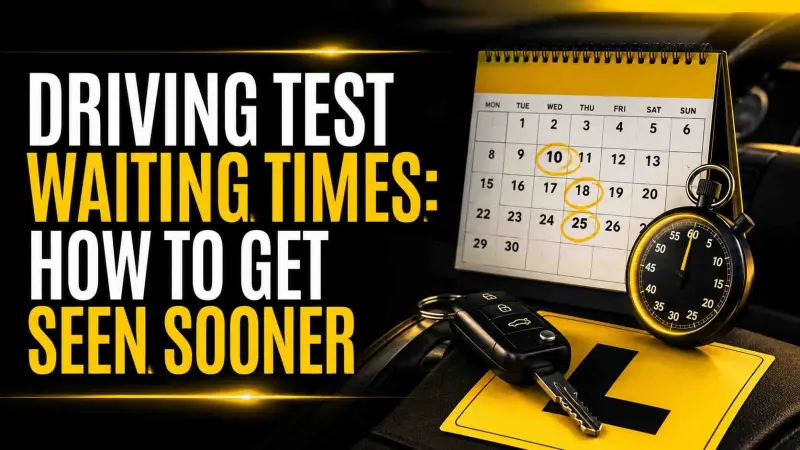
A driving test showing 22 weeks away can make it feel as though you have no choice but to wait for months. But there is an important detail behind that headline figure: 22 weeks does not necessarily mean every learner is waiting 22 weeks for their practical test.
The Driver and Vehicle Standards Agency (DVSA) has changed how it reports driving-test availability in 2026 because the traditional waiting-time figure did not always reflect what learners actually experienced. The latest data includes a median waiting time, which measures the period between booking and taking a test, alongside the older availability measure.
That distinction matters if you are trying to get seen sooner.
There are legitimate ways to improve your chances of getting an earlier appointment, but the rules have also become much stricter. Since May 2026, learners must manage their own car driving-test bookings, while unofficial cancellation-finder services that scan the booking system are no longer permitted. Learners are also limited to two changes to a car-test booking and can only move a booking to certain nearby test centres.
Here is what the 22-week figure really means, why waits vary so sharply between test centres, and what you can legally do if you want your test sooner.
What Does a 22-Week Driving Test Wait Actually Mean?
The 22-week figure is not necessarily your personal waiting time
The first thing to understand is that DVSA uses more than one measure of driving-test availability.
Historically, the headline "waiting time" figure has referred to the point at which at least 10% of weekly appointments are still available to book. In other words, if a test centre shows 22 weeks, it does not mean that every appointment before week 22 has disappeared.
There may still be individual appointments available earlier.
DVSA has explained that the old measure is useful for showing how far into the future a learner may need to look before a meaningful level of availability remains, but it does not directly tell you how long individual learners actually waited.
That is why the agency introduced a median waiting-time measure in June 2026.
What is the difference between availability and actual waiting time?
Think of the two measurements like this:
| Measure | What it tells you | Why it matters |
|---|---|---|
| 10% availability measure | How far into the booking window you need to look before at least 10% of appointments remain available | Shows how difficult a centre is to book |
| Median waiting time | The middle waiting time among tests actually completed | Gives a better picture of what learners experienced |
| Appointments available | Number of slots currently available in the booking window | Shows the practical opportunities available |
| Booking window | How far ahead the DVSA system allows tests to be booked | Defines the maximum forward horizon |
The difference can be substantial.
DVSA reported that for May 2026 the Great Britain average was 21.8 weeks using the 10% availability measure, while the median waiting time was 9.7 weeks. That means half of the learners who took a test during that month had waited less than 9.7 weeks, even though the traditional availability measure was close to 22 weeks.
So if you see "22 weeks" on a test-centre availability measure, do not automatically assume you personally have to sit out 22 weeks.
Why can you sometimes find an earlier test?
Suppose a busy test centre conducts 200 tests each week.
If fewer than 10% of appointments remain available at a particular point, the availability measure may still show a long wait. But 5% availability would still represent around 10 appointments in a 200-test week.
Those appointments can be taken by learners who happen to check at the right time.
Cancellations, newly released appointments and changes made by other learners can therefore create opportunities before the headline waiting-time figure.
This is one reason regular checking can work.
Why are some test centres much worse than others?
Driving-test availability is not evenly distributed across Great Britain.
DVSA's May 2026 data showed considerable regional differences. The median waiting time was 13.6 weeks in Scotland, compared with 7.1 weeks in the South West. London recorded 11.7 weeks, while the West Midlands was at 9.1 weeks.
Individual centres can be even more extreme.
For example, DVSA reported median waits of around 23 weeks at Pinner and Birmingham Kingstanding, while Banbury recorded a median of 24.3 weeks. By contrast, centres such as Darlington and Wakefield had much shorter median waits than their availability figures suggested.
This means location can make a huge difference.
Why are driving tests taking so long?
There is no single reason for long waiting times.
Demand for practical tests, the number of available examiners, local test-centre capacity, cancellations, examiner overtime and the number of appointments released all affect availability.
DVSA says it provided nearly a quarter of a million additional car driving tests between June 2025 and May 2026 compared with the same period a year earlier. It also reported that driving-examiner numbers had reached their highest level since 2019.
Despite those efforts, some locations continue to have very long waits.
This is why choosing the nearest test centre is not always the same as choosing the centre where you can obtain the earliest realistic appointment.
However, the rules introduced in 2026 mean you cannot simply move your test anywhere in Great Britain whenever you find a shorter queue.
What changed in the driving-test booking rules in 2026?
Several important changes have now taken effect.
For car driving tests:
- Since 31 March 2026, learners can make only two changes to an existing booking.
- Since 12 May 2026, only the learner can book, change, cancel or swap their own car driving test.
- Since 12 May 2026, unofficial services that scan the DVSA booking system for tests are prohibited.
- Since 9 June 2026, a learner can only move a booked test to one of the three nearest test centres to the centre where the test is currently booked, or back to the original centre.
These rules were introduced partly to tackle exploitation and third-party services that attempted to obtain scarce appointments.
They also mean that advice written before 2026 may now be out of date.
Can you still find a cancellation legally?
Yes.
A learner can still look for an earlier appointment through the official DVSA booking service.
The important distinction is how you search.
You can manage your own appointment and look for an earlier test through the official service. DVSA explicitly says that changing an appointment can be used to find an earlier driving test, sometimes called a cancellation appointment.
What you should not do is use an unofficial service that automatically scans or searches the DVSA booking system for you.
DVSA says that third parties, including unofficial booking and cancellation-finder services, are not permitted to book or manage car driving tests for learners under the new rules.
The safest way to look for an earlier test
If your test is currently booked, use a simple approach:
1. Keep your existing appointment.
Do not throw away a confirmed test simply because you hope something earlier will appear.
2. Check the official DVSA service yourself.
Earlier appointments can become available when other learners change their tests.
3. Check at different times.
There is no guaranteed time when cancellations will appear. Availability changes as learners and DVSA update appointments.
4. Act carefully.
You now have only two changes available for a car driving test. A change of date or time, a change of test centre, or swapping your appointment with another learner counts as a change.
5. Check your instructor's availability before moving.
Getting an earlier test is not useful if your instructor cannot take you.
6. Make sure you are genuinely ready.
A short waiting time is not a benefit if you are not test-ready.
Can your driving instructor book the test for you?
No, not for a car driving test under the current rules.
Since 12 May 2026, the learner must book and manage their own car driving test. Your instructor can give you their reference number so that their availability can be taken into account when you book, but they cannot manage the booking on your behalf.
This is a significant change from the previous system.
If a website or individual offers to log into the DVSA system and manage your car test for you, be cautious.
Can you use a cancellation app?
Not if it is an unofficial service that scans the DVSA booking service.
The 2026 rules specifically prohibit unofficial services from searching the booking system for available tests. DVSA warns that breaking its booking terms can result in online access being suspended and a booking being cancelled.
The safest rule is straightforward:
Use the official DVSA booking service and manage the booking yourself.
Can you move your test to another town with shorter waiting times?
Only within the limits of the new rules.
If you already have a test booked, you cannot simply move it to whichever test centre in the country has the shortest queue.
From 9 June 2026, you can move your car test to one of the three nearest test centres to your existing centre, or back to the centre where your current booking was originally made.
This means location strategy still matters when you make the original booking.
Before choosing a centre, discuss realistic options with your instructor. A centre that appears attractive because it has availability may not be suitable if you are unfamiliar with its roads or cannot get enough practice there.
Is taking a test at a different centre a good idea?
It can be, but an earlier appointment is not automatically the better appointment.
A learner who has spent months practising around one test centre may be disadvantaged by suddenly moving to an unfamiliar area.
Consider:
- unfamiliar junction layouts
- different speed-limit patterns
- complicated roundabouts
- unfamiliar road markings
- busy dual carriageways
- hill starts
- parking locations
- local traffic patterns
- your instructor's experience of the centre
If you can move legally and have enough time to practise at the alternative centre, it may make sense.
If you would arrive with little preparation, the apparent time saving may work against you.
What if you have already used both changes?
If you have used both permitted changes, you cannot continue moving the same booking indefinitely.
DVSA says that once the two changes have been used, you need to cancel the test and book a new one if you need another change. For a full refund on a car driving test, you normally need to cancel at least 10 full working days before the test date.
That makes the two-change allowance something to treat carefully.
Do not use a change casually just because you have seen a slot that is only marginally better.
Can you swap your test with another learner?
Yes, but the process has strict requirements.
DVSA introduced a formal process allowing learners to swap their test appointments with another learner.
The swap still counts as one of your permitted changes. Both learners need to agree, pass the required security checks and provide the relevant information. DVSA will not complete the swap if either learner has already used both permitted changes.
This can be useful when two learners have bookings that better suit each other's circumstances.
For example, imagine one learner has a Tuesday morning appointment but needs afternoons, while another learner has a Friday afternoon test but needs mornings. A permitted swap may solve both problems.
It should not, however, be treated as a way around the two-change limit.
What should you do if you find an earlier appointment?
Before confirming the change, check three things.
First, are you ready?
If your instructor still expects you to need several weeks of practice, an earlier test may simply result in a failed attempt.
Second, is your instructor available?
Your instructor's availability can be particularly important because you may need access to their car for the test.
Third, can you practise at the new centre?
If you are moving to another centre, make sure you have enough opportunity to learn its routes and road characteristics.
The best appointment is not necessarily the earliest one.
It is the earliest appointment for which you are genuinely prepared.
What happens if DVSA cancels your driving test?
A cancellation by DVSA is different from you cancelling your own test.
For example, a test may be cancelled because of an examiner becoming unavailable or because weather conditions make testing unsafe.
Where DVSA cancels a test, it will normally provide a new appointment. If the cancellation is caused by dangerous weather, DVSA says it automatically books the next available date and sends the details within three working days, although this can take longer during prolonged bad weather.
There is also a financial protection measure for certain short-notice DVSA cancellations.
If DVSA cancels your driving test with less than three full working days' notice, you can apply to claim eligible expenses, such as vehicle-hire costs, fuel costs or lost pay from unpaid leave. Claims must normally be made within six months.
This does not mean every inconvenience is automatically reimbursed. The claim must meet DVSA's eligibility requirements and supporting evidence may be required.
How can you use the waiting period productively?
A long wait is frustrating, but it can also create an opportunity to become genuinely test-ready.
Instead of taking a "test date first, preparation later" approach, build your training around the appointment.
A sensible plan might look like this:
Weeks 1–4:
Work on fundamental control, observation, junctions, positioning and independent driving.
Weeks 5–8:
Build consistency and practise more demanding routes.
Later weeks:
Focus on mock tests, weak areas and the specific roads around your test centre.
If an earlier appointment appears, you can then decide whether your ability has reached the required standard.
Should you book a test before you are ready?
Generally, you should book when you and your instructor reasonably expect you will be ready by the test date.
DVSA itself advises learners to speak to their instructor before booking and agree that they are ready to take the test.
Booking too early can create pressure.
Booking too late can leave you waiting unnecessarily.
The ideal approach is to estimate how much training you need, select a realistic appointment and then continue monitoring legitimate availability for an earlier date.
What mistakes should learners avoid?
The biggest mistake is assuming that every website offering a "guaranteed cancellation" is legitimate.
Other common mistakes include:
- paying an unofficial service to search for appointments
- using a third party to manage a car-test booking
- repeatedly changing a booking without considering the two-change limit
- cancelling a confirmed test before securing a better one
- choosing a centre purely because its queue appears shorter
- moving to an unfamiliar centre without enough practice
- forgetting to check instructor availability
- assuming a 22-week availability figure means every learner waits 22 weeks
- booking an earlier appointment before being test-ready
The 2026 rules make careful planning more important than ever.
What does the future of driving-test waiting times look like?
The situation is changing, but learners should not assume that waiting times will suddenly disappear.
DVSA is now publishing more detailed waiting-time information every month. The new dataset includes median waiting times, examiner overtime, total appointments available within the 24-week booking window, tests already booked and the percentage of appointments still available.
That is useful because it gives learners a more realistic picture of local availability.
It also makes comparisons between test centres easier.
The agency has said its aim is to reduce waiting times across Great Britain, while continuing to increase testing capacity.
Its reported increase in examiner numbers and additional tests indicates that capacity is being expanded, although individual centres can still experience severe shortages.
For learners, the most useful future development may therefore be better information rather than simply a single national waiting-time number.
A learner who understands the difference between a 10% availability figure and a median waiting time can make a much better decision about when and where to book.
A practical strategy for getting seen sooner
If you are staring at a 22-week figure, do not panic and do not pay an unofficial cancellation service.
Use this approach instead:
- Speak to your instructor and establish when you are realistically likely to be test-ready.
- Book through the official DVSA service.
- Choose your initial test centre carefully.
- Keep your confirmed appointment while looking for better legitimate availability.
- Check the official service yourself for earlier appointments.
- Remember the two-change limit.
- Consider only permitted nearby test centres.
- Check your instructor's availability before moving the appointment.
- Practise properly if you change test centre.
- Never use an unofficial service that scans the DVSA booking system.
The biggest advantage is patience combined with regular checking.
You do not need to refresh the system every minute. You simply need to understand how the system works and respond when a suitable appointment becomes available.
Why the 22-week headline can be misleading
The most important takeaway is that a 22-week figure needs context.
DVSA's own data shows why.
In May 2026, Great Britain's traditional 10% availability measure was 21.8 weeks, while the median waiting time was 9.7 weeks.
That is a substantial difference.
It does not mean everyone can get a test in 9.7 weeks. Some centres genuinely have very long waits, and local availability can be much worse than the national picture.
But it does mean that seeing "22 weeks" does not automatically tell you how long you personally will wait.
If you are willing to check for legitimate earlier appointments, remain flexible within the rules and choose an appointment that matches your actual readiness, you may be able to take your test considerably sooner than the headline figure suggests.
Key Takeaways
- A 22-week availability figure does not necessarily mean you personally must wait 22 weeks.
- DVSA now publishes a median waiting time, which better reflects how long learners actually waited.
- In May 2026, the Great Britain median was 9.7 weeks, compared with a 21.8-week 10% availability measure.
- You can legally search for earlier appointments through the official DVSA booking service.
- Since May 2026, learners must manage their own car driving-test bookings.
- Unofficial cancellation-finder services that scan the booking system are not permitted.
- You can make only two changes to a car driving-test booking.
- Since June 2026, moving an existing test is restricted to the three nearest test centres, or the original centre.
- Do not sacrifice preparation simply to obtain an earlier date.
- Always check your instructor's availability and make sure you can practise sufficiently at the test centre.
FAQ
1. Why is my driving test showing a 22-week wait?
The 22-week figure can reflect DVSA's availability measure rather than the exact time every learner waits. It indicates how far into the booking window you need to look before at least 10% of weekly appointments remain available.
2. Does a 22-week driving test wait mean I have to wait 22 weeks?
No. The availability measure does not mean there are no appointments before that point. DVSA's May 2026 data showed a Great Britain median waiting time of 9.7 weeks against a 21.8-week availability measure.
3. Can I find an earlier driving test legally?
Yes. You can use the official DVSA booking service to look for an earlier appointment. You must manage your own car driving-test booking under the rules introduced in 2026.
4. Can I use a driving test cancellation finder?
You should not use an unofficial service that scans the DVSA booking system for appointments. Since 12 May 2026, such services are prohibited under the new booking rules.
5. Can my driving instructor change my test for me?
No. For car driving tests, the learner must manage the booking themselves. Your instructor can provide their reference number so their availability can be considered when you book.
6. How many times can I change my driving test?
You can change a car driving-test booking twice. Changing the date, time, test centre or swapping the appointment with another learner counts as a change.
7. Can I move my driving test to another test centre?
You can move it only within the limits of the current rules. Since 9 June 2026, an existing car-test booking can generally be moved to one of the three nearest centres to the booked centre or back to the original centre.
8. Can I swap my driving test with another learner?
Yes. DVSA has introduced a process for learners to swap appointments. Both learners must meet the required conditions, and the swap counts as one of the permitted changes.
9. What happens after I use both changes?
If you need another change after using both permitted changes, DVSA says you must cancel the existing test and book another one. A full refund normally requires at least 10 full working days' notice.
10. Is it worth taking an earlier test at a different centre?
It can be, but only if you have enough time to practise there. An unfamiliar centre may be more difficult than waiting a little longer for a centre you know well.
11. When should I check for driving-test cancellations?
There is no guaranteed cancellation time. Availability changes as learners modify appointments and DVSA releases or adjusts slots. Regularly checking the official service is a legitimate approach.
12. Should I book a driving test before I am ready?
You should choose a realistic date based on your expected preparation. DVSA recommends discussing readiness with your instructor before booking. An earlier appointment is not useful if you are unlikely to be ready.
13. What if DVSA cancels my driving test?
DVSA will normally provide another appointment if it cancels your test. Where a cancellation occurs at short notice, eligible learners may also be able to claim certain expenses.
14. Can I claim money if DVSA cancels my test at short notice?
Potentially. If DVSA cancels your driving test with less than three full working days' notice, you can apply to claim eligible expenses. Claims normally need to be submitted within six months.
15. Will driving-test waiting times improve?
DVSA is increasing testing capacity and publishing more detailed monthly waiting-time information. Waiting times still vary considerably by region and individual centre, so improvement may not happen evenly everywhere.
Final Thoughts
A 22-week driving-test figure looks alarming, but it needs to be read correctly.
The biggest mistake is treating the headline availability number as a personal countdown clock. DVSA's newer median waiting-time data shows that the experience of learners can be very different from the traditional availability measure.
At the same time, getting an earlier test is no longer about paying a third party to hunt for cancellations. The 2026 rules put control firmly in the learner's hands.
The sensible strategy is to book through the official service, keep your existing appointment where possible, check legitimate availability yourself, use your two permitted changes carefully and stay within the restrictions on test-centre moves.
Most importantly, do not let a long queue push you into taking a test before you are ready.
The goal is not simply to get the earliest possible appointment. It is to get an appointment that is as early as reasonably possible while giving you a genuine chance of passing.
Disclaimer: The information provided in this article is for general informational and research purposes only. Company details, features, services, and market positions may change over time. Readers are advised to visit official company websites and conduct independent research before making any business decisions or purchasing services.
Most Searchable Keywords
Recent Blogs


Related Listings


Categories
- Accountants (295)
- Advertising Agencies (559)
- Architects (149)
- Automobiles (377)
- Beauty (300)
- Carpenters (146)
- Cleaning Services (387)
- Dentists (189)
- Driving (62)
- Education (1)
- Electricians (215)
- Energy (8)
- Event Organiser (687)
- Finance (602)
- Guide (3434)
- Health (2207)
- Information technology (206)
- Legal Services (361)
- Logistics (6)
- Maintenance (65)
Sponsored Listings in Manufacturing Services

Related Blogs
Driving Test Waiting Times How to Get Seen So...
Read this insightful article "Driving Test Waiting Times How to Get Seen Sooner" to expand your knowledge!

How to SORN Your Car Rules Refunds and Fines
Read this insightful article "How to SORN Your Car Rules Refunds and Fines" to expand your knowledge!
Employment Rights Act Changes Full UK Timelin...
Read this insightful article "Employment Rights Act Changes Full UK Timeline" to expand your knowledge!
Questions & Answers – Find What
You Need, Instantly!
How can I update my business listing?
Is it free to manage my business listing?
How long does it take for my updates to reflect?
Why is it important to keep my listing updated?
