
EES at EU Borders UK Airport Guide
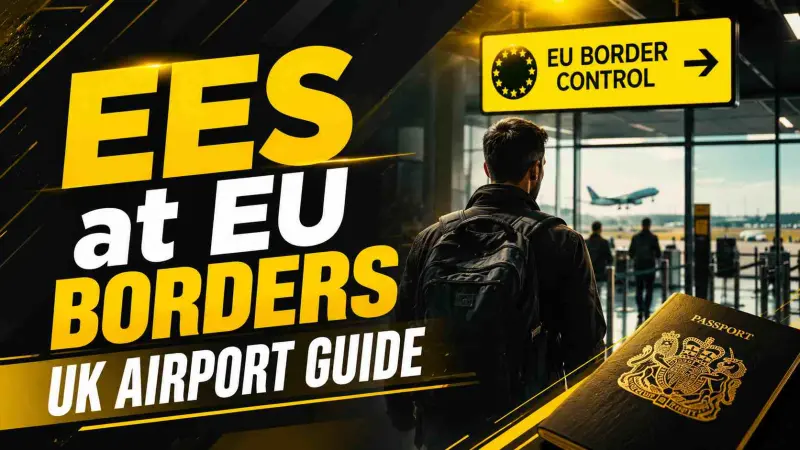
If you are a British traveller flying to mainland Europe, the border-control process is no longer quite the same as it was before Brexit. The EU's Entry/Exit System (EES) is now fully operational at the external borders of the 29 European countries using the system, following its phased introduction from October 2025 to April 2026.
For most UK visitors, there is nothing to apply for before travelling for EES itself. At the relevant EU border, your passport details are registered digitally and, on your first EES registration, your face is photographed and fingerprints are taken if you are aged 12 or over. Your passport is no longer stamped when EES applies.
That sounds more complicated than it usually is. The biggest practical change is that border control can take longer, particularly while airports and passengers get used to the new process.
This guide explains exactly what UK travellers should expect at the airport, what happens the first time, what changes on later trips, who is exempt, how EES relates to the 90-day rule, and what you can do to avoid unnecessary delays.
What UK travellers should expect from EES at EU borders
The EU Entry/Exit System (EES) is a digital border-management system for non-EU nationals visiting participating European countries for short stays. Instead of relying on passport stamps, it creates a digital record of travellers' entries, exits and, where applicable, refusals of entry. The system covers short stays of up to 90 days in any 180-day period.
For a typical British holidaymaker, the airport experience can be thought of as a sequence:
- Arrive at the airport and complete normal airline security and boarding procedures.
- Fly to a country using EES.
- Follow signs for non-EU/EEA/Swiss passengers at border control.
- Scan or present your passport.
- Complete EES registration if this is your first registration.
- Have your facial image captured.
- Provide fingerprints if you are aged 12 or over.
- Answer any normal border-control questions.
- Continue into the Schengen area once the border officer has completed the check.
- On future journeys, expect a simpler identity verification rather than full first-time registration.
The exact layout differs between airports. Some locations may have self-service equipment, while others rely more heavily on border officers. The European Commission says travellers may be able to provide some information in advance through dedicated equipment or a mobile application if that facility is available at the particular border crossing.
What exactly is EES recording?
EES is designed to electronically record information such as your travel-document details, entry and exit dates and biometric information. It is intended to replace manual passport stamping and help authorities identify overstays and people attempting to enter using false identities or documents.
The system is not a visa.
It is also not an online travel authorisation that you need to purchase before a holiday.
That distinction matters because another EU system, ETIAS, is being introduced separately. The EU currently says ETIAS is expected to start operating in the last quarter of 2026, and no applications are being collected yet.
Which countries use EES?
EES operates across 29 European countries:
| EES country group | Countries |
|---|---|
| EU countries using EES | Austria, Belgium, Bulgaria, Croatia, Czechia, Denmark, Estonia, Finland, France, Germany, Greece, Hungary, Italy, Latvia, Lithuania, Luxembourg, Malta, Netherlands, Poland, Portugal, Romania, Slovakia, Slovenia, Spain and Sweden |
| Schengen-associated countries | Iceland, Liechtenstein, Norway and Switzerland |
| EU countries outside EES | Ireland and Cyprus |
Ireland and Cyprus are particularly important exceptions. EES does not apply to travel to those countries under the current system, and passports continue to be stamped manually there.
Step 1: Get to the airport earlier than you normally would
EES does not change your airline's check-in or security process, but it can affect the amount of time you need at border control after landing.
The UK government has warned that additional checks can increase waiting times, particularly during busy travel periods. It previously estimated that the individual EES registration process could take around one to two minutes, although a queue can make the overall experience considerably longer.
For that reason, avoid planning a tight connection immediately after arriving in the Schengen area.
For example, suppose you fly from Manchester to Paris and then have a separate onward flight. Even if the first flight lands on schedule, you still have to clear the relevant external border before continuing into the Schengen area.
A short connection that looked comfortable on a timetable may become much less comfortable once hundreds of passengers need digital registration.
Practical tip: During busy holiday periods, allow more buffer time than you would have before EES, particularly if you are travelling with children, elderly passengers or people who may need additional assistance.
Step 2: Follow the correct border-control signs
After leaving the aircraft, follow the airport signs towards passport control.
You will normally see separate lanes or instructions for EU/EEA/Swiss citizens and other travellers.
As a British passport holder making a normal short visit, you should generally use the lane or process intended for non-EU travellers unless you have a status or document that gives you different treatment.
Do not assume that an automated gate designed for EU citizens will process you in exactly the same way.
Your passport remains the key travel document, so keep it accessible rather than burying it in your hand luggage.
Step 3: Present your passport
Your passport will be scanned or checked by the border-control system or an officer.
For EES purposes, both biometric and non-biometric passports are generally accepted by participating countries; having a non-biometric passport does not, by itself, mean you will be refused entry.
The information from your passport is linked to your EES record.
This is one reason it is sensible to travel using the same valid passport that you expect to use for your journey and to check that your personal details are correct before departure.
Step 4: Complete your first EES registration
If you have not previously been registered in EES, you will need to complete the initial biometric registration.
The European Commission describes the process as collecting personal data and recording fingerprints or a facial image in a digital file.
For UK visitors, the practical process normally involves:
- Passport scanning
- A facial photograph
- Fingerprints for travellers aged 12 and over
- Border-control checks by an officer
Children are treated differently for fingerprints. The UK government says children under 12 are not fingerprinted, while travellers in that age group can still have a facial image recorded.
Step 5: Have your face photographed
The facial image is part of the biometric registration.
This does not mean you need to prepare a special photograph before travelling. The image is captured as part of the border process.
Follow the instructions given by the equipment or border officer. If you are asked to remove anything that obstructs your face, do so.
For families, this can be one reason why the first EES crossing takes longer than a conventional passport check.
Step 6: Provide fingerprints if required
Adults and children aged 12 or over generally have fingerprints scanned during their initial EES registration.
The process is similar in principle to other biometric identity checks: you place your fingers on the relevant scanner when instructed.
If a fingerprint cannot be captured properly, do not panic. A border officer
can deal with the situation and explain what you need to do.
The important point is not to treat the fingerprint stage as something requiring a separate application or appointment. For ordinary short-stay travellers, it forms part of the border process.
Step 7: Answer any normal immigration questions
EES does not remove the underlying entry requirements.
A border officer can still ask questions about your trip, accommodation, onward travel, purpose of visit or other matters relevant to deciding whether you meet the conditions for entry.
The fact that your EES registration is complete does not automatically guarantee admission.
EES records the border crossing; the border authorities still decide whether you satisfy the applicable entry conditions.
Step 8: Enter the Schengen area
Once the border-control process has been completed and you are admitted, you can continue your journey.
If you are travelling between countries inside the Schengen area, you generally do not undergo another external-border EES registration simply because you cross an internal Schengen border.
The important distinction is between entering or leaving the Schengen area and travelling between countries within it.
For example, a British traveller flying London → Paris → Barcelona does not treat the Paris-to-Barcelona flight like a fresh UK-to-EU external border crossing.
Step 9: Understand what happens when you leave Europe
EES also records exits.
When you eventually leave the participating European area, your departure is recorded digitally rather than receiving the traditional passport stamp used under the old process.
The system therefore creates a more complete electronic record of when you entered and when you left.
This matters because the 90-day limit is based on your time in the relevant European countries collectively, rather than giving you a separate 90-day allowance for each country.
Step 10: Expect subsequent trips to be easier
Your first registration is the most significant change.
On subsequent crossings, you do not normally repeat the entire registration process from scratch. The European Commission says that travellers who have already crossed using EES will undergo a simpler process involving passport identification and verification of their identity.
The UK government describes subsequent entries and exits as requiring passport scanning plus either a photograph or fingerprint check.
That means your second or third EES journey should generally feel more like an enhanced border check than a full registration appointment.
How long does EES registration take?
There is no single guaranteed time because airports, passenger volumes and equipment differ.
The UK government has said the individual checks should take roughly one to two minutes, but queues can make the total experience substantially longer.
Think about the difference between processing time and waiting time.
If a border officer can register one passenger in two minutes, that does not mean you will necessarily clear immigration in two minutes. If several hundred people arrive together, a queue can build quickly.
This is especially relevant at:
- Major international airports
- Friday and weekend departures
- School holidays
- Christmas and New Year
- Easter
- Summer holiday peaks
- Airports receiving multiple large aircraft simultaneously
Can EES cause missed connections?
It can increase the risk, although no system can predict exactly how long an individual airport queue will take.
If your itinerary involves a connection after your first arrival in the Schengen area, leave a sensible buffer.
A particularly risky arrangement is a self-transfer where you have separate tickets. If the first flight is delayed and EES queues are also heavy, you may have little protection if you miss the second flight.
A through-ticketed connection may provide stronger passenger protections depending on the circumstances and airline, but travellers should still avoid unnecessarily tight connections.
What happens at Dover, Eurostar and Eurotunnel?
Air travellers are not the only people affected.
There is an important difference for people travelling from the UK through juxtaposed border controls, including the Port of Dover, Eurotunnel at Folkestone and Eurostar at St Pancras International.
For these journeys, the relevant EU border checks can happen before you leave the UK, rather than after arriving on the European mainland.
That can change how you plan your departure.
For example, someone taking Eurostar from London to Paris needs to allow enough time at St Pancras for the border process before boarding. Likewise, a driver using the Dover-Calais route may encounter the EES process before leaving Britain.
The UK government has funded infrastructure at these locations to help accommodate the new system, but queues can still occur during busy periods.
Who does not need to register for EES?
Not every person travelling on a UK passport is automatically subject to EES.
The rules contain several exemptions, including certain holders of residence permits and specific residence documents.
British citizens who are beneficiaries of the EU-UK Withdrawal Agreement can be exempt when they hold the required qualifying residence documentation. The same principle can apply to certain family members and other categories covered by EU rules.
UK-EU dual nationals are another important case.
If you are a British citizen who also holds an EU nationality, using your EU passport can mean you are treated differently from someone travelling solely as a UK national. The UK government specifically advises that UK-EU dual citizens using their EU passport are exempt from EES.
The safest approach is to check your specific status rather than assuming that
holding a particular card, visa or nationality automatically creates an exemption.
What about UK residents living in Europe?
A British national who legally resides in an EU or associated Schengen country may not be treated like an ordinary short-stay visitor.
Residence permits and qualifying residence documents can provide exemptions from EES registration. The exact document matters.
If you are a UK national living in France, Spain, Germany, Portugal or another participating country, carry the relevant residence documentation and present it when required.
Do not register through EES simply because you see a registration kiosk if you believe you are exempt. The EU guidance says exempt travellers should present the documentation establishing their exemption to the border authorities.
Does EES replace the 90-day rule?
No.
EES does not give British visitors additional time in Europe.
For ordinary short-stay travel, the basic limit remains 90 days within any 180-day period across the participating European countries covered by the rule. EES simply provides a digital way of recording entries and exits and helps authorities identify potential overstays.
Consider a traveller who spends:
- 10 days in France
- 12 days in Spain
- 8 days in Italy
- 15 days in Germany
Those days are not treated as four independent 90-day allowances.
The relevant short-stay calculation applies across the participating area.
This is one of the most useful reasons to keep your own travel records even though EES is digital. Do not rely entirely on a border system to remind you how many days you have left.
EES versus ETIAS: what is the difference?
These two names are easy to confuse.
| System | Purpose | When it happens |
|---|---|---|
| EES | Digitally records entry/exit and biometric information for eligible non-EU short-stay travellers | At the external border |
| ETIAS | Travel authorisation for visa-exempt travellers | Before travel, once the system begins |
| Passport control | Checks whether you meet entry conditions | At the border |
| Visa | Permission required by travellers from visa-required countries | Usually obtained before travel |
ETIAS is separate from EES. The EU currently says ETIAS is scheduled to begin in the last quarter of 2026, although the exact launch date has not yet been announced.
So if you are travelling now, do not confuse an EES registration requirement with an ETIAS application.
Does EES cost anything?
EES registration itself is free.
The UK government has specifically stated that British travellers do not need to pay a fee to register for EES.
This is worth remembering because unofficial websites may try to make border changes sound more complicated than they are or sell unnecessary services.
For current travel requirements, use official government or EU information rather than paying a third party to explain a free border-registration process.
What happens to your biometric information?
EES stores personal and biometric information under the EU's legal framework for the system.
The European Commission says the data is processed for purposes including external-border management, preventing irregular immigration, identifying overstayers and supporting the prevention, detection and investigation of terrorism and serious crime.
The system also has defined data-retention periods. For example, records of entries, exits and refusals of entry are generally retained for three years, while individual files can be retained for different periods depending on circumstances.
Travellers should therefore understand that EES is more than a passport scanner. It creates a digital border record associated with your identity and travel document.
Common EES mistakes UK travellers should avoid
Most problems are avoidable.
Mistake 1: Arriving at the airport at the usual time
If you normally arrive just before boarding, consider changing that habit for a journey where you expect significant border queues.
Mistake 2: Assuming EES is an online visa
It is not. EES registration takes place at the external border, although some locations may provide advance self-service facilities.
Mistake 3: Forgetting your passport
EES does not replace your passport. You still need your valid travel document.
Mistake 4: Assuming every European country uses EES
Ireland and Cyprus are outside the current EES system.
Mistake 5: Ignoring residence status
If you live in the EU and have qualifying residence documentation, your position may be different from that of a British tourist.
Mistake 6: Confusing EES with ETIAS
EES is a border-registration system. ETIAS is a separate travel-authorisation system that is not yet operational.
Mistake 7: Assuming registration means automatic entry
Border officers still assess whether you satisfy the conditions for entry.
A practical airport checklist for UK travellers
Before leaving home, check:
- Your passport is valid for the trip.
- You know whether your destination is one of the 29 EES countries.
- You understand whether you are a normal short-stay visitor or potentially exempt.
- You have relevant residence documentation if applicable.
- You have allowed extra time for border control.
- Your onward connection has a sensible buffer.
- You know your planned length of stay.
- You have not confused EES with ETIAS.
- You are using official travel information for the latest requirements.
At the airport, keep your passport easily accessible and follow the instructions given by border staff.
The future of EU border checks for UK travellers
EES is part of a much wider move towards digital European borders.
The long-term direction is clear: physical passport stamping is being replaced by electronic records, biometric identity checks and more automated border processing.
The EU's wider Travel to Europe programme also includes ETIAS, which will eventually require visa-exempt travellers from countries such as the UK to obtain travel authorisation before visiting the 30 European countries covered by that system. The EU currently expects ETIAS to start in the last quarter of 2026.
That means a future UK holidaymaker may face two distinct digital stages:
Before travelling: ETIAS, once operational and applicable.
At the border: EES registration or identity verification, where applicable.
These systems should not be confused, but together they represent a broader shift towards digital pre-travel screening and biometric border management.
For travellers, the practical lesson is simple: check requirements shortly before every European trip rather than relying on what was true for your last holiday.
Key Insights
- EES is now fully operational across the 29 European countries using the system.
- UK short-stay visitors generally register at the external border, rather than applying for EES beforehand.
- First-time registration normally involves a passport scan, facial image and fingerprints for travellers aged 12 or over.
- Later journeys should involve a simpler identity-verification process rather than full registration again.
- Ireland and Cyprus do not use EES, so their border procedures remain different.
- EES does not change the standard 90-days-in-180-days short-stay limit.
- Certain EU residents, Withdrawal Agreement beneficiaries and other exempt categories may not need EES registration.
- ETIAS is separate from EES and is currently expected to begin in the last quarter of 2026.
FAQ
1. What is EES for UK travellers?
EES is the EU's digital Entry/Exit System for eligible non-EU nationals making short stays in 29 participating European countries. It records travel-document details, entries and exits and biometric information instead of relying on traditional passport stamps.
2. Do British citizens need to register for EES?
Most British citizens visiting participating countries for short stays do. Registration takes place at the external border. However, certain residence-document holders and other exempt categories are outside the system.
3. Do I need to apply for EES before my holiday?
No. Ordinary UK travellers do not need to submit an EES application before travelling. Registration takes place at the relevant external European border, although some locations may offer self-service facilities.
4. Will I have my fingerprints taken at the airport?
If you are subject to EES and are aged 12 or over, fingerprints are generally collected during initial registration. A facial image is also captured as part of the biometric process.
5. Do children need EES registration?
Children travelling as eligible non-EU short-stay visitors can have an EES record and facial image. Children under 12 are not fingerprinted under the current rules.
6. Does EES replace passport stamping?
Yes, where EES applies. The system digitally records entries and exits instead of relying on traditional passport stamps.
7. How long does EES take at the airport?
The individual registration process may take around one to two minutes according to UK government guidance, but the total wait can be much longer when passenger queues are heavy.
8. Is EES free for UK travellers?
Yes. There is no EES registration fee for ordinary travellers. Be cautious of websites attempting to charge you for a process that is provided at the border without an EES application fee.
9. Does EES affect the 90-day Schengen rule?
EES does not change the 90-day rule. It digitally records travel and helps authorities monitor whether visitors have exceeded the permitted short-stay period of 90 days in any 180 days.
10. Does EES apply to Ireland?
No. Ireland does not use EES. It remains outside the 29-country EES system.
11. Does EES apply to Cyprus?
No. Cyprus is an EU member but is not currently part of EES. Passports continue to be stamped manually there.
12. What if I live in France or another EU country?
Your position may be different if you hold qualifying residence documentation. Some residence permit holders and Withdrawal Agreement beneficiaries are exempt from EES registration, so carry the appropriate documentation and present it at the border.
13. Do UK-EU dual citizens need EES?
A UK-EU dual citizen using their valid EU passport is generally exempt from EES because they are travelling as an EU national. The passport used at the border matters.
14. Is EES the same as ETIAS?
No. EES is a digital border-registration system. ETIAS is a separate travel authorisation for visa-exempt visitors. The EU currently expects ETIAS to begin operating in the last quarter of 2026.
15. Should UK travellers arrive earlier because of EES?
Yes, allowing additional time is sensible, especially during summer, school holidays and other peak periods. EES can increase queues even when the individual biometric check is relatively quick.
Final Thoughts
For UK travellers, EES is less complicated once you separate the registration process from the wider border rules.
On your first journey through an EES border, expect your passport to be scanned, your face to be photographed and, if you are aged 12 or over, your fingerprints to be recorded. On later trips, the process should be simpler because your initial registration is already in the system.
The bigger practical issue is time. A check that takes only a couple of minutes for one person can create a substantial queue when several aircraft arrive together. Giving yourself more time at the airport and avoiding tight connections is therefore one of the easiest ways to make the transition painless.
Most importantly, remember that EES does not replace your passport, visa requirements or the 90-day rule, and it is separate from ETIAS.
Before each European trip, check the latest official requirements for your destination and your personal circumstances.
For current guidance, the most reliable starting points are the UK Government's EES guidance and the EU's official Travel to Europe portal.
Disclaimer: The information provided in this article is for general informational and research purposes only. Company details, features, services, and market positions may change over time. Readers are advised to visit official company websites and conduct independent research before making any business decisions or purchasing services.
Most Searchable Keywords
Recent Blogs


Related Listings

Categories
- Accountants (295)
- Advertising Agencies (559)
- Architects (149)
- Automobiles (377)
- Beauty (300)
- Carpenters (146)
- Cleaning Services (387)
- Dentists (189)
- Driving (62)
- Education (1)
- Electricians (215)
- Energy (8)
- Event Organiser (687)
- Finance (602)
- Guide (3464)
- Health (2207)
- Information technology (206)
- Legal Services (361)
- Logistics (6)
- Maintenance (65)
Sponsored Listings in Legal Services

Related Blogs

School Uniform Grants Up to £200 Council Help
Read this insightful article "School Uniform Grants Up to £200 Council Help" to expand your knowledge!

Freshers Week What Happens and What It Costs
Read this insightful article "Freshers Week What Happens and What It Costs" to expand your knowledge!

UCAS Personal Statement New Three Questions
Read this insightful article "UCAS Personal Statement New Three Questions" to expand your knowledge!
Questions & Answers – Find What
You Need, Instantly!
How can I update my business listing?
Is it free to manage my business listing?
How long does it take for my updates to reflect?
Why is it important to keep my listing updated?
