
UK Airport Liquid Rules 2 Litres vs 100ml
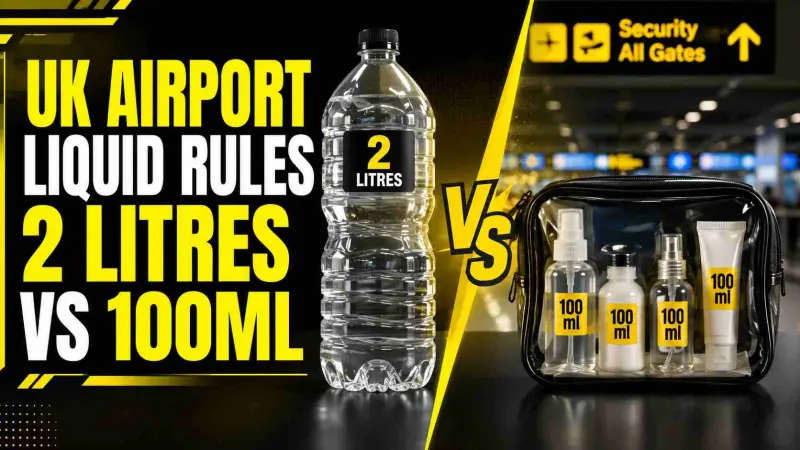
The familiar 100ml airport liquid rule is no longer the same everywhere in the UK. Some airports now allow individual liquid containers of up to 2 litres through security, while others still restrict passengers to containers of 100ml or less.
That means a bottle that is perfectly acceptable at one UK airport could be refused at another. The difference is particularly important when you are travelling with toiletries, drinks, cosmetics, baby products, food or medication.
The UK government currently advises passengers to check the liquid rules at their departure airport, connecting airports and return airport because requirements can differ. At most airports, containers over 100ml are still prohibited, while some airports permit containers holding up to 2 litres.
This guide explains the current position, identifies airports with confirmed 2-litre rules, highlights major airports that still enforce 100ml limits, and explains what you should do when your outbound and return airports have different rules.
Which UK Airports Allow 2 Litres of Liquids and Which Still Have the 100ml Rule?
The short answer is that some UK airports now permit liquids in individual containers of up to 2 litres, but the 100ml restriction remains at many others.
The change is linked to newer security-screening technology. Advanced scanners can produce more detailed images of cabin baggage, allowing participating airports to change how liquids and electronic devices are screened. However, the rollout has not created one universal rule across every UK airport.
This is why checking the exact airport you are departing from matters more than relying on what you experienced on your previous flight.
What is the current UK liquid rule?
The safest general rule is still 100ml unless your airport specifically confirms that it permits larger containers.
GOV.UK says that at most airports, liquids cannot be carried through security in containers larger than 100ml. It also confirms that some airports allow containers holding up to 2 litres.
The important point is that the restriction normally concerns the capacity of the container, not simply how much liquid is inside it.
For example:
- A 200ml bottle containing only 50ml can still be refused at a 100ml airport.
- A 100ml bottle containing 100ml is within the standard limit.
- At a participating 2-litre airport, a compliant 1.5-litre container may be permitted.
- At some 2-litre airports, metal or double-walled containers still have to be emptied before security.
This distinction is one of the easiest things to overlook when packing.
Which UK airports currently allow liquids up to 2 litres?
Several UK airports have confirmed that they allow individual liquid containers up to 2 litres through security.
| Airport | Liquid container limit | Key security point |
|---|---|---|
| Heathrow | Up to 2 litres | Liquids can remain in cabin baggage |
| Gatwick | Up to 2 litres | Metal/double-walled containers must be empty |
| Edinburgh | Up to 2 litres | Multiple containers permitted |
| Birmingham | Up to 2 litres | No limit on number of 2-litre containers |
| Bristol | Up to 2 litres | Clear plastic bag no longer required |
| Belfast International | Up to 2 litres | Liquids can remain in hand luggage |
| Belfast City | Up to 2 litres | Liquids, gels, creams and aerosols permitted |
| Teesside | Up to 2 litres | 2-litre limit introduced using newer scanners |
These rules are based on airport-specific guidance and should still be checked before travelling because security procedures can change.
Heathrow: up to 2 litres
Heathrow Airport now permits liquids in containers of up to 2 litres through security.
Heathrow says this applies across Terminals 2, 3, 4 and 5. Liquids can remain inside your cabin bag during screening, and there is no need to remove them for security.
The airport also warns passengers that the rules at their destination or return airport may be different.
So, if you fly from Heathrow with a 500ml bottle of shampoo, that may be acceptable at departure, but the same bottle could cause a problem when you fly home from an airport that still operates the 100ml restriction.
Gatwick: up to 2 litres
Gatwick Airport also permits liquid containers of up to 2 litres.
The airport's current guidance covers drinks, toiletries, cosmetics, food products, creams, gels, pastes and sprays. Containers larger than 2 litres are not allowed through security, even when they are only partially full.
There is an additional restriction: metal and double-walled containers cannot be taken through security with liquid inside. These need to be emptied first.
An empty reusable bottle can then be refilled after security.
Edinburgh: up to 2 litres
Edinburgh Airport allows individual containers of up to 2 litres.
Passengers can carry multiple containers, provided each container meets the 2-litre limit. Liquids can remain in the cabin bag, and a separate clear plastic liquids bag is no longer required.
There is also a specific rule for metallic or double-walled containers. These must be empty before reaching the security checkpoint.
Birmingham: up to 2 litres
Birmingham Airport permits liquids, pastes and gels in containers up to 2 litres.
Its guidance says there is no limit on the number of 2-litre containers that can be carried, provided the items comply with the airport's security requirements and fit within the passenger's cabin baggage.
Passengers should leave the liquids inside their hand luggage rather than placing them in the traditional transparent plastic bag.
Insulated bottles and similar containers must be empty when going through screening.
Bristol: up to 2 litres
Bristol Airport has also moved to a 2-litre maximum container size.
The airport states that each individual liquid container can be up to 2 litres and that liquids can remain inside hand baggage. A clear plastic liquids bag is no longer required.
Bristol also specifically warns passengers that metal bottles need to be taken through security empty.
Belfast International and Belfast City
Both Belfast International and Belfast City have introduced more relaxed liquid rules.
Belfast International Airport confirms that liquids up to 2 litres can remain in hand luggage during security screening, with no plastic liquids bag required.
George Best Belfast City Airport similarly states that liquids, creams, pastes, gels and aerosols can pass through security when they are 2 litres or less.
Teesside: an early adopter of the 2-litre system
Teesside International Airport was an early UK adopter of the technology behind the change.
The airport announced in 2023 that its new scanners allowed the 100ml liquid-container threshold to be increased to 2 litres.
This demonstrates why airport-by-airport checking is necessary: the change has not happened simultaneously across the UK.
Which major UK airports still use the 100ml rule?
A number of major airports continue to require liquids to be in containers of 100ml or less.
Examples include:
- Manchester
- London Stansted
- London Luton
- Glasgow
- Other airports that have not introduced or authorised a larger container allowance
The exact security procedure can differ even where the 100ml limit remains.
For example, Manchester now allows compliant liquids to stay inside your hand luggage during screening, but the individual container must still be under 100ml.
London Stansted has a similar arrangement. Its current guidance says liquids, gels and aerosols must be under 100ml each, although they no longer need to be placed in a plastic bag. Containers larger than 100ml cannot pass security.
London Luton also retains the 100ml/100g rule, with liquids kept inside the cabin bag during security.
Glasgow continues to restrict liquid containers to 100ml or less. Its current guidance says liquids over 100ml must be placed in hold baggage.
Why have some airports changed to 2 litres?
The difference is largely connected with security-screening equipment.
New-generation scanners can create detailed three-dimensional images of cabin baggage. This allows security officers to examine the contents of bags differently from older screening systems.
The UK government originally announced a programme to introduce new security technology across major airports, with the expectation that the traditional 100ml restriction would eventually be extended to 2 litres at airports using suitable equipment.
But the existence of newer scanners does not automatically mean that every airport has the same passenger rules.
Airport operators must follow the security requirements applicable to their operation, and passengers therefore need to follow the instructions published for the specific airport.
What counts as a liquid at airport security?
The word "liquid" covers much more than water.
UK government guidance includes:
- Drinks and water
- Shampoo and shower gel
- Perfume and aftershave
- Creams and lotions
- Sun cream
- Mascara and lip gloss
- Toothpaste
- Hair gel
- Hairspray
- Shaving foam
- Contact lens solution
- Liquid or semi-liquid food
- Soup
- Jam
- Honey
- Syrups
- Similar substances
This is why a traveller can be caught out by something that does not look like a conventional liquid.
A jar of honey, for example, may seem like food rather than a liquid, but its consistency means it falls under the liquid restrictions.
Does the 2-litre rule mean you can take 2 litres in total?
Not necessarily.
The wording usually concerns the maximum capacity of each individual container.
For example, if your airport permits containers up to 2 litres, you could potentially have:
- one 2-litre bottle;
- two 1-litre bottles;
- several smaller containers.
Some airports explicitly state that there is no limit on the number of compliant containers, although your airline's cabin-baggage size and weight restrictions still apply. Birmingham and Edinburgh, for example, provide guidance allowing multiple compliant containers.
So "2 litres" should not automatically be interpreted as "2 litres total per passenger."
Can you take a half-full 500ml bottle through a 100ml airport?
No.
At airports that retain the 100ml rule, the container capacity matters.
A 500ml bottle containing only 50ml of shampoo is still a container larger than 100ml and may be refused.
GOV.UK specifically says the 100ml restriction applies even when the container is only partly full.
This is one reason decanting toiletries into correctly sized travel containers remains useful when travelling from a 100ml airport.
What about metal and insulated water bottles?
This is another area where 2-litre airports can have additional requirements.
At several airports, metal, insulated or double-walled bottles must be empty when you reach security.
For example:
- Heathrow says reusable metal or insulated bottles should be emptied before security.
- Gatwick does not permit liquids in metal or double-walled containers through security.
- Edinburgh requires metallic and double-walled containers to be empty.
- Bristol requires metal drinks bottles to be taken through empty.
- Birmingham permits insulated bottles but requires them to be completely empty at screening.
The simplest approach is to empty your reusable bottle before security and refill it afterwards.
What happens if your outbound airport allows 2 litres but your return airport does not?
This is one of the most important practical points.
Suppose you fly:
London Heathrow → Spain
Heathrow may allow your 500ml toiletries through security.
On your return journey, however, the Spanish airport may apply a different liquid rule. If it operates a 100ml limit, your 500ml bottle could be rejected.
The same issue can arise during connections.
GOV.UK specifically tells passengers to check the requirements at the airport they are flying from, any airports they travel through and the airport they will use for their return journey.
The safest strategy is therefore to pack according to the most restrictive airport on your itinerary if you need to keep the same liquids throughout your trip.
What are the rules for medicines and baby food?
There are important exemptions.
GOV.UK says liquid containers of up to 2 litres can be taken through security at UK airports when they are for:
- essential medical purposes;
- special dietary requirements;
- baby food or baby milk.
However, additional screening may be required.
For larger quantities of liquid medication, the Civil Aviation Authority advises passengers to carry supporting documentation, such as a prescription or medical letter, and to contact the airport or airline beforehand where appropriate.
Do not assume that a medical exemption means security staff will not inspect the product.
Can you take duty-free liquids over 100ml?
Yes, duty-free liquids can be treated differently when purchased after security.
GOV.UK states that liquids bought at an airport or on an aircraft can pass through security when they are sealed in a security bag at purchase and the receipt is visible inside the bag. The security bag should not be opened until the final destination.
This can be particularly relevant if you buy perfume, alcohol or other liquids after passing through security.
However, connections can complicate matters, so check the requirements if you have another security screening point ahead.
How should you pack liquids for a UK flight?
If your airport still uses the 100ml restriction, use this approach:
- Check the departure airport first.
- Check every connection airport.
- Check the return airport.
- Use containers of 100ml or less if there is any uncertainty.
- Remember that container capacity matters.
- Keep medication and baby products accessible for inspection.
- Empty metal or insulated bottles where required.
- Do not assume another airport follows the same rules.
- Check your airline's cabin-baggage size and weight allowance.
- Follow the instructions displayed at the security checkpoint.
The last point matters because airport security staff can require additional screening when necessary.
Are the 2-litre rules likely to become standard?
The long-term direction is toward more advanced screening technology and less reliance on the traditional 100ml system.
The UK government's earlier programme envisaged the 100ml restriction eventually being extended
to 2 litres as new screening technology was introduced.
However, passengers should not treat this as a guarantee that every UK airport will immediately move to 2 litres.
The practical rule for travellers is simple: follow the published rule for the airport you are actually using.
Technology can be installed before passenger rules change, and security procedures can also be revised. Therefore, checking shortly before departure is more reliable than relying on an old travel article, social-media post or a previous trip.
Key Insights
- The 100ml rule has not disappeared across the UK. GOV.UK confirms that most airports still restrict containers to 100ml, while some permit up to 2 litres.
- Heathrow, Gatwick, Edinburgh, Birmingham, Bristol, Belfast International and Belfast City currently allow containers up to 2 litres, subject to their individual security conditions.
- Teesside was an early adopter of the 2-litre approach after introducing new security scanners.
- Manchester, Stansted, Luton and Glasgow still have 100ml limits under their current published guidance.
- A 500ml bottle containing only 50ml can still be rejected at a 100ml airport because container capacity matters.
- Some airports allowing 2 litres still require metal or double-walled bottles to be empty.
- The rules at your return or connecting airport may be stricter than those at your departure airport.
- If you are unsure, packing according to the most restrictive airport on your journey is the least risky approach.
FAQ
1. Which UK airports allow 2 litres of liquid?
Confirmed airports allowing individual liquid containers up to 2 litres include Heathrow, Gatwick, Edinburgh, Birmingham, Bristol, Belfast International and Belfast City. Teesside also introduced a 2-litre allowance using newer screening technology. Always check the airport's current guidance before travelling.
2. Does Heathrow allow 2-litre liquids?
Yes. Heathrow currently permits liquids in containers up to 2 litres through security across Terminals 2, 3, 4 and 5. Liquids can remain inside your cabin bag during screening. Metal and insulated bottles should be emptied first.
3. Does Gatwick allow 2 litres of liquid?
Yes. Gatwick allows liquid containers up to 2 litres. However, metal and double-walled containers cannot contain liquid when passing through security. Containers larger than 2 litres are not permitted even when partly empty.
4. Does Manchester Airport allow 2 litres?
No. Manchester currently retains the 100ml container limit. Liquids, aerosols and gels over 100ml are not permitted through security, although compliant liquids can remain inside your hand luggage during screening.
5. Does Stansted still have the 100ml rule?
Yes. London Stansted currently requires liquids in containers under 100ml. The liquids no longer need to be placed in a plastic bag, but containers over 100ml cannot pass through security.
6. Does Birmingham Airport allow 2-litre bottles?
Yes. Birmingham permits liquids, pastes and gels in containers up to 2 litres. Its guidance also states that there is no limit on the number of compliant 2-litre containers, subject to cabin-baggage restrictions.
7. Can I take a 500ml bottle through airport security?
It depends on the airport. At a 2-litre airport, a compliant 500ml container may be permitted. At a 100ml airport, it will normally be refused even if it contains less than 100ml of liquid.
8. Can I take several 2-litre containers through security?
At airports that permit multiple containers, yes. For example, Edinburgh and Birmingham state that passengers can take multiple compliant containers. Your airline's cabin-baggage size and weight limits still apply.
9. Do liquids have to be in a clear plastic bag?
Not necessarily. Many airports using newer security systems no longer require the traditional clear liquids bag. However, some airports may still have different procedures, so check the specific airport before packing.
10. Can I take toothpaste through airport security?
Yes, toothpaste is treated as a liquid or paste for airport-security purposes. At a 100ml airport, its container must normally be 100ml or less. At a 2-litre airport, larger compliant containers may be permitted.
11. Is perfume included in the liquid rules?
Yes. Perfume and aftershave are treated as liquids. The maximum permitted container size depends on the airport you are departing from. Duty-free perfume purchased after security can be subject to separate rules.
12. Can I take baby milk over 100ml?
Yes, baby milk and baby food are covered by exemptions from the standard liquid restrictions. You should carry what is reasonably required for the journey and be prepared for additional security checks.
13. Can I take liquid medicine over 100ml?
Essential liquid medication can be carried in larger quantities where necessary, but additional screening may apply. The CAA recommends carrying supporting evidence such as a prescription or medical letter when appropriate.
14. What happens if my return airport has a 100ml limit?
You may have to comply with the stricter rule on your return. A liquid container that passed security at a UK airport allowing 2 litres could be refused at a return airport that still operates the 100ml restriction.
15. Are all UK airports going to allow 2 litres eventually?
There has been a major move toward newer screening technology, but there is no reason to assume every airport currently has identical passenger rules. Always check the latest guidance for the airport on your itinerary before travelling.
Final Thoughts
UK airport liquid rules are no longer a simple case of remembering "100ml and a clear bag."
Some airports have moved to 2-litre individual containers, while others still enforce the traditional 100ml limit. Even airports with 2-litre rules can have additional requirements, particularly for metal or double-walled bottles.
The biggest mistake is assuming that the rule at your departure airport automatically applies to the entire journey. It does not.
Before you pack, check your departure airport, connecting airports and return airport. If any airport on the route retains the 100ml
restriction, packing smaller containers can save you from having to abandon toiletries, drinks or other liquids at security.
For the most reliable information, use the current airport guidance and the UK government's official hand-luggage rules rather than relying on older travel advice.
Disclaimer: The information provided in this article is for general informational and research purposes only. Company details, features, services, and market positions may change over time. Readers are advised to visit official company websites and conduct independent research before making any business decisions or purchasing services.
Most Searchable Keywords
Recent Blogs


Related Listings
Categories
- Accountants (295)
- Advertising Agencies (559)
- Architects (149)
- Automobiles (377)
- Beauty (300)
- Carpenters (146)
- Cleaning Services (387)
- Dentists (189)
- Driving (62)
- Education (1)
- Electricians (215)
- Energy (8)
- Event Organiser (687)
- Finance (602)
- Guide (3462)
- Health (2207)
- Information technology (206)
- Legal Services (361)
- Logistics (6)
- Maintenance (65)
Sponsored Listings in Legal Services

Related Blogs
UCAS Personal Statement New Three Questions
Read this insightful article "UCAS Personal Statement New Three Questions" to expand your knowledge!

Student Finance Payment Dates When Your Loan...
Read this insightful article "Student Finance Payment Dates When Your Loan Lands" to expand your knowledge!
How Long Does Probate Take UK Guide
Read this insightful article "How Long Does Probate Take UK Guide" to expand your knowledge!
Questions & Answers – Find What
You Need, Instantly!
How can I update my business listing?
Is it free to manage my business listing?
How long does it take for my updates to reflect?
Why is it important to keep my listing updated?
